%20(1).png)
Women's Fashion Factory China: The 2026 Strategic Sourcing Guide
- Powersweet Team

- Aug 9
- 11 min read
Updated: Aug 11
In the 2026 fashion landscape, your manufacturing partner isn't just a supplier; they're the engine of your brand's growth. Finding a reliable women's fashion factory china is the difference between hitting a trend at its peak or watching your inventory arrive three months too late. You've likely felt the frustration of trading companies masking as factories, or the anxiety of technical specs getting lost in translation while your lead times stretch toward 120 days. It's exhausting to manage fabric sourcing and quality control when you're thousands of miles away from the cutting table.
This guide changes that. You'll discover how to identify, vet, and partner with a premier factory to scale your brand with precision. We'll break down the 2026 regulatory landscape, including the new 12.5% Section 301 forced-labor duties and mandatory GB 18401 standards. You'll learn how to secure 10-day sampling and low MOQs to test the market without heavy risk. We're moving from a "wait and see" approach to transparent, end-to-end production that puts you back in control of your supply chain. Whether you're a startup or an established label, this is your roadmap to manufacturing excellence.
Table of Contents
What Defines a Top-Tier Women's Fashion Factory in China?
Choosing the right women's fashion factory china is no longer just about finding the lowest price per unit. It's about securing a strategic partner that integrates seamlessly with your brand's supply chain. The sheer scale of China's textile manufacturing sector provides brands with unmatched access to raw materials and specialized labor, but the most successful partnerships in 2026 are built on technical expertise and agility. A modern factory acts as a facilitator, offering both production power and the logistical intelligence needed to navigate global market shifts.
A specialized women's fashion factory china prioritizes technical pattern making to ensure garments meet strict Western sizing standards. Unlike generalist suppliers who might produce everything from industrial uniforms to home textiles, a specialist understands the nuances of female silhouettes and delicate fabric behavior. This focus is critical for brands that can't afford the high return rates associated with poor fit or inconsistent grading across a collection. Specialized factories invest in the specific skills required for high-end finishes, such as French seams or intricate lace placement, which generalist shops often struggle to execute at scale.
The industry has moved toward a high-efficiency, low-volume model to combat the risks of overstocking. In 2026, the most reliable partners are those that have optimized their lines for speed without sacrificing precision. This model allows brands to test the market with smaller drops and restock winning styles in real time. It's a pragmatic approach that favors stability and responsiveness, ensuring your brand remains lean and profitable while staying ahead of rapid fashion cycles.
OEM vs. ODM: Which Model Fits Your Brand?
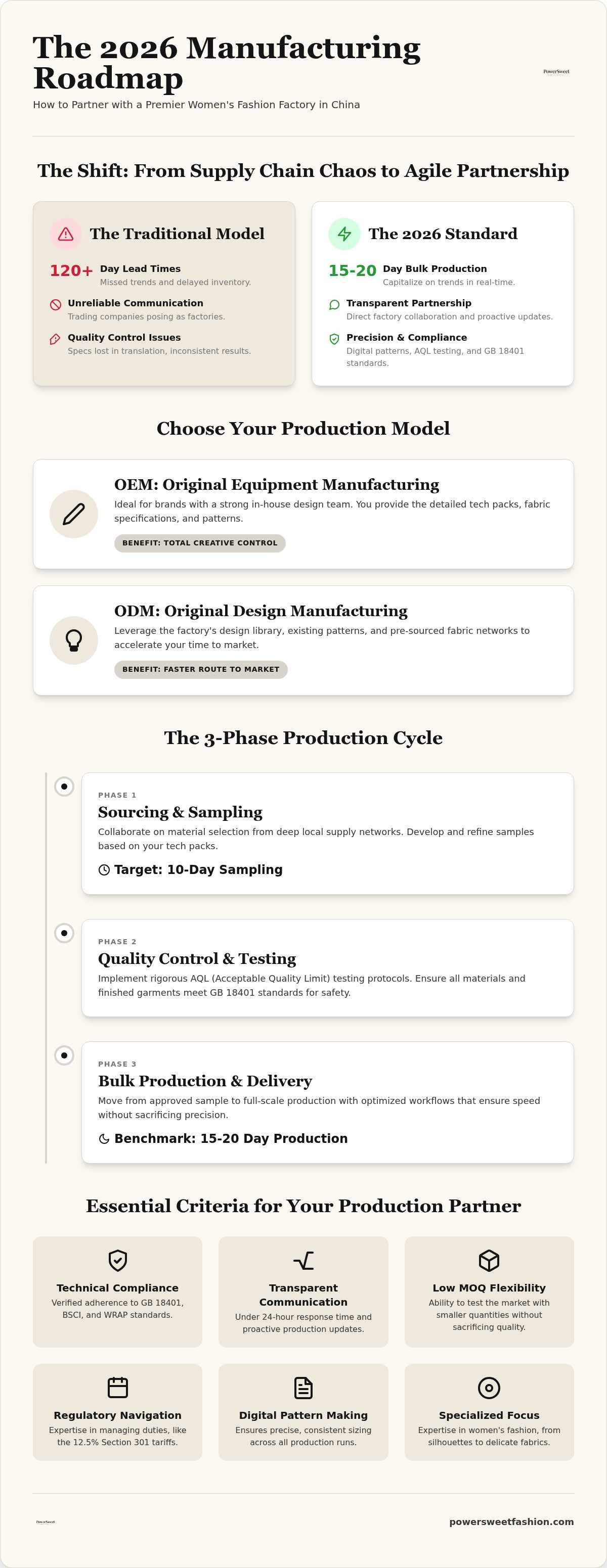
Original Equipment Manufacturing (OEM) is the standard choice for brands with a robust internal design team. You provide the tech packs and material specifications, and the factory handles the physical production. If your brand needs more support, Original Design Manufacturing (ODM) allows you to leverage the factory's existing design library and fabric sourcing networks. Choosing between these models depends on your team's capacity; OEM offers total creative control, while ODM provides a faster route to market by utilizing proven silhouettes and pre-sourced materials.
Technical Capabilities and Machinery Requirements
Precision in women's fashion requires specialized machinery, including overlockers for silk and automated cutting tables for complex patterns. Digital pattern making has become the industry benchmark, as it ensures that a size medium fits exactly the same in every production run. This technology eliminates the human error inherent in manual grading and allows for instant adjustments during the sampling phase. A tech pack is the comprehensive blueprint for production success that communicates every technical detail, measurement, and material requirement to the factory floor.
Essential Criteria for Evaluating Your Production Partner
Communication is the primary trust signal when vetting a women's fashion factory china. If a supplier takes more than 24 hours to respond to technical inquiries or struggles to explain garment construction details, they aren't a strategic partner. Reliable manufacturers act as an extension of your team. They provide proactive updates on fabric availability and production milestones, ensuring you're never left guessing about the status of your capital. This transparency is vital in a market where U.S. apparel import data shows a clear shift toward brands that prioritize supply chain agility and speed to market.
Lead times define your brand's ability to capitalize on trends. While the traditional production cycle often exceeds 90 days, the 2026 industry benchmark for bulk production has dropped to 15-20 days. Achieving this speed requires a factory with integrated workflows and a deep local supply chain. You should also look beyond basic BSCI or WRAP certifications. Ensure your partner complies with mandatory GB 18401 standards, which regulate formaldehyde and pH values. This technical compliance protects your brand from legal risks and ensures the safety of your end consumers.
The Power of Low MOQ for Boutique Brands
The belief that you must order thousands of units to get factory-direct pricing is a myth. Working with a specialized low MOQ women's clothing manufacturer allows you to protect your cash flow by avoiding massive upfront inventory costs. This flexibility is essential for testing new styles, such as the rising Neo-Chinese aesthetic, without the risk of deadstock. It's a pragmatic way to scale. You start with 50 to 100 pieces to verify market demand, then increase volume once you've proven the concept. Partnering with a transparent manufacturer simplifies this transition from small-scale testing to industrial-level growth.
Transparency and Factory Accessibility
The Production Timeline: From Sample Development to Bulk Delivery
Speed is the primary competitive advantage for modern labels. To achieve this, your women's fashion factory china must operate with a lean, integrated lifecycle that minimizes friction. This process begins with sourcing, moves through the critical sampling phase, and culminates in bulk delivery. Leveraging the world's largest textile industry allows for rapid material acquisition, but the internal coordination of the factory determines whether your collection hits the floor on time or misses the season entirely.
The sampling phase is often where brands lose the most time. A specialized sample development clothing manufacturer acts as a bridge between design and reality. In 2026, waiting 30 days for a prototype is no longer viable. Modern brands require a 10-day sample turnaround to maintain their design momentum. This speed allows for faster revisions and ensures that technical specs are perfected before the bulk production queue begins. If a factory can't deliver a sample within this window, they likely lack the internal organization needed for high-speed bulk runs.
The 10-Day Sampling Process Explained
Efficiency during sampling relies on immediate access to local supply chains and digital workflows. We follow a systematic approach to ensure precision:
Pattern creation: Translating tech packs into digital templates for consistent grading.
Fabric matching: Utilizing in-stock materials or local markets to mirror final production quality.
Prototype construction: Creating the first physical iteration for internal fit testing and aesthetic review.
To expedite approvals, brands should provide clear feedback loops via high-resolution video calls. This eliminates the need for multiple physical shipping rounds, keeping the project on its 10-day track.
Bulk Production Efficiency in 2026
Once the sample is approved, the transition to bulk must be seamless. While older manufacturing models often took 45 days, the new 2026 standard for a women's fashion factory china is 15-20 days for bulk apparel runs. This efficiency is achieved through automated cutting and modular sewing lines that maintain quality consistency whether you're producing 100 units or 10,000. Managing your production queue requires early booking, especially before peak seasonal launches, to guarantee your spot on the line. Logistics must also be factored in; air freight typically takes 5-7 days to reach global hubs, while sea freight ranges from 20 to 35 days.
Fabric Sourcing and Quality Control: The Foundation of Excellence
Fabric selection is where your brand's quality is won or lost. A premier women's fashion factory china provides a massive advantage through its proximity to the world's most dense textile hubs. This isn't just about finding a roll of cloth. It's about technical sourcing that ensures color consistency, hand-feel, and durability across thousands of units. By utilizing end to end clothing production, factories can minimize material waste and ensure that specialized trims or custom-branded labels are integrated perfectly from the start. This integrated approach creates a stable foundation for your collection before the first machine even runs.
Leveraging Local Supply Chains for Premium Materials
Local supply chains allow for rapid "Lab dips," where fabric is dyed to match your specific Pantone references in days rather than weeks. This speed is essential for maintaining your production timeline. In 2026, sustainability is no longer optional; it's a primary quality indicator. Research indicates that 55% of consumers now choose products from sustainable brands for their perceived higher quality. Leading factories now offer extensive libraries of GRS-certified recycled polyesters and organic cottons. This access allows boutique brands to compete with enterprise-level labels on material innovation without needing to manage multiple vendors. If you're ready to elevate your brand's material standards, you can secure your custom fabric sourcing with a partner that understands the global market.
Implementing a Multi-Stage QC System
Quality Control (QC) is the backbone of industrial stability. We don't wait until the boxes are packed to check for errors. A multi-stage system starts with fabric inspection before the first cut is made. This prevents bulk defects like pilling or color shading from entering the production line. Mid-line checks then verify that construction details, such as seam strength and pocket placement, align with your tech pack. Finally, a women's fashion factory china will use Acceptable Quality Level (AQL) statistical sampling or 100% inspection for high-end collections. This ensures that every garment meets retail-ready standards before it leaves the factory floor.
Pre-cutting inspection: Checking fabric for weight, color, and defects.
Inline inspection: Monitoring the sewing process to catch errors in real-time.
Final AQL testing: A statistical check of finished goods to guarantee batch consistency.
Why PowerSweet Fashion is Your Strategic Production Partner
PowerSweet Fashion isn't just another name in a supplier directory. We operate as a specialized women's fashion factory china that prioritizes the physical reality of garment construction over abstract promises. As a premier custom women's clothing manufacturer, we've developed a system that removes the traditional barriers to entry for emerging and established labels alike. Our facility serves as the engine for your creative vision, providing the stability of industrial-scale production alongside the flexibility of low MOQs. We've seen every challenge in the industry and have built a streamlined system to handle them all.
The human element is what truly drives a successful partnership. Our dedicated production teams don't just execute orders; they act as an extension of your brand. We encourage transparency at every level, from initial pattern making to final quality assurance. This collaborative approach ensures that technical specifications are never lost in translation. We invite you to experience this efficiency firsthand, whether through a virtual tour or an in-person visit to our factory floor in Guangzhou. We're the safe pair of hands you need to execute your brand's vision with meticulous care.
Speed as a Competitive Advantage
In the fast-paced fashion cycle of 2026, timing is everything. Our 10-day sampling and 15-20 day bulk production cycles are designed to beat industry averages by a significant margin. This speed enables a "test and repeat" model that's essential for influencer-led brands and fast-growing labels. By reducing the time-to-market window, you can respond to real-time consumer data rather than guessing what will sell six months in advance. It's a pragmatic strategy that minimizes risk and maximizes your brand's responsiveness to seasonal trends. We move fast so you can stay ahead.
Commitment to Partnership and Growth
Scaling a brand requires more than just a vendor; it requires a facilitator that grows with you. We specialize in helping small brands transition into global fashion leaders by providing customized support for fabric sourcing and precision pattern making. Our quality assurance protocols are rigorous, ensuring that as your volume increases, your standards never slip. We manage the logistical complexities so you can focus on design and marketing. It's time to move beyond the limitations of traditional manufacturing. You can start your production journey with PowerSweet Fashion today and secure the strategic partner your brand deserves.
Scale Your Fashion Brand with Industrial Precision
Success in the 2026 fashion market requires more than just a supplier; it demands a strategic engine that prioritizes speed and technical accuracy. You now have the roadmap to identify a premier women's fashion factory china by vetting their communication transparency and verifying their ability to meet the 15-20 day bulk production benchmark. Moving away from massive inventory bets allows your brand to remain lean while responding to real-time consumer trends. It's a pragmatic approach that favors stability and long-term growth.
PowerSweet Fashion is ready to facilitate this transition for your label. We offer a 10-day sample turnaround and low MOQ flexibility to ensure your capital stays protected while you test new silhouettes. Our team provides full end-to-end production support, acting as a seamless extension of your internal design department. You don't have to navigate the complexities of manufacturing alone. Request a Production Quote from PowerSweet Fashion today and take the first step toward a more efficient supply chain. We're excited to help you build your brand's future.
Frequently Asked Questions
How do I verify if a China clothing factory is legitimate?
You verify legitimacy by requesting direct factory documentation and conducting in-person or virtual tours. Legitimate partners will provide business licenses and show you the physical production floor rather than just a showroom. This transparency helps you identify trading companies that add unnecessary costs. You should also check for compliance with mandatory standards like GB 18401 to ensure the factory operates under legal industrial requirements.
What is a typical MOQ for custom women's clothing in China?
Typical Minimum Order Quantities (MOQs) for custom garments often range from 50 to 300 pieces per style. While larger factories may require higher volumes, specialized partners offer lower MOQs to help boutique brands test market trends without heavy risk. This flexibility is essential for maintaining lean inventory levels. It allows you to scale from small-batch testing to industrial-level production as your brand's demand grows.
Can I get samples before committing to a bulk order?
Yes, you should always receive a physical sample before approving a bulk production run. A professional women's fashion factory china provides a 10-day sample turnaround to verify fit, fabric hand-feel, and construction details. This prototype serves as the gold standard for your collection. It ensures that every technical specification in your tech pack is met before you commit your capital to a full production queue.
How long does it take to ship garments from China to the US or Europe?
Shipping times depend on your chosen method and destination. Air freight typically takes 5 to 7 days to reach major global hubs in the US or Europe. If you choose sea freight, expect a transit window of 20 to 35 days. You must factor these timelines into your seasonal launch calendar to ensure your inventory arrives before the peak selling period begins. This planning prevents stockouts during critical sales cycles.
What information do I need to provide for a production quote?
You must provide a comprehensive tech pack to receive an accurate production quote. This blueprint should include detailed measurements, material specifications, stitching requirements, and label placement. If you don't have a finished tech pack, a high-quality physical sample or clear reference photos can serve as a starting point. Detailed information minimizes ambiguity and ensures the factory can calculate costs with industrial precision, protecting your margins.
Do China factories handle fabric sourcing or do I need to provide materials?
Most integrated factories handle fabric sourcing through their local supply chain networks. You can specify the material type, weight, and color, and the factory's sourcing team will provide options for your approval. This "end-to-end" service is more efficient than providing your own materials; it reduces shipping costs and ensures the fabric is compatible with the factory's machinery. It simplifies the logistical burden on your internal team.
How does quality control work if I am not physically in China?
Quality control is managed through a multi-stage system that includes inline inspections and final AQL testing. A reliable women's fashion factory china will provide real-time reporting and high-definition photos or videos during the production process. You can also hire third-party inspection services to verify the batch quality before it leaves the factory. This ensures your garments meet retail-ready standards without requiring your physical presence on the cutting floor.
What are the payment terms for custom garment manufacturing?
Standard payment terms usually involve a 30% to 50% deposit to start sample development and material sourcing. The remaining balance is typically due after the final quality control inspection but before the goods are shipped. These terms provide a balance of security for the factory and protection for your brand. Always ensure your payment schedule is clearly outlined in your production agreement to maintain financial transparency throughout the partnership.


Comments