%20(1).png)
AQL Garment Inspection: A Guide for Fashion Brands
- Powersweet Team

- 3 minutes ago
- 12 min read
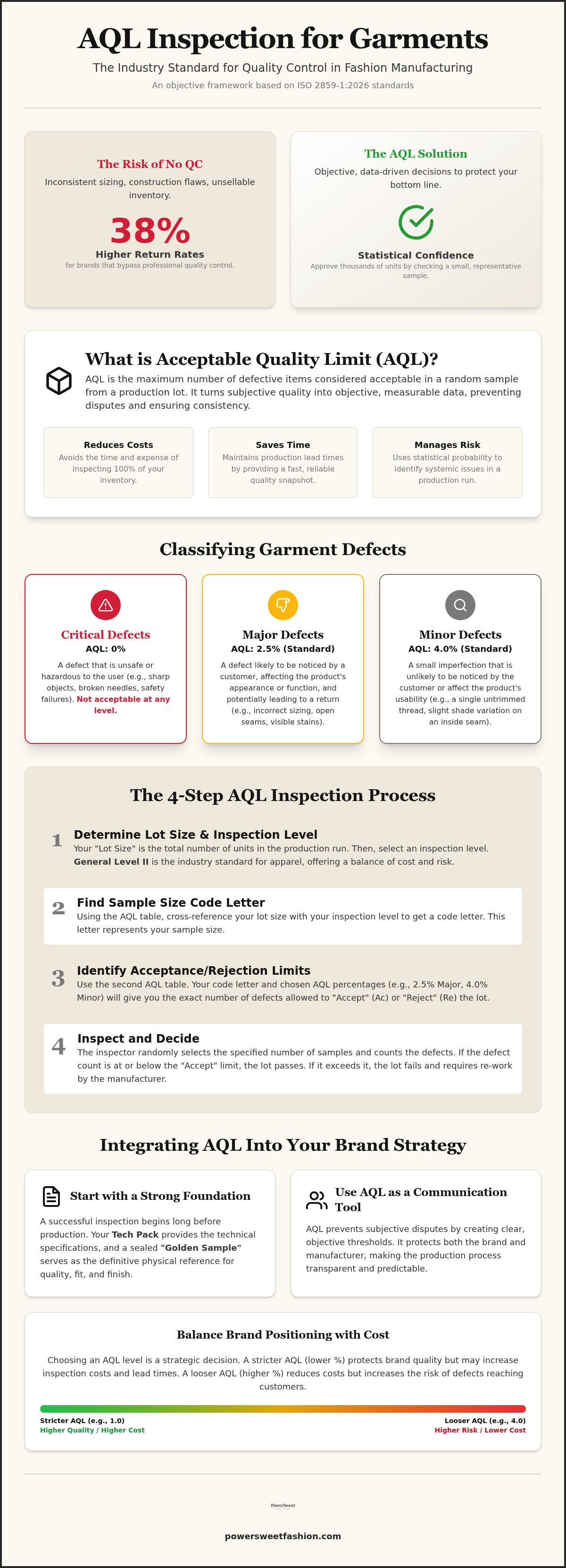
Brands that bypass professional quality control can face return rates up to 38% higher than those with a systematic process. It's a common fear for fashion founders: opening a shipment only to find inconsistent sizing or construction issues that make the entire batch unsellable. You shouldn't have to choose between losing money on inventory and spending weeks inspecting every single seam yourself. In this guide, you'll find AQL inspection for garments explained in a way that simplifies your manufacturing journey and protects your bottom line.
You already know that maintaining high standards is the only way to build a lasting brand. We'll show you how to master the industry standard for quality control to ensure your bulk production meets your exact requirements without the need for 100% inspection. This framework provides a repeatable process for accepting or rejecting batches based on the latest ISO 2859-1:2026 standards. By the end of this article, you'll have the technical confidence to manage your manufacturing partners and secure your inventory against costly defects.
Table of Contents
What is AQL in Garment Inspection?
AQL stands for Acceptable Quality Limit (AQL). It is a statistical measurement based on the ISO 2859-1 standards, which were updated in 2026 to include skip-lot sampling procedures. In simple terms, it's the maximum number of defective items that can be considered acceptable in a random sample of a production lot. Having AQL inspection for garments explained clearly is essential for any brand moving from small-scale samples to bulk manufacturing.
Inspecting every single garment in a 5,000-unit run is technically possible, but it's rarely practical or cost-effective. Checking every piece adds massive labor costs and can extend our standard 15-20 day bulk production lead times. AQL provides a mathematically proven snapshot of an entire production run. It allows us to verify that a batch meets your brand's standards by examining a representative slice of the total volume, ensuring you don't pay for unnecessary oversight.
The Role of Random Sampling
Random selection is the backbone of data integrity. If an inspector only checks the top boxes of a shipment, the results are biased and unreliable. True AQL requires pulling samples from different parts of the production lot to ensure the data reflects the reality of the whole batch. This method reduces lead times without sacrificing oversight. It creates a strategic balance where you manage quality risk effectively while keeping production costs manageable. By using statistical probability, we can identify systemic issues in the sewing line without touching every single shirt or dress.
AQL as a Communication Tool
Most disputes between brands and manufacturers happen because of subjective definitions of quality. One designer might overlook a loose thread, while another sees it as a reason to reject a shipment. AQL moves the conversation from "I want it perfect" to "These are our objective thresholds." It provides a clear framework that protects both the brand and the manufacturer from subjective disputes. When everyone agrees on the numbers, the production process becomes transparent and predictable. Ultimately, AQL serves as the bridge between a designer’s vision and industrial reality.
Understanding the AQL Tables and Sampling Levels
To master quality control, you need to navigate two primary tables. The first is the Sample Size Code Letter table, which converts your production volume into a manageable inspection task. The second is the Acceptance/Rejection Limit table, which sets the boundary for passing or failing a batch. Understanding these tools is the only way to have AQL inspection for garments explained with mathematical certainty. These tables remove the guesswork, allowing you to make data-driven decisions about your inventory.
Your "Lot Size" is the total number of units produced in a single batch. For instance, if your latest production run consists of 5,000 blouses, that is your lot size. Once you know this number, you must choose an inspection level. General Inspection Level II is the industry standard for apparel, providing a balanced ratio of cost to risk. While Level I offers less oversight and Level III offers more, Level II remains the go-to for most fashion brands seeking reliable results. Inspection levels also shift based on factory performance. Normal inspection is the default. If a manufacturer fails multiple inspections, you might move to Tightened inspection. Conversely, if a partner consistently delivers high-quality goods, you can transition to Reduced inspection to save time and costs.
Deciphering the Code Letter Table
Finding your sample size begins with locating your lot size on the vertical axis and your inspection level on the horizontal axis of the first table. This intersection gives you a code letter. It's vital to remember that larger orders don't require a proportional percentage of items to be checked. This is due to the math of diminishing returns; once a sample size reaches a certain point, checking more pieces doesn't significantly increase the accuracy of the snapshot. For example, a lot of 1,200 garments typically requires a sample of only 80 units to provide a reliable quality assessment. This efficiency is why AQL in the garment industry is the preferred method for growing brands.
The Accept/Reject Thresholds
Once you have your sample size, you move to the second table to find your "Ac" (Accept) and "Re" (Reject) limits. These columns tell you exactly how many defects are "too many" for the batch to pass. If your agreed-upon limit for major defects is 2.5, and your sample size is 80, the table might show an acceptance limit of 5 and a rejection limit of 6. This creates a clear, objective boundary. If the inspector finds 6 major defects, the batch falls into the "Reject" zone. When a batch fails, the manufacturer must re-sort the entire lot and fix the issues before a re-inspection. This structured approach to AQL inspection for garments explained ensures your brand's reputation remains intact. If you're ready to streamline your production with professional oversight, our team can help you implement Quality Control Services that fit your specific scale.
Critical, Major, and Minor: Classifying Garment Defects
In the manufacturing world, "quality" is an objective data point rather than a vague feeling. Not all defects carry the same weight because not all flaws impact the customer experience in the same way. When we have AQL inspection for garments explained for our clients, we start by categorizing every possible issue into three tiers: Critical, Major, and Minor. This classification determines whether a batch reaches your warehouse or stays at the factory for rework. The industry standard settings are typically 0 for Critical, 2.5 for Major, and 4.0 for Minor. These numbers represent the maximum allowable percentage of defects in each category before a batch fails.
A minor defect is often a matter of finishing, while a critical defect is a matter of safety or total failure. By using these standard thresholds, you create a balanced system that protects your brand reputation without demanding an impossible level of perfection that would drive up production costs. This tiered approach ensures that your quality control resources are focused on the issues that matter most to your customers and your bottom line.
Critical Defects: The Non-Negotiables
Critical defects are non-negotiable. These are safety hazards or regulatory failures that can lead to legal liability, expensive recalls, or physical harm to the wearer. Common examples include broken needles, sharp points, or pins left inside the lining of an intricate dress. Regulatory issues, such as missing care labels or incorrect fiber content, also fall into this category because they violate trade laws. Because these issues represent a total failure of the production process, a single critical defect usually results in an automatic batch rejection. There is no "acceptable" level for safety risks.
Major Defects: The Customer Return Drivers
Major defects are the primary drivers of customer returns and negative reviews. These flaws make a garment unacceptable to a reasonable consumer and reduce its usability or salability. Sizing issues outside of the allowed tolerance, such as a waistline that is more than 1cm off the tech pack specifications, are common major defects. In custom women's apparel, we look specifically for fabric holes, significant color shading differences between panels, or seam slippage on delicate fabrics like silk or lyocell. Functional failures, like a broken zipper or a non-functioning snap on a blouse, will also trigger a major defect count.
Minor Defects: The Finishing Touches
Minor defects are small issues that don't ruin the garment's usability but reflect a lack of attention to detail. These might include uncut threads longer than 0.5cm or slightly crooked stitching in a non-visible area, such as an inner pocket hem. Small soil marks that can be easily cleaned also count as minor. While a single minor defect won't typically cause a customer return, a high volume of them indicates that the factory's finishing department is losing focus. Monitoring these minor issues helps us identify when a manufacturing partner needs to tighten their internal oversight before major problems arise.
How to Set the Right AQL for Your Fashion Brand
Choosing your AQL level is a strategic business decision that directly impacts your profit margins and brand reputation. It's a careful calculation of risk versus reward. You must weigh your target audience's quality expectations against the logistical reality of production costs. When you have AQL inspection for garments explained as a business lever, you can choose a threshold that protects your brand without pricing your products out of the market. Most brands eventually settle on AQL 2.5 because it represents a global consensus on acceptable quality for ready-to-wear fashion. However, your specific path depends on your market positioning and the complexity of your designs.
Startups often benefit from choosing a stricter level during their first few production runs. This builds immediate trust with your initial customer base and sets a high bar for your manufacturing partners from day one. As the relationship with your factory matures and their internal quality control stabilizes, you can adjust these levels to optimize for speed and cost. The goal is to find a repeatable process that ensures consistency across every shipment you receive.
AQL 1.0 - 1.5: High-End and Luxury Standards
This tier is designed for brands where perfection is the primary selling point. It offers an extremely low defect rate, which is essential for protecting a premium brand reputation. The main drawback is that it often results in higher manufacturing fees. Slower production speeds and more frequent re-work are necessary to meet these tight tolerances. This level is best for high-margin custom women’s clothing manufacturer projects where the retail price supports the cost of intensive oversight.
AQL 2.5: The Industry Standard
This is the global "sweet spot" for the fashion industry. It provides a reliable balance between cost and quality, ensuring that garments are well-made without becoming prohibitively expensive to produce. Most professional factories are already optimized for this level, which makes the production process smoother for everyone involved. While it allows for a small percentage of minor issues, these rarely impact the customer's decision to keep the item. This is the ideal choice for mid-market brands and bulk women’s clothing production.
AQL 4.0: Budget and Fast Fashion
This level prioritizes speed and the lowest possible production costs. It allows for the fastest lead times because the factory spends less time on detailed finishing and internal QC checks. The trade-off is a significantly higher risk of customer complaints and returns. This setting is best for low-cost promotional items, basic essentials, or high-volume fast fashion where the price point is the customer's main priority.
If you're unsure which level fits your current collection, our experts can help you implement Quality Control Services that align with your brand's specific standards and growth goals.
Integrating AQL into Your Production Strategy
A successful quality control strategy is built on preparation rather than reaction. It requires moving beyond a simple "Pass/Fail" mentality to a collaborative system where standards are clear from the start. Having AQL inspection for garments explained as part of your initial planning ensures that your factory partner understands your expectations before the first roll of fabric is cut. This integration begins with a detailed tech pack. This document serves as the technical foundation for every inspection, providing the specific measurements and construction details that define a successful product.
We use "Golden Samples" as the definitive physical reference point for our inspectors. A Golden Sample is the final approved prototype that represents the exact standard the bulk production must match. By comparing the random AQL sample to this physical benchmark, we eliminate subjectivity and ensure that every piece in your 15-20 day production cycle remains consistent with your original vision.
Step 1: Define Your Standards Early
Setting clear tolerances is a critical part of the sample development clothing manufacturer phase. You must decide exactly what constitutes a major or minor defect for your specific designs. For example, a 1cm deviation might be acceptable on a loose-fitting linen tunic but a major defect on a structured blazer. We recommend including these specific AQL requirements directly in your manufacturing agreement. This transparency prevents disputes and ensures our Guangzhou-based team is working toward your exact requirements from the very first stitch.
Step 2: Monitoring the Production Cycle
Waiting until the end of production to check quality is a high-risk strategy. We utilize In-Line Inspections (DUPRO) to catch potential issues while the garments are still on the sewing line. This proactive approach is especially important when complex fabric sourcing is involved, as different materials react differently to industrial heat and tension. If an inspection fails, the data gathered provides a clear roadmap for the factory to re-sort and repair the batch. This turns a potential shipment delay into a controlled logistical correction.
Partnering for Success
At PowerSweet Fashion, we believe in open-door transparency. We encourage brands to oversee the QC process, whether through in-person factory visits or detailed digital reporting. This collaborative approach is vital for brands working with a low MOQ women’s clothing manufacturer, where every unit counts toward the brand's success. We handle rigorous internal checks throughout the production journey to ensure your final delivery is exactly what you promised your customers. Ready to scale your production with a partner you can trust? Contact PowerSweet Fashion for a reliable manufacturing partnership.
Securing Your Brand's Quality Standards
Mastering quality control is the foundation of a scalable fashion brand. By having AQL inspection for garments explained, you move from guesswork to a data-driven system that protects your inventory. You now understand how to classify defects, choose the right sampling levels, and use Golden Samples to maintain consistency across every batch. This framework ensures your bulk production meets your exact standards without the inefficiency of checking every single piece manually.
At PowerSweet Fashion, we combine Red Dot Design Award level attention to detail with transparent Guangzhou-based manufacturing. We offer 10-day sample turnarounds to keep your timelines tight and your designs precise. Our end-to-end service handles the technical complexities of AQL so you can focus on creative growth and market expansion. We believe in a collaborative process where your vision is backed by our industrial expertise and stable supply chain.
Ready to scale your production? Partner with PowerSweet Fashion for Reliable Bulk Production. Let's build a repeatable quality control process that gives you total confidence in your manufacturing partner and your final product.
Frequently Asked Questions
What does AQL 2.5 mean in simple terms?
AQL 2.5 represents the maximum percentage of major defects allowed in a production lot before it is rejected. In simple terms, it's a statistical boundary that balances quality and cost. If your sample of 80 units reveals more than five major defects, the entire batch fails the inspection. This level is the global standard for mid-market apparel because it ensures reliable quality without the extreme costs of zero-defect manufacturing.
Can I change my AQL level in the middle of production?
You can technically request a change, but it's highly discouraged once production has started. AQL levels are tied to the factory's internal quality control intensity and labor allocation. Changing the standard mid-run can disrupt the workflow and may lead to price renegotiations or shipment delays. It's best to finalize your AQL requirements during the sample development phase and include them in your manufacturing agreement to ensure consistent oversight from start to finish.
What happens if my garment shipment fails an AQL inspection?
When a batch fails, the manufacturer is responsible for re-sorting the entire lot to identify and fix the defects. This process is mandatory before a second inspection occurs. The brand should not accept the shipment until it passes a re-inspection. This systematic approach protects your brand from receiving unsellable inventory. We use these failure data points to identify weaknesses in the sewing line and improve future production efficiency for our partners.
Is AQL the same as 100% inspection?
No, AQL is a statistical sampling method, while 100% inspection involves checking every single unit in the lot. 100% inspection is often cost-prohibitive and time-consuming for bulk production. AQL provides a mathematically proven snapshot of the batch's quality using a representative sample. This guide to AQL inspection for garments explained shows that sampling allows you to maintain high standards and meet 15-20 day lead times without the massive labor costs of individual piece checks.
How do I choose between Level I, II, and III inspection?
General Inspection Level II is the standard choice for most apparel brands because it offers a reliable balance of risk and cost. Level I is used for low-risk items or when the factory has a long history of perfect deliveries. Level III provides the highest level of oversight with a larger sample size, which is ideal for high-end luxury goods or complex designs with intricate trims. Your choice should align with your brand's price point and risk tolerance.
Do small batch orders still need AQL inspections?
Yes, even small batches benefit from a structured quality control process. While the sample size will be smaller, using AQL helps you establish a repeatable standard as your brand scales. It provides objective data to evaluate your manufacturing partner's performance. For brands utilizing low MOQ options, AQL remains the most efficient way to ensure every unit counts toward your growth without spending excessive time on manual oversight for every small shipment.
Who typically performs the AQL inspection—the factory or the brand?
Inspections are typically performed by the brand's own QC team or a third-party inspection agency to ensure impartiality. While factories conduct their own internal checks, the final AQL report should come from an independent source. PowerSweet Fashion encourages transparency by allowing brands to oversee these inspections in person or remotely. This collaborative approach ensures that the final result reflects the brand's exact standards rather than just the factory's internal assessment of what is "good enough."
What is a "Golden Sample" and why is it used during AQL?
A Golden Sample is the final, approved prototype that serves as the definitive reference point for inspectors. During an AQL inspection for garments explained, the inspector compares units from the random sample directly to this "perfect" piece. It helps identify deviations in fabric drape, color shading, and construction details that a tech pack alone might miss. Using a Golden Sample eliminates subjectivity, providing a physical benchmark that ensures bulk production matches your original vision.


Comments