%20(1).png)
Factory Quality Audit Guide for Fashion Brands
- Powersweet Team

- 2 days ago
- 12 min read
Your factory’s glossy brochure and impressive showroom are not guarantees of a successful production run. In the garment industry, what you see in a marketing deck often differs from what happens on the production line. You likely know the anxiety of waiting for a bulk shipment, fearing that sub-standard quality or ethical oversights will derail your brand's reputation. Learning how to conduct a factory quality audit is the only way to move past these uncertainties and secure your supply chain. It transforms a risky gamble into a calculated partnership based on empirical evidence rather than empty promises.
We understand that verifying a partner's internal claims feels daunting when your creative vision is on the line. This article provides a systematic framework to audit garment factories for production reliability and superior product quality. We'll walk through the essential steps of a physical inspection, from evaluating fabric sourcing standards to testing technical capabilities during a 10-day sample phase. By the end of this guide, you'll have a repeatable process to minimize production delays and choose a manufacturing partner who acts as a safe pair of hands for your business.
Table of Contents
Understanding the Strategic Role of Factory Quality Audits
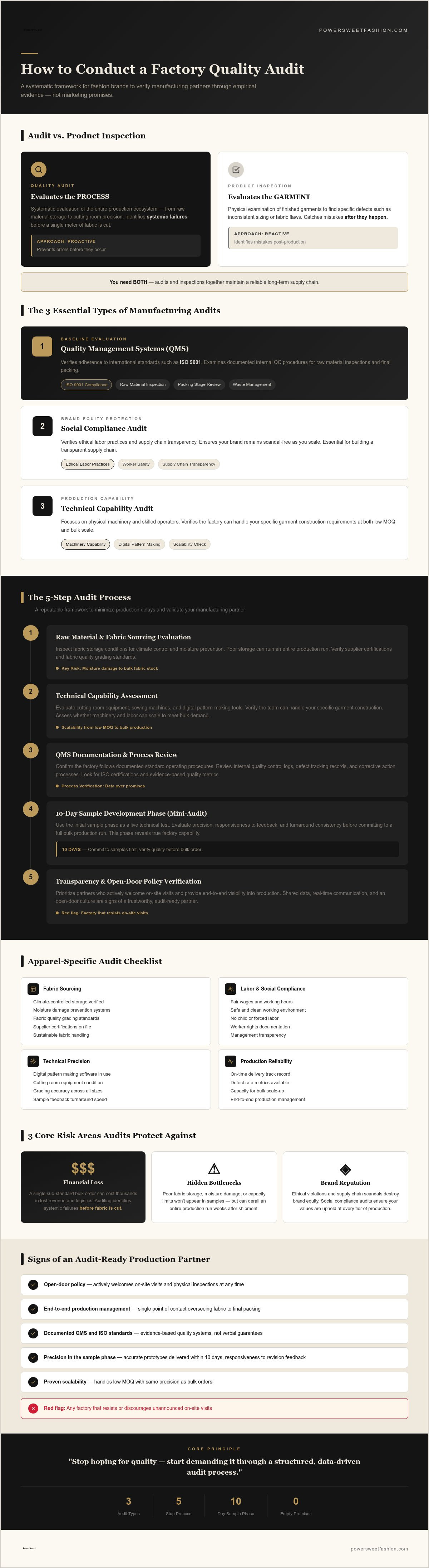
A factory quality audit is not a simple walkthrough. It's a systematic evaluation of a facility’s entire production ecosystem. When you learn how to conduct a factory quality audit, you're vetting the infrastructure that will either support or sink your brand. This process examines everything from raw material storage to the technical precision of the cutting room. It provides the empirical data needed to trust a manufacturer with your creative vision. You aren't just looking for a vendor; you're verifying a partner's industrial capability.
The financial impact of a rigorous audit is immediate. Preventing a single sub-standard bulk order can save a brand thousands in lost revenue and logistics costs. If a factory’s internal quality control is weak, your first shipment might arrive with inconsistent sizing or fabric defects. Auditing identifies these systemic failures before the first meter of fabric is cut. It ensures that your partner maintains the high standards required for successful end to end clothing production.
Quality Audit vs. Product Inspection
It's easy to confuse these two terms, but they serve different functions. A product inspection evaluates the physical garment to find specific defects. In contrast, an audit evaluates the process that created that garment. Inspections are reactive; they catch mistakes after they happen. Audits are proactive. They focus on prevention by ensuring the factory's management systems are robust enough to stop errors from occurring in the first place. You need both to maintain a reliable, long-term supply chain.
Risk Mitigation for Modern Fashion Brands
Modern fashion moves fast. Hidden bottlenecks can be fatal. An audit uncovers risks that a simple sample wouldn't show. For example, poor fabric storage can lead to moisture damage that ruins an entire production run weeks after it leaves the facility. Beyond technical risks, audits protect your brand equity. They verify social compliance and ethical labor practices, ensuring your supply chain remains transparent and scandal-free. This level of scrutiny is essential as you scale. A partner who manages low MOQ orders with precision must also prove they have the systems to handle bulk production without a drop in quality.
Process Verification: Confirms the factory follows documented standard operating procedures.
Scalability Check: Ensures machinery and labor can meet increased demand as you grow.
Transparency: Builds a foundation of trust through an open-door policy and shared data.
Mastering how to conduct a factory quality audit allows you to move from a place of anxiety to a position of authority. You stop hoping for quality and start demanding it through a structured, data-driven approach. This proactive stance is the hallmark of a professional fashion brand.
The 3 Essential Types of Manufacturing Audits
A comprehensive audit strategy isn't a single checklist. It's a multi-layered investigation into how a factory operates day-to-day. When you're determining how to conduct a factory quality audit, you must categorize your evaluation into three distinct types: Quality Management Systems (QMS), Social Compliance, and Technical Capability. Each layer provides a different level of security for your supply chain, ensuring that your production partner can meet both your aesthetic and ethical standards.
The QMS audit is your baseline. It verifies if the facility adheres to international standards like ISO 9001. You're looking for evidence of documented internal quality control procedures. This includes how they handle raw material inspections and how they manage the final packing stage. Without a functional QMS, even the best designers can't guarantee a consistent bulk run. Environmental audits are also becoming a standard requirement, evaluating waste management and the handling of sustainable fabrics to ensure the factory aligns with your brand’s green initiatives.
Assessing Technical Production Capability
Technical audits focus on the physical tools and the people using them. You need to verify that a custom women’s clothing manufacturer has the specific machinery required for your designs. If your collection involves delicate silk or complex draping, a factory optimized for heavy denim won't suffice. Check the machinery maintenance logs; well-maintained equipment is the only way to ensure consistent stitch quality across 1,000 units. We recommend using the 10-day sample phase as a technical mini-audit. It’s the fastest way to test the expertise of the pattern making and sample development teams before committing to a 15-20 day bulk production cycle.
Social and Ethical Compliance Standards
Social compliance is a non-negotiable requirement for modern fashion brands. During your audit, you must verify certifications such as WRAP, SEDEX, or BSCI. These documents prove the factory maintains fair labor practices and safe working environments. However, paperwork is only half the story. Observe the workplace culture during your visit. High staff retention rates often signal a stable, well-managed environment where workers are treated with respect. Transparency is vital to a healthy partnership. At PowerSweet Fashion, we maintain an open-door policy for factory visits because we believe trust is built on physical reality rather than just digital claims.
When you know how to conduct a factory quality audit across all these categories, you build a resilient brand. You aren't just buying clothes; you're investing in a verified production process that protects your reputation and your bottom line. This methodical approach ensures your supply chain remains a competitive advantage rather than a liability.
How to Conduct a Factory Quality Audit: A 5-Step Process
Executing a successful audit requires a methodical approach that leaves no room for assumptions. When you're learning how to conduct a factory quality audit, you must view the process as a forensic investigation of a factory's operational health. A structured five-step process ensures you capture a complete picture of the facility, from its legal standing to its physical production capacity. This systematic rigor is what separates professional brands from those that suffer through constant production errors.
Phase 1: Preparation and Planning
A successful audit begins long before you set foot on the factory floor. You must first define your audit scope and specific quality benchmarks. This involves creating a customized audit checklist based on your specific garment tech packs to ensure every technical requirement is addressed. We recommend scheduling the visit well in advance to ensure key production managers are available for interviews. Clear communication is essential here; you must set firm expectations for the "open-door" access required to view all areas of the facility during your visit.
Documentation Review: Verify business licenses, ISO certifications, and past audit reports before arriving.
Benchmark Alignment: Ensure the factory understands your tolerance levels for minor and major defects.
Team Readiness: Confirm that the personnel responsible for fabric sourcing and quality control will be on-site.
Phase 2: On-Site Execution
The execution phase is about physical verification. You should conduct a comprehensive "walk-through" that follows the natural flow of production, starting at the raw material storage and ending at the finished goods warehouse. Observe the QC stations in real-time during an active production run to see if workers actually follow the documented procedures you reviewed earlier. This is also the time to conduct management and staff interviews to cross-reference their verbal claims with the physical reality of the shop floor. The Golden Sample serves as the ultimate quality benchmark that all subsequent bulk production units must match exactly.
Phase 3: Reporting and Follow-Up
Once the physical inspection is complete, you must generate a final report that categorizes findings into critical, major, and minor non-conformities. This data forms the basis of a Corrective Action Plan (CAP). A CAP isn't just a list of complaints; it's a strategic roadmap that develops a clear timeline for the factory to implement necessary improvements. You must then determine if the findings require a follow-up visit before you feel confident placing a bulk order. Mastering how to conduct a factory quality audit means staying involved until every critical issue is resolved, ensuring your production remains reliable and your brand reputation stays protected.
The Apparel-Specific Audit Checklist: What to Look For
Generic manufacturing checklists often fail because they ignore the unique failure points of garment production. Knowing how to conduct a factory quality audit in the fashion sector means looking beyond the four walls and focusing on the physical properties of textiles. You must verify that the facility handles materials with the care required for high-end apparel. A technical audit should prioritize the mechanics of fit, the integrity of the seams, and the precision of the cutting room.
Material and Trim Management
The foundation of quality is the raw material. You must verify that the factory works with reliable fabric sourcing partners to ensure color fastness and shrinkage control. Inspect their Incoming Material Inspection (IMI) process during your visit. They should be checking every roll for defects before it moves to production. Storage is equally critical. Delicate silks or high-stretch synthetics require climate-controlled environments to prevent fiber degradation or moisture damage that can ruin a bulk order.
From Sample Development to Bulk Consistency
The transition from a single prototype to a bulk run is where most errors occur. Analyze the sample development clothing manufacturer workflow to ensure the bulk production team uses the exact same digital patterns as the sample makers. Any deviation in grading standards across different size ranges will lead to fit inconsistencies that trigger massive returns. Consistency is the primary goal of any industrial partner.
Cutting Room Precision: Markers must be aligned perfectly to the grainline to prevent garment twisting. Look for minimal fabric waste as a sign of technical efficiency.
Sewing and Assembly: Check for consistent thread tension and seam strength. High-quality finishes require specific needle types and machine settings tailored to the fabric weight.
Material Traceability: Ensure every batch of fabric and trim can be traced back to its specific supplier and production date.
When you're evaluating these technical details, you're looking for a facility that operates with precision and transparency. If you want to see these high standards in action, we invite you to partner with our technical production team to ensure your next collection meets every quality benchmark. Our 10-day sample phase acts as the first verification point in this rigorous quality journey.
Choosing an Audit-Ready Production Partner
Finding a manufacturer that welcomes scrutiny is the final step in securing your supply chain. When you understand how to conduct a factory quality audit, you quickly realize that a defensive or secretive factory is a significant red flag. Audit-ready partners maintain organized floors, clear documentation, and a culture of accountability. They don't just tolerate audits; they use them as an opportunity to prove their reliability and technical precision. This transparency is what builds the trust necessary for a long-term production relationship.
Speed shouldn't compromise stability. At PowerSweet Fashion, our 10-day sample turnaround and 15-20 day bulk production lead times are only possible because of elite internal QC systems. Rapid production requires precision at every stage to prevent the need for re-work. A factory that can move this quickly while maintaining high quality standards has already passed the most difficult part of any audit. Integrating these checks into a collaborative partnership ensures that your brand remains agile without sacrificing the integrity of the finished garment.
The Value of an Open-Door Factory Policy
We believe transparency is the foundation of a successful B2B relationship. PowerSweet Fashion encourages clients to visit our facility and meet the production team in person. This direct access allows you to verify our processes in real-time and see the human element behind the industrial work. Use the 10-day sample development phase as a live audit of our communication and technical skill. It's a low-risk way to determine if we are the "safe pair of hands" your brand needs before you commit to a full bulk production run.
Leveraging Low MOQ Women’s Clothing Manufacturers for Quality
Many growing brands find that low MOQ women’s clothing manufacturers offer superior visibility during the production journey. Smaller production runs often allow for more meticulous quality control because the volume is manageable and the attention to detail is higher. You can "scale small," verifying every technical detail of a limited order before committing to massive bulk quantities. This approach minimizes the risk of discovering a major non-conformity in a high-volume shipment that could drain your capital.
Your final goal should be to treat your manufacturer as a strategic partner, not just a vendor. A partner who understands how to conduct a factory quality audit from the provider side will actively help you maintain your benchmarks. This collaborative mindset turns the manufacturing process into a shared venture, ensuring your creative vision is delivered with empirical reliability every time.
Securing Your Brand's Future Through Rigorous Auditing
Mastering how to conduct a factory quality audit is the most effective way to eliminate supply chain anxiety and protect your brand's reputation. By focusing on process verification and technical capability, you ensure that every bulk shipment matches your original creative vision. A successful audit isn't just about finding faults; it's about building a foundation of trust with a partner who values transparency as much as you do. This systematic approach transforms manufacturing from a gamble into a reliable industrial partnership.
At PowerSweet Fashion, we specialize in custom women's apparel with a focus on end-to-end production management. We maintain an open-door policy because we believe physical reality is the best proof of quality. Whether you're leveraging our 10-day sample turnaround or our expertise as low MOQ specialists, we provide the stability you need to scale your fashion brand with confidence. Your vision deserves a manufacturing partner that stands up to scrutiny every day.
Schedule a visit to our facility and meet the PowerSweet Fashion production team to see our quality systems in action and start your journey toward production reliability.
Frequently Asked Questions
How long does a typical factory quality audit take?
A standard initial audit for a medium-sized facility typically takes one full working day. If the facility is large or includes multiple production lines for different garment types, it may extend to two days. This timeframe allows for the documentation review, physical walkthrough, and staff interviews. Preparation and final report generation are handled off-site and usually require an additional three to five business days.
Is a third-party auditor always necessary for a fashion brand?
Third-party auditors provide objectivity and specialized expertise, but they aren't always mandatory. Many emerging brands successfully perform their own audits by visiting the facility in person. This direct approach allows you to build a relationship with the production team while learning how to conduct a factory quality audit firsthand. As your volume grows, professional third-party services can provide more rigorous technical testing and legal compliance verification.
What are the most common "red flags" found during a factory audit?
Common red flags include unorganized fabric storage, missing machinery maintenance logs, and a lack of documented quality control procedures. If a factory cannot show you their internal inspection reports for recent bulk orders, it's a sign of systemic weakness. Obstructed fire exits or poor lighting also indicate social compliance risks. You should also watch for high staff turnover, which often leads to inconsistent stitching and frequent production errors.
Can I conduct a factory audit remotely if I cannot travel?
Remote audits are possible through live video walkthroughs and digital document sharing, but they lack the depth of physical inspection. You can't feel fabric quality or observe workplace culture through a screen. If travel isn't feasible, we recommend hiring a local agent to perform an on-site visit. This hybrid approach ensures someone is physically present to verify that the factory's digital claims align with their actual production reality.
How much does a professional factory audit cost in 2026?
Professional audit fees generally range from $300 to $900 per man-day, depending on the location and the complexity of the checklist. This price typically covers the auditor’s time on-site and the subsequent report generation. Travel expenses are usually billed separately. While this represents an upfront investment, the cost is minimal compared to the financial loss of a failed bulk production run or a major product recall.
What happens if a factory fails a quality audit?
A failed audit doesn't always mean you must terminate the relationship. Instead, you should issue a Corrective Action Plan (CAP) that outlines specific improvements with mandatory deadlines. The factory must then provide evidence that they've resolved the non-conformities. If the failures are critical, such as child labor or severe safety violations, you should immediately seek an alternative partner. Otherwise, a follow-up audit will verify if the necessary changes were implemented.
How often should I re-audit an existing manufacturing partner?
We recommend performing a full re-audit every 12 to 18 months to ensure standards haven't slipped. Even reliable partners can experience changes in management or labor that affect quality. You should also perform a mini-audit whenever you introduce a new garment category or a significantly more complex design. Regular check-ins reinforce your quality benchmarks and remind the production team that your standards remain a top priority.
Does a factory audit guarantee that my bulk order will be perfect?
An audit evaluates the factory's systems and capacity, but it isn't a guarantee of perfection. It significantly reduces risk by ensuring the facility has the right tools and processes to succeed. To ensure a perfect order, you must combine the initial audit with ongoing quality control services during production. Understanding how to conduct a factory quality audit is just the first step in a comprehensive strategy that includes sample approval and final inspections.


Comments