%20(1).png)
What to Look for in a Garment Manufacturer: The 2026 Professional Checklist
- Powersweet Team

- Jul 21
- 12 min read
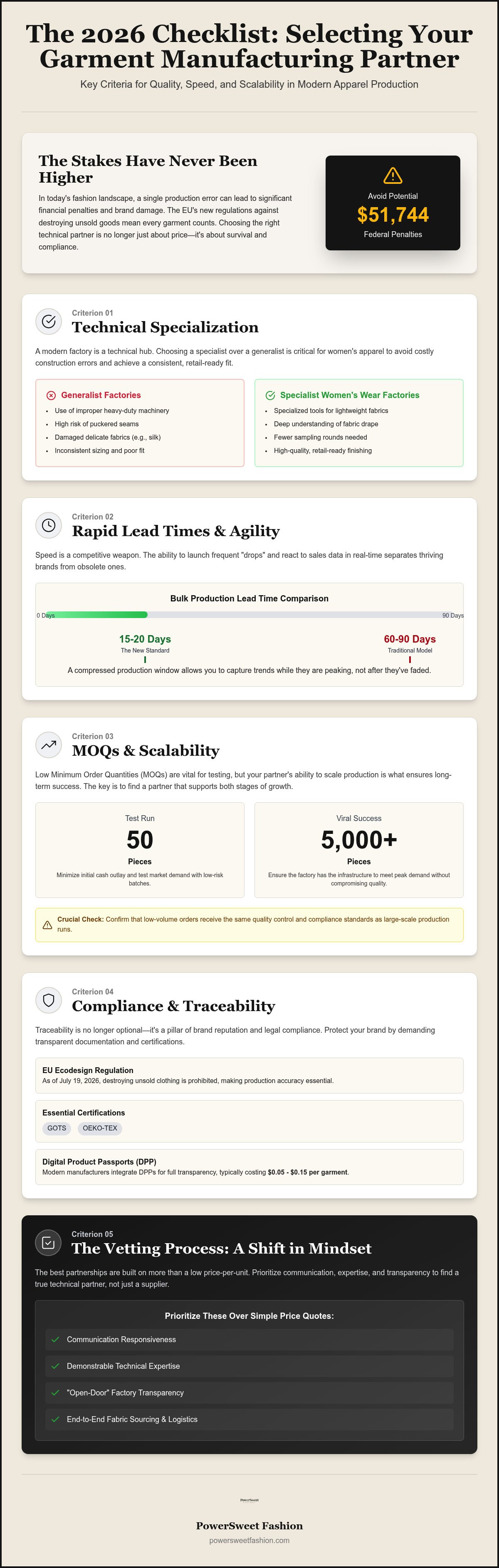
What if your next production run didn't just meet your quality standards but also protected your brand from a $51,744 federal penalty? Many fashion founders face this exact risk when they realize a single labeling error or a missed chemical test filing can derail an entire season. You've likely felt the frustration of opening a shipment only to find inconsistent sizing or production delays that kill your marketing momentum. It's a common pain point, but in a landscape where the EU now prohibits the destruction of unsold goods, the margin for error has vanished.
Understanding what to look for in a garment manufacturer has evolved. It's no longer just about finding the lowest price per unit. Instead, it's about finding a technical partner who bridges the gap between your digital designs and physical reality. This article provides the definitive 2026 checklist to help you master the criteria for selecting a production partner that balances speed, quality, and scalability. We will explore how to reduce sample turnaround times and achieve retail-ready quality at manageable MOQs, ensuring your fashion brand remains both compliant and profitable.
Table of Contents
The 2026 Standard: Why Technical Specialisation Matters Most
A modern factory is no longer just a sewing floor; it's a technical hub. It's the engine room where digital sketches transform into physical products that fit perfectly. When you evaluate what to look for in a garment manufacturer, you're searching for a partner that understands the mechanical nuances of your specific category. Generalist factories often struggle with the complex construction required for women's fashion. They might use the same heavy-duty machinery for denim as they do for a silk blouse, which leads to puckered seams or ruined fabric. Technical specialization eliminates this risk by ensuring the equipment and expertise match the material.
As the global garment industry becomes more fragmented and specialized, the "trial and error" phase of production has become too expensive to ignore. Specialized partners reduce sampling rounds because they already understand the drape of a specific rayon or the tension needed for a delicate lace insert. This expertise is why some facilities can offer 10-day sample turnarounds while others take a month just to get the fit right. By choosing a partner with category-specific expertise in dresses, blouses, or resort wear, you ensure your brand's vision isn't lost in translation during the move from pattern to prototype.
The Shift from Generalist to Specialist Women's Wear Factories
Specialized machinery for lightweight fabrics is a non-negotiable requirement for high-quality women's wear. Factories focused on this niche use specific overlockers and finishing tools designed for delicate textiles. This focus extends to the pattern makers, who play a critical role in maintaining consistent sizing across your collections. When a pattern maker only works on women's silhouettes, they develop an intuitive understanding of how fabric drapes over the body. This results in better finishing quality and a retail-ready feel that generalist factories simply can't replicate.
Traceability and Documentation in the Modern Supply Chain
Traceability has become a pillar of brand reputation. As of July 19, 2026, the EU's Ecodesign for Sustainable Products Regulation prohibits the destruction of unsold clothing, making production accuracy more vital than ever. You should request essential certifications like GOTS or OEKO-TEX during your vetting process. Modern manufacturers now integrate Digital Product Passports (DPP) into their workflow, often at a cost of $0.05 to $0.15 per garment. This transparent documentation ensures your brand meets global sustainability standards while protecting you from the legal risks of vague environmental claims.
Technical Capabilities: Balancing Low MOQs with Rapid Lead Times
Speed defines the winners in the 2026 apparel market. When deciding what to look for in a garment manufacturer, you must weigh the factory's agility against its long-term scalability. A low Minimum Order Quantity (MOQ) is often touted as the ultimate entry point for new brands, but the number itself is less important than the factory's ability to grow with you. If a facility can handle a 50-piece test run but lacks the infrastructure to produce 5,000 units once that style goes viral, they aren't a true partner. They're a bottleneck that prevents you from capturing market demand at its peak.
Rapid lead times of 15-20 days have become the survival standard for influencer-led brands and boutiques. This window allows you to respond to real-time sales data rather than guessing consumer demand six months in advance. For these agile brands, the ability to launch frequent "drops" is predicated on this speed. Traditional manufacturing lead times of 60-90 days are incompatible with the current digital consumption cycle. A compressed production window means you can capture a trend while it's still peaking on social feeds, transforming your supply chain from a cost center into a competitive weapon.
Understanding Minimum Order Quantities (MOQ) for Scaling
Low MOQs minimize your initial cash outlay and protect your brand from the inventory traps created by the 2026 EU regulations on unsold goods. While testing the market with small batches is smart, you must watch for hidden costs. Minimum order fees or higher unit prices are common, but the real risk is production quality. Some factories treat low-volume orders as "filler" work. A reliable partner maintains strict manufacturing compliance and safety standards regardless of the batch size, ensuring every piece is retail-ready. If you're ready to bridge the gap between design and delivery, you can partner with a specialist who understands the pace of modern fashion.
The Critical Role of 10-Day Sample Turnarounds
A 10-day sample turnaround is the new industry benchmark for success. In a world where trends vanish in weeks, waiting a month for a prototype is no longer viable. Working with a professional sample development clothing manufacturer streamlines the entire process from pattern making to final fitting. This speed prevents production bottlenecks and creates a reliable "Sample-to-Bulk" bridge. A specialist factory uses the sampling phase to solve technical construction problems before the machines start for the full run. This proactive approach ensures that the technical specifications of your prototype translate perfectly into the final production run, maintaining consistency across every size and colorway.
Infrastructure and Transparency: Evaluating Factory Operations
Transparency isn't just a buzzword; it's a physical requirement. When you are determining what to look for in a garment manufacturer, the physical infrastructure of the facility tells you more than a PDF quote ever will. A factory located in a major textile hub, like Guangzhou, offers a distinct logistical advantage. Proximity to massive fabric markets and trim suppliers means that material procurement happens in hours, not weeks. This geographical positioning is a primary driver behind the rapid lead times discussed earlier. If your partner is isolated from these clusters, your production timeline is at the mercy of internal shipping delays before the first stitch is even sewn.
Choosing the right sourcing and production partners involves looking at where the work actually happens. You need to know if the factory performs its core services in-house or if they outsource critical steps like pattern making or quality control to third parties. In-house operations provide a tighter feedback loop. When the technical designers, pattern makers, and sewing teams work under one roof, the risk of "design drift" decreases significantly. This structural unity ensures that the retail-ready quality you expect is maintained from the first sample to the final bulk shipment.
The 'Open-Door' Policy and In-Person Quality Control
A reliable manufacturer operates with an open-door policy. They should welcome physical visits or, at the very least, provide detailed live video tours of the production floor. During these walkthroughs, look for organized workflows and modern machinery. Red flags include cluttered workspaces, a lack of visible safety protocols, or outdated equipment that can't handle digital grading. Seeing your fabric and trim sourcing in person allows you to verify the hand-feel and color accuracy before mass production begins. This level of access builds the trust necessary for a long-term B2B partnership, transforming the factory from a distant supplier into a transparent extension of your own brand.
Professional Pattern Making and Technical Design Support
The difference between a standard sewer and a technical garment engineer is found in the pattern room. In 2026, digital pattern making is essential for meeting international sizing standards. It allows for precise digital grading, ensuring that a size small and a size extra-large maintain the same intended proportions. This technical precision is why end to end clothing production is so effective; it keeps the design and the machine in the same room. By integrating technical design support directly with manufacturing, the factory can identify construction issues during the digital phase. This saves you from the "volume trap" of producing hundreds of units with a fundamental fit flaw that should have been caught at the screen level.
End-to-End Supply Chain Management: Sourcing and Logistics
Integrated sourcing is the backbone of a resilient fashion brand. When evaluating what to look for in a garment manufacturer, you must decide if you want a simple sewing contractor or a full-service production partner. Managing fabric procurement yourself often leads to a logistical nightmare; coordinating material arrivals from multiple vendors to an overseas factory is a recipe for delays. An integrated partner handles this complexity for you. They leverage their existing relationships with local mills to ensure that the materials arriving at the cutting table exactly match your technical specifications. This end-to-end approach eliminates the communication barriers that usually occur when a factory blames a fabric supplier for production errors.
The speed of your supply chain is dictated by the proximity of your materials. By leveraging local supply chain clusters, a manufacturer can procure fabrics and trims in a fraction of the time required for international shipping. This geographical advantage is what allows for a 15-20 day bulk production cycle. It transforms the manufacturing process from a series of disconnected steps into a streamlined, high-speed operation that responds to market trends in real-time.
Fabric and Trim Sourcing Expertise
A professional manufacturer uses your tech pack as a blueprint for procurement. They don't just find a "similar" fabric; they source textiles that meet your specific weight, composition, and hand-feel requirements. Local sourcing within a major industrial cluster also significantly reduces your brand's carbon footprint by minimizing the transit of raw materials. Before production begins, a high-tier partner performs rigorous quality testing. This includes checking for color fastness, shrinkage rates, and durability under stress. These preventative steps ensure that your bulk production window isn't derailed by material failures that should have been caught at the sourcing stage.
Managing Bulk Production and Quality Assurance
Quality assurance at scale requires a systematic approach. You should look for a partner that utilizes the AQL (Acceptable Quality Level) standard to provide a statistically significant measure of batch quality. Mid-production inspections are equally vital. These checks allow the technical team to identify and correct sewing issues before the entire run is completed. This level of oversight is a hallmark of a reliable custom women's clothing manufacturer. It ensures that the final product delivered to your warehouse is retail-ready and free from the sizing inconsistencies that plague unmanaged production runs.
The final hurdle is moving your goods from the factory floor to your distribution center. A partner with a robust logistics network can manage the complexities of international shipping, customs documentation, and last-mile delivery. This streamlines your operations and allows you to focus on marketing and sales rather than tracking containers. If you want to simplify your production cycle and reduce lead times, you can start your sourcing journey with a partner that manages every detail from fiber to finished garment.
Navigating the Partnership: How to Vet Your Production Partner
Vetting is the most critical phase of your brand's growth. When determining what to look for in a garment manufacturer, you must shift from price-first to process-first thinking. A low unit price is meaningless if the factory lacks a robust system for dispute resolution or quality maintenance. Communication responsiveness serves as the primary predictor of production success. If a factory takes three days to respond to a simple fabric query during the honeymoon phase, they'll likely go silent when a production delay occurs. You need a partner who views the manufacturing process as a joint venture, providing the transparency required to manage a modern fashion business.
Testing the relationship with a small batch is a strategic necessity. By starting with a low MOQ women's clothing manufacturer run, you can evaluate the factory's attention to detail without over-leveraging your cash flow. This initial project reveals how the team handles technical design challenges and whether they respect your deadlines. It's a low-risk way to identify a "Safe Pair of Hands" in a crowded global market before committing to the larger volumes required for a full seasonal launch.
Essential Questions for Your Manufacturing Team
Move beyond surface-level inquiries and ask about the mechanics of their operation. You should ask: "What is your internal quality control process for bulk runs?" A reliable partner will describe specific checkpoints, such as the AQL standards mentioned in the previous section. Ask for a clear timeline from the receipt of your tech pack to final delivery. In 2026, a professional tech pack costing between $300 and $800 should significantly reduce sampling rounds, but you must know how the factory handles fabric shortages or production errors. Their answer will reveal if they have the contingency plans necessary to protect your inventory from the $51,744 federal penalties associated with mislabeling or safety non-compliance.
Transitioning from Prototype to Bulk Production
The transition from a sample to mass production is where most errors occur. The "Gold Seal" sample is your final safeguard; it's the exact version of the garment that the production line must replicate. Never allow mass cutting to begin until you've signed off on this physical prototype. Use this stage to set clear expectations for packaging, labeling, and shipping logistics. Detailed documentation prevents the "design drift" that can happen when a factory scales from one sample to five hundred units. Finally, create a long-term growth roadmap with your factory partner. As your brand scales, you'll need to know they have the capacity to grow with you, moving from agile boutique drops to consistent, high-volume retail deliveries.
Building Your Brand on a Foundation of Technical Excellence
Selecting the right production partner is the most consequential decision your fashion brand will make this year. You now have a professional framework for identifying what to look for in a garment manufacturer, from category-specific technical expertise to the transparency of an open-door factory policy. Success in 2026 requires more than just a supplier; it requires a technical engineer who understands the nuance of fabric drape and the absolute necessity of retail-ready quality. By prioritizing integrated sourcing and rapid lead times, you protect your cash flow and ensure your collections hit the market while trends are still peaking.
As specialists in women's fashion since 2008, we provide the industrial stability your creative vision deserves. We actively encourage factory visits because we believe transparency is the bedrock of a professional B2B partnership. Whether you require a 10-day sample turnaround or a scalable production run, we're here to facilitate your journey from concept to delivery. Start your production journey with PowerSweet Fashion today and transform your designs into a physical reality. Your brand's future is built one stitch at a time; let's work together to make sure every single one is perfect.
Frequently Asked Questions
What is a Tech Pack and why do I need one for a garment manufacturer?
A tech pack is the technical blueprint for your garment that contains every specification needed for production. It's a non-negotiable tool for ensuring what to look for in a garment manufacturer aligns with your actual design vision. Without one, you risk sizing inconsistencies and material errors that lead to costly production delays. It serves as a contract between you and the factory, ensuring the final product matches your prototype exactly.
How do I verify the quality of a clothing manufacturer before ordering?
Verify quality by requesting a physical sample and auditing the factory's internal quality control standards. You should look for partners that use the AQL (Acceptable Quality Level) system and offer transparency through live video tours. Checking for certifications like GOTS or OEKO-TEX provides empirical evidence of their manufacturing standards. A reliable partner will always provide a "Gold Seal" sample for your approval before mass cutting begins.
What is the typical lead time for custom clothing production in 2026?
In 2026, the industry benchmark for custom bulk production is 15 to 20 days. Sample development typically requires about 10 days from the receipt of your tech pack. These compressed timelines allow agile brands to respond to social media trends without the risk of holding excessive unsold inventory. If a factory quotes longer than 45 days, they likely lack the integrated supply chain needed for modern fashion cycles.
Should I choose a domestic or overseas clothing manufacturer?
Overseas manufacturers in major industrial hubs often provide faster material procurement due to their proximity to massive fabric markets. While domestic production can reduce shipping times, overseas facilities in clusters like Guangzhou offer a more integrated end-to-end service. This makes them a safe pair of hands for brands requiring both speed and technical specialization. The absence of local material clusters in many domestic markets can actually slow down the sampling phase.
How do low MOQs affect the unit price of my garments?
Low MOQs typically increase the per-unit cost because the fixed setup expenses are distributed across a smaller volume. Machine calibration, pattern making, and fabric sourcing require the same amount of labor whether you're making 50 or 500 pieces. However, this premium is often offset by the reduced risk of over-inventory and the ability to test new designs. It's a strategic investment that prevents capital from being locked in unsold stock.
Can a manufacturer help me with fabric sourcing and pattern making?
End-to-end manufacturers provide integrated fabric sourcing and pattern making as part of their core service. This integration is a critical factor in what to look for in a garment manufacturer because it eliminates the need for third-party technical designers. It ensures that the technical engineer making the pattern is the same person overseeing the sewing line. This unified approach reduces the "trial and error" phase and ensures your bulk production matches your original sample.
What are the common red flags when vetting a new factory partner?
Common red flags include slow communication responsiveness, vague answers regarding their quality control process, and a refusal to provide factory walkthroughs. If a partner is evasive about where they source materials or how they handle production errors, it's a sign of a fragmented supply chain. Professional partners prioritize transparency and empirical reliability. Any factory that hides its physical location or production team should be avoided to prevent future logistics issues.
How do I protect my designs when working with a manufacturer?
Protect your designs by using a formal Non-Disclosure Agreement (NDA) and working with manufacturers that have a documented history of serving international brands. Established factories value their reputation and long-term B2B partnerships more than the short-term gain of copying a design. Clear documentation of your tech pack also establishes your ownership of the technical specifications. Choosing a partner with an "open-door" policy ensures you're working with a legitimate business that respects intellectual property.


Comments