%20(1).png)
The Ultimate Clothing Pre-Production Checklist for Fashion Brands in 2026
- Powersweet Team

- 6 days ago
- 11 min read
A single overlooked detail in your tech pack can drain your season's profit before the first garment is even sewn. In 2026, with wholesale fabric prices up by as much as 22 percent and strict new EU safety regulations in effect, there's no room for "trial and error" at the factory level. You've likely felt that knot in your stomach while waiting for a bulk shipment, wondering if the fit will actually match your sample. It's a common fear, but it's one that a systematic clothing pre-production checklist can eliminate.
We've built this roadmap to help you master the transition from creative design to industrial reality. You'll learn how to navigate the complexities of 10-day sampling, professional pattern making, and the mandatory eFiling requirements for US imports. This expert-verified guide bridges the communication gap between your brand and the manufacturing floor. We'll walk through every critical milestone, from lab dip approvals to quality control protocols, ensuring your final product is exactly what you envisioned.
Table of Contents
What is the Clothing Pre-Production Phase?
Pre-production is the industrial bridge between a creative concept and a finished garment. While design development focuses on aesthetics and market trends, the pre-production stage handles the rigorous logistics required for mass manufacturing. It is a systematic validation process. This phase ensures that every detail, from the tension of a seam to the placement of a care label, is perfected before the machines start running at scale.
Successful execution relies on a collaborative effort between designers, pattern makers, and production managers. The designer provides the vision, while the production manager oversees the clothing pre-production checklist to ensure the factory can replicate that vision thousands of times without deviation. Central to this transition is the sewing pattern, which serves as the precise physical template for every cut of fabric in your custom women's apparel collection.
The Financial Impact of Skipping Pre-Production
Skipping steps during this phase is a high-stakes gamble. In 2026, wholesale fabric prices have increased by 8 to 22 percent, making material waste a significant threat to your bottom line. A "bad batch" of 500 units represents a total loss of capital, whereas thorough sampling identifies fit issues or fabric shrinkage early. Investing in the sampling phase is always more cost-effective than discarding a bulk shipment that fails to meet quality standards.
Pre-production is the final validation of the manufacturing blueprint.
Beyond the immediate financial ROI, this stage improves your brand's sustainability scores. By minimizing textile waste and ensuring product durability, you align your production with the latest EU regulatory standards. We treat this phase as a risk-mitigation strategy that protects both your profit margins and your brand reputation.
Setting Your Production Timeline
Speed is the lifeblood of the modern fashion cycle. Today, 10-day sample turnaround has become the industry standard for brands that need to stay ahead of rapid trend shifts. You must integrate your development calendar with seasonal launch dates to maintain momentum. We recommend a "read-and-react" ecosystem where your pre-production is streamlined but never rushed.
Balancing speed with precision is essential to avoid last-minute revisions. A mistake discovered during the bulk run can stop a factory line for days, but a mistake caught during the clothing pre-production checklist review is a simple fix. Aim for a timeline that allows for 15 to 20 days of bulk production after your samples are finalized to ensure every piece meets your original vision.
The Technical Blueprint: Tech Packs and Pattern Making
Tech packs are often called the "blueprint" of a garment, but in 2026, they function more like a legal contract. Every line on a technical sketch dictates a physical movement on the sewing floor. For custom apparel, an "overly detailed" tech pack is your only defense against production errors. It translates fluid creative sketches into rigid technical sewing instructions. This level of precision is vital for competing within the U.S. textile and apparel industry, where efficiency and accuracy define market leaders.
Professional pattern making is the engine behind consistent sizing. Without a master pattern, your collection will lack the fit-identity that builds customer loyalty. Digital patterns have revolutionized this process. They allow us to grade sizes instantly while maintaining the integrity of the original silhouette. If you need help refining your technical foundation, our team provides expert pattern making and sample development to ensure your vision is factory-ready.
Essential Components of a 2026 Tech Pack
Technical sketches, or "flats," must show front, back, and internal construction details. A comprehensive Bill of Materials (BOM) is equally critical. It must list every thread type, button SKU, and zipper length required. Finally, Point of Measure (POM) charts provide the benchmarks for your clothing pre-production checklist. These charts allow quality control teams to verify that bulk units match the approved samples within a millimeter of tolerance.
Pattern Grading and Sizing Accuracy
Everything starts with the "base size" pattern. If the base size is flawed, every graded size will carry those errors. Common pitfalls in women's wear often involve inconsistent grading in the bust and hip areas. This leads to high return rates in e-commerce. By prioritizing sizing accuracy during the clothing pre-production checklist phase, you directly reduce your return logistics costs. Precision here ensures that the product your customer receives matches the vision you sold them.
Material Sourcing and Approval: Fabrics and Trims
Choosing materials is where your design meets the physical world. In 2026, the logistics of fabric sourcing for custom designs require a proactive approach to handle rising wholesale costs and supply chain volatility. Every roll of fabric and every box of buttons must be verified against your clothing pre-production checklist before production begins. Changing a fabric after a prototype is approved is a costly mistake that forces a complete sampling restart. We treat sourcing as a collaborative venture, ensuring every material choice supports the final quality of the garment.
The Lab Dip Approval Process
Color consistency is non-negotiable for professional brands. We use the lab dip process to ensure that the shade on your screen matches the dye on the roll. This involves reviewing small dyed swatches, typically using the "A, B, C, D" selection method to find the closest match to your target color. It's essential to view these under standardized lighting conditions, such as D65 (daylight) and TL84 (store light). This prevents metamerism, where colors appear different under different bulbs. Expect this process to take 7 to 14 days, depending on the complexity of the dye and the fabric composition.
Strike-offs and Print Accuracy
For printed textiles, a strike-off is your final check. This is a small print run on the actual production fabric. You're looking for scale, color vibrancy, and hand-feel. If the ink feels too heavy or the pattern scale is off by even a few centimeters, it can ruin the silhouette of the garment. We verify these details early to maintain the momentum of your fashion cycle. A precise strike-off approval prevents the waste of hundreds of meters of printed fabric and ensures the final product matches your original vision.
Trim and Accessory Validation
Hardware and notions are often an afterthought, but a broken zipper can trigger a mass return. We test zippers, buttons, and elastics for durability through industrial washing cycles before they reach the assembly line. Your clothing pre-production checklist must also include a review of labels and hangtags. These must balance your branding with legal care requirements, such as fiber content and safety warnings. In 2026, it's critical to ensure all trims comply with new regulations like the PFAS ban in various markets. Having all trims in-house and counted before the first stitch is sewn prevents mid-production delays that could derail your launch schedule.
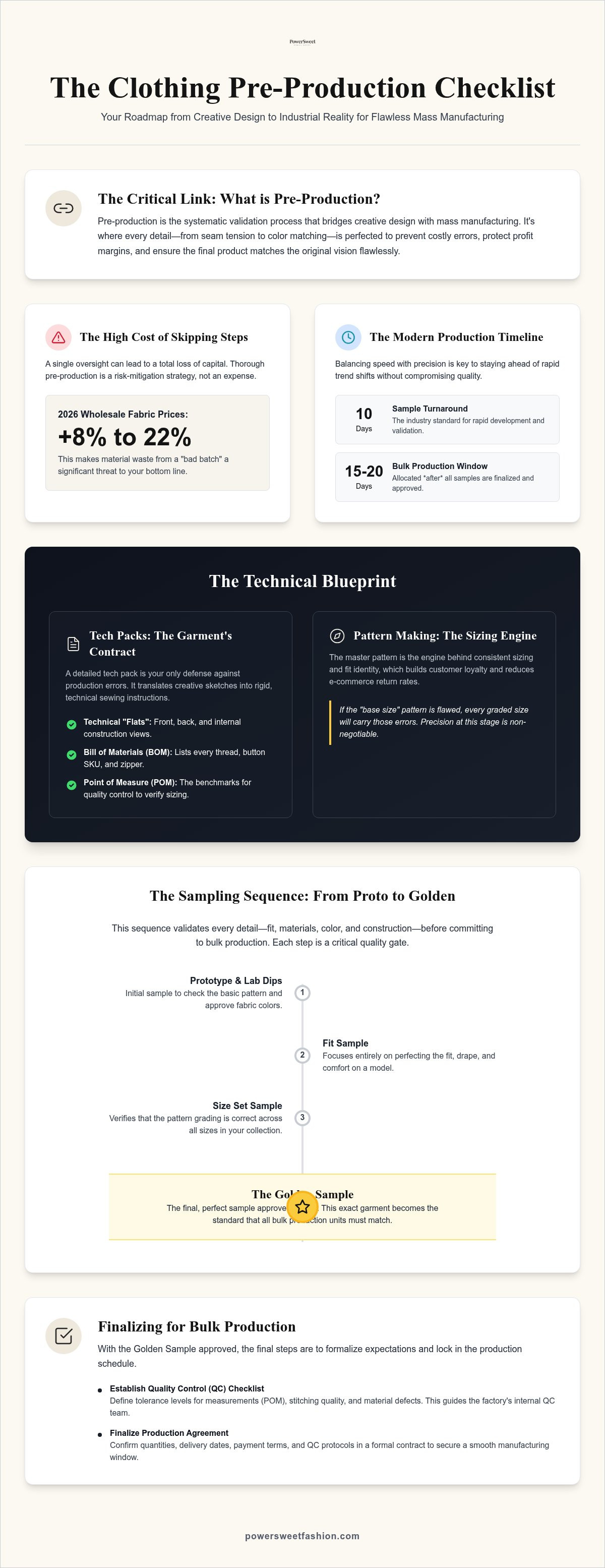
The Sampling Sequence: From Proto to Golden Sample
Sampling is the physical manifestation of your tech pack. It is the most interactive stage of the clothing pre-production checklist. This sequence is designed to catch errors before they scale into expensive mistakes. We move through four distinct steps to ensure that every measurement, seam, and fabric choice is validated before the factory begins bulk cutting.
Step 1 is the Prototype (Proto). It tests the basic design and silhouette using available fabrics to see if the creative vision translates to a 3D form. Step 2 is the Fit Sample. This validates your measurements on a live model or form to ensure the drape and movement are correct. Step 3 is the Size Set. This is where we ensure the grading works across the entire size range, from XS to XL. Finally, Step 4 is the Pre-Production Sample (PPS). This is the "Golden Sample" that serves as the final benchmark for bulk approval.
Reviewing the Pre-Production Sample
Your PPS must be checked against the tech pack for 100 percent compliance. Every seam, label, and button placement is scrutinized. Once you are satisfied, the sample undergoes the "Seal" process. This means you officially approve the sample for the factory floor. You must keep your sealed samples in a secure location until the bulk order is delivered. These physical benchmarks are your only protection if the final shipment deviates from your original vision.
Speeding Up Development Cycles
In a market that demands responsiveness, speed is a competitive advantage. Top-tier sample development clothing manufacturers now use 10-day turnarounds to help brands beat competitors to market. This pace allows you to react to trends without sacrificing the stability of your production schedule. Some brands are also integrating 3D digital sampling to reduce physical waste and iteration time.
While skipping a sample step might seem like a way to save time, it's often too risky for complex custom women's apparel. A single missed fit check can result in a bulk run that doesn't sell. By following every step of the clothing pre-production checklist, you ensure that speed never comes at the cost of quality. If you want to move from design to delivery without the typical delays, start your sample development with our expert team today.
Finalizing the Bulk Production Agreement
The transition from a "Golden Sample" to a bulk production run is the final milestone in your clothing pre-production checklist. At this stage, your creative development ends and industrial execution begins. We use the approved Pre-Production Sample (PPS) to lock in the final bulk production fees. This ensures there are no pricing surprises once the fabric is cut. The production agreement serves as a binding roadmap, aligning your brand's expectations with the factory's output capabilities. It's the moment where abstract design becomes a scalable business asset.
While digital communication is efficient, the physical reality of the factory floor is where your brand comes to life. We encourage transparency and often invite clients to visit the facility to oversee initial production runs. This human element bridges the gap between a tech pack and a finished garment. Seeing the assembly line in person builds a level of trust that no email can replicate. Once the "Go" signal is given, the 15 to 20 day production clock starts, and our team moves into high-speed manufacturing mode.
Setting Quality Standards (AQL)
Defining your Acceptable Quality Level (AQL) is a core part of the production agreement. You must establish what constitutes "major" versus "minor" defects based on your brand's price point and target market. A loose thread might be a minor issue, while a structural seam failure is a major defect that requires immediate correction. Utilizing end to end clothing production simplifies this process. It allows our internal quality control team to monitor every step of the assembly, ensuring that the bulk run matches the approved PPS exactly.
Final Logistics and Shipping Prep
Your clothing pre-production checklist isn't complete until the logistics are finalized. Packaging requirements are just as important as the sewing instructions. You must specify polybag types, carton markings, and weight limits to prevent damage during transit. In 2026, efficient shipping prep is vital for maintaining margins against rising freight costs. We coordinate with your freight forwarders to ensure global distribution is seamless. This final sign-off moves your collection from the pre-production phase to the retail floor, ready for your customers. Every detail you've verified up to this point ensures that the shipment you receive is a flawless reflection of your original vision.
Scale Your Vision with Industrial Precision
A successful fashion launch in 2026 depends on more than just creative talent. It requires a disciplined, systematic approach to manufacturing that leaves nothing to chance. By following this clothing pre-production checklist, you've established a roadmap that mitigates financial risk and ensures your bulk production matches your original vision. You now understand that the bridge between design and delivery is built on detailed tech packs, professional pattern making, and a rigorous sampling sequence.
We specialize in turning these technical blueprints into high-quality reality. Whether you need a 10-day sample turnaround to capture a trending silhouette or specialized bulk custom women's clothing production, our team acts as an extension of your brand. We provide end-to-end fabric and trim sourcing to simplify your supply chain and keep your production on schedule. Ready to start production? Contact PowerSweet Fashion for expert manufacturing today. You don't have to navigate the complexities of the factory floor alone. Let's build your next collection with the precision and speed your brand deserves.
Frequently Asked Questions
What is the difference between a prototype and a pre-production sample?
A prototype is an initial version used to test the basic design and silhouette using available materials. In contrast, the pre-production sample is the final "Golden Sample" made with production-ready fabrics and trims. This sample serves as the ultimate benchmark for your clothing pre-production checklist. It is the version you "seal" to signify that the factory is authorized to begin the bulk manufacturing run without further alterations.
How long does the garment pre-production process usually take?
The duration depends on the complexity of your custom women's apparel but usually spans four to six weeks. While we provide a 10-day sample turnaround to maintain your brand's momentum, you must account for fabric sourcing and lab dip approvals. These material stages can add two weeks to the timeline. Planning for a thorough pre-production phase ensures that your 15 to 20 day bulk production run proceeds without unexpected delays or technical errors.
Can I start bulk production without a tech pack?
Starting bulk production without a tech pack is a high-risk move that often leads to total product failure. The tech pack acts as a technical contract between your brand and the factory. It contains essential technical sketches, a Bill of Materials, and Point of Measure charts. Without these instructions, the factory cannot guarantee sizing consistency or construction quality. A detailed tech pack is the foundation of any professional clothing pre-production checklist.
What should I look for when reviewing a fit sample?
When reviewing a fit sample, focus on how the garment drapes and moves on a live model or dress form. You must compare the physical measurements against the Point of Measure chart in your tech pack. Check for tension at the seams, the placement of the armholes, and the overall balance of the silhouette. This stage is your primary opportunity to correct sizing issues before grading the pattern for your full size range.
How many sizes should be included in a size set sample?
A size set sample typically includes every size in your range, from XS to XL, to verify that the grading logic works. Some brands choose to sample every other size if the range is extensive, but checking the full set is the safest path to consistency. Professional pattern making ensures that the fit identity remains identical across all sizes. This prevents the common pitfall where larger sizes lose the intended silhouette of the original design.
What happens if the bulk production doesn’t match the golden sample?
If the bulk shipment deviates from the approved Golden Sample, you must refer to the Quality Control standards established in your production agreement. This is why keeping your sealed pre-production samples is essential. These physical benchmarks serve as empirical evidence during the dispute resolution process. By defining Acceptable Quality Levels early, you have a clear framework for identifying major defects and negotiating repairs or replacements with the factory team.
Is a factory visit necessary during the pre-production phase?
While digital communication is highly effective, a factory visit provides a level of transparency that builds long-term trust. Seeing the production line in person allows you to oversee the initial run and verify that the factory's quality control protocols match your standards. We encourage these visits to foster a sense of partnership. It bridges the gap between digital instructions and the physical reality of garment construction, ensuring a more collaborative manufacturing experience.
What are lab dips in the clothing industry?
Lab dips are small swatches of fabric dyed to test color accuracy before the bulk fabric is processed. This process ensures that your custom designs achieve the exact shade required across different lighting conditions, such as daylight and retail store light. Reviewing lab dips usually takes 7 to 14 days. This step is a critical component of the material approval process, preventing color inconsistencies that could ruin the visual cohesion of your entire collection.


Comments