%20(1).png)
The Designer’s Guide to Pattern Making: The Foundation of Garment Manufacturing
- Powersweet Team

- Jul 20
- 12 min read
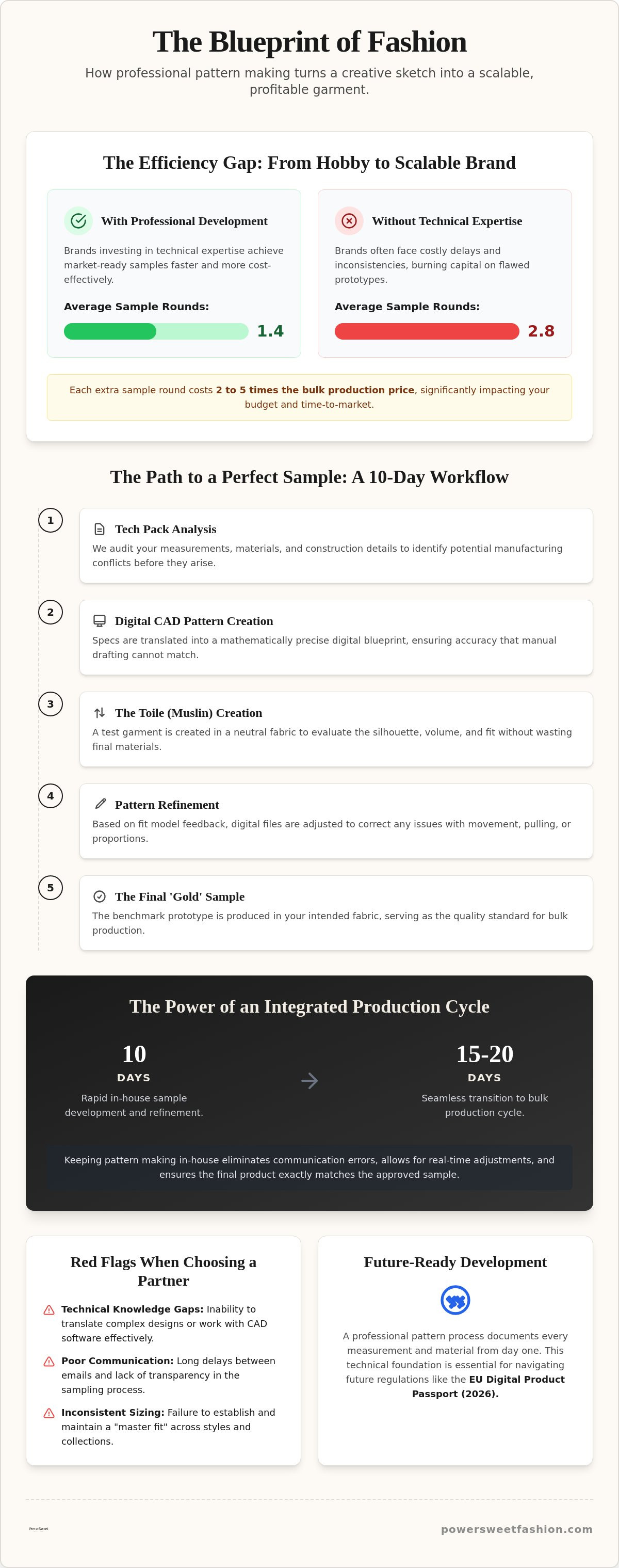
Brands that invest in professional technical development average just 1.4 sample rounds, while those without it often struggle through nearly three iterations before getting it right. This is a costly gap that separates a hobbyist project from a profitable, scalable fashion brand. When you partner with a specialized pattern making garment manufacturer, you aren't just buying a template. You're building the precise architectural blueprint for your entire production run.
We understand the frustration of inconsistent sizing across collections and the mounting costs of samples that simply don't match your design intent. You need your vision to translate perfectly from a 2D sketch to a 3D garment that fits every body type in your range with precision. This guide explores how professional pattern making bridges the gap between your creative ideas and scalable manufacturing. You'll discover the specific workflow used to reduce sample iterations and learn how to build a reliable partnership for end-to-end development. We'll also look at how these technical foundations help you navigate 2026 regulations, like the EU Digital Product Passport, by ensuring every measurement and material is documented from day one.
Table of Contents
What is a Pattern Making Garment Manufacturer?
A designer’s sketch is a creative vision, but it isn't a production plan. A professional pattern making garment manufacturer serves as the industrial architect who turns that vision into a functional reality. They bridge the gap between a high-level concept and a physical product that fits, moves, and lasts. This technical translation is the most critical phase of garment development. It determines your cost of goods, the efficiency of your fabric yield, and the ultimate quality of your brand.
Consistency is the primary benefit of a technical approach. When you work with a dedicated pattern making garment manufacturer, you establish a "master fit" for your brand. This ensures that your customers can buy a specific size across different styles and seasons with the confidence that the fit remains identical. In an industry where sizing varies wildly, this reliability becomes your strongest competitive advantage. It builds trust with your audience and significantly reduces the rate of returns due to fit issues.
The Blueprint of Fashion
Turning a 2D flat drawing into a 3D wearable garment requires deep knowledge of human anatomy and textile behavior. The pattern accounts for seam allowances, which provide the space needed to join fabric pieces without altering the final dimensions. It also considers grain lines to ensure the fabric hangs correctly and doesn't twist after the first wash. This foundational Pattern (sewing) serves as the master guide for every subsequent step in the factory. A garment pattern is a technical template used to guide the cutting of fabric pieces that will be joined to create a finished piece of clothing.
Why In-House Pattern Making Matters
Communication errors are the leading cause of high sample costs and production delays. By keeping pattern development in-house, we eliminate the friction between the designer's intent and the sewing team's execution. This proximity allows for a 10-day sample turnaround because adjustments happen in real-time rather than through weeks of back-and-forth emails. When the pattern maker sits just steps away from the sewing room, they can troubleshoot construction issues immediately. Once the prototype is perfected, the transition to our 15-20 day bulk production cycle is seamless. The same team that built the blueprint oversees the cutting and assembly, ensuring the final product matches the approved sample exactly.
The Garment Sampling Process: From Tech Pack to Prototype
The transition from a technical document to a physical prototype is where your brand's vision meets the reality of the factory floor. It's a high-stakes phase where the math of the pattern must align with the behavior of the textile. As a specialized pattern making garment manufacturer, we treat this process as a rigorous engineering cycle designed to eliminate manufacturing defects before they reach the cutting table for bulk production.
The workflow follows a logical, step-by-step progression to ensure no detail is overlooked:
Step 1: Tech Pack Analysis. We audit your measurements, material specs, and construction callouts to identify potential assembly conflicts.
Step 2: Digital CAD Pattern Creation. Our technicians translate these specs into a digital blueprint, ensuring mathematical precision that manual drafting can't match.
Step 3: The Toile or Muslin. We create a "test" garment in a neutral fabric to evaluate the basic silhouette and volume without wasting expensive final materials.
Step 4: Pattern Refinement. Based on fit model feedback, we adjust the digital files to correct for restricted movement or unintended pulling.
Step 5: The Final Sample. This is the "gold" sample produced in your intended fabric, serving as the benchmark for quality control.
Getting this right early saves significant capital. Statistics from July 2026 indicate that brands using professional tech packs and patterns average just 1.4 sample rounds, whereas those without them often require 2.8 iterations. This efficiency directly impacts your bottom line, as factories typically charge 2 to 5 times the bulk price for a single sample.
The Power of 10-Day Sample Turnarounds
Speed is a competitive necessity. A rapid 10-day turnaround allows you to test market trends and secure buyer approval without the traditional months-long wait. This efficiency is only possible when your pattern making garment manufacturer handles development in-house, cutting out the transit time between external studios and the sewing room. You can learn more about optimizing this phase in our guide to Mastering Sample Development.
Refining the Fit
The first fitting session is where we solve for drape and movement. We look for how the fabric breaks across the body and ensure the grain line remains vertical during wear. These adjustments are vital because even a minor error in the pattern can lead to thousands of dollars in wasted fabric during a bulk run. Utilizing professional sample development acts as your ultimate risk-reduction tool. If you're ready to see your designs in 3D, you can start your development journey with our technical team today.
Digital Pattern Making vs. Manual Techniques
Digital transformation has redefined the standard for modern apparel production. While manual pattern making remains a respected craft in bespoke luxury and couture, it often lacks the speed and scalability required for a growing brand. When you partner with a digital-first pattern making garment manufacturer, you're investing in data-driven precision. Digital patterns don't tear, warp, or degrade over time; they serve as a permanent, high-fidelity archive of your brand's technical history.
Computer-Aided Design (CAD) software allows technicians to visualize the interaction between seams and curves with millimeter accuracy. This level of detail is essential for complex women's fashion where a single degree of difference in a dart can ruin the silhouette. Beyond initial creation, digital files facilitate instant adjustments. If a fit model identifies a minor issue during the 10-day sampling window we discussed earlier, we can update the master file in minutes and push the changes across all sizes simultaneously. This agility is what allows us to maintain a 15-20 day bulk production cycle without sacrificing quality.
Grading and Sizing Accuracy
Maintaining brand trust depends on consistent fit across your entire size range. Digital grading ensures that a size 2 and a size 12 share the same design DNA by applying mathematical "grade rules" to every point on the pattern. This process eliminates the human error inherent in manual measurement increments. When a customer knows your size 8 fits them perfectly every time, they're more likely to become a repeat buyer. Precise grading is the engine behind that loyalty, ensuring your brand's reputation for quality remains intact as you scale.
Marker Making and Fabric Optimization
Fabric accounts for 40% to 60% of a garment's total manufacturing cost according to industry data from 2026. Minimizing waste isn't just an environmental goal; it's a financial necessity. Marker making is the puzzle-like arrangement of patterns to maximize fabric yield. By using CAD software, a pattern making garment manufacturer can calculate the most efficient layout for cutting, often achieving much higher utilization rates than manual methods. This precision has a direct, positive impact on your per-unit cost, allowing you to maintain healthy margins even with low MOQ production. Every inch of fabric saved during the marker phase is profit added back to your collection's bottom line.
Red Flags When Choosing a Pattern Making Partner
Selecting the wrong technical partner can derail an entire collection before the first yard of fabric is cut. A reliable pattern making garment manufacturer must demonstrate more than just sewing ability; they need deep engineering expertise. If a potential partner doesn't ask detailed questions about your fabric's stretch percentage or GSM weight, they likely lack the technical depth to create a functional pattern. Patterns for a high-stretch jersey and a rigid denim are fundamentally different. Ignoring these nuances leads to garments that pull, sag, or fail to fit the intended size.
Another critical red flag is a lack of transparency regarding your digital assets. Some manufacturers refuse to provide the digital pattern files to the client, effectively holding the brand's technical DNA hostage. This practice prevents you from switching factories or archiving your designs for future seasons. You should always ensure that you maintain full ownership of your CAD files from the start. Additionally, look for consistency between your tech pack and the final sample. If the measurements in the physical prototype don't match your specification sheet, it indicates a failure in quality control that will only amplify during a bulk run.
The Cost of Poor Pattern Engineering
Poorly engineered patterns create visible defects that no amount of sewing skill can fix. You might see "twisting" seams where the side seam migrates toward the front of the leg or a poor drape that makes a garment look cheap. These aren't just aesthetic issues; they are structural failures. A premium Dress manufacturer must prioritize pattern balance to ensure that the weight of the fabric is distributed evenly across the body. Without this balance, you'll find yourself stuck in a cycle of multiple failed sample rounds. This cycle quickly erodes your development budget and pushes back your launch date.
Communication and Transparency
Reliability is built on responsiveness. During the development phase, evaluate how quickly a manufacturer responds to technical queries. Delays in communication usually signal deeper operational issues that will amplify during the high-pressure bulk production phase. We believe in open-door transparency, where clients are encouraged to visit the factory and oversee the quality control process in person. This physical connection to the manufacturing site ensures that design intent isn't lost in translation between the office and the factory floor.
A partner who understands bulk production constraints will flag potential issues early, such as a pocket placement that is impossible to automate or a seam construction that will drive up per-unit labor costs. This proactive approach is the hallmark of a seasoned industrial partner. If you're looking for a transparent development process that prioritizes your brand's scalability, you can partner with our technical team to secure your production foundation today.
Scaling Your Brand with End-to-End Production
The transition from a perfected sample to a commercial bulk run is the moment of truth for any fashion brand. A high-quality prototype is meaningless if the factory cannot replicate it at scale with absolute consistency. When you work with an integrated pattern making garment manufacturer, the technical data from your sampling phase flows directly into the cutting room. This alignment is the secret to maintaining our efficient 15-20 day bulk production cycle. It eliminates the friction often found when a designer uses one studio for patterns and a separate factory for assembly.
Scalability also depends on your ability to source the right materials without delaying the production timeline. We leverage deep local supply chains to ensure your fabric and trim sourcing happens in parallel with pattern development. This synergy allows us to flag potential textile issues, such as excessive shrinkage or dye lot variations, before they impact your bulk order. By centralizing these services, we provide a "safe pair of hands" for brands that need to move fast without risking their capital on unproven workflows.
From Sample to Bulk Success
The technical hand-off between the pattern maker and the production line is a critical quality control gate. We "bake" quality into the pattern itself by including precise notches, drill holes, and alignment markers that guide the sewing team during high-speed assembly. This level of technical detail ensures that the thousandth garment in your run fits exactly like the first gold sample. This integrated approach is a core component of end to end clothing production, providing a streamlined path from your initial concept to a retail-ready collection.
Strategic Partnership for Growth
PowerSweet Fashion is built to support the growth of influencers, boutique brands, and established designers who require low MOQ flexibility. Traditional manufacturing often punishes smaller runs with high per-unit costs, but our adaptable pattern making process allows us to remain efficient even at smaller scales. We act as your industrial engine, handling the complex logistics of fabric sourcing and technical development so you can focus on marketing and creative direction.
Whether you are launching a 5-piece capsule collection or scaling a proven bestseller, our team provides the authoritative guidance needed to navigate the manufacturing landscape. We invite you into the process with open-door transparency, ensuring you understand every step of the journey. If you are ready to stabilize your supply chain and ensure your designs meet the highest industry standards, the first step is a technical consultation. Contact our pattern making garment manufacturer team today to start your first production run and experience the reliability of a professional manufacturing partnership.
Build Your Collection on a Technical Foundation
Professional pattern making is the most effective way to eliminate sizing inconsistencies and reduce the high cost of failed sample rounds. By prioritizing technical precision through digital CAD software, you secure a master fit that builds long-term customer trust across every collection. Choosing a specialized pattern making garment manufacturer that integrates development with production ensures your creative vision translates perfectly into a scalable bulk run without communication gaps. This structural blueprint is what allows your brand to maintain quality as you move from a single sketch to a full production line.
PowerSweet Fashion acts as your industrial facilitator, providing the speed and transparency needed to grow in a competitive market. We specialize in custom women's fashion with a focus on empirical reliability and meticulous care. Start your production journey with PowerSweet Fashion’s expert pattern making services. You'll benefit from our 10-day sample turnaround and comprehensive fabric sourcing included in our end-to-end development process. As low MOQ production specialists, we're ready to help you move from a single prototype to a successful brand launch. We're here to provide the safe pair of hands your brand deserves and help you scale with confidence.
Frequently Asked Questions
What is the difference between a pattern maker and a fashion designer?
A fashion designer focuses on the aesthetic vision, silhouette, and creative direction of a collection. In contrast, a pattern making garment manufacturer acts as the technical engineer who translates those sketches into precise templates for cutting fabric. The designer defines the creative "what," while the pattern maker determines the technical "how" through mathematical precision and construction expertise.
How much does professional pattern making typically cost for a new brand?
Professional pattern making costs vary based on the complexity of the garment and the total number of sizes required in your grading range. Industry standards typically factor in the labor hours required for the master pattern plus additional fees for each graded size. You should also budget for tech pack creation, as this technical document is essential for ensuring the manufacturer understands your design intent before the first cut is made.
Can I provide my own patterns to a garment manufacturer?
Most manufacturers accept external patterns, but they must be technical and production-ready to avoid assembly errors. If you provide manual paper patterns, a pattern making garment manufacturer will typically need to digitize them into a CAD format to ensure grading accuracy and efficient fabric yield. Providing digital files in industry-standard formats is the most efficient way to start your production journey without technical delays.
What is a tech pack, and do I need one before pattern making starts?
A tech pack is a comprehensive blueprint that includes flat sketches, measurement charts, material specifications, and construction details. You absolutely need one because it serves as the master reference for the pattern maker. Without a detailed tech pack, the risk of miscommunication increases, often leading to samples that don't match your vision and higher development costs due to avoidable mistakes.
How many sample rounds are normal before a pattern is ready for bulk production?
Professional brands aim for one to two sample rounds to perfect the fit and construction. Research from July 2026 indicates that designers who provide a technical pattern and tech pack average 1.4 rounds before approval. Without these technical foundations, that average often doubles to 2.8 rounds, which significantly delays your launch and drains your development budget through repeated sampling fees.
Why is digital pattern making better than manual paper patterns?
Digital pattern making offers superior precision, speed, and long-term brand security. CAD software allows for instant grading across multiple sizes and enables "marker making" to maximize fabric yield and reduce per-unit costs. Digital files are also easier to archive and share, ensuring that your brand's technical DNA isn't lost or damaged over time like physical paper templates often are.
What is pattern grading, and why is it important for my size range?
Pattern grading is the process of scaling your master pattern up or down to create a full range of sizes, such as XS through XL. It's important because it ensures your design's proportions and fit remain consistent across every size you offer. Proper grading uses mathematical rules to adjust specific points on the garment, maintaining the same look and feel for every customer regardless of their body type.
How long does the pattern making and sampling process take?
The initial pattern and sample creation often takes 10 to 14 days in a high-efficiency industrial environment. At PowerSweet Fashion, we specialize in a 10-day sample turnaround to help you move from concept to prototype as quickly as possible. The total timeline depends on the complexity of your design and how many revisions you request after the first fitting session.


Comments