%20(1).png)
The Definitive Guide to Choosing a Women’s Fashion Manufacturer in 2026
- Powersweet Team

- Aug 9
- 11 min read
Updated: Aug 10
In 2026, the success of your apparel brand depends less on your marketing budget and more on the agility of your supply chain. You probably recognize the struggle of searching for a reliable women's fashion manufacturer only to be met with high minimum order requirements that drain your cash flow. It's frustrating to deal with slow sample turnarounds and communication gaps that delay your launch dates, especially with new compliance hurdles like the U.S. CPSC mandatory eFiling and California's SB 707 now in effect.
You deserve a production process that moves as fast as the market does. This guide provides a clear roadmap to finding a technical partner that balances low MOQs with global production standards. You'll discover how to secure high quality samples in under two weeks and identify a manufacturer that handles the heavy lifting of fabric sourcing and pattern making. We'll examine the specific steps to evaluate factory transparency, ensure quality control, and build a streamlined partnership that turns your creative vision into a scalable reality.
Table of Contents
Defining the Role of a Specialized Women’s Fashion Manufacturer
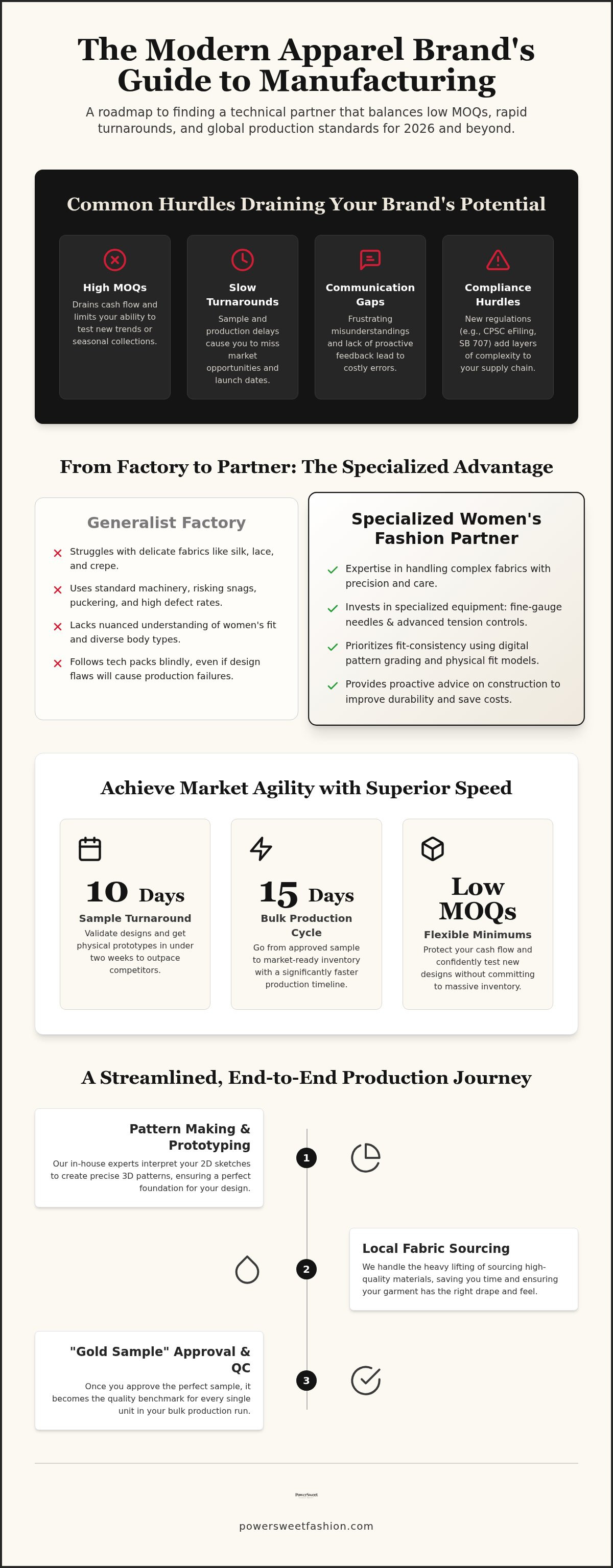
Machinery plays a decisive role in this differentiation. Delicate fabrics like silk, lace, and crepe are notoriously difficult to handle. If you use a standard industrial sewing machine on a delicate silk charmeuse, the fabric will pucker or snag. Specialized factories invest in fine-gauge needles, specific feed dog systems, and advanced tension controls to ensure every seam is flat and durable. This equipment is essential for maintaining the integrity of modern textiles. Without it, your production run is at risk of high defect rates and inconsistent quality.
Fit is everything. If a garment doesn't drape correctly on the body, your brand's reputation suffers immediately. Fit-consistency remains the primary challenge in women's wear production because every fabric reacts differently to a pattern. A design that works in a heavy cotton twill will fail completely in a lightweight viscose. A specialized partner understands how to adjust tolerances for fabric stretch and weight. They prioritize consistency across size runs by using digital pattern grading and physical fit models to verify the silhouette before bulk production begins.
The Technical Complexity of Women's Wear
Draping and structured tailoring are two sides of the same coin. While structured pieces like blazers require internal stabilizers and precise canvassing, draped dresses depend on the "hand" and flow of the material. Generalist factories often lack pattern makers who specialize in these nuances. Within the global clothing industry, specialized facilities are the ones capable of handling modern technical fabrics. These materials often require specific temperature settings for heat-pressing and specialized stitching to prevent fraying. A factory with diverse silhouette experience can pivot between these requirements without sacrificing speed.
Production Partner vs. Traditional Factory
The difference between a factory and a partner lies in the feedback loop. A traditional factory follows your tech pack blindly, even if a design flaw will cause production failures later. A strategic partner provides proactive advice on garment construction to save you money and improve durability. They manage the entire lifecycle, from sourcing the right trims to the final quality check. This collaborative approach ensures that your creative vision is technically feasible and commercially viable. A production partner is a collaborative engine for brand growth. This transition turns a simple transaction into a long-term asset for your business.
Technical Excellence: Sample Development and Pattern Making
Speed in development is a decisive competitive advantage. In the fast-paced 2026 market, a 10-day sample rule allows you to validate designs before trends shift or competitors react. A women's fashion manufacturer that can turn a tech pack into a physical prototype in under two weeks gives you the agility needed to capture market share. This process isn't just about sewing; it's about technical interpretation. Every stitch type, fabric weight, and trim placement must be meticulously reviewed to ensure the design is ready for the assembly line.
Converting a concept into a prototype involves several critical steps. First, the pattern maker interprets your 2D sketches to create a 3D form. Next, the sampling team selects the closest available fabric to test the drape and movement. When evaluating your supplier selection criteria, you should prioritize factories that offer in-house development. This proximity between the pattern room and the sewing floor reduces errors and slashes lead times.
The Anatomy of a Perfect Sample
A sample is your blueprint for bulk production. You must inspect it for seam strength, drape, and color accuracy against your original vision. If the drape is off, the fabric choice might be wrong for the silhouette. We recommend providing feedback that is specific and actionable. Instead of saying "it looks wrong," tell your manufacturing team that "the shoulder seam needs to move forward by 1cm." Once you approve the final version, it becomes the 'Gold Sample'. This piece serves as the definitive quality control benchmark for every unit in your bulk order.
Pattern Making and Grading for Global Markets
Professional pattern making is the foundation of brand loyalty. If your customers can't trust your sizing, they won't return for future collections. Consistency across different regions requires expert grading that accounts for regional demographic variations. While manual pattern making still has its place for high-end couture, CAD-assisted systems provide the precision needed for modern scale. These digital tools ensure that a size Small fits exactly like a size Small every single time. Specialized sample development clothing manufacturer services bridge the gap between a 2D sketch and a 3D reality. They catch fit issues early, preventing costly mistakes during the bulk run. If you're looking for a partner to handle these technical nuances, explore how PowerSweet Fashion streamlines the entire development cycle through integrated pattern and sample rooms.
Evaluating Efficiency: Low MOQ and Lead Time Realities
Efficiency in 2026 isn't just about how fast a factory can sew; it's about how effectively they manage your resources. Choosing a women's fashion manufacturer that supports low minimum order quantities (MOQs) is a strategic move for brands looking to minimize financial risk. This flexibility allows you to test a new silhouette or a bold colorway without committing to thousands of units that might end up as dead stock. It's far more profitable to sell out of a 50-unit run and re-order quickly than to liquidate a massive inventory because a trend shifted unexpectedly.
The strategic power of low MOQ women's clothing manufacturers lies in their ability to provide modular production. This approach enables boutique and influencer-led labels to maintain a constant stream of "new arrivals" which keeps customer engagement high. To succeed, you must find a partner that balances these low minimums with realistic per-unit pricing, ensuring your retail margins remain sustainable even on smaller runs.
The Economics of Small Batch Production
There's a natural trade-off between order volume and manufacturing fees. While a run of 5,000 units offers the lowest per-piece cost, the total capital required can cripple a growing brand's cash flow. Small batch production often carries a per-unit cost that is 30% to 50% higher than high-volume orders, but it protects your liquidity. A reliable partner helps you identify the "sweet spot" where your margins stay healthy while your inventory remains lean. This setup allows you to scale organically, moving from 50 units to 5,000 as your demand grows, without the need to switch partners or re-develop your patterns.
Lead Times and Seasonal Planning
In the current market, 15-20 days has become the industry benchmark for bulk production cycles. This timeline covers everything from fabric cutting to final quality assurance, provided your materials are already in-house. To avoid the 'stockout' trap during peak seasons, you need a responsive manufacturing cycle that supports rapid re-orders. Mapping out your 2026 fashion calendar requires coordinating your 10-day sample approvals with these production windows. Quick-response manufacturing reduces the need for heavy inventory and lets you react to real-time sales data. This agility is your best defense against market volatility and ensures you never miss a sales opportunity during a viral trend or a holiday rush.
Navigating the Supply Chain: Fabric Sourcing and Quality Control
Mastering Material Sourcing
Accessing premium textiles is significantly more efficient when you leverage end to end clothing production partners. These specialists manage the entire supply chain, from the initial yarn search to the final button attachment. Trims, zippers, and labels are critical markers of quality that your customers notice immediately. Sourcing experts navigate the fabric shortages and price fluctuations typical of the 2026 market by maintaining diverse supplier relationships. This proactive management ensures your production stays on schedule even when global logistics face volatility. It turns a potential bottleneck into a streamlined part of your business model.
Quality Control Benchmarks
Protecting your brand's reputation requires a rigorous 4-point quality control system. This industry standard evaluates fabric quality before the first cut is made, minimizing waste and errors. We recommend a combination of in-line and final inspections to catch issues before they become systemic. In-line checks identify problems during the assembly process, while final inspections verify that every finished piece matches your Gold Sample.
You should watch for common defects specific to women's apparel:
Seam Puckering: This occurs when needle tension is incorrect for delicate fabrics like chiffon or satin.
Grading Inconsistencies: These lead to sizing errors that frustrate your customers and increase return rates.
Shading Issues: Variations in dye lots can make a single collection look mismatched on a retail rack.
Transparent QC reporting is essential for remote brand owners. You need a partner that provides detailed data and photo evidence at every stage of the production journey. This "Open-Door Transparency" ensures you have full visibility into the factory floor without needing to be there in person. In 2026, compliance with regulations like the EU Ecodesign for Sustainable Products and California's SB 707 is mandatory. We help you navigate these legal hurdles by sourcing compliant materials and maintaining the necessary documentation for global trade. If you want to secure a supply chain that prioritizes both precision and compliance, partner with PowerSweet Fashion to refine your production standards today.
Partnering for Growth: Why PowerSweet Fashion is the Strategic Choice
Choosing a women's fashion manufacturer is one of the most critical decisions you'll make for your brand's future. It's not just about finding a factory; it's about securing a technical partner that understands the physical reality of garment construction. We position ourselves as an authoritative facilitator for brands that require both speed and precision. By operating as an extension of your design team, we help you overcome the common hurdles of high minimums and slow development cycles that often stall growth in the apparel industry.
The PowerSweet Manufacturing Process
Our workflow is designed for maximum efficiency and transparency. It begins with your initial inquiry and tech pack review, where our team provides proactive feedback on construction and material feasibility. We've optimized our facility in Guangzhou to support a 10-day sample turnaround, allowing you to move from concept to a physical prototype with record speed. Once you approve the 'Gold Sample,' we transition into bulk production with a 15-to-20 day cycle. This methodical progression ensures that every detail, from the drape of a silk blouse to the reinforcement of a structured blazer, meets our rigorous quality standards.
Our deep specialization in women's wear makes us a unique ally for boutique labels. We've spent over 18 years refining our techniques for handling delicate fabrics and complex silhouettes that generalist factories often avoid. We maintain an open-door policy for factory visits and provide full QC transparency to ensure our clients feel secure at every stage of the production journey. This collaborative approach removes the mystery from the manufacturing floor and places the control back into your hands.
Scaling Your Brand with Confidence
Financial health is the foundation of any successful fashion brand. Our low MOQ model is a strategic tool that protects your cash flow by preventing overproduction and unsold inventory. While many domestic manufacturers charge premium rates that eat into your margins, our location in a global textile hub allows us to offer competitive pricing without sacrificing ethical standards or quality. This balance is essential for scaling from small, trend-focused drops to large-scale seasonal collections.
Reliability is the ultimate currency in the fashion world. A high-speed production partner allows you to respond to market demands in real time, reducing the risk of stockouts during peak selling periods. We handle the complexities of fabric sourcing, pattern making, and global compliance so you can focus on design and marketing. If you're ready to move beyond transactional manufacturing and build a scalable production engine, start your production journey with PowerSweet Fashion today and experience the benefits of a true strategic partnership.
Future-Proof Your Production Strategy
Success in the 2026 apparel market requires more than just a vendor; it requires a technical ally that understands the nuances of complex silhouettes and delicate fabrics. We've explored how a specialized women's fashion manufacturer provides the speed and precision necessary to outpace the competition. By prioritizing 10-day sample turnarounds and leveraging low MOQ flexibility, you can protect your brand's cash flow while testing bold new trends. This agile approach minimizes inventory risk and ensures your supply chain remains compliant with global production standards.
PowerSweet Fashion has been a dedicated specialist in women's apparel since 2008. We provide the end-to-end support you need, from expert pattern making to 15-20 day bulk production cycles. It's time to move beyond the constraints of traditional manufacturing and build a streamlined system designed for growth. Partner with PowerSweet Fashion for Your Next Collection and turn your creative vision into a scalable, high-quality reality. We're ready to help you build a brand that lasts.
Frequently Asked Questions
How do I find a reliable women's fashion manufacturer for my new brand?
You find a reliable partner by verifying their technical history and specific expertise in women's apparel. Look for a women's fashion manufacturer that offers transparent communication and proof of past production for similar silhouettes. Guangzhou remains a top global hub where you can find facilities that balance speed with precision. Always request a factory tour or detailed video evidence of their current production lines to ensure they have the machinery needed for your specific fabrics.
What is the typical minimum order quantity (MOQ) for custom women's clothing?
Typical MOQs for custom clothing vary significantly depending on the factory's scale. While massive industrial plants require thousands of units, boutique-focused partners often offer minimums as low as 50 to 100 pieces per style. This flexibility is essential for startups that need to test market demand without overextending their budget. It allows you to launch multiple colorways or designs simultaneously, reducing the financial risk associated with large, unproven inventory runs.
How long does the garment sampling process take in 2026?
In 2026, the standard garment sampling process takes approximately 10 days at high-efficiency facilities. This timeline includes pattern creation, initial fabric sourcing, and the construction of the first prototype. Faster turnaround times are now a competitive necessity for brands reacting to viral trends. Choosing a partner with an in-house sampling room ensures that feedback is implemented quickly, which prevents the development phase from dragging on for weeks or months.
Can a manufacturer help with fabric sourcing and pattern making?
Yes, a full-service women's fashion manufacturer provides integrated fabric sourcing and pattern making as part of their end-to-end service. This setup removes the burden of finding individual vendors for every component of your garment. Sourcing experts at the factory can access local textile markets to find specific trims and fabrics that match your tech pack. Having pattern makers on-site also ensures that your designs are technically sound and optimized for the bulk assembly line.
What should I include in a tech pack for a women's wear factory?
Your tech pack should include detailed technical sketches, a Bill of Materials (BOM), size grading charts, and specific stitching instructions. Don't forget to include clear photos of trims, buttons, and label placements. A comprehensive tech pack acts as a legal contract between you and the factory. It eliminates ambiguity and ensures that the final product matches your creative vision exactly. High-quality documentation is the best way to prevent costly errors during the sampling phase.
What are the benefits of working with an end-to-end production partner?
Working with an end-to-end partner streamlines your entire supply chain by keeping development and production under one roof. This model reduces communication gaps and eliminates the logistical headache of shipping materials between different vendors. You benefit from a more cohesive quality control process and faster lead times, such as a 15-20 day bulk production cycle. It turns the manufacturing journey into a collaborative partnership rather than a series of disconnected transactions.
How do I ensure quality control when manufacturing overseas?
You ensure quality control by implementing a 4-point inspection system and requesting detailed reports at every production stage. Overseas manufacturing requires "Open-Door Transparency" where the factory provides photo or video evidence of in-line and final inspections. It's also vital to approve a 'Gold Sample' before bulk production begins. This physical prototype serves as the definitive benchmark that the factory must match for every unit in your order.
Is low MOQ production more expensive per unit?
Low MOQ production is generally more expensive on a per-unit basis, often costing 30% to 50% more than high-volume orders. This price difference covers the labor-intensive setup required for smaller runs. However, the total investment is much lower, which protects your cash flow and prevents expensive deadstock. For most growing brands, the higher per-piece cost is a worthwhile trade-off for the ability to scale organically and maintain a lean inventory.


Comments