%20(1).png)
Switching Clothing Manufacturers: A Smooth Transition Guide for Fashion Brands in 2026
- Powersweet Team

- Jul 22
- 12 min read
A recent survey of independent designers found that 58% cited poor communication as the primary reason for switching clothing manufacturers. It's a high-stakes decision that often feels like a gamble with your brand's future.
You've likely spent months, or even years, training your current partner on your specific fit and grading.
The fear that they might hold your patterns hostage or that production downtime will ruin your next seasonal launch is a valid concern for any fashion executive in 2026.
We understand that reliability is the engine of your creative vision.
You shouldn't have to tolerate rising defect rates or missed deadlines just because a transition seems too complex.
This guide will show you how to migrate your production to a more stable partner without sacrificing quality or missing a single delivery.
We'll outline the "Parallel Run" protocol, which allows for a de-risked three-month transition period.
You'll learn how to protect your proprietary tech packs, navigate the latest 2026 tariff structures, and ensure your supply chain remains fully compliant with the new EU Digital Product Passport requirements.
Table of Contents
Recognizing the Signs: When to Consider Switching Clothing Manufacturers
Growth often reveals the structural cracks in a manufacturing partnership. While a factory might have been the perfect fit for your initial launch, your brand's evolution requires a partner that maintains precision at scale.
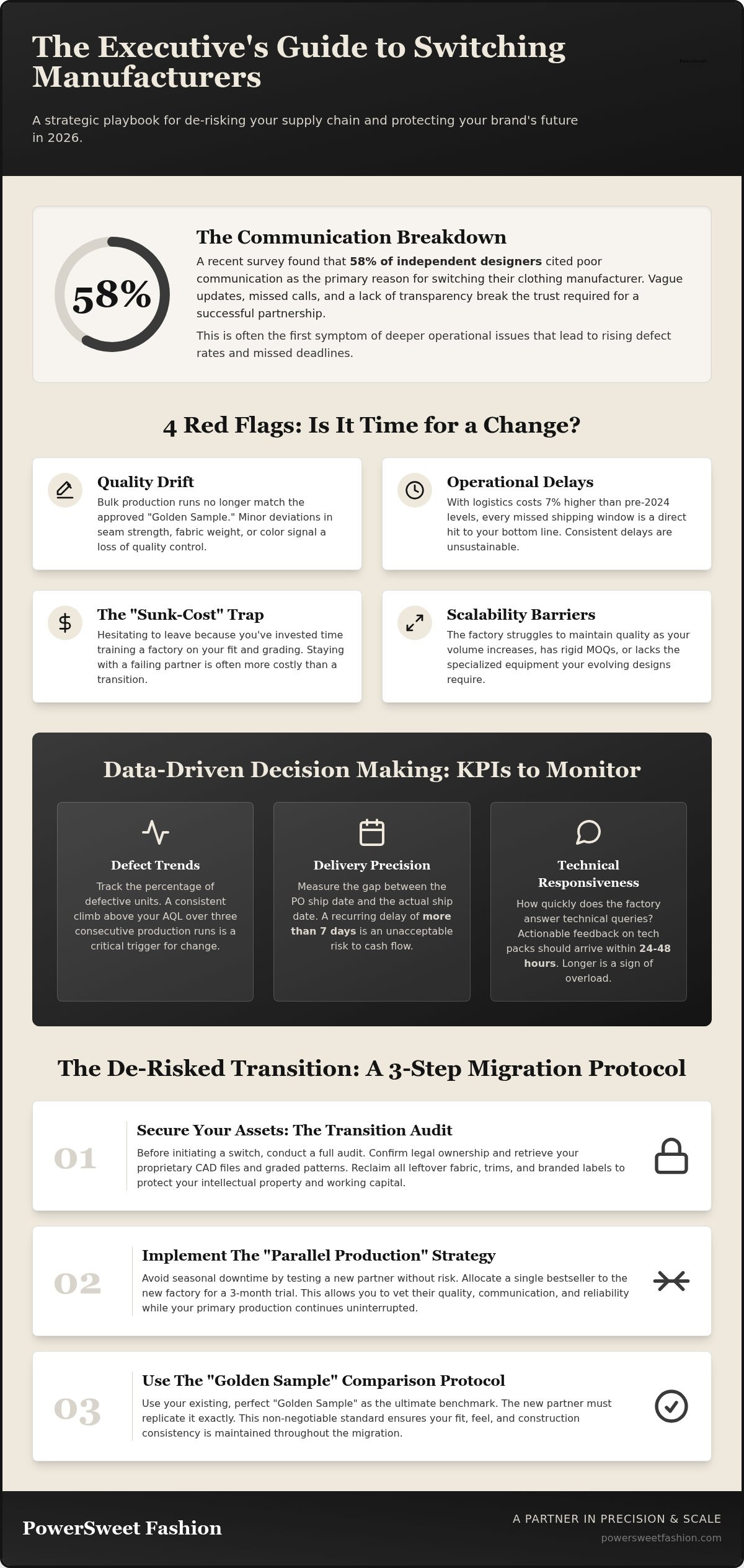
The first red flag is usually "Quality Drift." This occurs when bulk production runs no longer match the approved "Golden Sample." Small deviations in seam strength or fabric weight might seem minor, but they signal a loss of control in the factory's quality assurance process.
A deep understanding the clothing industry reveals that these inconsistencies often stem from a factory overextending its resources or subcontracting work without your knowledge.
Operational delays provide the second warning sign. In 2026, logistics costs have stabilized at 7% higher than pre-2024 levels, making every missed shipping window a direct hit to your bottom line.
When lead times slip, you face retail penalties and depleted cash flow. If your current partner consistently misses their promised production windows, they're no longer a viable engine for your business.
This often coincides with the "Communication Wall." According to a 2024 survey, 58% of designers cited poor communication as their top reason for switching clothing manufacturers.
If you're chasing updates or receiving vague answers about production status, the trust is already broken.
Many brands fall into the "Sunk-Cost Factory Trap."
They hesitate to leave because they've already spent months training a factory on their specific fit and grading.
However, the process of switching clothing manufacturers is a calculated move toward long-term stability. Staying with a failing partner is almost always more expensive than the cost of a transition.
With 46% of fashion executives expecting industry conditions to worsen this year, maintaining a "safety net" or a more agile primary partner is a strategic necessity.
Performance KPIs That Signal a Necessary Move
Defect Trends: Track the percentage of defective units over three consecutive runs. Any consistent climb above your allowable AQL (Acceptable Quality Level) is a trigger for change.
Delivery Precision: Measure the gap between the ship date on the purchase order and the actual date the goods leave the factory. A recurring delay of more than seven days is unacceptable.
Technical Responsiveness: Evaluate how quickly the production team answers technical queries. A professional partner should provide clear, actionable feedback on tech pack adjustments within 24 to 48 hours.
Scalability Barriers with Your Current Partner
Your brand's success shouldn't be limited by your factory's physical capacity. If a manufacturer struggles to maintain quality as your volume increases, they've reached their limit.
Rigid MOQs are another common barrier. If you can't test new designs without committing to thousands of units, your ability to innovate is stifled.
Finally, consider technical specialization. Custom women's fashion often requires specialized equipment for complex construction that basic garment factories simply don't possess.
If your designs are outgrowing their machinery, it's time to find a partner capable of executing your vision.
The Manufacturer Transition Audit: Securing Your Assets
Before you finalize the process of switching clothing manufacturers, you must secure your intellectual property.
Many brands mistakenly believe their designs are safe because they have a sketch or a single sample.
In reality, the industrial "blueprint" of your garment often resides within the current factory's computer systems.
If you don't own your CAD files and graded patterns, you're essentially starting from scratch with every new partner.
Review your non-compete and IP agreements to confirm your legal right to these assets.
This audit ensures that your brand's DNA is portable and protected during the migration.
Inventory reclamation is the next critical step.
It's common for factories to hold leftover fabric, specialized trims, or branded labels from previous runs.
These materials represent significant working capital. You should conduct a physical count of all raw materials currently stored at the facility.
If your current contract allows, arrange for these items to be shipped to your new partner or a neutral third-party warehouse.
This prevents your materials from being held hostage during a dispute and ensures a faster startup at the next facility.
The Technical Asset Checklist
A factory-independent tech pack is your most valuable tool. If your documentation relies on "factory standards" for seam allowances or stitch types, it will fail when moved. Review your files to ensure they include:
Graded Size Charts: Detailed measurement tables for every size in your range, not just the sample size.
Consolidated BOM: A complete Bill of Materials for every active SKU, listing every thread, button, and zipper.
Construction Specifications: Precise notes on SPI (stitches per inch) and specific seam types to maintain fit consistency.
Sourcing Continuity and Material Management
True end to end clothing production requires a clear understanding of your supply chain.
You must identify which fabrics are "unlocked," meaning you can buy them from any wholesaler, and which are exclusive to your current factory.
If a textile is exclusive, you'll need to source a comparable alternative before the switch.
Specialized trims or custom-engraved hardware should be moved early, as these often have longer lead times than the garments themselves.
If you're feeling overwhelmed by the technical requirements of a move, reaching out for a professional pattern audit can help identify gaps in your documentation before they cause production delays.
Evaluating New Partners for Scalability and Speed
The vetting process serves as a filter for your brand's future stability. When switching clothing manufacturers, your priority should shift from finding the lowest price to identifying a partner with specialized experience in custom women's fashion.
This specialization is critical because the complex construction of women's apparel requires specific machinery and skilled labor that generalist factories lack.
You should also prioritize a low MOQ women’s clothing manufacturer to mitigate risk. Starting with smaller runs allows you to verify the factory's internal Quality Control (QC) protocols without overcommitting your capital.
Trust is built through transparency and the "Human Element." A reliable partner invites you to visit the facility and meet the production team responsible for your designs.
This open-door policy bridges the gap between digital communication and physical reality when switching clothing manufacturers.
During these visits, you can observe the QC team in action; look for a documented process where every garment is inspected at multiple stages of construction rather than just a final spot check before packing.
The 10-Day Sample Litmus Test
A factory's sampling department is a window into their bulk production reliability. If a partner takes weeks to return a prototype, they'll likely struggle with bulk deadlines.
You should evaluate a sample development clothing manufacturer based on their ability to deliver a precise prototype within a 10-day window. This speed indicates a mature supply chain and a responsive technical team.
The Golden Sample is the final, approved prototype that serves as the absolute quality benchmark for all subsequent bulk production units.
Communication and Logistical Transparency
Responsiveness during the fabric sourcing phase is a non-negotiable requirement.
With logistics costs remaining 7% higher than pre-2024 levels, you need a partner who provides real-time updates on material availability.
Ask about the digital project management tools they use to track production stages.
In 2026, premium factories are increasingly using digital twin technology for virtual sampling, which can save weeks in the development cycle.
Finally, assess their expertise in international logistics. With tariffs estimated to drive sourcing price increases by as much as 35%, your manufacturer must understand the nuances of customs documentation to avoid costly border delays.
The Parallel Production Strategy: Avoiding Seasonal Downtime
A "cold turkey" approach to switching clothing manufacturers is the most common cause of missed seasonal launches.
Moving your entire production line overnight creates a single point of failure that your brand may not recover from.
Instead, we recommend a "Parallel Run" protocol. This strategy involves keeping your current factory active for immediate needs while simultaneously onboarding your new partner over a three to four-month window.
This overlap ensures that if the new facility encounters a technical hurdle, your retail delivery remains protected by your existing inventory stream.
The first step in this de-risked transition is placing a "Shadow Order."
Rather than starting with a complex new design, give the new manufacturer a tech pack for an existing bestseller.
This allows you to evaluate their performance against a known quantity.
Once the prototype arrives, compare it directly against your original "Golden Sample" to verify fit consistency and construction quality.
If the shadow order meets your standards, proceed to a small batch production run.
This tests the factory’s ability to handle bulk timing and Quality Control (QC) at scale before you commit your entire seasonal budget.
Volume migration should be gradual. Shift your production in increments of 25% or 50% over two to three cycles.
This measured pace allows the new production team to familiarize themselves with your brand's specific aesthetic and technical requirements without the pressure of a massive bulk order.
It also provides a "safety net" should you need to pivot back to your original source during the learning curve.
If you are ready to begin this transition with a partner that values precision, you can schedule a production consultation to map out your parallel run timeline.
Managing Cash Flow During a Dual-Production Phase
Transitioning requires a temporary increase in working capital. You should budget for double sampling fees during the first cycle, as you'll be paying both factories to develop prototypes.
To offset these setup costs, negotiate milestone-based payment terms with your new partner.
Leveraging low MOQs is essential here; it allows you to maintain stock levels without overextending your capital on massive bulk runs.
In 2026, with logistics costs 7% higher than previous years, keeping your inventory lean during a switch is a vital financial safeguard.
The "Clean Break" Protocol
Timing your exit is as important as starting the new partnership. Only notify your old manufacturer of the contract termination once the new factory has successfully delivered their first bulk batch.
This prevents the "hostage inventory" scenario where a disgruntled supplier might delay your final shipment.
Ensure all final payments are settled in exchange for the release of proprietary molds, specialized tools, or leftover branded hardware.
Maintaining a professional tone during this exit is strategic; you want to keep the door open should you ever need a secondary backup facility for high-volume seasons.
Onboarding with PowerSweet Fashion: Your End-to-End Production Partner
Transitioning to a new partner doesn't have to be a source of friction for your brand.
PowerSweet Fashion simplifies switching clothing manufacturers by acting as a direct extension of your design team.
We specialize exclusively in custom women's apparel, which means our machinery and technicians are optimized for the specific fit and construction requirements of your market.
While generalist factories might juggle diverse product categories, our singular focus ensures that your drape, stitch tension, and grading remain consistent across every bulk run.
This specialization is the foundation of the trust we build with our partners.
Speed is our primary currency in a competitive retail environment.
Our 15 to 20 day bulk production window is designed to help brands catch up on lost time caused by previous supplier delays or supply chain bottlenecks.
We eliminate the logistical headache of managing multiple vendors by providing end-to-end fabric and trim sourcing.
This comprehensive model allows you to focus on marketing and growth while we handle the mechanics of the factory floor.
We invite every client to visit our facility to meet their dedicated production team and oversee the meticulous quality control checkpoints that protect their brand reputation.
Streamlined Integration for Growing Brands
Our pattern-making team bridges the gap between your existing files and our production floor.
We translate your CAD patterns and tech packs into production-ready assets, ensuring no technical detail is lost during the move.
Utilizing our 10-day sampling turnaround allows you to rapidly iterate and perfect your next collection before committing your capital to bulk orders.
PowerSweet’s role as an "Authoritative Facilitator" reduces founder burnout by providing a transparent, managed system that removes the daily guesswork from the manufacturing process.
Getting Started: Your First Transition Meeting
Your first transition meeting is where we map out the "Parallel Run" strategy to ensure your brand remains active during the switch.
To make this session productive, you should prepare your current tech packs, physical samples of your bestsellers, and your target delivery timelines for 2026.
Our technical team will audit your current garment construction to identify opportunities for optimization or material improvements.
Once we align on the technical specifications, the next step is requesting your first prototype to begin the de-risked process of switching clothing manufacturers with confidence.
Securing Your Brand's Growth with a Reliable Manufacturing Partner
The decision to begin switching clothing manufacturers is a strategic pivot toward higher quality and more reliable lead times.
By auditing your technical assets and implementing a parallel production run, you protect your seasonal revenue while building a foundation for long-term growth.
You don't have to settle for the "Quality Drift" or missed retail windows that often plague aging factory partnerships.
A methodical transition ensures that your brand remains agile and responsive to the 2026 market.
A successful migration relies on a partner that understands the mechanics of the garment industry.
We provide specialized women’s fashion expertise combined with a 10-day sample development window to prove our reliability before you commit to bulk.
Once you're ready to scale, our 15–20 day bulk production timeline ensures your collections reach the market ahead of the competition.
It's time to trade production anxiety for a partnership rooted in transparency and speed.
Ready to upgrade your production? Contact PowerSweet Fashion for a seamless transition consultation.
Your creative vision deserves a manufacturing engine that is as ambitious and precise as your designs. We're ready to help you build a more resilient and profitable supply chain.
Frequently Asked Questions
How long does it typically take to switch clothing manufacturers?
A fully de-risked transition takes approximately three to four months.
This timeline allows for a parallel production process where the new factory completes sampling and pre-production while your current partner finishes immediate orders.
Attempting to rush this window increases the risk of seasonal downtime or fit inconsistencies in your bulk runs.
Will I lose my patterns if I switch to a new garment factory?
You won't lose your patterns if you ensure you own the digital CAD files before the transition begins.
Many brands rely on physical patterns stored at the factory, which can be difficult to reclaim.
When switching clothing manufacturers, you must secure these digital assets to ensure your brand's DNA remains portable and under your control.
Is it better to switch manufacturers between seasons or during production?
Switching between seasons is the most logical choice to avoid interrupting active sales cycles.
However, using the "Parallel Run" strategy allows you to begin onboarding at any time.
By placing a shadow order of an existing bestseller while your current factory handles new arrivals, you can test a new partner without risking your primary revenue stream.
What is the most common mistake brands make when changing factories?
The most common mistake is quitting the current factory before the new partner has successfully delivered a bulk batch.
This creates a single point of failure and leaves your brand vulnerable to production gaps.
Many brands also fall into the "Sunk-Cost Factory Trap," staying with a failing partner because they've already invested significant time in training them.
How do I know if a new manufacturer can handle my specific fabric requirements?
You should request a fabric sourcing audit and a 10-day sample prototype to verify their capabilities.
A professional manufacturer will provide clear updates on material availability and specialty textile lead times for 2026.
If they can't match your "Golden Sample" in construction and material feel, they aren't the right partner for your aesthetic.
Can I use my existing tech packs with a new clothing manufacturer?
You can use existing tech packs if they are factory-independent and include detailed construction notes.
If your files rely on "factory standards" for seam allowances or stitch types, your new partner will struggle to replicate the fit.
We recommend a technical audit to ensure your tech packs include graded size charts and a complete Bill of Materials.
How many samples should I request before committing to a bulk run with a new partner?
You should request at least one "Golden Sample" that serves as the absolute quality benchmark for bulk production.
For higher-risk transitions, we recommend a small batch "shadow order" of 50 pieces.
This allows you to test the factory's bulk quality and timing before committing your entire seasonal budget to the new partnership.
What should I do if my current factory refuses to return my patterns?
You should first review your intellectual property agreements to confirm your legal ownership of the designs.
If the factory remains uncooperative, you may need to re-develop your patterns from physical garments.
Our pattern-making team can help translate your existing samples into new, production-ready digital assets to get your brand back on track quickly.


Comments