%20(1).png)
Sustainable Clothing Production: A Guide for Fashion Brands

A sustainable claim isn’t proof of sustainable production. The most useful sustainable clothing production practices form a chain of decisions you can check, from fabric selection to garment construction and supplier records.
Responsible choices still need to meet a product’s design, performance, quality, and production requirements. A preferred material may not suit every garment, and broad supplier claims can be difficult to verify. Define requirements early so teams can assess them before production scales.
This guide explains how to assess sustainability across materials, manufacturing, and supplier relationships. You’ll learn what evidence to request, how to compare suppliers against defined criteria, and how sampling and quality checks can help you evaluate material and construction choices before bulk production. The aim is a practical process that supports product requirements while making sustainability expectations specific and verifiable.
Table of Contents
What sustainable clothing production practices cover across a garment's lifecycle
How materials, design, and sampling shape more responsible garment production
Comparing sustainable clothing production practices with evidence, not promises
A practical checklist for putting sustainable production requirements into practice
Choosing a manufacturing partner for accountable sustainable clothing production
What sustainable clothing production practices cover across a garment's lifecycle
Sustainable clothing production involves environmental and social decisions made as a garment is designed, sourced, manufactured, and prepared for use. No single material, factory action, or certification establishes sustainability across every product and supply chain. Sustainable fashion provides a broader overview of the movement and its links to lifecycle thinking and the circular economy. For brands, the practical task is to identify which impacts matter for a product and define how to assess them.
Brands and manufacturers influence different parts of production. A factory can manage processes within its control, while a brand shapes the product brief, order planning, expected garment life, and end-of-life design. These responsibilities connect, but they aren’t interchangeable. A well-managed sewing process, for example, does not verify the fabric’s origin or impacts.
Which stages of clothing production can brands influence?
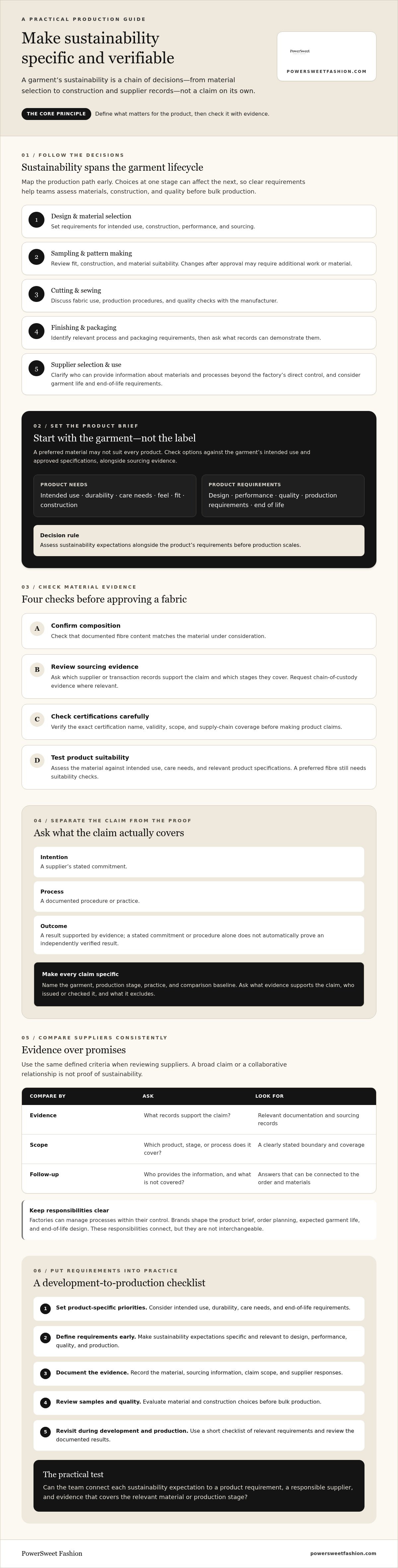
Map the production path before setting requirements. Decisions at one stage can affect the next, so clear specifications early in development help teams assess material use, construction, and quality before bulk production.
Design and material selection: Set requirements for intended use, construction, performance, and sourcing.
Sampling and pattern making: Review fit, construction, and material suitability. Changes after approval may require additional work or material.
Cutting and sewing: Discuss fabric use, production procedures, and quality checks with the manufacturer.
Finishing and packaging: Identify relevant process and packaging requirements, then ask what records can demonstrate them.
Supplier selection: Establish who will provide information about materials and processes beyond the factory’s direct control.
Some evidence comes from upstream suppliers, such as documentation about fibre sourcing or processing. Ask who can provide it, which product or production stage it covers, and whether it can be connected to the materials used for your order.
Why do sustainable production claims need context?
A claim is useful only when its scope is clear. Specify the garment, production stage, practice, and comparison baseline it refers to. “Uses recycled fibre,” for example, describes a material attribute. It does not establish the performance of the full supply chain or the garment’s durability.
Distinguish intention, process, and outcome. A supplier’s stated commitment is not the same as a documented procedure, and neither automatically proves an independently verified result. Ask what evidence supports the claim, who issued or checked it, and what it excludes. This gives your team a precise basis for comparison and prevents one label or practice from standing in for the whole production picture.
How materials, design, and sampling shape more responsible garment production
Start material decisions with the garment, not a sustainability label. A fibre that suits one product may not meet another’s requirements for fit, durability, feel, or care. Compare options against the garment’s intended use and approved specifications, then request evidence for any sourcing or environmental claim.
How can brands assess lower-impact material options?
Build a practical comparison before approving a fabric. Ask for its fibre composition and available supplier documentation, including chain-of-custody evidence where relevant. Then check whether the material suits the garment’s expected wear, care instructions, construction, and design requirements. A recycled or otherwise preferred fibre still needs product-specific review. Its label alone does not establish the performance or impact of the finished garment.
Confirm the composition: Check that the documented fibre content matches the material under consideration.
Review the evidence: Ask which supplier or transaction records support the sourcing claim and which stages they cover.
Check certifications carefully: Verify the exact certification name, validity, scope, and supply-chain coverage before making product claims.
Check suitability: Assess the material against intended use, care needs, and relevant product specifications.
Use guidance on choosing a custom women's clothing manufacturer to frame sourcing questions as part of production planning, rather than treating fabric selection as a standalone decision.
How can sampling prevent avoidable production problems?
A sample makes requirements tangible. Check how the selected material behaves in the planned construction, whether the fit matches the pattern, and whether seams and finishing meet the approved design. Sampling doesn’t guarantee less waste, but it gives the team a chance to identify and address issues before bulk production.
Document every revision. Record approved measurements, construction details, material choices, and finishing requirements in the confirmed product specifications. Share the current version with the people responsible for production and quality checks, and mark superseded versions so they aren’t used by mistake.
Fabric sourcing, pattern making, and sample development can be coordinated around these requirements. Brands planning these steps with a production partner can review custom clothing production support as they consider material decisions and sample checks.
Comparing sustainable clothing production practices with evidence, not promises
Supplier assessments are more useful when each claim is tied to a specific practice and supporting evidence. A supplier commitment describes an intention; evidence shows whether a defined practice was implemented, where, and for which production. Ask the same questions of each supplier, and keep conclusions within what the records support.
What evidence should a fashion brand request from a supplier?
Request relevant material records, written procedures, and audit information. Confirm which facilities and production stages they cover, who collected the information, when it was collected, and whether it relates to your product or describes a general company practice. Transaction-specific records can connect evidence to an order; a written procedure can explain how a process is intended to work. Neither alone necessarily proves an environmental outcome.
Record gaps alongside supporting evidence. If a figure is an estimate, label it as an estimate rather than presenting it as a measured result. Clear scope makes supplier comparisons fairer and keeps claims proportional to what has been verified.
How can brands compare sustainability certifications responsibly?
GOTS and OEKO-TEX are examples to research, not automatic requirements or proof of a supplier’s credentials. Check each standard’s current criteria, certificate validity, and exact scope. Confirm whether it applies to a facility, material, process, or product, and whether it includes the relevant production stage.
Treat certification as one input alongside supplier records, site-level practices, and product requirements. No single document answers every question about sustainable clothing production practices. A disciplined review shows what is supported, what remains unclear, and what your team should verify before making a claim.
A practical checklist for putting sustainable production requirements into practice
Turn broad sustainability goals into instructions your production team and suppliers can act on. Keep the requirements focused: choose a small number that matter to each product, define what evidence will demonstrate them, and agree when to review progress. This makes sustainable clothing production practices part of the workflow rather than a separate statement of intent.
How should brands turn sustainability goals into production specifications?
Before production, identify the evidence, responsible contacts, review points, and acceptable alternatives. Record approved materials, construction details, and relevant checks in the tech pack or other agreed production documents. If a substitution is proposed, specify who must review and approve it before the change is made.
What should teams review before approving bulk production?
Use a pre-production review to confirm that the approved sample, supporting material documents, and current specifications align. Resolve open questions first, then agree how the team will communicate changes, substitutions, defects, and production records. A shared, current set of documents helps keep decisions consistent across the brand and production team.
Product priorities: Confirm the measurable requirements selected for this garment.
Material evidence: Check that records support the approved material and clarify their scope.
Sample approval: Confirm fit, construction, and finishing against the latest specifications.
Quality-control records: Decide what checks will be recorded and how findings will be reviewed.
Production review: Compare available records with requirements and document gaps or follow-up actions.
Quality-control findings can show whether a garment conforms to approved specifications. They don’t establish environmental impact unless that impact is measured and supported by suitable evidence. Keep those conclusions separate.
With clear requirements in place, fabric sourcing, sample development, and quality checks can be coordinated around the product’s documented needs. Review custom clothing production support when planning development and production.
Choosing a manufacturing partner for accountable sustainable clothing production
A production partner should be ready to discuss how your requirements fit into the actual workflow. Look for clear answers about sourcing, documentation, samples, production specifications, and quality checks. Openness supports due diligence, but it isn’t proof of environmental performance. Verify each sustainability claim against evidence covering the relevant facility, material, process, or order.
End-to-end support can simplify coordination by connecting fabric sourcing, sample development, pattern making, production, and quality control. It doesn’t independently demonstrate that a supplier meets sustainability targets. For more on how production stages connect, see this end-to-end clothing production guide.
Questions to ask a potential production partner
Ask direct questions to establish what the partner can document and where additional supplier information is needed. Request specific examples and clarify the scope of any records provided.
Which sustainability requirements can the factory document directly, and which depend on upstream suppliers?
What material records are available, and can they be connected to the fabric selected for this order?
How are material substitutions, sample revisions, and quality issues reviewed, approved, and recorded?
Which facilities and production stages are covered by the evidence, and what are its limits?
A credible partner should be able to explain what they know, what they can support with records, and what remains unverified. Be cautious of broad environmental promises that aren’t tied to a defined practice and evidence.
How can a brand start a transparent supplier conversation?
Share the product specifications, sustainability priorities, expected order scope, and evidence requirements at the outset. This gives the production team a clear basis for discussing material options, sample review, and quality-control checkpoints. Keep the conversation connected: a sourcing decision may affect sample approval, while a specification change may require updated records and confirmation before production proceeds.
PowerSweet Fashion provides custom women’s clothing production support, including fabric sourcing, sample development, pattern making, and quality control. These capabilities can help brands coordinate production requirements, but any sustainability-specific capability or environmental claim should be verified before you rely on it. Discuss your product needs and the evidence you expect to review as part of the process.
Make your next production decision more accountable
Sustainable clothing production practices are strongest when they’re specific, documented, and connected to the product. Assess materials against design and performance needs, define the evidence suppliers must provide, and use approved samples and quality checks to review requirements before and during production.
Keep claims within the evidence you have. A supplier conversation or a single certification doesn’t prove every sustainability outcome, so verify the scope of any certification or impact claim before using it. Clear specifications and open communication provide a practical starting point.
PowerSweet Fashion supports production from fabric sourcing through finished garments, and clients can visit the factory to meet the team and oversee quality control. These production capabilities can support coordination, but sustainability-specific credentials or outcomes should be verified separately.
Ready to discuss your product requirements? Discuss your custom clothing production requirements and plan your next steps.
Frequently Asked Questions
What are sustainable clothing production practices?
Sustainable clothing production practices are decisions and documented processes across design, material selection, manufacturing, and supplier management. They may address resource use, working conditions, product durability, and waste. No single action, such as choosing a preferred fibre, establishes the sustainability of an entire garment or supply chain. Define the product and production stages covered, request relevant evidence, and make claims only as broad as the supporting documentation allows.
How can I tell whether a clothing manufacturer is sustainable?
Ask for current evidence tied to the facilities and production stages involved in your order. Review material documentation, written procedures, relevant audit information or certifications, and records of how changes are approved. Ask who collected or verified each item, when it applies, and what it excludes. A general sustainability statement isn’t enough to assess performance. Don’t assume a manufacturer holds a certification until its validity and scope are confirmed.
Are recycled fabrics always more sustainable?
No. Recycled content can be one useful consideration, but it doesn’t establish the full impact of a garment. Check fibre composition, available traceability evidence, and relevant processing information, then assess whether the fabric suits the product’s intended use, durability, and care needs. Compare material options against the same product requirements. Keep any claim specific: evidence about one material input doesn’t necessarily cover the garment’s construction or the rest of its production.
What certifications should clothing brands look for?
The right certification depends on the material, product, facility, and claim you plan to make. GOTS and OEKO-TEX can be starting points for research, but they have different scopes and aren’t interchangeable. Check current criteria, certificate validity, and supply-chain coverage directly with the relevant standard or certifier. Treat certification as one useful piece of evidence, not automatic proof that every material, facility, and production stage is sustainable.
How can a fashion brand reduce waste during clothing production?
Review design requirements, material planning, sample approval, cutting plans, production changes, and quality findings with your manufacturing partner. Clear specifications and timely decisions can help identify opportunities to address avoidable rework or material issues, though results depend on the product and process. Ask what production records are available and agree how performance will be assessed. Don’t publish waste-reduction figures unless they’re based on measured evidence with a clear scope.
Can small fashion brands use sustainable production practices?
Yes. Start with a few product-specific priorities, document them clearly, and ask prospective suppliers what evidence they can provide. Focus on decisions within your control, such as material requirements, sample approval, product durability, and precise claims. Smaller order volumes don’t remove the need for due diligence. Clear communication and realistic requirements help a brand understand what a supplier can document and where further evidence may be needed.
How do I add sustainability requirements to a clothing manufacturer's brief?
Add clear requirements to the product brief or tech pack, including material composition, approved alternatives, required documentation, sample review points, and how substitutions must be approved. Identify who provides each piece of evidence and when it’s due. Keep the requirements feasible for the product and production scope. Before sampling or bulk production begins, confirm that both teams understand the criteria and know how to record changes or unresolved questions.


Comments