%20(1).png)
Solving Inconsistent Garment Production: A Guide to Manufacturing Reliability

Why can a bulk order look and fit differently from the sample you approved? Inconsistent garment production often starts before sewing begins, when patterns, fabric lots, grading, or pre-production checks drift from the approved standard. The result can be sizing-related returns, quality complaints, and stock that’s difficult to sell.
If you’ve experienced that gap, you know it’s more than a finishing issue. It can disrupt launch plans and erode confidence in your production partner. The good news: consistency can be built into the process, not left to chance.
This guide explains the technical causes of production variance and the controls that help bulk garments stay aligned with an approved sample. We’ll cover how pattern making, fabric sourcing, and quality checks work together, from sample development through final inspection. You’ll also learn how a clear production framework supports more predictable planning and better fit. PowerSweet Fashion supports custom women’s clothing production with services spanning sample development, fabric sourcing, pattern making, and quality control.
Table of Contents
The Hidden Costs of Inconsistent Garment Production
Inconsistent production means garments in the same order vary from the approved standard. The differences may show up in fit, fabric weight, seam alignment, or finishing details such as hems and closures. One variation can seem minor on its own. Across a bulk order, it can create customer complaints, extra inspection work, and products that are harder to sell at full value.
The costs extend beyond the defective garment. Poor sizing can trigger a return cycle: a customer orders multiple sizes to find one that fits, sends the rest back, and may be less inclined to buy again. A brand then handles additional returns, inspection, restocking, and customer support. Production consistency is the foundation of brand trust because customers need each order to meet the standard they were promised.
There’s an operational drain, too. Teams may have to sort garments by issue, separate repairable pieces, rework them, and reinspect them before release. That takes time away from planned production and fulfillment. A faulty batch can also weaken brand equity: customers remember a poor fit or finish, and one disappointing experience can undermine confidence built through many reliable orders.
Financial Impact of Reworks and Dead Stock
Consider a 1,000-piece order with a hypothetical 10% defect rate: 100 pieces require assessment. Not every one will be unsellable, but each needs a disposition decision. To estimate the true impact, tally the cost of inspection, repairs, handling, delayed fulfillment, returns, and any units that must be discounted or liquidated. The final figure depends on the defect type and the brand’s own costs, so a low quoted manufacturing price alone can’t show the full picture.
Faulty inventory creates its own logistics burden. It must be identified, stored separately, and either corrected, resold at a reduced value, or written off. Lower-cost production can therefore result in a higher effective cost per sellable garment once rework and returns are included. The broader Mass production challenges in garment manufacturing include the difficulty of maintaining quality and making changes once a production run is underway.
The Psychology of the Fashion Consumer
Unreliable sizing encourages “bracket shopping,” where customers order several sizes with plans to keep only one. If returns are free, shipping and handling still add work and logistics costs for the brand; if they aren’t, the experience can frustrate shoppers. Either way, uncertain fit can weaken repeat-purchase confidence.
Durability matters after the first try-on. If seams, fabric, or finishing fail sooner than customers expect, they may not return to the brand. Consistent fit and dependable construction help customers know what to expect, making each purchase feel less risky.
Why Inconsistency Happens: The Technical Root Causes
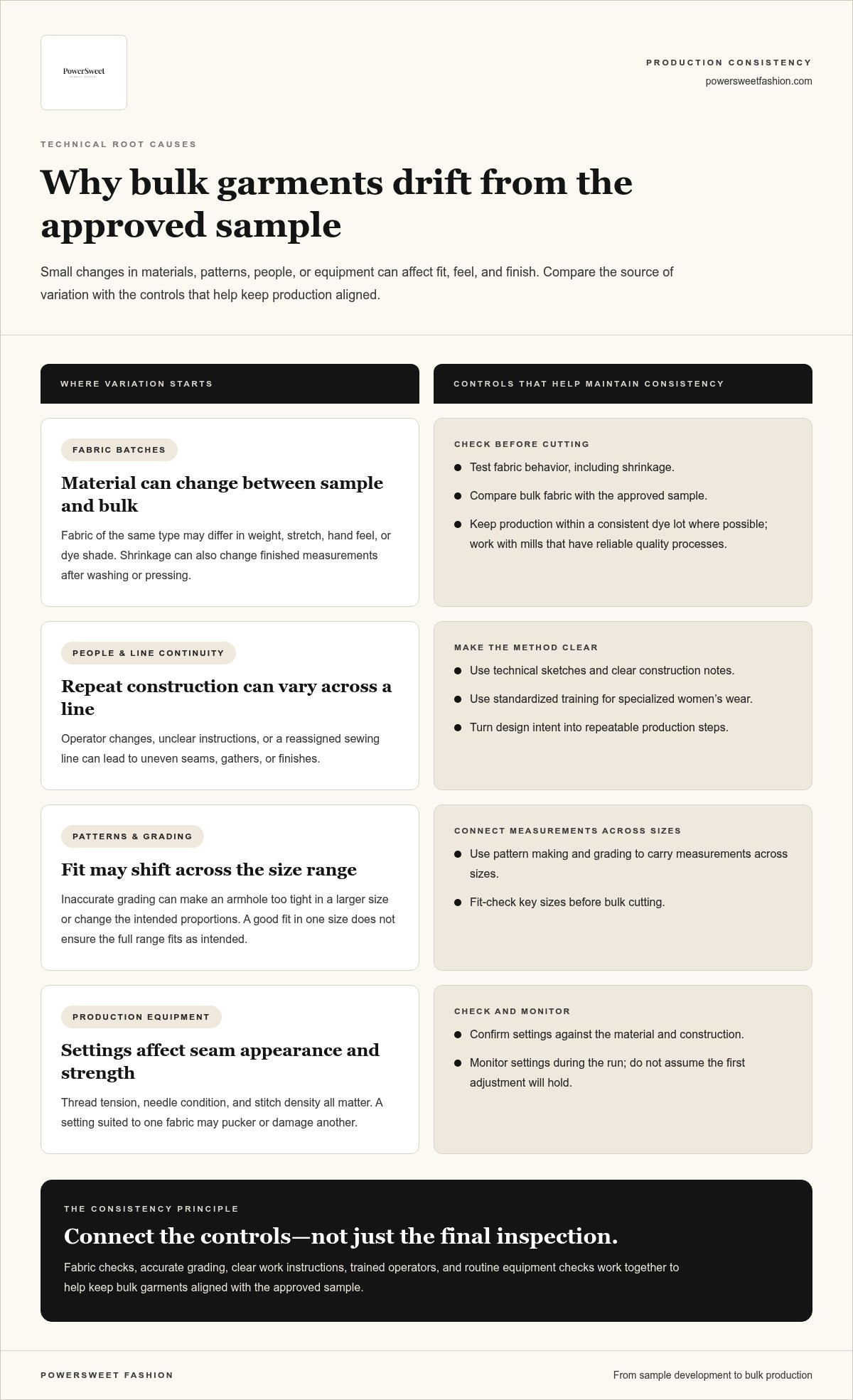
Bulk garments can drift from an approved sample for reasons that start well before final inspection. Inconsistent garment production usually reflects several small changes across materials, patterns, people, or equipment. If those variables aren’t controlled together, a garment that looks right in a sample room can come off the production line with a different fit, feel, or finish.
Material Sourcing and Textile Stability
The sample may use a fabric roll that differs from the bulk order. Even within the same fabric type, weight, stretch, hand feel, or dye shade can vary between batches. Fabric testing before cutting helps identify shrinkage and other behavior that could change finished measurements after washing or pressing. Comparing bulk fabric with the approved sample, and keeping production within a consistent dye lot where possible, helps reduce avoidable differences.
Stable sourcing matters, too. Working with mills that have reliable quality processes makes it easier to maintain material expectations from order to order. Global supply conditions can affect which textiles are available and when; the WTO provides context on trade in textiles and clothing.
People, Patterns, and Production Equipment
A sample room prioritizes close attention to one garment. A production line must repeat the approved construction efficiently across many pieces. If operators change mid-run, instructions are unclear, or a sewing line is reassigned, small differences in handling can produce uneven seams, gathers, or finishes. Technical sketches, clear construction notes, and standardized training for specialized women’s wear help turn design intent into repeatable steps.
Patterns also need to work across the full size range. If grading rules are inaccurate, a well-fitting small may become too tight through the armhole or lose the intended proportions in a large. Pattern making and grading help keep measurements connected across sizes, while fit checks at key sizes can reveal problems before bulk cutting.
Machines need attention as well. Thread tension, needle condition, and stitch density affect seam strength and appearance. A setting that works for one fabric may pucker or damage another. Operators should confirm settings against the material and construction, then monitor them during the run rather than assuming the first adjustment will hold.
Consistency depends on connecting these controls: fabric checks, accurate grading, clear work instructions, trained operators, and routine equipment checks. For custom women’s apparel, coordinated pattern making and fabric sourcing can help establish a more controlled path from sample to bulk production.
Bridging the Gap: Ensuring Bulk Production Matches the Approved Sample
The sample-to-bulk bridge is a controlled handoff, not simply permission to start cutting. A practical process links the approved garment, its pattern, the production instructions, and the checks used on the line. Without that link, inconsistent garment production can reappear even after a successful sample fitting.
Set a Clear Reference Before Bulk Production
Keep one approved “golden sample” as the controlled reference for the production and quality control teams. Label and store it so it isn’t altered or worn during routine handling. Pair it with a measurement chart, construction notes, and clear photos of details such as seam placement, closures, and finishing. This gives the team one agreed standard to compare against, rather than relying on memory or scattered comments.
Before bulk begins, develop a pre-production (PP) sample using the intended bulk fabric, trims, and construction method. Where production conditions allow, make it on the line or with the equipment and workflow planned for the order. Review how the garment behaves in that setting, including difficult seams and finishing details. Record each approved change in the tech pack, then circulate the revised version so operators and QC staff work from the same instructions. The PP sample can also serve as a hands-on reference for assembly steps that are easy to misinterpret.
Make Measurements and Grading Verifiable
Pattern making connects fit decisions to the pattern used for production. The pattern team can review how a change to one measurement affects related areas, then update the specification and pattern together. Grading software can help apply consistent rules across sizes, but the grade rules still need technical review and fit validation.
Don’t assume the approved base size proves the full range is ready. Use “jump-size” sampling to check a smaller and a larger size, such as Small and XL, and look for changes in balance, ease, armhole shape, and garment length. This can reveal size drift that a single sample won’t show.
Measurement tolerance isn’t one universal number for every garment or point of measure. Define the acceptable range for each measurement in the tech pack, alongside the method and reference points used to measure it. A garment within the agreed range passes that measurement check; one outside it needs review and a documented decision before it moves forward. Keep the golden sample, approved PP sample, and measurement record aligned as the production reference.
For a deeper look at the sample stage and its role in production readiness, explore Mastering Sample Development.
A Brand’s Checklist for Vetting Manufacturing Consistency
A useful factory review looks beyond a finished garment. It checks whether the production process can catch a problem early, communicate changes clearly, and apply the approved standard across an entire order. Use this checklist to assess controls that reduce the risk of inconsistent garment production.
Four Checks for a More Reliable Production Process
Map the QC checkpoints. In-line checks can catch issues while garments are being assembled; end-line checks assess completed pieces before packing. Look for a defined process that records what was checked, what failed, and how a recurring issue is addressed. PowerSweet Fashion provides quality control services as part of its garment manufacturing offering.
Review technical communication. A useful tech pack should make measurements, construction, fabric, trims, and approved revisions easy to interpret. Check that updates are dated and the production team is working from the same final version.
Assess relevant category experience. Women’s garments can require different construction techniques, fits, and finishing. Review examples of comparable categories and consider how pattern making, grading, and quality checks support those requirements.
Start at a manageable scale. A lower-MOQ order can help establish a quality baseline before you scale a style. It doesn’t remove the need for production controls, but it can make early review more manageable and limit exposure while you assess fit, construction, and finishing.
Turn QC Questions into Evidence
Use practical prompts to understand how the work is controlled, then look for clear process explanations and records that support the answers:
Fabric: How are materials inspected before cutting, and how are visible defects or shade differences handled?
Measurements: What happens when a garment falls outside the agreed measurement tolerance? A sound workflow identifies the issue, separates affected pieces, and documents the corrective decision.
Reporting: What do internal QC records show about inspection points, defect types, and corrective actions across production runs?
These details connect the production process to the garments delivered. PowerSweet Fashion coordinates pattern making, fabric sourcing, and quality control services to help keep technical specifications connected to production checks.
Scale After Establishing a Baseline
A smaller first order gives your team a chance to review the finished garments against the approved requirements before committing to a larger run. PowerSweet Fashion offers low minimum order quantities for custom women’s clothing, giving brands a manageable starting point for evaluating a style. Learn more about using low MOQ women’s clothing manufacturers to test styles and build a quality baseline before scaling.
Explore custom women’s clothing production to learn how sample development, fabric sourcing, and production can fit together.
Achieving 100% Consistency with PowerSweet Fashion’s Production Model
Consistency comes from carrying one approved standard through every production stage. At PowerSweet Fashion, the approved fit and finish can serve as the reference for bulk production, with coordinated support from fabric sourcing through quality control. The goal is for each garment to match the agreed sample, rather than relying on a last-minute inspection to catch preventable variation. No process can remove every possible source of variation, so clear specifications and checks at multiple stages remain essential.
PowerSweet Fashion focuses on custom women’s apparel and provides services including pattern making, sample development, fabric sourcing, and quality control. Connecting these steps helps keep production decisions aligned with the agreed specifications and reduces handoff gaps that can contribute to inconsistent garment production. Clients can also visit the factory to meet the production team and oversee quality control.
Multi-Step Quality Control in Practice
Checks at more than one stage help identify issues while there’s still time to respond. A practical production workflow can include:
Before cutting: Inspect fabric for weight, color consistency, and visible defects, and compare it with the approved material standard.
During sewing: Review stitching and construction as garments move through production, so an issue can be addressed before it carries through the finished order.
Before completion: Audit garment measurements against the approved tech pack and review finishing details against the sample reference.
These checkpoints connect material selection and sewing decisions to the final garment. A smaller starting order can also make it more manageable to review pieces, document findings, and establish a quality baseline before increasing order volume. PowerSweet Fashion offers low minimum order quantities for custom women’s clothing, giving brands a manageable scale for testing a style and its production requirements.
Build a Reliable Rhythm for Growth
Once a style is established, repeatable specifications and QC checks help brands plan upcoming drops with greater confidence. PowerSweet Fashion’s bulk production timeframe is 15–20 days. Clear planning and consistent checkpoints help keep that production schedule aligned with the approved sample and the brand’s requirements.
Coordinating fabric sourcing, pattern making, production, and quality checks can reduce communication gaps between separate stages. Learn how end to end clothing production supports a connected workflow from development through bulk manufacturing.
PowerSweet Fashion develops samples in 10 days, creating a starting point for reviewing fit, materials, and construction before bulk production. Start your first sample with PowerSweet Fashion.
Build Consistency Into Your Next Production Run
Inconsistent garment production isn’t inevitable. As this guide shows, material differences, pattern and grading issues, and gaps in production checks can all pull bulk garments away from an approved sample. A protected sample reference, clear technical specifications, and quality checks at multiple stages help teams identify and address variation before it spreads through an order.
Reliable production also depends on a partner who connects the details. PowerSweet Fashion supports custom women’s clothing production with pattern making, sample development, fabric sourcing, and quality control. Its low minimum order quantities give brands a manageable way to begin a style and establish a quality baseline as they scale.
Set your next order up for a closer match between sample and bulk. Partner with PowerSweet Fashion for Reliable Bulk Production to discuss your custom women’s clothing project. With a clear standard and a capable production team, you can move forward with greater confidence in every garment.
Frequently Asked Questions
What causes the most common inconsistencies in garment production?
The most common causes are variation in fabric, inaccurate patterns or grading, unclear production instructions, changes in sewing operators, and inconsistent machine settings. A fabric roll may shrink or drape differently from the sample material, while unclear stitch or finishing instructions can lead to different results across a run. Inconsistent garment production often stems from several small process gaps, so controls need to cover materials, patterns, people, and equipment.
How can I ensure my bulk production matches my approved sample?
Use the approved sample as a documented production reference, then align the tech pack, measurement chart, materials, and construction instructions with it before bulk begins. Review a pre-production sample made with intended production materials and methods, record any changes, and share the final specifications with the production and QC teams. Checks during sewing and before completion help catch deviations early. Keep measurement methods and acceptance tolerances clear for every point of measure.
What is an acceptable measurement tolerance in clothing manufacturing?
There isn’t one tolerance that fits every garment and measurement. The acceptable range should be stated for each point of measure in the tech pack, based on the garment’s fit requirements and construction. Specify where to measure, how to position the garment, and the permitted variance from the approved specification. A measurement outside that agreed range should be documented and reviewed against the approved sample before the garment is accepted.
Does low MOQ manufacturing affect garment quality?
A low minimum order quantity doesn’t automatically mean lower quality. Quality depends on material selection, pattern accuracy, construction instructions, and inspection standards, whatever the order size. A smaller run can make it easier for a brand to review garments closely and establish a quality baseline before scaling, but it still needs clear specifications and systematic QC. PowerSweet Fashion offers low minimum order quantities for custom women’s clothing production.
How do I handle a batch of clothing that doesn’t meet my quality standards?
Separate the affected garments from approved stock and document the issue by type, size, and quantity. Compare representative pieces with the approved sample and tech pack, including measurements and construction details. Share the findings with your production partner and agree on a documented disposition, such as repair, reinspection, or exclusion from the order. Check unaffected pieces too, so you can determine whether the defect is isolated or part of a wider pattern.
Why is in-house pattern making important for consistency?
Pattern making keeps fit decisions connected to the patterns used for production. When a measurement or construction detail changes, the pattern team can assess related areas and update the pattern and specifications together. Accurate grading also helps preserve proportions across sizes instead of simply enlarging the base pattern. For custom women’s clothing, this coordination supports consistent fit from sample development through bulk production and makes technical adjustments easier to track.
How long does it typically take to fix production errors?
Correction time depends on the type and extent of the defect, how many garments are affected, and whether pieces can be repaired or need more substantial rework. A sewing adjustment on a limited number of garments differs from a measurement issue that affects a full size run. First identify the cause and affected quantity, then agree on corrective steps and reinspect the results. Don’t assume the bulk production lead time also applies to rework.
What should be included in a tech pack to prevent manufacturing mistakes?
A clear tech pack should include the design drawing, construction details, fabric and trim specifications, size measurements, grading information, and finishing requirements. Add a point-of-measure guide that shows measurement locations and tolerances, plus clear notes or images for details that could be interpreted more than one way. Include approved sample references and document revisions with dates, so production and QC teams use the same current instructions throughout the order.


Comments