%20(1).png)
Chinese Garment Factory Guide for Fashion Brands 2026

What helps a bulk order match the design you approved? Often, it comes down to the decisions documented before the first sample. A Chinese garment factory can take a women’s apparel design from specifications to finished garments, but unclear measurements, material choices, or construction details can create gaps between the approved sample and the bulk order.
Fabric, patterns, sampling, and production timing all affect one another. Shared specifications and clear sample approvals help keep the work aligned from development through quality control.
This guide walks through the production process, including what to prepare for sampling and how to plan for bulk manufacturing. You’ll see how fabric sourcing, pattern making, sample development, and quality checks connect within one manufacturing relationship. PowerSweet Fashion offers low minimum order quantities, with samples ready in 10 days and bulk production in 15-20 days. These details can help you plan your order and move from design brief to finished women’s apparel with clear decisions at each stage.
Table of Contents
What Does a Chinese Garment Factory Do for a Fashion Brand?
A Chinese garment factory turns a fashion brand’s design specifications into physical garments by coordinating materials, patterns, sampling, bulk manufacturing, and quality checks. Its role goes beyond sewing. The factory helps translate design intent into decisions about fabric, fit, construction, and production so the finished apparel can be made to an agreed standard.
China’s manufacturing background provides useful context for this work. The Textile industry in China overview traces the country’s textile sector and its development. For a fashion brand, the practical question is how the production relationship connects that wider industry to the details of a specific women’s apparel design.
What work can a custom women’s garment factory handle?
Custom production starts with design information such as sketches, reference images, measurements, and construction details. Fabric sourcing connects material choices to the intended garment. Pattern making translates the design and fit requirements into pattern pieces used to construct it. Sampling then turns those decisions into a physical garment for review.
A sample is a development tool, not the bulk order itself. Once you approve the design, bulk production follows the agreed version, and quality checks compare production garments with the approved reference. Keeping material choices, patterns, and sample feedback connected helps prevent decisions from being lost between stages.
How is a factory relationship different from marketplace sourcing?
A supplier directory or marketplace helps a brand discover businesses and begin supplier conversations. That is different from managing production. A factory relationship involves coordinating the work that follows: aligning materials with the design, developing patterns and samples, carrying approved details into manufacturing, and checking the finished garments.
With a Chinese garment factory, that coordination can create a clearer handoff between development and bulk production. Rather than treating fabric, sampling, manufacturing, and quality control as isolated tasks, the brand and production team can work from shared specifications and sample feedback. This is particularly useful when fit or construction details need to remain consistent across an order.
Order suitability depends on the design, materials, construction requirements, and requested quantity. A clear brief helps the production team understand the work involved and identify which decisions need to be settled before sampling or bulk production. Custom manufacturing differs from buying ready-made wholesale garments: the brand develops apparel around its own specifications rather than selecting finished stock.
How a Chinese Garment Factory Moves a Design from Brief to Bulk
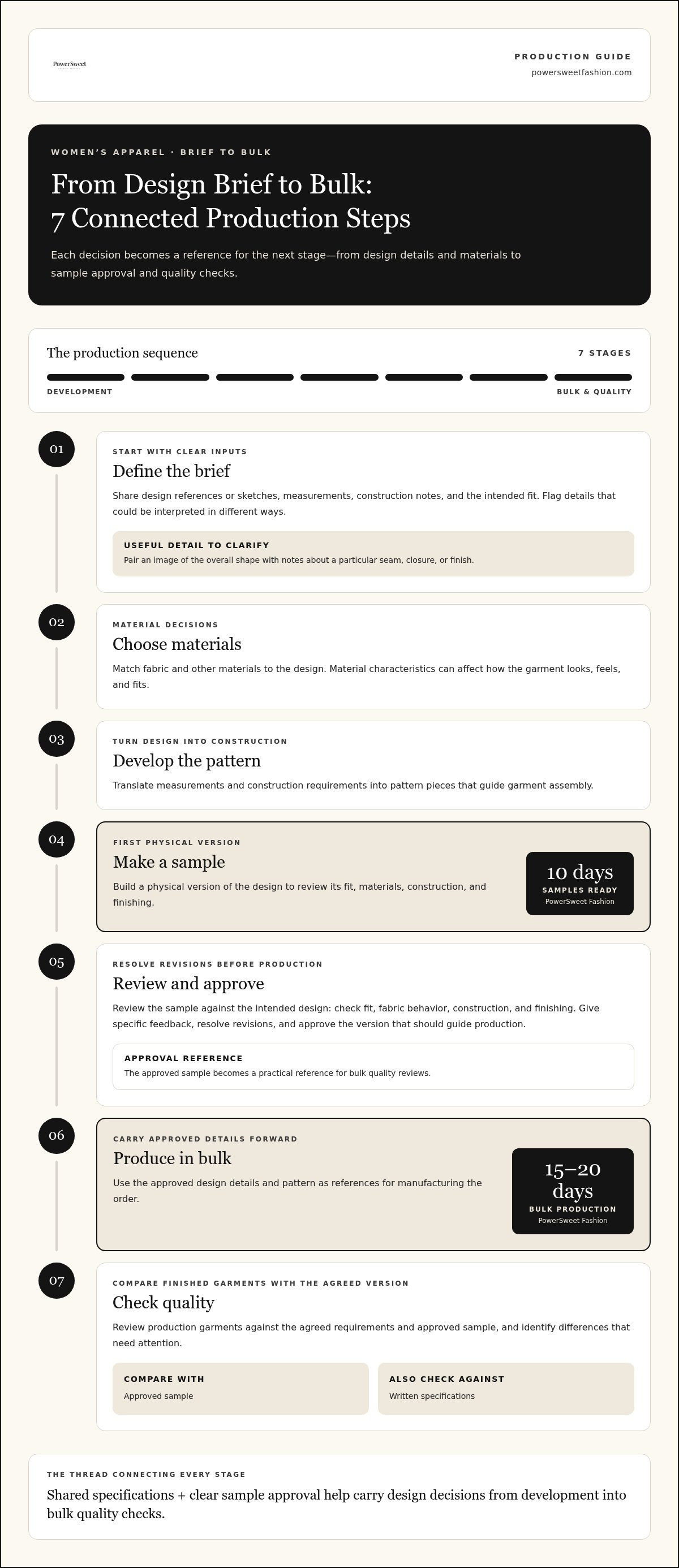
A production run moves through a series of connected decisions, not one handoff from sketch to sewing line. At each stage, the information agreed with the factory becomes the reference for the next, helping keep the design intent clear as the garment takes shape.
Define the brief. Share design references, measurements, construction notes, intended fit, and details that matter to the finished garment.
Choose materials. Match fabric and other materials to the design. Their characteristics can affect how the garment looks, feels, and fits.
Develop the pattern. Translate measurements and construction requirements into pattern pieces that guide garment assembly.
Make a sample. Build a physical version of the design to review its fit, materials, construction, and finishing.
Review and approve. Give specific feedback, resolve revisions, and approve the version that should guide production.
Produce in bulk. Use the approved design details and pattern as references for manufacturing the order.
Check quality. Review garments against agreed requirements and the approved sample, and identify differences that need attention.
PowerSweet Fashion’s samples are ready in 10 days, and bulk production takes 15-20 days. These are useful planning details for sequencing development and manufacturing. Broader sourcing context, including trade patterns, is available in the World Trade Organization’s overview of global textile and clothing trade.
What information helps a factory develop the first sample?
Give the development team a clear picture of the design: reference images, measurements, construction notes, and material preferences. Flag details that could be interpreted in different ways, such as the intended fit or how a feature should be finished. For example, pair an image showing the overall shape with notes explaining a particular seam or closure. A focused brief reduces avoidable guesswork. For a closer look at sampling, see the guide Mastering Sample Development.
Why does sample approval matter before bulk production?
Review the sample against the intended design, checking fit, fabric behavior, construction, and finishing. Record specific revision notes, then approve the version that should guide production. That sample is a practical reference for bulk quality reviews, but it does not replace ongoing checks. Review production garments against both the sample and the written specifications.
Clear coordination helps carry development decisions through to production. To see how custom clothing production brings sourcing, pattern making, samples, and quality control together, explore PowerSweet Fashion’s manufacturing approach.
How to Manage Quality and Communication with a Chinese Garment Factory
Remote production works best when both teams use the same specifications and agree on when decisions and reviews happen. A clear process gives the production team a shared reference, makes feedback easier to act on, and helps surface differences before they affect more of the order.
Separate requirements that can be checked directly from preferences that need visual or design judgment. Measurements, fabric selection, seam placement, and label position can be documented as specific requirements. Terms such as “soft drape” or “relaxed fit” describe intent but can be interpreted in different ways unless supported by reference images, sample comments, or construction details. For a custom women’s garment, this distinction makes feedback on fit and finish more precise.
Which production details should stay consistent?
Keep one current specification set with the decisions that production and quality reviews should follow. If an approved detail changes, update the record and share the revision with the people working from it. This prevents an earlier message or document from conflicting with newer instructions.
A practical quality review checklist can include:
Measurements: Compare key points with the agreed size specifications.
Materials: Check the fabric and other materials against the selected references.
Construction: Review seams, closures, and design features against the approved details.
Trims and labels: Confirm that placement and appearance match the instructions.
Finishing: Assess the garment’s overall presentation against the approved sample and design intent.
The approved sample is a practical reference, not a promise that every bulk garment will be identical. Use it alongside written specifications, then document observations and agreed follow-up clearly.
How can brands stay involved in production oversight?
Set communication points for sample review, production progress, and quality observations. At each point, share focused feedback using notes or marked-up images, identify the garment detail involved, and record what has been agreed. This gives the team an actionable next step instead of relying on broad comments such as “make it look better.”
PowerSweet Fashion clients can visit the factory to meet the production team and oversee quality control. A visit offers a way to collaborate directly, while clear specifications and documented decisions also help keep the brand and production team aligned.
How to Prepare Your Brand for a Chinese Garment Factory Production Run
Good preparation makes production conversations more useful. You don’t need every design decision finalized before requesting a sample, but you should distinguish what is already defined from what you want to test. As development moves toward bulk, turn the working brief into an approved set of materials and production specifications.
This distinction shows the production team which details are still being developed and which need to be repeated consistently. Fabric decisions can affect a garment’s feel and fit, while pattern details translate fit intent into construction. Sample feedback records what to adjust before approval. Include order planning early, since the design, materials, construction, and requested quantity all shape production planning. PowerSweet Fashion offers low minimum order quantities, with order requirements considered in relation to the garment and production needs.
What should a brand prepare before requesting a sample?
Gather available design references, intended fit, measurements, material preferences, and construction details. Mark what is fixed and what you are open to refining through sample development. For example, a reference image can communicate the overall shape, while written notes clarify a particular feature. For additional preparation guidance, see The Professional Guide to Choosing a Custom Women’s Clothing Manufacturer in 2026.
What changes between sample planning and bulk planning?
Sample planning focuses on developing the design and reviewing fit, fabric behavior, and construction. Bulk planning shifts to consistency: approved materials, finalized specifications, and clear quality checkpoints become the working references. Document sample feedback and approved revisions so the production team isn’t relying on earlier instructions. The guide End to End Clothing Production: The Complete Guide for Fashion Brands in 2026 explores how these stages connect.
PowerSweet Fashion’s samples are ready in 10 days, and bulk production takes 15-20 days. Treat these as planning details for the respective stages, not as one combined timeline. A prepared brief helps you coordinate development and production with fewer unresolved decisions.
Ready to organize your design inputs for production? Plan your custom women’s clothing production with PowerSweet Fashion.
How PowerSweet Fashion Supports Custom Production with a Chinese Garment Factory
A custom women’s apparel order involves linked decisions. PowerSweet Fashion coordinates fabric sourcing, pattern making, sample development, bulk production, and quality control, helping design information move from early development into finished garments.
Material choices inform development; pattern making turns design requirements into a construction plan; and sample feedback clarifies what needs refining. Once approved, those details guide bulk production and quality reviews. Working through these stages together gives your brand and the production team a clearer basis for coordinating handoffs.
How does an end-to-end production relationship help?
When sourcing, pattern making, sampling, and production are coordinated, material and design decisions can carry through development rather than being repeatedly reinterpreted at separate stages. Your team can share references and requirements, review the sample, and document approved changes as the garment moves toward bulk production. For more guidance on assessing a production relationship, read The Professional Guide to Choosing a Custom Women’s Clothing Manufacturer in 2026.
PowerSweet Fashion’s samples are ready in 10 days, and bulk production takes 15-20 days. These are planning details for their respective stages. The production plan also reflects the project’s requirements and the decisions involved.
Collaboration can extend beyond shared production information. Clients can visit the factory, meet the production team, and oversee quality control in person. For remote project management, a clear brief and agreed review points help keep the work coordinated.
What is the next step for a fashion brand?
Start with the information you already have: design references, garment details, intended fit, material preferences, and production goals. Note which choices are settled and which you’d like to develop during sampling. This gives the project discussion a practical starting point and helps focus attention on the garment’s specific development needs.
Whether you’re refining a first sample or preparing an approved design for bulk production, a Chinese garment factory relationship works best when each stage has clear inputs and decisions. PowerSweet Fashion supports custom women’s clothing production from sourcing through quality control, with the production team involved across the process.
Discuss your custom women’s apparel production project with PowerSweet Fashion and outline the design and development requirements you’re working toward.
Turn Your Design Brief into a Production Plan
A successful partnership with a Chinese garment factory depends on carrying clear design decisions from materials and patterns through sample approval, bulk production, and quality review. Prepare your references, measurements, and construction details, then document feedback so the approved design guides the next stage.
PowerSweet Fashion coordinates fabric sourcing, pattern making, sampling, women’s apparel production, and quality control. Samples are ready in 10 days and bulk production takes 15-20 days, providing planning details for the respective stages. Clients can also visit the factory to meet the production team and oversee quality control.
Ready to map out your production requirements? Discuss your custom women’s clothing production project with PowerSweet Fashion. Bring your design brief and production goals to start planning the path from specifications to finished garments.
Frequently Asked Questions
What does a Chinese garment factory do?
A Chinese garment factory turns a fashion brand’s design requirements into finished apparel. Work can include fabric sourcing, pattern making, sample development, bulk manufacturing, and quality control. The process connects design information to practical decisions about materials, measurements, construction, and finishing. For custom women’s clothing, the brand shares its design intent and reviews development samples before the approved details guide bulk production.
How do I work with a Chinese garment factory?
Start by sharing design references, measurements, construction details, material preferences, and production goals. The factory uses these inputs to coordinate material selection, pattern development, and sampling. Review the sample and give specific feedback, then document approved changes and requirements before bulk production begins. Agreeing on communication and review points helps both teams work from the same information as the garment moves through development, manufacturing, and quality checks.
How long does garment sampling and bulk production take?
PowerSweet Fashion’s samples are ready in 10 days, and bulk production takes 15-20 days. These are separate timelines for sample development and bulk manufacturing, not one combined duration. Use them to map the stages of your project and plan for development decisions and reviews. Clear specifications and timely sample feedback help keep the handoff between sampling and production organized.
Can a Chinese garment factory make custom women’s clothing?
Yes. PowerSweet Fashion produces custom women’s clothing for fashion brands, developing garments from brand-provided design requirements rather than supplying only ready-made stock. The process can include fabric sourcing, pattern making, sample development, bulk production, and quality control. Prepare references, intended fit, measurements, and construction details to guide the work. Sampling gives the brand and production team a physical design reference to review before bulk manufacturing.
How can a brand maintain quality when manufacturing remotely?
Maintain quality remotely by working from clear specifications, a reviewed sample, and agreed production checkpoints. Record measurable requirements such as garment measurements, materials, construction details, trims, labels, and finishing. Keep sample feedback and approved revisions in one current set of instructions, then use it alongside the sample as a reference during bulk quality reviews. PowerSweet Fashion clients can also visit the factory to meet the team and oversee quality control.
What information should I send a garment factory to develop a sample?
Send the clearest available design references, intended fit, measurements, material preferences, and construction notes. Images or sketches can show the overall appearance, while written instructions clarify details that might otherwise be interpreted differently. Mark which decisions are final and which you want to refine during development. This gives the team a practical starting point for pattern making and sample development and focuses review feedback on the changes needed.
Does a Chinese garment factory handle fabric sourcing and pattern making?
Yes. PowerSweet Fashion provides fabric sourcing and pattern making as part of its custom women’s clothing production process. Sourcing connects material choices to the garment design, while pattern making translates measurements and construction requirements into pieces used to build the garment. These steps support sample development and help carry agreed details into bulk production. Coordinating material and pattern decisions gives the brand and production team a shared basis for development.


Comments