%20(1).png)
Resolving Overseas Supplier Disputes: Fashion Guide (2026)

The most effective dispute resolution isn't found in a courtroom; it's found in the alignment of technical specifications and transparent production milestones. When a bulk order arrives with defects, the immediate fear of losing your capital is paralyzing. You've likely felt the anxiety of trying to bridge a communication gap across time zones while wondering if your contract holds weight in a foreign jurisdiction. We understand that resolving disputes with overseas suppliers often feels like a high-stakes gamble where the manufacturer holds all the cards. It's a common frustration that can stall even the most promising fashion brands.
This guide changes that dynamic by providing a pragmatic framework for conflict management. You'll learn how to navigate international legalities, negotiate from a position of technical strength, and protect your brand's bottom line. We'll examine the 2026 landscape of arbitration enforcement, the strategic use of 10-day sampling for alignment, and the specific steps required to turn a manufacturing conflict into a manageable logistical hurdle. By the end of this article, you'll have a systematic approach to maintaining production stability and securing your investments.
Table of Contents
Common Types of International Sourcing Disputes in Fashion
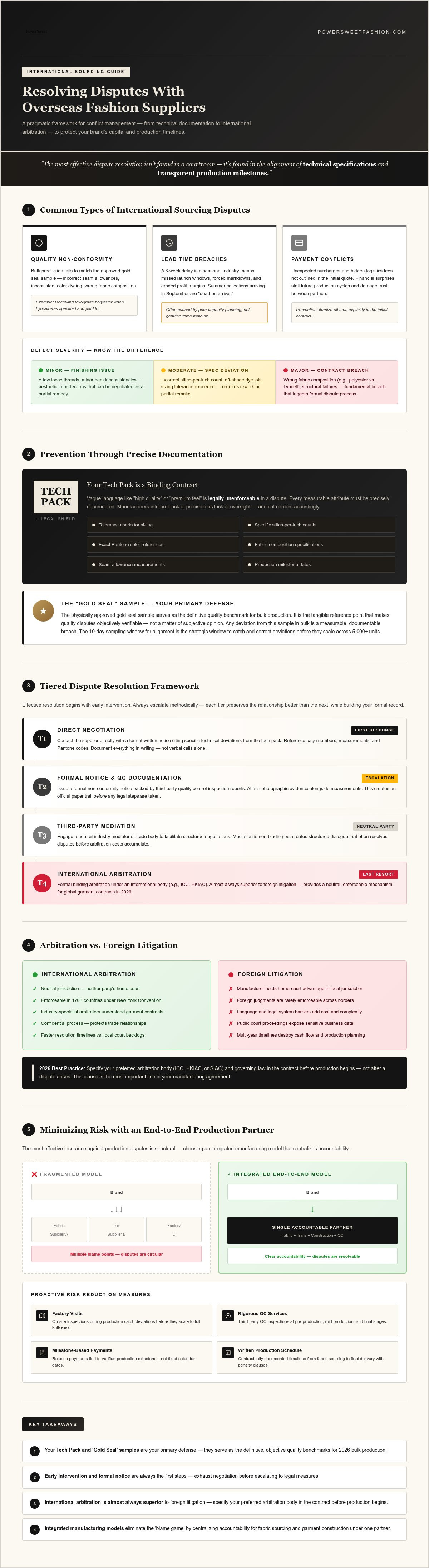
International commercial disputes in the garment industry represent a breakdown in the technical and logistical alignment between a brand and its manufacturer. These aren't just abstract legal disagreements. They are tangible failures in the production chain that directly threaten your inventory and cash flow. Whether it's a shipment of 5,000 dresses with incorrect stitching or a sudden price hike halfway through production, resolving disputes with overseas suppliers requires a deep understanding of these specific failure points. We see these conflicts as manageable hurdles when you have the right technical documentation in place.
The most frequent conflict arises when bulk production fails to match the approved gold seal sample. This deviation can involve anything from incorrect seam allowances to inconsistent color dyeing across different fabric rolls. When the physical reality of the shipment contradicts the technical promise of the sample, your brand faces a total loss of retail value. These quality gaps often occur because the factory prioritized speed over the precision required by your original designs.
Lead time breaches are equally destructive. In a seasonal industry, a three-week delay can result in missed launch dates and forced markdowns that erode your entire profit margin. Additionally, payment conflicts often stem from unexpected surcharges or hidden logistics fees that weren't clearly outlined in the initial quote. These financial surprises create friction that can stall future production cycles and damage the trust between partners.
Material and Quality Non-Conformity
Distinguishing between minor aesthetic flaws and major functional defects is critical for effective negotiation. A few loose threads are a finishing issue; however, a fabric composition discrepancy is a fundamental breach of contract. For example, receiving a low-grade polyester blend when you specifically requested and paid for high-performance Lyocell creates a product that doesn't meet your brand's quality promise. Non-conformity is the failure to meet agreed-upon tech pack standards. Identifying these issues early through rigorous quality control services prevents the nightmare of discovering defects only after the shipment clears customs.
Logistical and Supply Chain Delays
Manufacturers often cite "force majeure" to excuse delays that actually stem from poor capacity planning or sub-supplier mismanagement. While genuine global disruptions occur, many delays are avoidable through better oversight. These delays carry heavy financial repercussions because retail windows are unforgiving. If your summer collection arrives in September, the inventory is essentially dead on arrival. Utilizing end to end clothing production models can mitigate these risks by centralizing oversight of the entire timeline. Resolving disputes with overseas suppliers becomes much simpler when there's a clear, unified point of accountability for every logistical milestone from fabric sourcing to final delivery.
Preventing Conflict Through Precise Documentation and Tech Packs
Prevention is the most profitable strategy in global sourcing. While resolving disputes with overseas suppliers is sometimes unavoidable, establishing a rigid technical framework before production begins minimizes your risk. In 2026, the success of a garment run depends on the clarity of your initial agreement. We prioritize transparency by ensuring every detail is captured in writing, leaving no room for subjective interpretation by the factory floor. Clear documentation transforms your creative vision into a verifiable set of manufacturing requirements.
The Tech Pack as a Legal Shield
A technical pack is not just a design tool; it's a binding set of instructions. Vague descriptions like "high quality" or "premium feel" are legally unenforceable in a dispute. To protect your brand, you must document every measurable attribute. This includes tolerance charts for sizing, specific stitch-per-inch counts, and exact Pantone references for dyeing. In 2026, manufacturers expect professional-grade documentation. A lack of precision is often interpreted as a lack of oversight, which can lead to corner-cutting during the bulk run. For a deeper look at how early alignment impacts your success, you might consider mastering sample development to bridge the gap between design and production.
Establishing 'Gold Seal' samples provides a definitive quality benchmark for the entire production cycle. Our 10-day sample turnaround ensures you reach this alignment quickly without stalling your launch calendar. This physical reference point, signed by both parties, serves as the standard that bulk runs must replicate. Additionally, your contract should specify Incoterms 2020 to define exactly where the supplier's liability for the goods ends. Whether you are using FOB or DDP, knowing who is responsible for damage during transit prevents the "blame game" if inventory arrives compromised.
Defining Inspection and Acceptance Criteria
Setting an Acceptable Quality Level (AQL) standard is a prerequisite for any deposit. This statistical tool defines the maximum number of defects allowed in a batch before the entire order is rejected. By defining whether you are using a 1.5 or 2.5 AQL for major defects, you provide the manufacturer with a clear target for their internal teams. We recommend conducting third-party or in-person factory inspections while the goods are still on the production line. It's vital to remember that the formal acceptance of a shipment often waives your right to file quality claims later. Our quality control services ensure that every garment meets your AQL before it leaves the facility.
Tiered Resolution Strategies: From Negotiation to Mediation
Effective conflict resolution follows a logical escalation path. When resolving disputes with overseas suppliers, jumping immediately to legal threats often backfires; it shuts down communication and halts production. Instead, a tiered approach allows you to maintain the relationship while asserting your rights. We recommend a four-step framework that prioritizes speed and cost-effectiveness over adversarial litigation.
Step 1: Early Intervention. Flag issues the moment they appear on the production line. Use your quality control services to identify deviations before the goods are packed.
Step 2: Formal Notice of Dispute. If informal talks fail, issue a professional claim. This document must clearly link the defect to specific requirements in your Tech Pack.
Step 3: Commercial Leverage. Remind the supplier of your long-term value. Future orders and your industry reputation are powerful incentives for a factory to make things right.
Step 4: Facilitated Mediation. Bring in a neutral third party to find a middle ground. This is often the final chance to settle before entering binding arbitration.
The Power of Professional Negotiation
Data wins arguments. When presenting a claim, provide undeniable evidence. High-resolution photos, video walkthroughs of the defects, and independent lab reports on fabric composition trigger a rework much faster than emotional pleas. In 2026, resolving disputes with overseas suppliers requires a balance of firm technical standards and cultural respect. You must decide when to demand a full refund and when to accept a compromise, such as a discount on the current batch or credit toward future production. This pragmatic flexibility often saves the partnership while protecting your bottom line.
When to Engage Mediation Services
Mediation is a confidential, non-binding attempt to settle. It's significantly cheaper than a full legal battle. A professional mediator helps both parties look past the immediate conflict to find a commercial solution. In 2026, Online Dispute Resolution (ODR) has become the standard for small-batch fashion brands. These digital platforms allow you to settle disagreements across time zones without the expense of international travel. Perform a cost-benefit analysis before proceeding. If the cost of mediation exceeds a significant portion of the order value, direct negotiation remains your best tool.
The Legal Backstop: International Arbitration vs. Litigation
When tiered resolution strategies reach an impasse, your legal contract provides the final line of defense. Litigation in a foreign court is rarely successful for overseas fashion brands. Suppliers often fight to keep disputes in their local jurisdiction to leverage a "home court" advantage. In these local courts, proceedings are conducted in the native language and may follow legal traditions that favor domestic manufacturers. Consequently, resolving disputes with overseas suppliers through local litigation often results in years of delay and high legal fees with no guarantee of a fair outcome.
International arbitration has become the standard for 2026 cross-border trade. It offers a neutral ground where experts in commercial law, rather than local judges, decide the outcome. This process is generally faster and more private than traditional litigation. However, this protection only exists if you include a specific "Arbitration Clause" in your initial production agreement. This clause should specify the seat of arbitration, the language of the proceedings, and the governing law that will apply to the contract.
Why Arbitration is the Industry Standard
Arbitration provides a level of neutrality that local courts cannot match. It allows both parties to select an arbitrator with specific expertise in the garment industry or international trade. This ensures that technical arguments regarding fabric quality or lead time breaches are understood in a commercial context. The New York Convention is the international treaty that allows for the enforcement of arbitration awards in over 170 countries. Because of this treaty, an arbitration award is much easier to enforce across borders than a standard court judgment, which many countries may simply choose to ignore.
Enforcement Challenges and Reality Checks
A legal victory is only valuable if it results in recovered capital. You must consider the risk of a "judgment-proof" supplier. This occurs when a factory has no seizable assets or operates under a complex web of shell companies that shield their finances. Before escalating to legal action, calculate the true cost of a legal victory against the value of the disputed goods. If the legal fees exceed the potential recovery, a negotiated settlement remains the more pragmatic choice. Effective vetting is your first line of defense against these legal headaches. You can find detailed strategies for evaluating partners in The Professional Guide to Choosing a Custom Women’s Clothing Manufacturer. To ensure your production is backed by a reliable partner from the start, we invite you to partner with an integrated manufacturer that prioritizes transparent legal standards.
Minimizing Sourcing Risks with an End-to-End Production Partner
The most effective way to manage manufacturing conflict is to choose a partner that eliminates the structural causes of friction. While the legal and negotiation strategies discussed previously are essential tools, they are reactive by nature. True production stability comes from a model that prioritizes single-source accountability. By consolidating fabric sourcing, pattern making, and garment construction under one roof, you remove the 'blame game' that often complicates resolving disputes with overseas suppliers. When resolving disputes with overseas suppliers, the lack of a unified point of contact is often your biggest hurdle. A single entity managing the entire chain ensures there is no ambiguity regarding who is responsible for a quality deviation or a missed deadline.
Transparency acts as the ultimate dispute insurance. We believe that an open-door policy is not just a courtesy; it's a fundamental requirement for a successful B2B partnership. We encourage factory visits because they provide the physical oversight that digital communication cannot replicate. Seeing the production floor and meeting the technical team behind your collection builds a foundation of empirical trust. This transparency ensures that the manufacturing world is no longer shrouded in mystery, allowing you to focus on growth rather than damage control.
The Benefits of Single-Source Accountability
Fragmented supply chains are the primary breeding ground for disputes. If a fabric mill delivers substandard material to a separate cut-and-sew factory, the manufacturer will blame the fabric quality, while the mill will blame the factory's handling. An end-to-end partner assumes total responsibility for the final output. This integrated approach ensures that quality control services are applied at every stage, from the initial raw material inspection to the final packing list. Testing this reliability with small-batch orders is a pragmatic way to vet a new partner. To learn more about this approach, explore our insights on Scaling Small with Low MOQ Manufacturers.
Building a Dispute-Resistant Brand Strategy
A healthy partnership is defined by speed and responsiveness. Our 10-day sampling cycles act as a rapid alignment tool. They allow us to catch and correct design nuances before they ever reach the bulk production phase. This rapid feedback loop is essential for 2026 brands that need to move from concept to delivery without the risk of communication breakdowns. By identifying misunderstandings early, we ensure that the final shipment matches your gold seal sample with precision. This proactive alignment is the core of a dispute-resistant strategy. To secure your brand's future with a partner that values transparency and industrial precision, Partner with PowerSweet Fashion for reliable, transparent production.
Building a Conflict-Resistant Supply Chain in 2026
Managing a global fashion brand requires more than just creative vision; it demands a rigorous approach to logistical stability. We've explored how technical precision in your tech packs and gold seal samples provides the ultimate legal shield. When issues arise, a tiered strategy starting with early intervention is your most efficient path. While international arbitration remains a vital legal backstop, the goal is always to prevent conflict before it reaches a courtroom. Technical alignment ensures that your production stays on track and your capital remains secure.
The process of resolving disputes with overseas suppliers becomes significantly simpler when you work with an integrated partner. By centralizing fabric sourcing and garment construction, you eliminate the fragmented accountability that leads to production friction. We prioritize transparency through welcomed factory visits and ensure early alignment with our 10-day sample turnaround. This end-to-end material management keeps your brand's bottom line protected. It's time to move forward with a partner that values precision as much as you do.
Secure Your Production with a Reliable Partner—Contact PowerSweet Fashion Today
Frequently Asked Questions
Can I sue an overseas supplier in my own country's courts?
You can technically file a lawsuit in your home country; however, enforcing that judgment in a foreign jurisdiction is extremely difficult. Most international manufacturers lack seizable assets in your local territory. This makes a local court victory practically worthless if the factory chooses to ignore it. Instead, savvy brands prioritize arbitration clauses that fall under the New York Convention. This ensures the ruling is legally binding and enforceable in over 170 countries, providing a more reliable path for resolving disputes with overseas suppliers.
What is the most common cause of disputes with clothing manufacturers?
Quality deviations are the leading cause of conflict in the garment industry. This usually happens when the bulk production fails to match the approved gold seal sample. Discrepancies in fabric weight, color shading, or stitch precision create inventory that doesn't meet retail standards. These issues often stem from poor communication or a lack of technical documentation. Precise tech packs and rigorous quality control services are the best way to prevent these disagreements before they escalate into financial losses.
How much does international arbitration typically cost in 2026?
The cost of arbitration varies based on the institution used and the complexity of the claim. Generally, it's more expensive than mediation but significantly cheaper than a multi-year litigation battle in a foreign court. Small brands often find that the administrative fees and arbitrator costs are manageable when compared to the total value of a lost bulk order. You should always weigh these potential legal expenses against the recovery amount before initiating formal proceedings to ensure the action is commercially viable.
What should I do if my supplier sends a shipment of defective garments?
Immediately document the defects with high-resolution photos and video evidence. Don't sell or alter the garments; keep the shipment intact as proof. Compare the defective items directly against your signed gold seal sample and tech pack specifications to highlight the non-conformity. Once you have a clear evidence file, issue a formal notice of dispute. This professional claim signals your seriousness and provides the manufacturer with a technical basis to offer a rework, discount, or credit toward future production.
How do I ensure my contract is enforceable in an overseas jurisdiction?
Include a clear governing law and dispute resolution clause in your initial agreement. You must specify which country's laws apply and whether disagreements will be handled via arbitration or litigation. In 2026, using a contract that aligns with international treaties like the New York Convention is essential for cross-border enforcement. It's also helpful to have the contract translated into the supplier's native language. This ensures there is no ambiguity regarding the technical or legal requirements expected by both parties.
Is mediation better than arbitration for small fashion brands?
Mediation is often the better first step because it's faster, less expensive, and non-adversarial. It allows you to find a commercial compromise that can save the business relationship. Arbitration is a binding legal process that functions like a private court; it's more definitive but carries higher costs. For small brands, mediation offers a low-risk way to settle conflicts without the financial strain of a full legal proceeding. It prioritizes finding a middle ground that keeps your production moving.
What are Incoterms and why do they matter for dispute resolution?
Incoterms are standardized shipping terms that define when risk and liability transfer from the supplier to the brand. They are critical because they determine who is responsible if goods are damaged or lost during transit. If your contract uses FOB (Free on Board), the supplier's liability ends once the goods are loaded onto the vessel. Clear Incoterms prevent the "blame game" between the factory and the freight forwarder if your inventory arrives compromised, making it easier to identify the responsible party.
Can I get my deposit back if a supplier misses a production deadline?
Recovery of a deposit depends entirely on the "time is of the essence" clause in your contract. If you clearly defined the delivery date as a fundamental term, you have a stronger legal basis for a refund. However, many suppliers will push for a credit toward future orders rather than a cash return. Using an integrated partner with transparent timelines and 10-day sampling cycles is the most effective way to avoid these deadline-related conflicts and protect your initial investment.


Comments