%20(1).png)
Key Benefits of Visiting Your Garment Factory Before Bulk Production

Is it truly worth traveling to inspect your manufacturing facility in person? If you've ever lost weeks waiting on courier deliveries just to adjust a single collar or sleeve, you already know the frustration. Remote communication often leaves apparel brands guessing whether claimed capabilities match daily floor operations. Experiencing the practical benefits of visiting your garment factory firsthand replaces that guesswork with operational certainty, transforming an arms-length vendor transaction into an accountable manufacturing partnership.
We understand the hesitation. Scheduling an on-site visit takes logistical effort when digital approvals seem faster on a screen. Yet, stepping onto the sewing floor bridges the vital gap between digital tech packs and physical craftsmanship. Discover how touring your garment factory mitigates production risks, accelerates sampling, and secures long-term manufacturing quality. In this guide, we break down how direct collaboration with floor managers and pattern makers compresses revision cycles from weeks into hours while verifying quality control workflows before bulk cutting begins.
Table of Contents
Why In-Person Factory Visits Beat Digital Sourcing in 2026
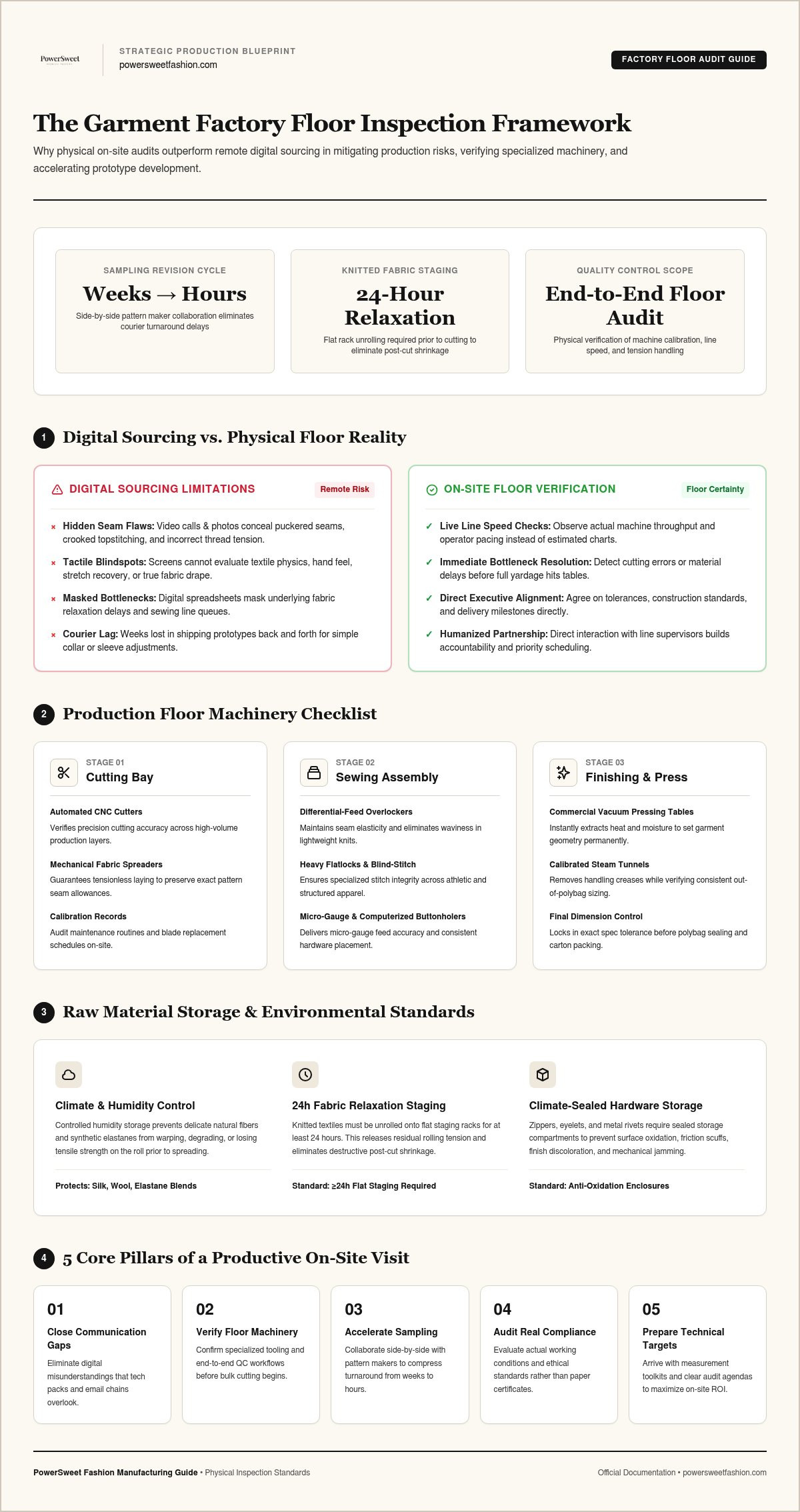
Digital sourcing platforms promise total transparency through online dashboards and photo attachments. The physical reality on the production floor tells a very different story. Email threads and remote updates frequently mask underlying bottlenecks, ranging from fabric relaxation delays to sewing backlog queues. Walking through the facility reveals actual machine throughput, operator pacing, and material handling in minutes. Experiencing the practical benefits of visiting your garment factory firsthand replaces theoretical spreadsheets with verifiable production metrics. When teams meet directly on the floor, technical friction dissolves before bulk yardage hits the cutting tables.
Live Capacity Checks: Observe actual line speeds instead of relying on estimated scheduling charts.
Immediate Bottleneck Resolution: Spot material delays or cutting errors before they disrupt delivery deadlines.
Executive Alignment: Agree on tolerances and delivery milestones directly with production heads.
The Limitations of Digital Communication in Garment Manufacturing
A high-resolution monitor cannot convey physical textile physics. Video calls fail to reveal true fabric drape, stretch recovery, or the tactile hand feel of delicate blends. Tech pack annotations often get misinterpreted across long message chains, while camera angles can easily conceal puckered seams, crooked topstitching, or improper thread tension on prototypes. Setting rigorous quality control inspection workflows requires tactile verification directly at the assembly line. Direct physical inspection ensures your construction standards translate accurately from design files to finished garments.
Building Trust and Strategic Alignment Across the Supply Chain
Apparel manufacturing fundamentally depends on skilled human hands. Meeting line supervisors, technical pattern makers, and sewing specialists humanizes your brand beyond a digital purchase order. Production facilities consistently prioritize orders for brand partners who take the time to evaluate operations on-site. An open-door policy reflects total confidence in operational safety, clean environments, and assembly precision. That mutual visibility builds deep accountability and turns basic supplier transactions into durable, responsive production partnerships.
Auditing Production Capabilities, Machinery, and Quality Control Workflows
A manufacturing facility can make bold promises on paper, but the machinery installed on the floor determines actual output quality. Inspecting factory infrastructure confirms whether a supplier possesses the specialized tooling required for your designs, from micro-gauge knit feed mechanisms to computerized buttonholers. Direct audits reveal equipment maintenance routines, operator handling standards, and systematic calibration records. To understand how these operational layers integrate into a seamless run, review our guide on end to end clothing production. Securing consistent sizing across thousands of pieces starts with confirming that physical workflows match your technical specifications.
Evaluating the Cutting, Sewing, and Finishing Equipment
Precision begins at the cutting table. Verify automated CNC cutters and mechanical fabric spreaders, ensuring tensionless laying that preserves exact seam allowances. Check dedicated machinery along the sewing lines, such as differential-feed overlockers, heavy flatlocks, and specialized blind-stitch units. In the finishing bay, inspect commercial vacuum pressing tables and calibrated steam tunnels. Proper final pressing locks in garment geometry and ensures pieces match approved fit standards straight out of the polybag.
Inspecting Raw Material Storage and Environmental Controls
Defects frequently originate in storage bays long before sewing begins. On-site audits let you assess warehouse conditions directly:
Climate Control: Controlled humidity levels prevent delicate natural fibers and synthetic elastanes from warping or degrading on the roll.
Fabric Relaxation Stages: Quality-driven facilities unroll knitted textiles onto flat staging racks for at least 24 hours to prevent post-cut shrinkage.
Hardware Management: Zippers, eyelets, and metal rivets require climate-sealed shelving to eliminate oxidation, friction scuffs, and mechanical jamming.
Observing In-Line Quality Assurance Checkpoints
Evaluating an operational floor reveals how factory supervisors implement lean manufacturing and continuous improvement across active production cells. Rather than waiting for final random sampling at the shipping dock, observe in-line checkpoints where technicians measure critical points of measure (POMs) mid-sewing. Verify that dual-head metal detection machines actively scan every finished women's apparel piece to capture broken needle fragments. Witnessing these checkpoints proves that acceptable quality limit standards, such as standard AQL 2.5 thresholds for major defects, are maintained during daily assembly runs.
These verifiable audit checkpoints highlight the structural benefits of visiting your garment factory before authorizing large cutting orders. If you want to review specialized equipment and live testing procedures directly, explore partnering with PowerSweet Fashion to experience transparent, open-floor manufacturing.
Accelerating Sample Development and Live Material Sourcing
Sampling is often the slowest bottleneck in apparel manufacturing. Standard remote prototyping frequently drags through two to four rounds per style, with each revision burning two to four weeks in transit and sample-room queues. Visiting your production facility transforms this fragmented process into an intensive, hands-on workshop. Instead of waiting weeks for couriers, your team can review fit models, alter patterns, and cut revisions within 24 to 48 hours. Maximizing the benefits of visiting your garment factory means treating the sample floor not as an inspection gate, but as an active co-creation studio. To understand how structured prototyping protects production timelines, review our guide on selecting a sample development clothing manufacturer.
Instant Fit Adjustments with In-House Pattern Makers
Live fit sessions yield immediate results that digital comments cannot replicate. When a prototype garment is draped on an in-house fit model, technical pattern makers can pin adjustments directly to the silhouette. You stand side-by-side at the CAD workstation as pattern makers adjust digital grading rules, revise dart placements, and shift seam angles. Within hours, the sample cutting room produces a corrected toile or prototype using the updated cut file. This rapid loop condenses weeks of back-and-forth email explanations into a single productive afternoon.
Hands-On Sourcing Through On-Site Fabric and Trim Libraries
Material verification becomes straightforward when you access the factory swatch library in person. Digital scans rarely capture the nuance of surface texture, true opacity, or fabric hand feel:
Direct Swatch Comparisons: Test hundreds of in-stock fabric rolls to compare real-world drape, GSM weights, and fiber recovery across different weaves.
Hardware Pairing: Place physical zippers, pulls, metal eyelets, and woven labels directly against your selected base cloths to verify color matching and proportion.
Lead Time Compression: Selecting verified available yardage from on-site textile inventories bypasses mill production queues, securing immediate materials for fast production.
Working directly within the material library eliminates the risk of approving swatches that fail under sewing tension or arrive out of stock. Partnering with a manufacturer capable of rapid 10-day sample turnarounds and 15 to 20-day bulk manufacturing cycles gives you an operational edge. Physical collaboration during development ensures your women's apparel line launches on schedule with zero compromises on fit or fabric integrity.
Verifying Ethical Standards, Working Conditions, and Factory Compliance
Paper certificates can be forged, framed, or staged for pre-announced third-party audits. Walking the active production floor unannounced provides the only unfiltered proof of genuine social compliance and physical safety. Modern apparel consumers actively investigate supply chain ethics, making unverified production an existential risk for independent labels. A single safety failure or labor violation can permanently damage your brand reputation. For a comprehensive roadmap on selecting fully vetted production partners, read our strategic guide to choosing a custom women's clothing manufacturer. Transparent operations protect your brand equity before commercial marketing begins.
Assessing Physical Workplace Safety and Hygiene
A physical walk-through exposes structural hazards that static audit checklists overlook. Focus on core environmental safety indicators across every department:
Emergency Exits: Ensure fire exits remain completely unlocked, illuminated, and clear of stacked fabric rolls or scrap bins during active shifts.
Air Quality and Ventilation: Inspect active air filtration and exhaust systems around industrial steam presses, solvent spot-cleaning stations, and cutting areas where fabric dust accumulates.
Line Safety: Verify that high-speed sewing tables feature needle eye guards, pulley covers, and recessed floor channels for electrical wiring to prevent trip hazards.
Observing Labor Practices and Operator Well-Being
Workplace culture directly influences garment craftsmanship and seam precision. Observe the operational rhythm across the sewing cells. Rushed, chaotic pacing often signals dangerous overtime crunches and hidden subcontracting, while calm, methodical assembly reflects skilled labor and realistic production scheduling. Inspect worker break rooms, sanitation stations, and posted legal notices detailing transparent wage standards and grievance procedures. Skilled seamstresses working in comfortable, well-lit environments produce cleaner topstitching, tighter tolerance adherence, and fewer rework cycles.
Verifying daily operational standards in person remains one of the primary benefits of visiting your garment factory. Direct observation confirms that the people bringing your designs to life are treated with fairness and respect. Ready to build a clean, fully compliant production run? Schedule a factory tour with PowerSweet Fashion to inspect our sewing floors, meet our production supervisors, and review our ethical manufacturing standards in person.
How to Prepare for a Productive Garment Factory Visit
Walking into an industrial facility without an explicit agenda wastes valuable production floor time. To unlock the full benefits of visiting your garment factory, every hour on-site must generate tangible manufacturing progress. Treat the trip as an intensive working session rather than a casual tour. Coordinate your travel dates several weeks in advance so factory leadership can reserve bench time with head pattern makers, technical leads, and floor supervisors. When both parties work from an aligned technical schedule, critical production hurdles get solved in hours instead of days.
Pre-Visit Documentation and Sample Preparation
Arriving with organized documentation keeps discussions anchored in measurable engineering specifications. Bring physical assets that digital screens simply cannot communicate:
Hard-Copy Tech Packs: Print updated construction sheets, point-of-measure (POM) tolerances, and bill of materials (BOM) breakdowns for floor supervisors.
Problem Prototypes: Bring problematic sample garments marked with tailoring chalk or pins directly over problem areas like puckering armholes or uneven hems.
Structured Hourly Agendas: Share an itinerary outlining when your team plans to audit sewing lines, review warehouse stocks, and conduct live fittings.
Conducting the Exit Meeting and Locking in Next Steps
Never step off the factory floor without formalizing every agreement made across the visit. Schedule a mandatory exit debrief with the production director and quality managers before departing. Review identified assembly challenges directly, addressing root causes rather than surface symptoms. Document all pattern revisions and construction updates in written notes signed by both parties.
If a revised prototype was sewn during your visit, sign and seal duplicate counter-samples alongside the facility manager to serve as the definitive Golden Sample benchmark. Finally, confirm your manufacturing calendar, locking in milestone dates for pre-production sign-offs and bulk delivery cycles so everyone remains completely accountable.
Build Manufacturing Certainty Before Bulk Production Begins
Stepping onto the cutting floor eliminates the uncertainty of remote apparel manufacturing. When you experience the direct benefits of visiting your garment factory, you protect your capital, align technical specifications with in-house pattern makers, and verify strict ethical standards firsthand. Physical observation transforms passive vendor monitoring into an active, collaborative production partnership.
At PowerSweet Fashion, we operate an open-door facility built for seamless custom women's clothing production. Take advantage of our comprehensive end-to-end services, including curated fabric sourcing, live pattern making, and multi-stage quality control. With rapid 10-day sample prototyping and agile 15 to 20-day bulk manufacturing cycles, we help you take collections from design sketches to finished racks without costly delays. Schedule an on-site factory visit with PowerSweet Fashion today to review our sewing floors and engineer your next collection with total confidence.
Frequently Asked Questions
How often should a fashion brand visit their garment manufacturing facility?
Most apparel brands benefit from visiting at least once during initial onboarding and prototype development. After establishing a reliable workflow, scheduling visits once or twice a year before major seasonal collection runs keeps standards aligned. Visiting whenever you introduce complex new garment categories or new textile blends ensures that pattern makers and floor supervisors understand your evolving quality expectations.
Can small apparel brands with low minimum orders still visit their factory?
Yes, reputable apparel manufacturers welcome emerging brands regardless of order volume. Transparent facilities maintain an open-door policy because hands-on client collaboration improves operational efficiency for both parties. Touring early helps independent founders master production workflows, resolve pattern questions quickly, and build personal relationships with floor supervisors that pay long-term dividends as your production volumes grow.
What is the best stage of production to schedule an in-person factory visit?
The optimal window is during late sample development or right before bulk fabric cutting begins. Scheduling your trip during this transition phase maximizes the benefits of visiting your garment factory. You can review fit models live, approve the Golden Sample with technical leads, and verify fabric relaxation protocols before high-volume automated cutters slice through your production rolls.
How does an in-person visit speed up custom garment sample development?
On-site visits compress development cycles by eliminating international shipping delays and miscommunicated design markups. Instead of waiting weeks between courier deliveries, you review physical prototypes side-by-side with in-house pattern makers. Technicians can adjust digital CAD files, recut pattern pieces, and assemble revised toiles within hours. This hands-on collaboration ensures your technical specifications are locked in without weeks of sample room queuing.
What specific machinery should I look for during a garment factory tour?
Look for automated tensionless spreading tables, computerized CNC fabric cutters, and specialized sewing stations suited to your garment categories. For custom women's apparel, inspect differential-feed overlockers, flatlocks, blind-hem units, and commercial vacuum pressing tables. You should also confirm the active use of dual-head needle detection machines and calibrated lightboxes to verify structural and color consistency.
Is an in-person visit necessary if our supplier already provides video audits?
Yes, because video feeds cannot convey tactile textile physics or spontaneous floor realities. Pre-scheduled video calls frequently highlight sanitized sample rooms while masking assembly line bottlenecks, improper fabric storage, or worker fatigue. Experiencing the true benefits of visiting your garment factory includes evaluating fabric drape, inspecting seam tension up close, and confirming that everyday working conditions meet strict ethical standards.
What documents should I prepare before touring a garment production facility?
Bring complete physical tech packs with point-of-measure tolerances, detailed bills of materials, and graded size charts. Include fabric swatch standards, approved color swatches, and physical sample garments marked with tailoring chalk to illustrate specific construction adjustments. Having an organized, hour-by-hour audit checklist also ensures your time on the production floor remains focused and efficient.


Comments