%20(1).png)
The Essential Factory Visit Checklist for Fashion Brands (2026 Edition)

A shiny showroom doesn't guarantee a seamless production run. Too many fashion founders walk through a polished front office only to have their bulk orders plagued by construction errors and ethical inconsistencies. If you want to move beyond the surface level, you'll need a rigorous factory visit checklist for fashion brands that separates the performers from the pretenders. It's about auditing systems, not just admiring machines.
We understand the pressure of finding a reliable partner for your custom women's apparel. It's natural to feel anxious about the transition from a perfect sample to a thousand-piece bulk order. This guide provides a professional framework to help you evaluate technical capabilities and ethical compliance on-site. You'll learn how to spot construction red flags and verify the hand-off points between departments. We'll walk you through the essential steps to secure your production quality and build a partnership grounded in transparency and precision. By the end of this article, you'll have a concrete tool to ensure your manufacturing partner is as reliable as they claim.
Table of Contents
Pre-Visit Preparation: Setting the Stage for a Successful Audit
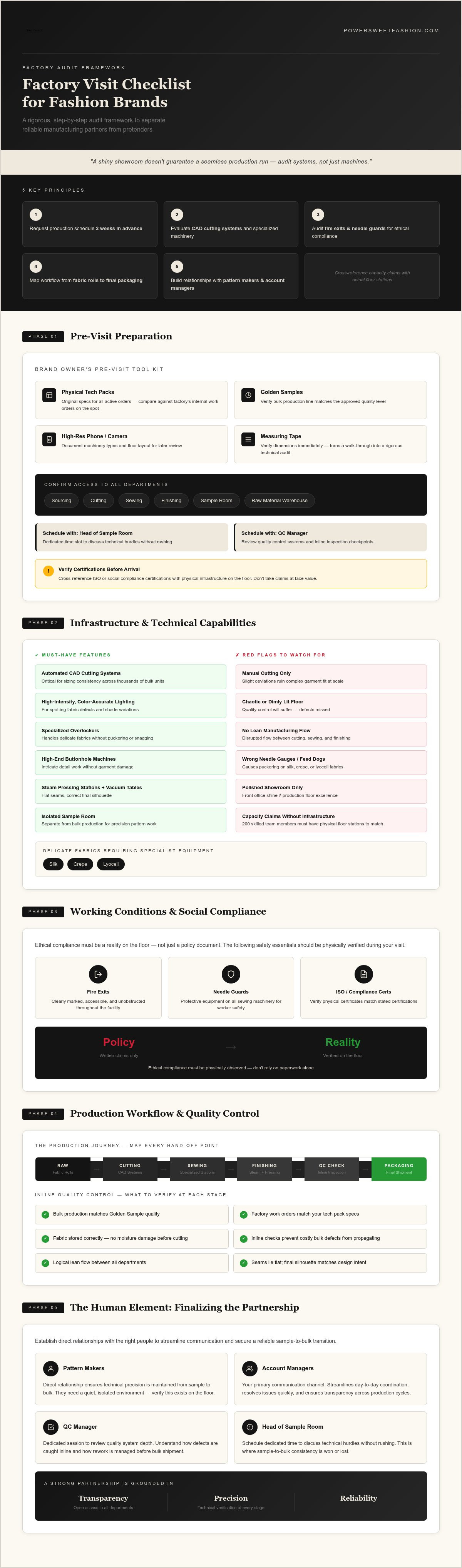
Success on the factory floor starts in your office. You must define your primary objectives before booking a flight. Are you vetting a new partner for custom women's apparel or performing a mid-production quality check? Clear goals allow you to customize your factory visit checklist for fashion brands to address the specific risks of your current production cycle. Request a detailed production schedule at least two weeks in advance. This ensures you see your specific garments moving through the line rather than a staged demonstration of generic samples.
Logistics require meticulous planning. Beyond securing visa requirements and local transport, you should consider your facility visit within the wider framework of supply chain management. Understanding how raw materials enter the facility and how finished goods depart is critical for long-term stability. Dress for the environment. Wear comfortable, closed-toe shoes and avoid loose clothing that could catch on machinery. This pragmatic approach signals to the factory that you're a serious industrial partner, not just a visitor.
The Brand Owner’s Pre-Visit Tool Kit
Your tool kit is your benchmark for quality. Bring original physical tech packs for all active orders. You'll need these to compare your specifications against the factory's internal work orders on the spot. Carry your "Golden Samples" to verify that the bulk production line matches the approved quality level. A high-resolution phone is essential for documenting machinery types and layout. Always include a professional measuring tape to verify dimensions immediately. These tools turn a casual walk-through into a rigorous technical audit.
Setting Expectations with Factory Management
Transparency is the foundation of a strong partnership. Confirm which departments will be open for inspection, specifically Sourcing, Cutting, Sewing, and Finishing. Schedule dedicated time slots with the head of the sample room and the QC manager. You need to discuss technical hurdles without rushing. Request access to the raw material warehouse to check storage conditions. Proper fabric storage prevents moisture damage and ensures the longevity of your materials before they reach the cutting table.
Researching Factory Certifications
Verify ISO or industry-specific social compliance certifications before arrival. Don't take claims at face value. Cross-reference their stated capacity with the actual number of sewing stations on the floor. A factory with 200 skilled team members must have the physical infrastructure to support that scale. Evaluate their end to end clothing production capabilities to see if they can handle your brand's growth. This research ensures you're choosing a partner that offers both speed and meticulous care.
Evaluating Infrastructure and Technical Capabilities
The physical layout of a production facility directly impacts the precision of your final product. When you're using a factory visit checklist for fashion brands, you must look beyond the number of sewing machines to the specific technology powering them. Start in the cutting room. Automated CAD cutting systems are critical for maintaining sizing consistency across thousands of bulk units. Manual cutting often leads to slight deviations that can ruin the fit of complex custom women's apparel.
Efficiency on the floor depends on organization. A factory utilizing lean manufacturing principles will have a logical flow where garments move seamlessly from cutting to sewing and then to finishing. Observe the lighting. Technicians need high-intensity, color-accurate lighting to spot subtle fabric defects or shade variations. If the floor feels chaotic or dimly lit, your quality control will suffer. A dedicated sample room should be isolated from the noise of bulk production to allow pattern makers the quiet environment needed for precision work.
Specialized Machinery for Women’s Apparel
Women's fashion often involves delicate fabrics like silk, crepe, or lyocell. These materials require specific needle gauges and feed dogs to prevent puckering or snagging. Look for specialized overlockers and high-end buttonhole machines that can handle intricate details without damaging the garment. Check for professional steam pressing stations equipped with vacuum tables. These ensure that seams lie flat and the final silhouette matches your design intent. If you're looking for a partner with these specific technical capabilities, exploring custom women's clothing production can provide the reliability your brand needs.
Raw Material and Fabric Management
Quality begins before the first stitch. Observe how the factory handles incoming fabric rolls. Professional facilities use fabric inspection machines with a four-point system to identify holes, stains, or weaving flaws. Fabric relaxation is another critical step. Knitted or elasticated fabrics must be unrolled and allowed to rest for 24 to 48 hours before cutting to prevent post-production shrinkage. This patience in the pre-production phase is a hallmark of a high-quality manufacturer.
Storage conditions for hardware and trims are equally important. Zippers, buttons, and metal tags should be kept in climate-controlled environments. High humidity leads to oxidation and tarnishing, which can ruin a luxury aesthetic. A factory that manages these small details demonstrates the meticulous care required for high-end production. By verifying these technical points, you ensure your manufacturing partner is a safe pair of hands for your creative vision.
Auditing Working Conditions and Social Compliance
Ethical integrity is as vital as technical skill. When you use your factory visit checklist for fashion brands, the human element should be your top priority. Observe the general atmosphere on the sewing floor. Well-trained, focused workers usually indicate a stable management system and a low turnover rate. This stability directly correlates with consistent production quality. Check for basic safety essentials. Fire extinguishers must be serviced and visible. Exit paths must be clear of fabric scraps or boxes. Every sewing machine should have a needle guard in place. These guards are often removed to increase speed, but their absence is a major safety violation and a red flag for poor oversight. A safe floor is a productive floor.
Verify age requirements and labor standards through direct observation. A professional facility adheres strictly to legal requirements and maintains a transparent hiring process. If the factory provides dormitories or a canteen, ask to see them. Humane living standards reflect a company's respect for its 200+ skilled team members. A manufacturer that invests in its people is far more likely to invest the necessary care into your custom women's apparel. This investment in the workforce ensures that your designs are handled by artisans who take pride in their craft.
Health and Safety Red Flags to Watch For
A thorough factory visit checklist for fashion brands must include a section on health and safety to protect your brand's reputation. Look for blocked aisles or poor ventilation in pressing areas. Chemical odors shouldn't be overwhelming. Check for first aid kits and safety signage in local languages. Observe if workers are wearing appropriate PPE during fabric dyeing. These details prove the factory prioritizes long-term worker health over short-term cost-cutting.
Transparency and Record Keeping
Ask to see the time-tracking systems to verify that working hours are compliant with local laws. Inquire about the factory's policy on subcontracting. Your order should stay in-house to maintain quality control. Choosing a custom women's clothing manufacturer with transparent practices ensures you aren't surprised by hidden production sites. This level of openness is the hallmark of a "Safe Pair of Hands" in the industry.
Production Workflow and Quality Control Systems
Trace the path of a single garment. It's the best way to understand a factory's operational logic. Start at the fabric roll and follow the assembly through to final packaging. Your factory visit checklist for fashion brands must prioritize the identification of 'Inline QC' stations. These are locations where technicians inspect partially finished garments directly on the sewing line. Early detection prevents a small tension issue from becoming a batch-wide disaster.
Inspect the 'Red Tag' area. This is where defective items are quarantined. A professional factory doesn't just discard these pieces; they track the reason for failure to prevent recurrence. This section of your factory visit checklist for fashion brands ensures your sizing remains consistent by verifying that the QC team checks final measurements against the original spec sheets from your tech pack.
The Sample-to-Bulk Hand-off Process
The transition from a single sample to bulk production is where most errors occur. Ask the production manager how the 'Approved Sample' is communicated to the sewing line. You should see the physical sample or a detailed reference sheet at every workstation. Check for 'Pre-Production (PP) Meeting' records. These meetings are where the design and production teams flag potential construction issues before the first cut. It's essential to partner with a sample development clothing manufacturer that carries a precision-first mindset into bulk execution.
Final Inspection and Packaging Standards
The final steps determine the customer's first impression. Observe the final steam-pressing area. It should be the last step before garments enter polybags to ensure a crisp, retail-ready finish. Metal detection is a mandatory safety step for any reputable manufacturer. Every garment must pass through a sensor to ensure no broken needles or pins remain in the fabric. Review the packing list for accuracy. Check that labels, hangtags, and polybags are applied according to your exact requirements. If you're ready to secure your production quality, you can request a quality control audit today.
Inline vs. Final Inspection Comparison
Inline inspection is the only way to maintain low MOQ women's clothing manufacturer efficiency. Real-time feedback significantly reduces fabric waste and prevents long lead times caused by rework. By catching errors at the source, the factory maintains a steady flow and protects your margins.
The Human Element: Finalizing the Partnership
A successful audit ends with a face-to-face meeting. While machines and workflows provide the foundation, the people you meet determine the long-term success of your production. Meet your dedicated account manager to establish preferred communication channels. Whether you prefer Email or WhatsApp, clear lines of contact prevent delays. This meeting is the final piece of your factory visit checklist for fashion brands, turning a technical inspection into a collaborative venture.
Take the time to sit down with the pattern makers. Discuss specific fit issues you've encountered in the past. These technicians are the architects of your custom women's apparel, and direct dialogue ensures your aesthetic vision translates into a wearable reality. Review the 'Critical Path' document together. Align on lead times, specifically the 10-day sample turnaround and the 15-20 day bulk production window. Discussing scalability is also vital. You need to know if the factory can support your brand as it grows from a 50-piece test run to a 5,000-piece seasonal collection.
Establishing Communication Protocols
Ambiguity is the enemy of efficient manufacturing. Define who your primary point of contact is for technical questions versus logistical updates. Agree on a weekly reporting format to keep production on track without constant follow-ups. Discuss how the team handles emergencies or fabric delays. A proactive factory will have a contingency plan ready, reinforcing their status as a safe pair of hands for your brand. This level of transparency lowers the barrier to entry for new labels and builds trust with seasoned professionals.
Post-Visit Action Plan and Follow-up
The work doesn't end when you leave the facility. Summarize your findings in a formal email within 24 hours of your departure. This document should list any 'corrective actions' identified during the audit with a clear timeline for resolution. Requesting these updates ensures the factory takes your quality standards seriously. Finalize the next steps for sample development or bulk deposit payments to keep the momentum moving. By closing the loop professionally, you solidify a partnership that values both industrial precision and human connection.
Securing Your Brand's Manufacturing Future
A successful manufacturing partnership isn't built on faith; it's built on verified systems. By implementing a rigorous factory visit checklist for fashion brands, you move beyond the surface of a showroom to audit the technical precision and ethical standards that define your product's quality. You've learned how to trace a garment's path through inline QC and why meeting the human team behind the machines is vital for scaling from small batches to major collections.
We invite you to experience this transparency firsthand. PowerSweet Fashion offers 18+ years of manufacturing expertise and a facility where our 200+ dedicated team members prioritize your brand's growth. We understand the need for responsiveness, which is why we maintain a 10-day sample turnaround for fast-moving brands. It's time to partner with a manufacturer that values precision as much as you do.
Book a Tour or Order Your First Sample with PowerSweet Fashion to see our commitment to excellence in action. We're ready to be the safe pair of hands your creative vision deserves.
Frequently Asked Questions
How long should a thorough clothing factory visit take?
A thorough visit typically requires four to six hours. This timeframe allows you to move beyond the showroom and execute your factory visit checklist for fashion brands across the cutting, sewing, and finishing departments. You'll need at least two hours for the floor audit and another two hours for technical meetings with pattern makers or account managers. Rushing the process often leads to overlooked red flags in garment construction or safety compliance.
Do I need to hire a professional translator for the visit?
While many established manufacturers provide English-speaking account managers, hiring a professional translator is a wise investment for technical discussions. Precise communication is vital when discussing pattern adjustments or fabric tolerances. A translator ensures that your specific quality requirements aren't lost in translation during high-stakes negotiations. If your overseas manufacturing partner has extensive experience with global brands, their internal team might suffice, but having your own representative provides an extra layer of security.
What is the most common red flag to watch for on the factory floor?
The most significant red flag is a lack of basic safety infrastructure, such as blocked fire exits or missing needle guards on sewing machines. These violations suggest that management prioritizes speed over worker welfare and systematic oversight. Poor organization on the floor often translates to inconsistent quality in your custom women's apparel. If you notice fabric scraps obstructing aisles or inadequate lighting in the quality control area, it's likely that your production will face similar negligence.
Can I take photos and videos during the factory tour?
Most transparent manufacturers allow you to document the facility for your internal audit records. Always ask for permission before filming specific production lines to respect the privacy of other clients' designs. High-resolution photos of machinery types and the "Red Tag" area are essential components of a professional factory visit checklist for fashion brands. This documentation helps your technical team verify that the facility's infrastructure matches the requirements listed in your original tech packs.
Should I visit the factory before or after placing a deposit?
You should always visit the facility before placing a bulk production deposit. This visit serves as the final vetting stage to confirm the factory's scale and technical expertise. Seeing the 200+ skilled team members in person provides the reassurance needed to commit your brand's capital. While you might pay for initial sample development first, the physical audit ensures the partner is a safe pair of hands before you transition into high-volume manufacturing.
Is it appropriate to bring my own physical samples to the meeting?
Bringing your own physical samples or competitor garments is highly encouraged. Physical samples provide a concrete reference point for quality, fit, and construction details that tech packs might not fully capture. Sitting down with the pattern makers to compare your samples against their capabilities helps align expectations immediately. This hands-on approach reduces the risk of multiple sampling rounds and ensures the factory understands the exact finishing standards your brand requires for its collection.
What should I wear when visiting a garment manufacturing facility?
Wear professional yet practical attire that prioritizes safety on the factory floor. Closed-toe shoes are mandatory to protect against dropped needles or heavy machinery. Avoid loose jewelry or flowing scarves that could potentially catch in moving parts during the tour. Dressing like a pragmatic industrial partner rather than a high-fashion critic signals that you're focused on the mechanics of production. This choice demonstrates respect for the facility's safety protocols and the technical nature of the work.
How do I verify if the factory is actually doing the sewing in-house?
Verify in-house production by requesting to see your specific order moving through the sewing lines. Match the number of active workstations with the factory's claimed capacity of 200+ skilled team members. Check the internal production logs and time-tracking systems to ensure the work is being performed on-site. If the facility is strangely quiet or lacks the specialized machinery required for your custom women's apparel, it may be a sign of unauthorized subcontracting to a secondary location.


Comments