%20(1).png)
How to Prepare for a Factory Visit in China: The 2026 Fashion Brand Checklist

A factory visit isn't a simple meet-and-greet; it's a high-stakes technical audit that determines if your brand survives the next production cycle. While many designers treat these trips as casual tours, the most successful labels approach the factory floor as a strategic battlefield for quality. You've likely spent months refining tech packs while worrying if your bulk order will actually match your vision. It's natural to feel anxious about travel logistics or the risk of receiving subpar garments after a significant investment.
Understanding how to prepare for a factory visit in China is the only way to turn that uncertainty into a competitive advantage. We'll show you how to master the 2026 landscape, from utilizing the 30-day unilateral visa-free policy to setting up mobile payments for seamless local transit. You'll learn how to execute NNN agreements that protect your designs and how to audit production lines for technical compliance. This guide provides a clear roadmap to help you evaluate sample development, verify quality control systems, and leave the facility with a signed production plan and total confidence in your manufacturing partnership.
Table of Contents
Why a Physical Factory Visit is Essential for Your Fashion Brand
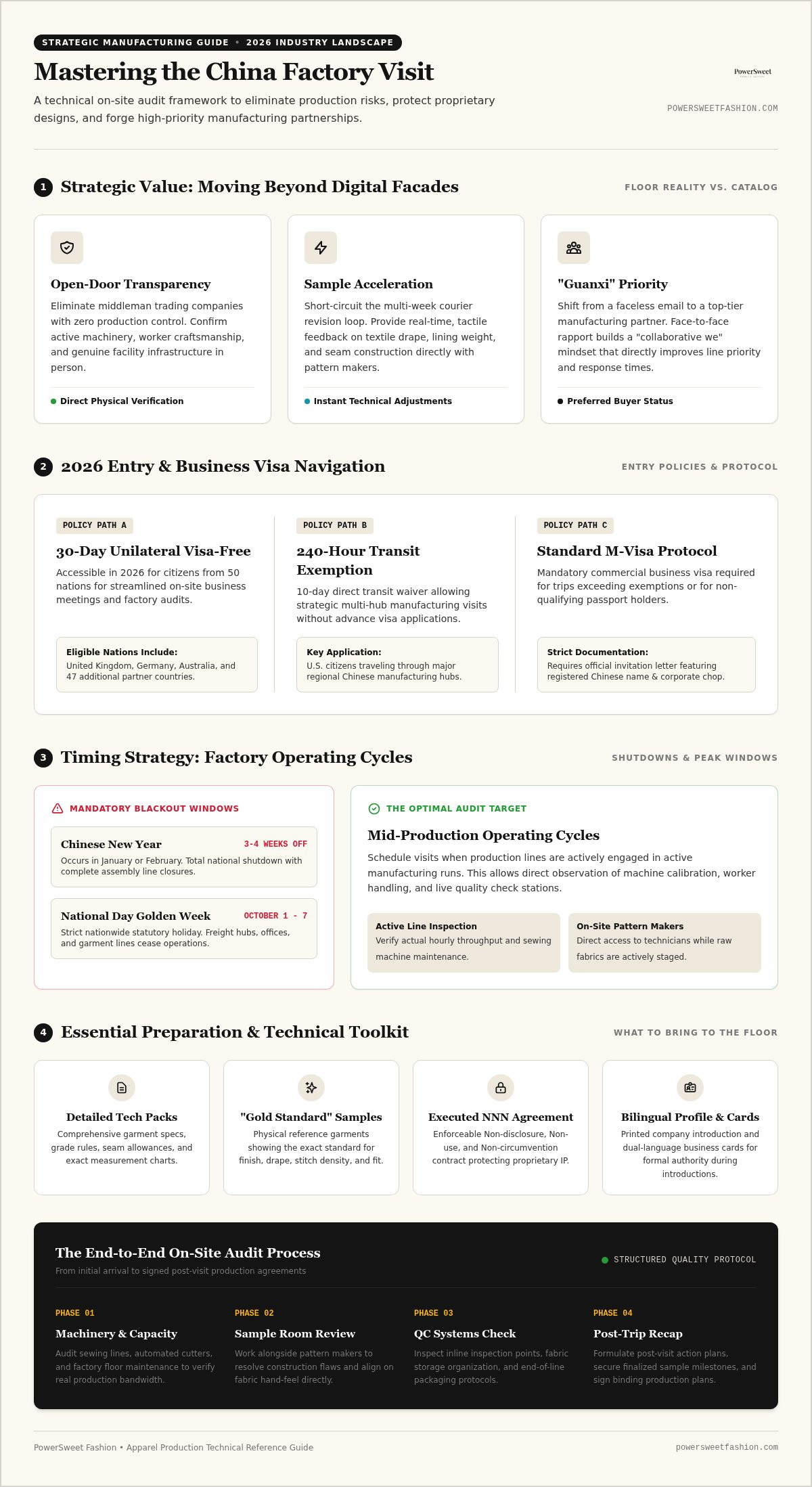
A digital storefront can hide a lot of operational reality. For fashion brands, the biggest risk isn't just a delay; it's the discovery that your "factory" is actually a middleman trading company with no control over your production line. Seeing the facility in person provides "Open-Door Transparency." It lets you verify the machines are running, the workers are skilled, and the facility actually exists. This physical verification is the first step in learning how to prepare for a factory visit in China to protect your brand's capital.
When you walk the floor, you move from being a faceless email to a real partner. You'll meet the production managers and pattern makers who turn your sketches into physical garments. This face-to-face interaction allows you to short-circuit the sample development clothing manufacturer process. Instead of waiting weeks for a revision to arrive by courier, you can provide instant feedback on the drape of a fabric or the placement of a seam. It ensures the people actually sewing your garments understand your specific quality standards before the first meter of fabric is cut.
Moving Beyond Digital Communication
Video calls fail to capture the tactile reality of the garment industry. You can't feel the hand-feel of a textile or judge the weight of a lining through a screen. Assessing these materials in person is an essential part of how to prepare for a factory visit in China because it reveals the factory's true capacity. A physical visit allows you to spot red flags that are invisible in a digital catalog, such as poorly maintained machinery or disorganized fabric storage. Being on-site also changes your status. Factories often prioritize clients they've met in person, which directly impacts your production lead times and overall responsiveness.
Establishing Long-Term Trust
Success in the Chinese manufacturing sector relies heavily on building guanxi with Chinese suppliers. This network of mutual trust transforms your business from a one-off buyer into a strategic priority. Within an end to end clothing production strategy, these relationships are the engine of your brand. Meeting face-to-face resolves complex construction issues in minutes rather than days of back-and-forth emails. It establishes a "collaborative we" mentality where the factory is as invested in your brand's growth as you are. By standing on the production floor, you transition from a simple customer to a valued partner in the factory's long-term success.
Pre-Trip Logistics: Planning for a Successful Visit
Logistics are the silent engine of a successful production trip. If you fail to plan the entry requirements or timing, you risk losing thousands in wasted airfare and missed production windows. Learning how to prepare for a factory visit in China starts with a meticulous logistical plan that accounts for the 2026 regulatory environment. This isn't just about booking a flight; it's about aligning your schedule with the factory's operational rhythm and local business standards.
The Business Visa and Documentation
In 2026, entry requirements are more accessible than ever. Citizens from 50 countries, including the UK, Germany, and Australia, can now utilize the 30-day unilateral visa-free policy for business meetings. U.S. citizens often qualify for the 240-hour transit visa-free exemption when traveling through major manufacturing hubs. If you don't qualify for these exemptions, you must secure an M-Visa. This requires an official invitation letter from your manufacturing partner, complete with their registered Chinese name and the official corporate chop. Reviewing the U.S. Commercial Service business travel guidelines provides a reliable baseline for the latest etiquette and documentation standards. Always carry bilingual business cards and a printed company profile to establish immediate professional authority during introductions.
Optimizing Your Schedule
Timing is everything in the garment industry. You must avoid the Chinese New Year shutdown in January or February, as factories close for three to four weeks. Similarly, the National Day Golden Week from October 1 to 7 is a total national shutdown. The best time to visit is during mid-production cycles when you can observe active lines. If you're ready to begin the process, we can help you coordinate your visit to ensure maximum productivity while you're on the ground.
Allocate at least two full days per facility. This gives you enough time to tour the fabric warehouses, inspect the sample rooms, and allow for "on-the-fly" adjustments with the pattern team. Remember that local transport between factories and fabric markets can be time-consuming; plan for dedicated drivers or use mobile payment apps like Alipay or WeChat Pay. These apps allow you to bind international credit cards. It's helpful to know that a 3% fee applies to transactions over 200 RMB, and there's a $5,000 single transaction limit for foreign users. Ensuring your travel insurance covers business activities is the final step in a secure itinerary.
Technical Preparation: What to Bring to the Meeting
Walking into a factory meeting without the right tools is a recipe for production delays. You've already handled the travel logistics; now you must focus on the technical assets that bridge the gap between your design vision and the factory's output. Knowing how to prepare for a factory visit in China requires moving beyond digital files. You need a physical toolkit that allows for real-time problem-solving on the production floor. This preparation turns a simple tour into a high-value technical audit.
Your primary asset is a comprehensive tech pack. It must document every measurement, stitch type, and construction detail. Pair this with "gold standard" reference samples. These are garments that represent your ideal fit and finish. By showing these to the pattern-making team, you establish a baseline that words alone cannot convey. According to McKinsey's apparel sourcing analysis, successful brands are moving toward these collaborative, detail-oriented partnerships to mitigate supply chain volatility. This level of detail protects your brand from costly misinterpretations during bulk production.
Don't forget fabric and trim swatches. These are essential for clarifying your expectations for fabric sourcing. If you have specific buttons, zippers, or linings in mind, bring them. Finally, bring your launch calendar. Aligning your internal deadlines with our 15 to 20 day bulk production lead times ensures your collection hits the market on schedule. Clear communication about timelines prevents the "rush" mistakes that often compromise quality.
The Designer's Technical Toolkit
Bring digital and physical copies of your grading charts. This prevents confusion when scaling from a small to an extra-large. Your bill of materials (BOM) should be organized and ready for review; this prevents sourcing delays for small components like thread or labels. It's also the time to define your Acceptable Quality Level (AQL) standards. Setting these benchmarks now prevents disputes during final quality control. It's much easier to agree on a tolerance level while standing next to the production line than it is via email.
Sample Feedback and Prototypes
Use this time to address construction "pain points." Bring previous prototypes that didn't quite hit the mark. Pointing out exactly where a seam pulled or a drape failed helps the pattern team understand your requirements. This face-to-face feedback is what powers our 10-day sample turnaround. It allows for instant corrections that would otherwise take weeks of shipping. This is the core of how to prepare for a factory visit in China: turning a meeting into an active development session that accelerates your path to market.
The On-Site Checklist: Evaluating the Production Floor
Walking the production floor is the most critical phase of your journey. It's where the theoretical plans from your tech packs meet the physical reality of industrial manufacturing. Part of learning how to prepare for a factory visit in China involves developing an eye for operational flow and machinery health. You aren't just looking at the finished product. You're auditing the system that creates it. A streamlined facility reduces the risk of bottlenecks and ensures your bulk production remains on schedule.
Start with a machinery audit. Modern sewing, cutting, and finishing equipment are non-negotiable for high-quality women's apparel. Observe the workflow efficiency from the moment fabric is unrolled to the final packing stage. A disorganized floor often leads to lost trims or mixed-up sizing. You should also verify the workforce expertise and conditions. Ethical standards are essential; verify if the facility follows SMETA 7.0 guidelines for management systems. Skilled operators are the backbone of any successful brand partnership, and their environment reflects the factory's overall stability.
Inspecting the Cutting and Sewing Rooms
Precision in the cutting department is the foundation of a good fit. If the cutting is inaccurate, even the best sewing won't save the garment. Look for automated CAD cutters or high-precision manual tools that prevent sizing discrepancies. Cleanliness is equally vital. A dusty sewing floor can easily contaminate light-colored fabrics or delicate materials. If your collection includes specialized fabrics like lyocell or crepe, check for the specific machinery required to handle these textures without snagging. If you're ready to see these standards in action, you can book a tour of our production facility to evaluate our equipment firsthand.
Auditing Quality Assurance (QA) Processes
Quality isn't just checked at the end. It must be integrated into every station. Identify where the QC checkpoints are located along the line. You need to know how the factory handles "seconds" or defective garments. Are they clearly marked and separated, or do they risk being mixed back into the bulk order? Check for environmental compliance through the Higg Facility Environmental Module (Higg FEM 4.0) to ensure the factory manages resources responsibly. Pay close attention to the final pressing and packaging standards. A garment that's poorly pressed can arrive at your warehouse with permanent creases. Verifying these steps is a key part of how to prepare for a factory visit in China and secure your brand's reputation.
From Visit to Volume: Streamlining Post-Trip Production
The flight home marks the transition from inspection to execution. You must act quickly to capitalize on the momentum of your visit while the technical details are fresh. A formal visit recap is your most powerful tool here. It summarizes every agreed-upon change, from seam allowances to specific trim placements. Sending this document within 48 hours ensures that the verbal promises made on the factory floor become binding production requirements. This step is a vital part of how to prepare for a factory visit in China; it creates a clear paper trail that eliminates ambiguity during the bulk production phase.
Once the recap is confirmed, you move to finalize your agreement with a low MOQ women's clothing manufacturer. This is the moment to lock in your unit costs, delivery schedules, and payment terms. You'll align your launch calendar with our 15 to 20 day bulk production cycle. Clear communication during this hand-off prevents the delays that often plague remote manufacturing. You're no longer just a client; you're a strategic partner with a verified production roadmap and a shared vision for quality.
Formalizing Agreements
You need a concrete benchmark for quality control. Sign off on "sealed samples" before you leave or immediately upon your return. These garments serve as the physical standard for the entire bulk order; they are the reference point for every stitch and seam. If you've planned for third-party inspections, establish that protocol now. Defining these boundaries early protects your investment and ensures the factory knows exactly what constitutes a "pass" or "fail" based on your brand's specific AQL standards. It's about creating a system of accountability that works even when you aren't physically present.
The PowerSweet Fashion Partnership
The PowerSweet Fashion team supports your brand's growth long after you return home. We leverage our deep local supply chain to provide continuous fabric innovation and technical insights that keep your collections competitive. This allows you to scale your orders seamlessly as your brand moves from small batches to larger volumes. We act as your eyes on the ground, maintaining the high standards you verified during your visit. This partnership is the engine that powers your creative vision. We bridge the gap between digital communication and physical reality, ensuring every garment reflects the meticulous care you observed on our production floor.
Securing Your Brand's Production Future
A successful manufacturing partnership is built on more than just digital tech packs; it requires the physical reality of a production floor audit. Mastering how to prepare for a factory visit in China ensures you transition from a simple buyer to a strategic partner. By aligning your logistics with the 2026 visa-free entry policies and arriving with "gold standard" reference samples, you eliminate the guesswork that often leads to quality issues. You've seen how to audit machinery, verify workforce expertise, and formalize agreements that protect your brand's capital.
At PowerSweet Fashion, we specialize in high-efficiency women's wear production designed to power your creative vision. Our system offers a 10-day sample turnaround and a rapid 15-20 day bulk delivery cycle, ensuring your collection hits the market exactly when you need it. We invite you into our facility to experience our "Open-Door Transparency" firsthand. Transition from uncertainty to total production confidence today. Book Your Visit to PowerSweet Fashion and let's build your next collection together. Your brand deserves a partner that values precision as much as you do.
Frequently Asked Questions
Do I need a translator for a factory visit in China?
While many export managers speak English, hiring a professional translator ensures technical garment details are fully understood. It prevents miscommunication regarding specific stitch types or fabric specifications. If you are learning how to prepare for a factory visit in China, consider that a translator also acts as a cultural bridge during negotiations. This investment often pays for itself by avoiding costly production errors and ensuring your quality standards are met.
How long should I spend at the factory during a visit?
Plan to spend at least one to two full days at the facility. This duration allows you to tour the cutting and sewing rooms, audit the quality control stations, and meet with the pattern-making team. Rushing the visit can lead to overlooked operational issues. Dedicating enough time ensures you can thoroughly evaluate the machinery and workflow efficiency before committing your brand’s capital to a bulk order.
Is it better to visit before or after the sample development phase?
Visiting during the sample development phase is most effective. It allows you to provide immediate feedback to the pattern makers, which can significantly accelerate our 10-day sample turnaround. Face-to-face adjustments on a prototype are much faster than remote revisions. This timing ensures that the benchmark sample is perfected and approved before you transition into the 15-20 day bulk production cycle for your collection.
Can I visit fabric markets near the factory during my trip?
Yes, visiting local fabric markets is a strategic way to explore new materials and trims for your brand. We often facilitate these trips to help designers leverage local supply chains for continuous innovation. Seeing the vast array of textiles in person allows you to make tactile decisions that digital catalogs cannot replicate. It is an excellent opportunity to source unique components for your custom women's clothing production.
What is the best way to pay for my factory visit expenses and production deposits?
Use mobile payment apps like Alipay or WeChat Pay for local expenses, as most vendors rely on QR-code payments. You can bind international credit cards to these apps easily. For production deposits, bank wire transfers remain the standard for security. Remember that mobile apps have a $5,000 single transaction limit for foreign cards; they are best for daily travel costs, meals, and small fabric purchases.
What should I do if I find a red flag during my factory audit?
Address any concerns immediately with the production manager while you are on-site. Clear communication is the key to determining if a concern, such as disorganized storage or outdated machinery, can be corrected through better management. If the issues are systemic or affect safety, it is better to pause the partnership before bulk production begins. Documenting these findings helps you compare facilities and make an informed decision.
How do I handle business etiquette and gift-giving during the visit?
Focus on building professional trust through mutual respect and transparency. While elaborate gifts aren't required, bringing a small, high-quality item from your home country is a thoughtful gesture that builds rapport. Present business cards with both hands as a sign of respect. Understanding these nuances is part of how to prepare for a factory visit in China and helps transition your relationship from a transaction to a partnership.
Can I request to see the factory's social compliance certifications on-site?
You should always request to see physical copies of certifications like SMETA 7.0 or Higg Index modules during your tour. A transparent factory will have these documents ready for review and will be happy to discuss their management systems. Verifying these on-site confirms the factory's commitment to ethical standards and environmental compliance. This level of transparency is a hallmark of a reliable manufacturing partner in the modern fashion industry.


Comments