%20(1).png)
Reordering Bestsellers from Your Manufacturer: A Practical 2026 Guide

What if your bestseller’s next production run is the order most likely to disappoint? Strong sales create pressure to replenish quickly, but repeating the last purchase order without checking current demand can leave you short in key sizes, overstocked in slower colors, or facing a product that doesn’t match the approved original. Reordering bestsellers from your manufacturer works best as a controlled repeat-production decision, not a copy-and-paste purchase.
It’s reasonable to want a fast, straightforward reorder. Yet sales momentum alone doesn’t tell you how many units to make, and a familiar style still needs clear specifications and quality checks to keep production consistent. A reliable process makes those decisions visible before the order moves forward.
This guide will help you set reorder quantities using sales and inventory signals, document what must stay consistent, and coordinate a practical timeline with your manufacturing partner. We’ll walk through the process from reviewing size and color performance to confirming materials, specifications, production details, and quality checks. The goal is a repeatable plan that protects stock availability without taking unnecessary inventory risk.
Table of Contents
When should you reorder a bestseller from your manufacturer?
A bestseller reorder replenishes an established style based on current sales and inventory evidence, not simply because the style sold well before. Timing matters: order too late and stock may run out before replenishment arrives; order too early or too heavily and you may tie up inventory in units that sell more slowly than expected.
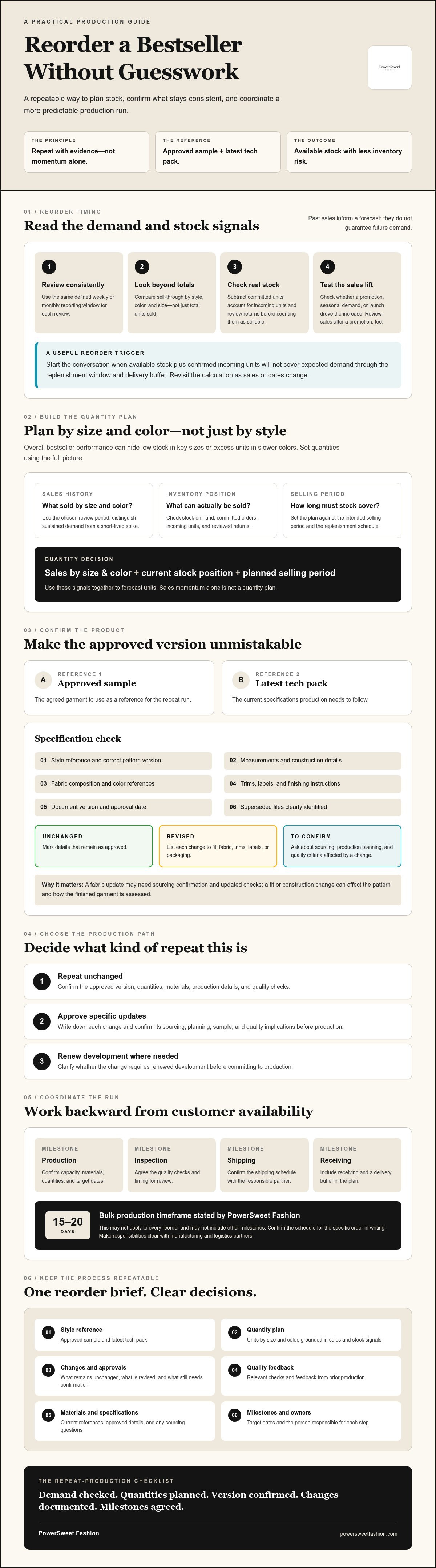
Use a defined, consistent review period to judge performance, such as the same reporting window for each weekly or monthly stock review. A bestseller should show sustained demand across that period, not just a short-lived jump. Past sales help inform a forecast, but they can’t guarantee future demand. Treat the reorder point as a useful inventory trigger, then adjust it for your production and delivery schedule.
Which sales and stock signals indicate a reorder?
Look beneath the total units sold. A style may be performing well overall while specific sizes or colors are already running low, or its total sales may be concentrated in one unusually busy week. Compare sell-through by style, color, and size over your chosen review period, then check what inventory is actually available.
Subtract units committed to existing orders from stock on hand.
Account for incoming units, and review returns before treating them as sellable stock.
Check whether a promotion, seasonal demand, or a product launch drove the sales lift.
If a promotion created the spike, assess sales after the promotion as well. That helps separate ongoing demand from a temporary lift before you set quantities.
How early should you start the reorder conversation?
Work backward from the date you need replenishment available to customers. Map the confirmed milestones for production, inspection, shipping, and receiving, and leave a buffer for delays or changes. Confirm who is responsible for each milestone with your manufacturer and logistics partners; don’t assume one timeline covers the entire journey.
PowerSweet Fashion states that bulk production takes 15-20 days, but that timeframe may not apply to every reorder or include the other milestones. Confirm the schedule for your specific order in writing before relying on it. For reordering bestsellers from your manufacturer, an early conversation gives both sides time to verify materials, capacity, quantities, and target dates before the order is finalized.
Practical check: If available stock plus confirmed incoming units won’t cover expected demand through the replenishment window and your delivery buffer, begin discussing the reorder. Revisit the calculation as sales or production dates change.
What should you confirm before repeating a bestseller?
A repeat order is only straightforward when everyone is working from the same approved version. Confirm the style first, then verify its specifications, check that the original materials are still intended, and approve quantities only after any differences are clear. This sequence helps prevent an old file, an informal change request, or an unconfirmed fabric substitution from becoming a production assumption.
Use the approved sample and latest tech pack as the reference points for communication. The sample shows the agreed garment; the tech pack records the specifications the production team needs to follow. Together, they give both sides a clear basis for reviewing what stays unchanged and what needs a decision.
How do you verify the original product specifications?
Match the style reference to the correct pattern version, measurements, construction details, and approved sample. Then check fabric composition and color references, along with trims, labels, and finishing instructions. Record the document version and approval date you send to the manufacturer, and identify any superseded files so they aren’t mistaken for current instructions.
Unchanged: Mark specifications that remain as approved.
Revised: List each requested change to fit, fabric, trims, labels, or packaging.
To confirm: Ask the manufacturer to review material sourcing, production planning, and quality criteria affected by a change.
Even a small revision can have downstream effects. A new fabric may require sourcing confirmation and updated checks, while a fit or construction change can alter the pattern and how the finished garment is assessed. Make the distinction explicit before approving the order.
Does a changed bestseller need a new sample?
Not every update calls for a new sample. A corrected document reference or administrative label update may leave fit and construction untouched. But don’t assume a proposed fabric, trim, or design change is production-ready: ask the manufacturer to assess its impact first. If the change could affect appearance, fit, materials, or construction, sample development can help you approve it before bulk production.
Keep the discussion specific: state what is changing, what must remain the same, and what evidence you need to approve the revision. Clear expectations also make it easier to negotiate with powerful suppliers about responsibilities and approval points without blurring the production brief.
If you’re unsure whether a bestseller is a true repeat or needs renewed development, discuss the specifications and sample requirements with a partner in custom women’s clothing production.
Should you reorder the exact style or revise it?
A bestseller doesn’t always need to stay exactly as it is. Choose between an unchanged repeat, a repeat with clearly approved updates, or renewed development based on what sales, customer feedback, and product checks show. The greater the change to fit, fabric, or construction, the more carefully you should reassess sampling and production readiness.
Use this comparison to frame the conversation with your manufacturer. The right route depends on the evidence and the scale of the proposed changes, not on an assumption that any option will be faster or cheaper.
When is an unchanged repeat order the clearest option?
Choose a straight repeat when demand still supports replenishment and the approved specifications remain right for the product plan. Confirm that the fabric, trims, pattern, and production instructions are still current and available. Keep any exception, such as a one-time label change, separate from the approved original so it doesn’t quietly become the new standard.
When should you revise or redevelop the style?
Consider a revision when customer feedback or returns point to a specific issue, rather than making changes simply because the style is being reordered. Assess whether the proposed fix affects fit, materials, construction, or consistency with the approved version. Ask the manufacturer to confirm sample and approval requirements before classifying the order as repeat production.
This is a shared planning decision. Applying supply chain management principles means weighing product requirements alongside sourcing and supplier coordination. For reordering bestsellers from your manufacturer, document the chosen route, the specifications it covers, and any approvals still needed before production starts.
How do you set reorder quantities and protect quality?
Build the quantity from expected demand across a defined selling period, then subtract stock that can already meet it. A practical starting formula is: forecast demand + planned buffer − sellable stock on hand − confirmed incoming units = estimated reorder quantity. The buffer should reflect your own demand uncertainty and replenishment plan, not an assumed industry standard. Treat the result as a working forecast to review with your manufacturer, not an automatic order quantity.
Before confirming the order, ask the manufacturer to assess whether the requested quantities are feasible, whether the specified materials are available, and which production milestones can be confirmed. Agree on inspection points and acceptance criteria before production starts, so quality expectations are part of the production plan rather than a discussion after delivery.
How can size and color quantities reflect actual demand?
Break the forecast down by each size-color combination. A strong total for a style can hide a mismatch, such as one color selling through quickly while another remains in stock. Compare sales with remaining sellable units for each combination, and review returns, stockouts, sales channels, and promotions. A stockout can obscure demand, while a promotion may make a short period look more typical than it is.
Share the assumptions behind your forecast, including the review period and planned selling window. That gives the manufacturer a clearer basis for discussing the proposed breakdown and planning materials and production milestones.
Which checks help keep repeat production consistent?
Set the approved sample and specifications as the reference for repeat units. Identify the applicable measurements and tolerances, materials, and workmanship requirements, then agree when checks will take place. For example, you can discuss whether material checks, in-process reviews, and a final inspection are appropriate for the order. Define how any nonconforming units will be documented and reviewed, including who will assess the issue and what decision is needed before the order proceeds.
Clear checkpoints connect the quantity plan to execution. Explore quality control in apparel manufacturing for more on setting quality expectations, and review end-to-end clothing production for broader workflow context.
For reordering bestsellers from your manufacturer, keep the forecast, size-color breakdown, approved specifications, and quality criteria together in the order brief. To discuss coordinating these details with PowerSweet Fashion’s clothing production team, share whether the order is an unchanged repeat or includes proposed revisions.
How can your manufacturer make bestseller reorders repeatable?
A repeatable reorder process depends on shared records, clear responsibilities, and confirmed milestones. Keep the approved specifications, order history, and quality feedback together so the manufacturer can distinguish the established product from any new request. That history also gives both sides a useful reference when discussing material availability, production planning, or a recurring quality concern.
Build a concise reorder brief for each order. Keep it practical and current:
Product reference: Style identifier, approved tech pack, sample status, and specification version.
Order details: Total quantity and breakdown by size and color, plus any requested changes and material requirements.
Plan and approvals: Target milestones, quality checks, approval owners, and open questions to resolve before production is confirmed.
Documenting open questions matters. It makes clear what still needs confirmation rather than allowing assumptions to become production instructions.
What should you ask a prospective reorder partner?
Ask how the manufacturer confirms specifications and materials before production begins, how sampling is assessed when a style changes, and how production updates or quality issues will be communicated. Agree on who reviews decisions and how they’ll be recorded. These answers show whether the workflow supports consistent repeat orders, not just whether the factory can make the garment.
PowerSweet Fashion offers fabric sourcing, sample development, pattern making, bulk production, and quality control for custom women’s clothing. Its stated sample timeline is 10 days and its stated bulk production timeline is 15-20 days, but confirm in writing whether either applies to your specific order and what milestones it includes. For a wider framework for assessing a potential production partner, see this guide to choosing a custom women’s clothing manufacturer.
With reordering bestsellers from your manufacturer, the brief is a working record, not a one-time form. Update it with confirmed decisions and quality feedback after each order, so the next conversation starts from accurate information. If you’re preparing a reorder, discuss your next bestseller reorder with PowerSweet Fashion, including whether the specifications are approved, need updating, or require renewed development.
Make Your Next Bestseller Reorder More Predictable
Strong reorders start with evidence, not assumptions. Use current demand and available stock to guide quantity, confirm whether the style is an unchanged repeat or needs development, and align on specifications and quality checks before production begins. Reordering bestsellers from your manufacturer becomes more manageable when the order brief, approvals, and milestones are clear to everyone involved.
A collaborative production partner can help coordinate the work from fabric sourcing through finished garments. PowerSweet Fashion offers sample development, pattern making, bulk production, and quality control for custom women’s clothing. Clients can also visit the factory to meet the production team and oversee quality control.
Bring your style reference, current specifications, proposed quantities, and any open questions to the first reorder discussion. Discuss your next bestseller reorder with PowerSweet Fashion and clarify whether it’s ready to repeat or needs renewed development. With a shared plan, you can keep proven styles moving while making informed decisions at each production stage.
Frequently Asked Questions
When should a fashion brand reorder a bestseller?
Start the reorder conversation when current demand suggests available and incoming stock may not cover sales through production and delivery. Review sell-through over a consistent period, broken down by size and color, and check for temporary influences such as promotions or seasonal demand. Reordering bestsellers from your manufacturer should rely on current evidence, not just past popularity. Work backward from your target in-stock date, including confirmed production, inspection, shipping, receiving, and a suitable buffer.
How do I calculate how many units of a bestseller to reorder?
Estimate demand for your planned selling period, then subtract sellable stock on hand and confirmed incoming units. Add a buffer that reflects your demand uncertainty and replenishment plan. Calculate the result separately for each size and color rather than using one blended style total. Check returns, stockouts, channel performance, and promotion effects before finalizing the forecast, then review the proposed quantities with your manufacturer for material availability and production feasibility.
Do I need a new sample when reordering a clothing style?
Not always. For an unchanged repeat, ask whether the existing approved sample and current specifications are sufficient for production. If you’re changing fabric, fit, trims, or construction, have the manufacturer assess the impact before confirming the order. A change that affects how the garment looks or fits may need sample development and approval first. Keep administrative updates separate from changes that could affect the finished product or its quality criteria.
How can I make sure a reordered bestseller matches the original?
Send the manufacturer the approved sample reference and latest tech pack, and confirm the correct pattern version, measurements, materials, color references, trims, construction, and finishing instructions. Record the document version and approval date so there’s no confusion about which specifications apply. Before production starts, agree on quality checks and acceptance criteria, including how issues will be documented. Clear references and approvals help reduce interpretation gaps between orders.
Can I change the fabric or fit when I reorder a bestseller?
Yes, but treat the order as a documented revision rather than assuming it’s an unchanged repeat. Ask the manufacturer to review how the proposed fabric or fit adjustment could affect sourcing, pattern work, construction, sampling, production planning, and quality checks. Confirm whether a new sample is needed and approve the revised specifications before bulk production. If customer feedback or returns prompted the change, describe the issue clearly so the proposed revision addresses it.
How long does a manufacturer take to complete a bestseller reorder?
Timing depends on the order, material availability, sampling requirements, production schedule, inspection, and delivery arrangements. PowerSweet Fashion states that samples can be ready in 10 days and bulk production takes 15-20 days, but confirm in writing whether those timelines apply to your specific reorder and what milestones they cover. Build a schedule with the manufacturer and relevant delivery partners, working backward from the date you need stock available.
What information should I send my manufacturer for a repeat order?
Provide the style reference, approved tech pack, sample status, and specification version, along with quantities by size and color. State whether the order is unchanged or list every proposed revision, including material details. Include target milestones, quality checks, approval owners, and questions that still need answers. A complete reorder brief gives your manufacturer a shared working reference for confirming specifications, planning production, and tracking decisions through the order.


Comments