%20(1).png)
Planning Your Second Clothing Production Run: A Practical Checklist

What if the smartest second production run isn’t a larger repeat, but a more selective one? Planning your second clothing production run means using what the first order taught you, rather than assuming every style, size, or specification should carry forward unchanged. Sales, remaining inventory, fit feedback, and quality issues can all help shape a more informed order.
It’s reasonable to be unsure how much to reorder or whether problems from the first run will show up again. Your first order gives you evidence to work with, but only if you review it before committing to bulk production. This guide will help you turn that experience into clear decisions about styles, size distribution, and quantities.
You’ll also learn how to carry approved measurements, materials, and quality expectations into the next run, using sample development or pattern revisions where needed. Finally, you’ll see how to set practical milestones and responsibilities with your manufacturing partner, so approvals and production checks are clear before work begins.
Table of Contents
Planning Your Second Clothing Production Run Starts with a First-Run Review
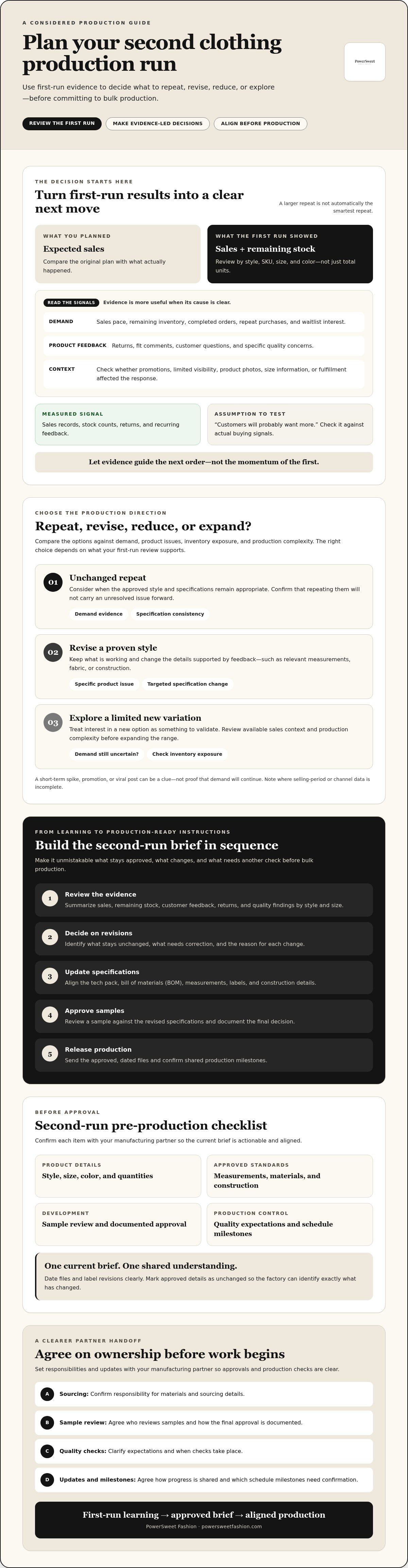
Should you repeat, revise, reduce, or expand? Decide only after comparing the first run’s results with your original plan. Strong sales for one style may support a reorder, while unsold stock, returns, or recurring fit concerns may point to a revision or smaller quantity. Let evidence guide the second run, rather than the momentum of placing the first order.
Start with a simple comparison: what did you expect to sell, what sold, and what remains in inventory? Review each SKU by size and color, not just total units. An overall sell-through figure can hide a mismatch, such as strong demand for one color alongside slow sales of another, or a popular style with certain sizes still on the shelf.
Separate measurable signals from assumptions. Sales records and stock counts are measurable; “customers will probably want more” is a hypothesis to check. This distinction matters in mass production. Repeating standardized specifications can support consistency, but it can also carry an uncorrected issue into the next run.
Which first-run numbers and feedback should you review?
Review sales pace and remaining inventory by SKU, size, and color. Add returns, fit comments, customer questions, and quality issues. Record recurring concerns with specific examples, such as comments that a sleeve feels restrictive or reports that a seam opened after wear. Note whether each issue relates to fit, fabric, construction, or care.
Check the context before treating every complaint as a product problem. A confusing product photo, unclear size information, or a fulfillment error can affect customer response without requiring a garment change. Separate these causes in your review so the next production brief addresses the right issue.
How do you distinguish a real demand signal from a short-term spike?
Compare performance across the available selling period and relevant sales channels. Look for consistent interest, not just a burst tied to a promotion or viral post. Repeated requests for a size or color are useful clues, but check whether they align with completed orders, repeat purchases, or a waitlist before using them to justify a larger order.
Note where the data is incomplete. If a style was available for only part of the selling period, or one channel had limited visibility, its results may not support a confident forecast. Strong interest during a promotion, for example, may warrant further review, but it doesn’t automatically show that demand will continue. Use the first-run review to identify what is validated, what needs adjustment, and what remains uncertain before planning your second clothing production run.
Turn First-Run Learnings into a Production-Ready Second-Run Brief
Once you’ve reviewed the first run, turn your findings into instructions your manufacturing partner can act on. A clear brief shows what stays approved, what changes, and what needs another check before bulk production. That distinction is central to planning your second clothing production run: a change mentioned in an email but missing from the current specifications can create avoidable confusion on the production floor.
Use this sequence:
Review the evidence. Summarize sales, remaining stock, customer feedback, returns, and quality findings by style and size.
Decide on revisions. Identify which details stay unchanged and which need correction, and record the reason for each change.
Update specifications. Align the tech pack, bill of materials (BOM), measurements, labels, and construction details.
Approve samples. Review a sample against the revised specifications and document the final decision.
Release production. Send the approved, dated files and confirm the shared production milestones.
For more on the sampling process and working with a manufacturer, see this sample development and manufacturer guide.
What should you update in the tech pack and bill of materials?
Revise only what the first-run evidence supports. If feedback points to a fit issue, check the relevant measurements and grading. If it identifies a fabric or construction concern, update those specifications instead. Date each file and label revisions clearly. Mark approved details as unchanged, so the factory can identify the exact changes without interpreting the full document from scratch.
Check that artwork, labels, care information, trims, and packaging instructions match the current product. The tech pack and BOM should describe the same version, including material choices and construction details. If pattern making or sample development is part of the revision, record the approved changes in the specifications too.
When should you request a new sample before the second run?
Request a sample for confirmation when you change a material, fit, construction method, or measurement. Agree in advance on who reviews it and which comments require another sample or approval round. Record the final approved sample as the reference for bulk production, alongside the matching dated files. This gives both teams one clear standard for checking that the revised product is ready to proceed.
Clear documentation also supports a responsible supply chain by making decisions and responsibilities easier to track. Brands reviewing sample development, fabric sourcing, or pattern making can also explore PowerSweet Fashion’s production capabilities as they prepare their brief.
Repeat, Revise, or Expand? Compare Second-Run Production Options
There isn’t one right move for every style. Choose an unchanged reorder when the product has earned it, revise when evidence points to a specific fix, and consider a new variation only when the opportunity justifies the added work. More options can mean more specifications, materials, approvals, and inventory decisions. Expansion isn’t automatically growth when demand evidence is thin or coordination becomes difficult.
When does a straight reorder make sense?
Consider repeating the same specification when sales, customer response, and quality records support it. First check remaining stock, then set the next quantity and size distribution using your own demand evidence instead of automatically copying the first order. Confirm that key fabrics and trims are still available and match the approved materials. A repeat is simpler only when the inputs and specifications remain aligned.
When should you revise or expand the assortment?
Revise a style when feedback points to a specific fit or construction improvement. Treat a new color, fabric, or silhouette as a change that needs clear specifications and validation, not as a proven reorder. Compare the evidence for each proposal with the additional coordination it requires. Cornell’s overview of the production planning process covers planning elements such as bills of materials, construction, and timelines.
If you’re considering a staged test rather than a broad assortment expansion, review this low-MOQ production strategy guide. It can help frame the questions to discuss with a manufacturer; confirm which quantities and production approach work for your project. Careful planning keeps each new variation tied to evidence, clear approvals, and manageable inventory exposure.
Use This Checklist Before You Approve the Second Clothing Production Run
A pre-production check turns decisions into shared instructions. As you plan your second clothing production run, confirm that the product, quantity, materials, approvals, quality checks, and schedule all refer to the same current version. Use this checklist with your manufacturing partner before authorizing bulk work.
Product: Confirm styles, colors, size range, measurements, construction details, labels, and approved revisions.
Materials: Verify fabric, trims, color references, and sourcing substitutions. Resolve differences before bulk production begins.
Quantity: Match the order to the approved assortment plan. Check units by style, color, and size against your sales evidence and remaining inventory, and document changes to the original plan.
Approvals: Name the person responsible for each sign-off, including sample approval and authorization to release production.
Quality controls: Agree on inspection points, the approved sample reference, measurement tolerances, acceptance criteria, and how to report and resolve issues.
Schedule: Set milestone dates with your manufacturing partner and confirm lead times for the specific project, including sample review or revision steps.
What must be confirmed about quantities, materials, and timing?
Use your approved assortment plan as the quantity reference, then check that the size distribution reflects demand instead of simply repeating the first order’s size mix. Record any styles and sizes added, reduced, or removed. Confirm that fabric, trims, and color references match the approved specifications. If a sourcing substitution is proposed, document and approve it before bulk work starts.
Agree on milestone dates together. Include when materials must be confirmed, samples reviewed, and production authorized. Then verify the project-specific lead time with your manufacturing partner rather than assuming it will match a previous order.
Which quality-control approvals should be written down?
Document who checks the product, when inspections occur, which measurements and tolerances apply, and what qualifies as acceptable. Set a clear process for reporting defects, reviewing affected items, and agreeing on corrective action. Keep decisions and sign-offs accessible to both teams, so production questions can be resolved against the same record.
The approved sample and current tech pack are the production reference documents. Keep them aligned and accessible to both teams. If you need support carrying approved specifications into production, explore PowerSweet Fashion’s quality control services.
Coordinate the Second Run with a Manufacturing Partner
A smooth second run depends on both sides working from the same decisions. Give your manufacturing partner one agreed brief and one current set of specifications, then document who approves changes and when. This creates a clear handoff: your team shares first-run findings and priorities, while the manufacturer confirms what needs review before production moves forward.
Prepare a focused package before requesting a production plan. Include your first-run review, current tech pack and bill of materials, a clear list of requested changes, and target quantities by style and size. Treat those quantities as proposed until the manufacturer confirms the project requirements. Add open questions about material sourcing, sample review, quality checks, and milestone dates so responsibilities and dependencies can be discussed early.
For a broader view of the process from initial development through finished garments, see this end-to-end clothing production guide.
What should you share with a factory before requesting a production plan?
Make the handoff easy to review. Separate confirmed specifications from proposed revisions, and identify decisions that are still pending. For example, say whether a fabric choice is approved or still under consideration. Share your target quantity breakdown, but ask the manufacturer to confirm the project’s production requirements before finalizing the order.
Agree on communication points as well. Decide who on each team will review samples, approve changes, report quality findings, and share schedule updates. This routes questions to the right person instead of leaving important decisions buried in separate messages.
How can a partner support revisions from sample through bulk production?
PowerSweet Fashion offers sample development and pattern making to help brands assess product revisions before bulk production, along with fabric sourcing and quality-control services. Your brand should provide feedback and approve the sample; the manufacturing partner should clarify how approved changes carry into production specifications and quality checks. Confirm responsibilities together, including how sourcing substitutions or production concerns will be raised and resolved.
PowerSweet Fashion states that samples can be ready in 10 days and bulk production in 15-20 days. These timelines may depend on the product and project scope, so verify whether they apply to your specific run before setting milestones.
Planning your second clothing production run is a shared process. Clear inputs from your team and transparent checkpoints with your manufacturer help turn first-run lessons into actionable production decisions. If you’re ready to align on revisions, samples, sourcing, or quality control, discuss your next production run with PowerSweet Fashion.
Make the Next Run a More Confident Step
Your first production run gives you a practical foundation for the next one. Use its results to choose which styles to repeat, revise, or test, then carry approved decisions into a clear production brief. Planning your second clothing production run is less about ordering more and more about turning what you’ve learned into controlled, documented choices.
Keep the process collaborative. PowerSweet Fashion supports custom women’s apparel production with sample development, fabric sourcing, pattern making, and quality-control services. Confirm project scope, responsibilities, and applicable timelines with your manufacturing partner before setting milestones.
Ready to put your first-run learnings to work? Discuss your next clothing production run with PowerSweet Fashion. With clear priorities and shared approvals, you can approach the next order with a stronger plan.
Frequently Asked Questions
When should a fashion brand plan its second clothing production run?
Start planning when you have enough first-run information to review sales, remaining inventory, customer feedback, and quality results. Begin early enough to account for material confirmation, sample approvals, and the manufacturer’s project-specific production schedule. Don’t wait until stock is nearly gone to begin discussions. A timely review gives you room to decide whether to repeat, revise, reduce, or expand before committing to production.
Should I reorder the same clothing styles for my second production run?
Reorder the same styles when sales and customer response support continued demand and quality records show no unresolved product problems. Check performance by style, color, and size rather than relying on total sales alone. A proven style may still need a different size mix, and unsold inventory should factor into the order. If feedback points to a specific issue, consider revising the product instead of repeating it unchanged.
How do I decide how many garments to order in my second run?
Set quantities using your own sales history, remaining inventory, and demand by style, color, and size. There’s no universal formula that fits every brand. Review how the first order performed over the available selling period, then account for stock still on hand and any planned product changes. Share your proposed breakdown with the manufacturer and confirm project requirements before approving final quantities.
Do I need a new sample for a repeat clothing order?
Not necessarily. If the style, materials, measurements, construction, and approved specifications remain unchanged, ask your manufacturing partner whether the existing approved sample can serve as the production reference. Request a new sample or confirmation if you’re changing fit, fabric, construction, or measurements, or if first-run quality issues need correction. Record who approves the sample and keep the final decision with the current production documents.
What documents should I prepare for a second clothing production run?
Prepare your first-run review, current tech pack, bill of materials, measurement specifications, and proposed order quantities by style and size. Include approved artwork, label and care details, construction instructions, and any quality criteria the manufacturer needs to follow. Clearly identify unchanged specifications, requested revisions, and open questions. Use dated files and confirm which version is current so both teams work from the same information.
How can I prevent the same quality problems in my next production run?
Identify the cause of each recurring problem before changing the product or process. Record specific examples, such as a measurement concern or construction issue, then update the relevant specification if a revision is approved. Agree with your manufacturer on the approved sample, inspection points, measurement tolerances, acceptance criteria, and who will review findings. Keep decisions documented so production checks follow the same expectations as the approved brief.
Can I change fabrics or colors for a second clothing production run?
Yes, but treat a fabric or color change as a product revision that needs review and approval. Confirm the material choice, color reference, and any sourcing substitution with your manufacturing partner before bulk production. A fabric change may also affect fit, construction, or the product’s appearance, so decide whether a new sample is needed. Update the bill of materials and tech pack so the approved version is unambiguous.


Comments