%20(1).png)
Questions to Ask a Potential Clothing Manufacturer: The Complete Vetting Checklist

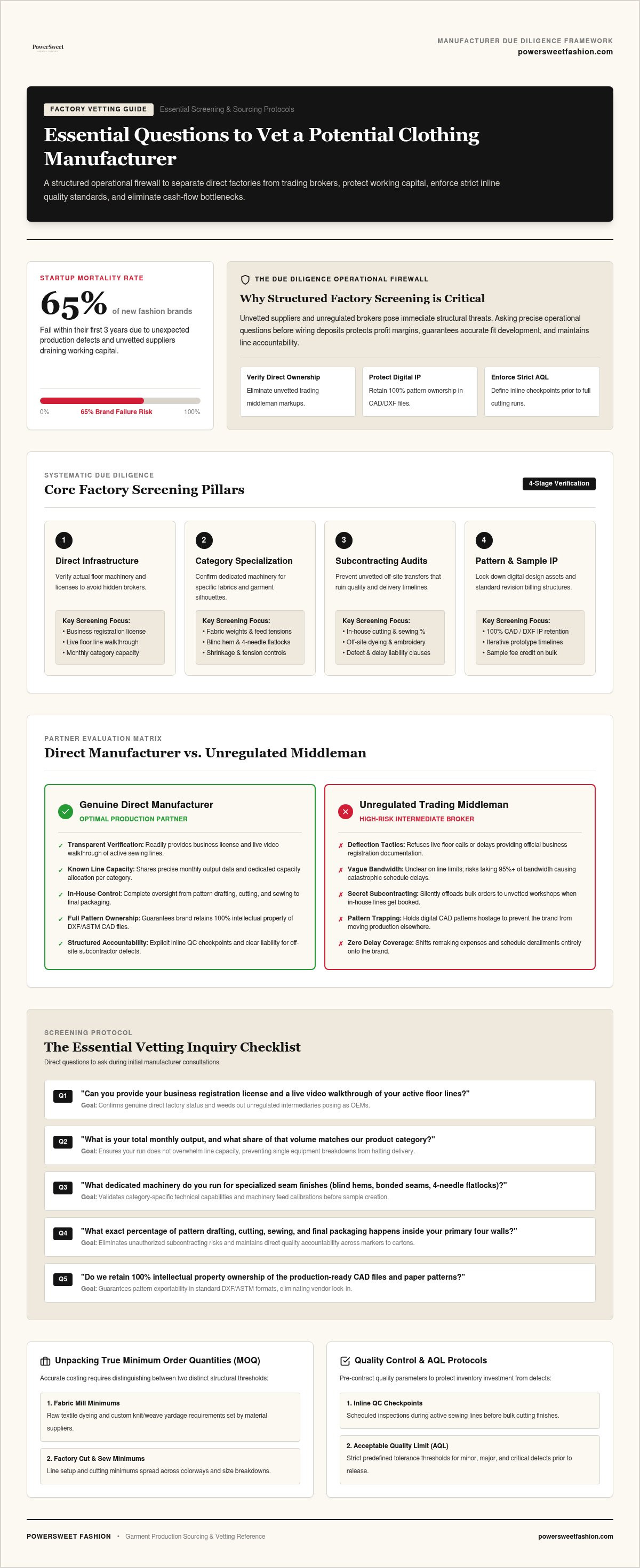
An estimated 65% of new fashion brands fail within their first three years, frequently because unexpected production defects and unvetted suppliers drain their working capital. You've poured months into refining your designs and tech packs, so the fear of wiring a deposit only to unpack unwearable garments or face missed retail deadlines is entirely justified. Knowing the right questions to ask a potential clothing manufacturer isn't just standard due diligence; it's the operational firewall that protects your brand from unregulated brokers, hidden surcharges, and catastrophic quality failures.
We believe transparency should be the baseline in garment production, not a rare luxury. In this guide, you'll master the essential screening questions needed to protect your profit margins, enforce rigorous quality control, and eliminate cash-flow bottlenecks before signing any contracts. We walk you through a structured vetting checklist covering sample development, minimum order quantities, and shop-floor capacity, giving you the clarity to secure a manufacturing partner that scales seamlessly with your business.
Table of Contents
Essential Questions to Vet a Clothing Manufacturer's Core Capabilities
Technical Inquiries for Sample Development and Pattern Making
Critical Questions on Minimum Order Quantities and Production Capacity
Quality Control, Material Sourcing, and Compliance Questions
How to Evaluate Manufacturer Responses and Finalize Your Production Partnership
Essential Questions to Vet a Clothing Manufacturer's Core Capabilities
Before negotiating unit costs or delivery windows, you must verify the operational foundation of the facility. An attractive catalog means little if the workshop floor cannot handle your garment specifications. Within the clothing industry, thousands of trading intermediaries pose as original equipment manufacturers, adding unnecessary markups and muddying communication. Your first objective is confirming that you're speaking with a legitimate, direct production facility equipped with the right machinery, seasoned operators, and stable line capacity.
When compiling your initial screening checklist, these targeted questions to ask a potential clothing manufacturer will quickly separate genuine factories from unregulated trading brokers:
"Can you provide your business registration license and a live video walkthrough of your active floor lines?" Legitimate facilities welcome operational transparency; brokers will deflect.
"What is your total monthly output, and what share of that volume matches our product category?" If your collection takes up 95% of their total line bandwidth, any equipment breakdown will derail your delivery schedule.
"Can you share non-confidential reference garments or case studies from brands operating in our market segment?" This confirms their hands-on familiarity with your target quality baseline and finishing standards.
Assessing Specialization and Garment Category Experience
Garment machinery is highly specialized. A factory churning out basic cotton t-shirts rarely owns the equipment or sewing expertise required for structured tailored blazers, bias-cut silk dresses, or high-stretch performance knits. You must ask:
"Which garment silhouettes and fabric weights move across your sewing lines every week?"
"What dedicated machinery do you run for specialized seam finishes, like blind hems, bonded seams, or four-needle flatlocks?"
"How do your pattern makers and machine operators manage delicate or high-shrinkage fabrics during line setup?"
A focused manufacturer understands the precise machine tensions, needle gauges, and feed dogs needed for specific textiles. If their answers remain vague, they'll likely use your production run as an unpaid experiment.
Verifying In-House Operations Versus Third-Party Subcontracting
Unauthorized subcontracting is a major hidden risk in fashion sourcing. A factory takes your deposit, realizes their line capacity is booked, and quietly offloads your order to an unvetted third-party workshop. That breaks quality assurance and destroys delivery predictability. As part of your core questions to ask a potential clothing manufacturer, press them on structural control:
"What exact percentage of pattern drafting, cutting, sewing, and final packaging happens inside your primary four walls?"
"Which off-site partners execute your fabric dyeing, screen printing, or decorative embroidery, and who supervises their quality checks?"
"If an off-site subcontractor produces a defect or misses an operational milestone, who absorbs the remaking costs and schedule delays?"
Direct oversight protects your timeline. Knowing exactly whose hands touch your fabric ensures true operational accountability from marker planning to carton packing.
Technical Inquiries for Sample Development and Pattern Making
Sampling is where your creative vision collides with physical production realities. Many emerging labels assume that delivering an immaculate tech pack guarantees a flawless garment on the first try. In practice, the sampling phase is an iterative engineering process. Without explicit written protocols covering pattern creation, sample lead times, and revision billing, development can stall for months, exhausting your pre-launch budget. Proactively addressing these technical touchpoints protects your schedule and prevents expensive misunderstandings later.
Before commissioning physical prototypes, integrate these questions to ask a potential clothing manufacturer into your evaluation:
"Do we retain 100% intellectual property ownership of the production-ready CAD files and paper patterns?" Some suppliers withhold your digital patterns to trap your business at their facility. Insist on full exportable ownership in standard DXF or ASTM formats.
"How are sampling fees structured, and do they credit toward bulk purchase orders?" Professional facilities often offset initial pattern drafting and prototype fees against your first bulk production invoice once order thresholds are met.
"What is the step-by-step workflow between initial tech pack handoff and pre-production (PP) sample approval?" Demand clarity on each stage, from digital grading and muslin fit mockups to the final counter-sample sewn in actual bulk yardage.
Clarifying Prototype Turnaround Times and Sample Revision Policies
Bottlenecks during sampling frequently derail retail launch calendars. While unoptimized supply chains can take six to eight weeks per iteration, an agile partner offering dedicated sample development clothing manufacturer services can achieve fast sample turnaround in as little as 10 days. When vetting candidates, ask:
"How many working days do you require from tech pack receipt to dispatching the initial fit sample?"
"How many rounds of fit revisions are covered under the initial development agreement before incurring supplemental fees?"
"How does your team pre-wash and test fabric swatches to account for dimensional stability and shrinkage before cutting final samples?"
Clear rules around sample revisions keep both teams aligned on quality and timing.
Evaluating Pattern Making and Tech Pack Translation Skills
Translating flat design sketches into accurate three-dimensional drape requires master pattern cutters. When selecting production partners, ask whether they employ on-site pattern makers or rely on external digital conversions. Inquire about their standard grade rules across your complete size run. Precise questions to ask a potential clothing manufacturer should cover how they verify seam balances, grade increments, and fit consistency from XS to 3XL before grading markers are locked for bulk cutting.
If you need structured pattern engineering, reliable fabric sourcing, and low-friction sampling, partnering with an agile specialist like PowerSweet Fashion provides end-to-end support to convert your initial concepts into market-ready collections efficiently.
Critical Questions on Minimum Order Quantities and Production Capacity
Minimum order quantities (MOQs) dictate your initial cash outlay and inventory risk. Many emerging brands stumble because they take a supplier's advertised MOQ at face value, only to discover later that the number applies under highly restrictive conditions. A factory might advertise an MOQ of 100 units, but that figure could require cutting a single silhouette in one single colorway across limited sizes. True production vetting requires unpacking the structural layers behind those figures so you don't overcommit capital on excess stock.
To avoid tied-up cash flow, focus on these tactical questions to ask a potential clothing manufacturer before committing to production agreements:
"How does your cut-and-sew MOQ interface with your textile mill minimums?" A workshop might agree to sew 100 units, but custom-milled or bespoke-dyed yardage often requires 500 to 1,000 meters. If that occurs, ask if you can draw from in-stock fabric libraries instead.
"What is your surcharge policy for smaller testing runs below your baseline threshold?" Reputable partners often accommodate lower volumes by applying a manageable small-run surcharge rather than turning away your business entirely.
"What is your total monthly floor capacity, and what window do you allocate for replenishment runs?" You need to know if an unexpected bestseller can be cut, sewn, and restocked before consumer demand cools off.
Deciphering Tiered MOQs Across Styles, Sizes, and Colors
Flexibility across colorways and size curves defines modern inventory efficiency. If a supplier forces you into 300 units per color, your balance sheet bears substantial SKU risk. Modern brands maintain tight stock controls by partnering with an agile low MOQ women's clothing manufacturer that supports responsive, tiered ordering. When qualifying a facility's flexibility, ask:
"Does your baseline MOQ apply per total style, or is it enforced per individual colorway?"
"How many distinct sizes can we include across a single cut-order marker without triggering pattern-setup penalties?"
"Can we split our total fabric yardage across two complementary styles sharing the exact same base material?"
These distinctions allow you to test fresh silhouettes in your market without carrying thousands of speculative units.
Confirming Production Lead Times and Surge Capacity
Vague delivery promises frequently result in missed retail drop dates. High-performing facilities complete rapid bulk production cycles within 15 to 20 days once pre-production samples and materials receive final sign-off. When evaluating scheduling, essential questions to ask a potential clothing manufacturer should pin down their exact calendar commitments:
"What is your door-to-door timeline from fabric delivery and tech-pack sign-off to final carton dispatch?"
"How do you prioritize boutique batch runs during peak seasonal manufacturing months and national holiday downtimes?"
"What happens to our production slot if a textile supplier delivers raw materials three days behind schedule?"
Clear delivery commitments keep your seasonal collections on schedule and protect your margins from costly delays.
Quality Control, Material Sourcing, and Compliance Questions
Defective garments destroy customer trust and ruin your bottom line. Sourcing high-grade textiles and approving a golden sample won't protect you if bulk manufacturing lacks rigorous oversight. Fabric typically accounts for 50% to 70% of a garment's total production cost, making raw material errors exceptionally expensive. To safeguard your investment, your vetting process must probe the factory's quality inspection gates, component traceability, and factory floor working standards.
When auditing factory reliability, add these concrete questions to ask a potential clothing manufacturer to your technical questionnaire:
"What statistical inspection standard governs your quality auditing, and what is your target Acceptable Quality Limit (AQL)?" Insist on standard benchmarks, such as AQL 2.5 for major visual defects and AQL 4.0 for minor cosmetic issues.
"Who absorbs the financial loss if the finished shipment exceeds the contractual AQL threshold?" Secure written terms guaranteeing remakes, immediate credit notes, or full refunds for units that fail agreed tolerances.
"Do you maintain an open-door policy welcoming factory visits and independent third-party QC auditors during active production?" Reputable partners encourage physical oversight; evasion signals hidden operational shortcuts.
Auditing In-Line Quality Assurance and Defect Thresholds
Effective quality management catches sewing errors early on the line rather than after packing cartons. Discover how top labels manage risk through integrated end to end clothing production ecosystems that combine cutting, assembly, and inspection under one roof. When questioning their quality protocols, ask:
"At what construction stages do inline quality auditors inspect tension, seam alignment, and dimensional stability?"
"How are shading differences across dye lots recorded and isolated prior to marker cutting?"
"What specific mechanical checks do you perform on seam strength and button attachment security?"
Defects discovered while garments are still on the sewing line cost pennies to fix. Defects discovered after international container shipping can bankrupt a young label.
Inquiring About Fabric Sourcing and Component Traceability
A dress is only as resilient as its weakest thread. Ask whether the manufacturer provides comprehensive fabric sourcing networks and dedicated trim management. How do they inspect incoming bulk yardage for barre marks, snags, and width variance? Require concrete verification protocols for dimensional shrinkage, wash fastness, and crocking resistance before cutting rolls. Ensure secondary hardware like zippers, fusible interlinings, and snaps match your durability benchmarks.
Inspecting Compliance, Ethical Labor, and Factory Visit Policies
With international supply chain regulations tightening globally, regulatory compliance is now an operational mandate. Transparent manufacturers readily provide social audit documentation, wage compliance verifications, and clear facility floor plans. If you are preparing your next collection drop, contact PowerSweet Fashion to explore our production capabilities and discuss how our transparent quality control protocols can safeguard your upcoming line.
How to Evaluate Manufacturer Responses and Finalize Your Production Partnership
Collecting answers is only half the vetting equation; you must systematically interpret how candidates respond under operational scrutiny. An ideal production partner operates as a pragmatic problem solver rather than an agreeable salesperson. When assessing feedback, note whether their engineers ask clarifying questions about your stitch counts, seam finishes, and fabric weight tolerances, or simply say "yes" to every demand without reviewing the files. True manufacturing experts highlight technical friction early to save you money.
Applying structured questions to ask a potential clothing manufacturer gives you objective benchmarks across three key pillars: communication velocity, technical competency, and operational honesty. A supplier that takes five business days to answer basic operational questions during the courtship phase will likely disappear when production hits a critical deadline. Trust data over promises.
Identifying Red Flags in Initial Factory Communications
Be skeptical of instant price quotes issued before estimators review your detailed bill-of-materials and pattern schematics. Evasive replies regarding shop-floor access, machinery capacity, or off-site decoration steps are serious warnings. Consult our detailed guide to choosing a custom women's clothing manufacturer to score prospective suppliers against disciplined operational criteria before committing capital.
Establishing Transparent Payment Terms and Production Milestones
Never agree to wire 100% of production costs upfront before cutting starts. Standard commercial practice ties payments to verified production gates. Common structures divide financial outlays across an initial deposit for fabric purchasing, an interim draw upon inline sewing milestones, and a final balance release only after third-party quality control sign-off. Clarify international commercial terms (Incoterms) early, establishing whether your agreement covers EXW, FOB, or landed DDP terms to prevent surprise customs surcharges at the destination port.
When you're ready to bypass middleman markups and establish a dependable partnership, connecting with an experienced apparel production team provides the structured, end-to-end framework needed to move confidently from preliminary sampling to scalable bulk delivery.
Turn Vetting Insights Into Long-Term Manufacturing Success
Selecting the right production partner transforms your brand from a vulnerable startup into a resilient, scalable fashion business. Armed with the essential questions to ask a potential clothing manufacturer, you can confidently eliminate unregulated brokers, defend your profit margins against hidden fees, and secure enforceable delivery timelines. Thorough operational auditing ensures you never compromise on garment construction, fabric performance, or ethical standards.
Manufacturing shouldn't be a gamble. When you work with a team committed to open-door transparency, production becomes your greatest growth asset. Partner with PowerSweet Fashion for transparent, end-to-end apparel production. We support your growth with fast sample turnaround in as little as 10 days, rapid bulk production cycles completed within 15 to 20 days, and flexible low minimum order quantities tailored for emerging labels. With complete in-house capabilities spanning pattern making, fabric sourcing, and rigorous quality control, you'll have the reliable infrastructure you need to launch every collection on schedule and scale with absolute confidence.
Frequently Asked Questions
What is the single most important question to ask a prospective clothing manufacturer?
The single most critical inquiry focuses on operational control: "What exact production steps take place inside your facility versus third-party workshops?" Knowing whether pattern making, cutting, sewing, and finishing remain strictly in-house reveals true accountability. When evaluating questions to ask a potential clothing manufacturer, this inquiry quickly exposes whether you're negotiating with a direct producer or an intermediary who outsources your garments to unvetted workshops.
How can I tell if a potential manufacturing partner is an actual factory or a middleman agent?
Request a live video walkthrough of active floor lines during working hours and ask for their official manufacturing business license. Direct factories will readily walk their sewing lines and explain specific machinery setups on the spot. Middlemen and trading brokers typically offer vague technical explanations, delay real-time floor tours, and prevent direct communication with on-site pattern cutters or production managers.
What standard defect rate should I establish when negotiating apparel production contracts?
Most commercial apparel contracts adhere to the international standard of Acceptable Quality Limit (AQL) 2.5 for major defects and 4.0 for minor defects. Major defects compromise structural integrity, fit, or aesthetics, making the item unsellable. Minor defects represent slight cosmetic issues. Insist on writing these exact thresholds into your formal manufacturing agreement, paired with clear remedies if inspection batches exceed those limits.
How many samples should a manufacturer produce before starting bulk garment production?
Most custom apparel projects require two to three sampling stages before bulk cutting begins. The process typically starts with a proto or fit sample to verify pattern dimensions and silhouette balance. Once revisions are completed, the manufacturer produces a pre-production (PP) sample in the actual bulk yardage with final trims. Bulk cutting should only begin after you sign off on this approved reference piece.
Can an apparel brand visit the factory to inspect production lines and working conditions?
Reputable clothing manufacturers maintain an open-door policy and encourage clients to visit their production facilities in person. Visiting allows your team to audit working conditions, review fabric warehousing, and observe inline quality control protocols firsthand. If international travel isn't practical, top manufacturers accommodate third-party inspection firms and provide regular video updates throughout the cutting and sewing process.
What payment terms are standard when working with a custom clothing manufacturer?
Standard B2B apparel production typically operates on a milestone deposit structure. Brands usually pay a deposit to fund fabric sourcing and line setup, followed by the remaining balance upon final quality inspection sign-off before shipment leaves the factory. Never accept terms demanding 100% upfront payment before cutting begins. These commercial milestones are essential questions to ask a potential clothing manufacturer before signing purchase orders.
What happens if a clothing manufacturer fails to deliver bulk goods by the agreed deadline?
Your manufacturing agreement should include a clear delay clause specifying operational and financial remedies for unexcused timeline slips. Standard protections require the supplier to cover expedited air freight shipping if delays threaten retail drop dates, or provide structured percentage discounts for each week of delay. Establishing clear timeline penalties before issuing a deposit ensures the factory prioritizes your production slot during peak cycles.


Comments