%20(1).png)
2026 Guide to Apparel Manufacturing in China

What if the advantage of apparel manufacturing in China isn’t simply lower costs, but a more connected supply chain and a faster path from design to production? For women’s fashion brands, sourcing overseas can still mean long lead times, costly shipping, sample misunderstandings, and uncertainty about fabric quality or working conditions. Those concerns are real, especially when you’re building a collection and need a manufacturer that can grow with your plans.
This guide lays out a practical roadmap for finding a reliable production partner, managing samples and quality checks, and planning for scale without losing control of your standards. You’ll learn what to clarify before production, how to reduce avoidable communication delays, and what to check when assessing materials and factory practices.
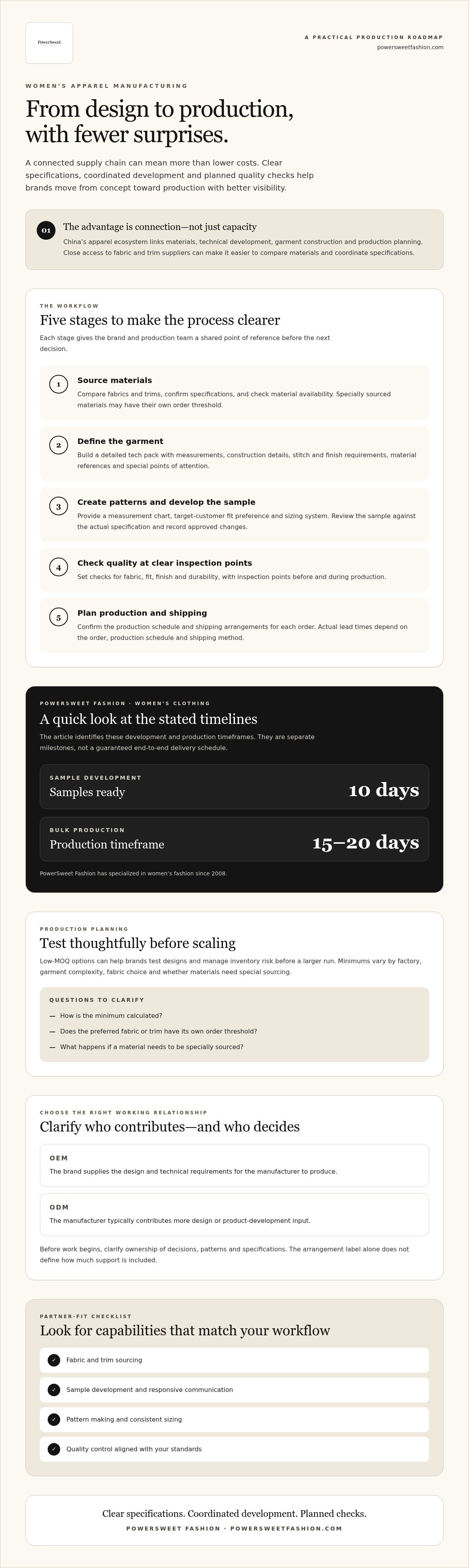
Speed matters, but so does a clear process. PowerSweet Fashion has specialized in women’s fashion since 2008, with samples ready in 10 days and bulk production in 15–20 days. We’ll explain how fabric sourcing, pattern making, sample development, and quality control fit together, so you can approach your next production run with better visibility and fewer surprises.
Table of Contents
Strategic Landscape of China Apparel Manufacturing 2026
Apparel manufacturing in China has moved beyond a model built mainly around high-volume, standardized orders. Automation and improved production systems are helping manufacturers pursue more specialized work, while experienced teams remain central to turning a design into a consistent garment. Modern Chinese apparel manufacturing is a tech-driven ecosystem that connects materials, technical development, garment construction, and production planning.
That connected structure is a major advantage. The country’s textile and apparel sector has a long industrial history and broad production capacity; the largest in the world overview offers useful background on its scale and development. For a fashion brand, close access to fabric and trim suppliers can make it easier to compare materials, coordinate specifications, and move a design from development toward production. Established manufacturing and transport infrastructure can also support international shipping, although actual lead times depend on the order, production schedule, and shipping method.
Why Fashion Brands Still Choose China
Women’s clothing often involves details that need careful technical execution, from shaping and fit to closures and finishing. A capable production partner combines skilled garment workers with clear patterns and specifications, helping translate a design into a repeatable result. Access to varied fabrics and trims gives brands more options, while established logistics networks provide routes for moving finished orders to global markets. Brands should still confirm material availability, inspection practices, and shipping arrangements for each order.
The Shift Toward Flexible Manufacturing
Influencer-led labels and boutique brands often need to test a design before committing to a larger run. That demand is challenging the old assumption that China is only suitable for mass production. Low-MOQ options do exist, but minimums vary by factory, garment complexity, fabric choice, and whether materials need to be specially sourced. Ask how the minimum is calculated and what happens if your preferred fabric or trim has its own order threshold.
Production relationships can also be more collaborative. In a traditional OEM arrangement, a brand supplies the design and technical requirements for a manufacturer to produce. ODM arrangements typically involve a manufacturer contributing more design or product-development input. Clarify who owns each decision, pattern, and specification before work begins; the label alone doesn’t tell you how much support is included.
Rapid fashion cycles depend on more than machinery. Timely decisions, accurate technical information, responsive sample development, and coordinated sourcing all shape the pace. For example, PowerSweet Fashion specializes in women’s clothing and offers sample development with samples ready in 10 days. That defined step can help brands assess fit and construction sooner, while keeping communication between the brand and production team grounded in a physical sample.
From Design to Prototype: Mastering Technical Development
A strong design needs precise instructions before it reaches a sewing line. A tech pack brings those instructions together, including garment measurements, construction details, stitch and finish requirements, material references, and points that need special attention. Clear specifications reduce guesswork during sampling and give the production team a consistent reference when moving from an approved sample to bulk production.
Pattern making turns a two-dimensional design into a three-dimensional garment by shaping and connecting pattern pieces to create the intended fit and construction. It’s the foundation for consistent sizing. A professional pattern maker can interpret design details, flag construction challenges, and prepare graded patterns so proportions remain deliberate across the size range.
The Pattern Making and Sizing Process
Digital pattern tools can support precise adjustments and consistent grading when measurements and rules are clearly defined. But software alone won’t resolve sizing differences: brands should provide a measurement chart, specify the target customer and fit preference, and identify the sizing system they use. This matters in international women’s wear, where labels such as “medium” don’t guarantee the same garment measurements between brands. Review the sample against the actual spec, then record approved changes before production. For a closer look at the process, explore this guide to mastering sample development.
Fabric and Trim Sourcing Strategies
Material decisions affect more than appearance. Compare fabric weight, drape, stretch, surface texture, and care requirements against the garment’s intended use. Request swatches and assess the hand-feel directly rather than relying on a name or image alone. If sustainability is a priority, ask suppliers for details about options such as Lyocell, organic cotton, or recycled polyamides, and confirm the material composition and supporting documentation before approving a choice.
Buttons, zippers, and custom labels should be specified alongside the fabric. Sourcing trims near the production operation can simplify coordination, but availability, minimum quantities, and lead times still need confirmation. List each trim’s size, finish, placement, and color in the tech pack. Then check that the approved sample uses the intended components.
Sampling is the bridge between design intent and production reality. PowerSweet Fashion has samples ready in 10 days, giving brands a defined point to review fit, construction, and materials before authorizing bulk production. Treat approval as a controlled handoff: document revisions, confirm the final specifications, and ensure the production team is working from the approved sample. For a practical starting point, review women’s clothing sample development. In apparel manufacturing in China, this disciplined sample-to-bulk transition helps prevent an approved prototype from becoming an inconsistent production run. A Colorado State University thesis examines the industry’s international competitive advantage, offering broader context for why technical capability and coordinated development matter.
Navigating Order Volumes: The Power of Low MOQ Production
Low minimum order quantities (MOQs) let a women’s clothing brand produce a smaller run per style instead of committing to a large volume before demand is clear. The right minimum isn’t universal. It depends on garment complexity, fabric and trim availability, and the manufacturer’s production setup. Ask whether the MOQ applies per style, color, or fabric, and confirm any supplier minimums that could affect the total order.
Small batches can lower inventory exposure and help you test customer response before repeating or expanding a style. They don’t automatically mean a lower cost per unit. Setup work and material requirements are spread across fewer garments, so the unit cost may be higher, while the smaller initial commitment can reduce the risk of holding unsold stock. Compare both sides before choosing a run size.
The Economics of Small-Batch Manufacturing
For boutique brands, flexibility can matter more than maximizing volume. Smaller orders may make it practical to test a new silhouette, adjust a seasonal assortment, or bring a focused drop to market without overcommitting. Plan the full order, not just the garment count: consider fabric availability, trim minimums, sample approval, and your sales timeline. This helps reveal whether a proposed MOQ is genuinely workable for your design.
Scaling from 50 pieces to 5,000 shouldn’t mean starting the development process over, but it does require planning. Keep the approved sample, pattern, measurements, material details, and construction notes consistent. Before increasing volume, confirm that the manufacturer can support the larger run and that fabric and trims can be replenished to the same specifications. A staged approach lets you use early sales information to guide the next order. For more on this strategy, read the strategic power of low MOQ.
Bulk Production Timelines and Expectations
Once a sample is approved and order details are confirmed, bulk production can move through material preparation, cutting, sewing, finishing, quality checks, and final packing. PowerSweet Fashion’s stated bulk production window is 15–20 days. Confirm what that window covers for your order, and ask when the schedule begins. Material availability, pending approvals, or changes to specifications can affect the production plan.
Build in time for each handoff. Approve fabrics and trims before production, confirm quantities and size breakdowns, and agree on inspection points and packing requirements. During peak fashion seasons, ask the production partner to confirm capacity and timeline early rather than assuming the usual schedule will hold. Clear milestones help both teams spot delays sooner. In apparel manufacturing in China, the strongest low-MOQ strategy is not simply ordering less; it’s building a repeatable process that can grow with proven demand.
Ensuring Excellence: Quality Control and Transparency
Reliable quality control turns design expectations into checks the production team can follow. For women’s garments, assess four pillars: fabric for composition and consistency, fit against approved measurements, finish for seams and details, and durability for how the garment holds up with wear and care.
Set inspection points before bulk production begins. Review fabric and trims before cutting, check the first garments against the approved sample and specifications, and inspect finished pieces before packing. Record defects with clear notes and photos, then agree on how corrections will be verified. This staged approach can catch a problem while it’s still manageable, rather than after the full order is complete.
A “Gold Seal” sample is an informal name for the final approved garment that serves as the quality benchmark for bulk production, not a formal industry certification. Keep it alongside the current tech pack so both teams can compare construction, fit, materials, and finish against the same reference.
Internal vs. External Quality Inspections
An in-house QC team can check work during production and flag issues close to where they occur. Third-party inspections offer an additional, independent review when a brand needs one. Social or environmental audits are a separate process: ask what they assess, who conducts them, and whether findings can be shared. Neither type of inspection should replace clear product specifications. For a broader view of coordinated production, read this guide to end-to-end clothing production.
Communication and Project Management
Misunderstandings often start with vague instructions. Use a shared tech pack with measurement tolerances, material details, construction notes, and annotated reference images. Assign one primary contact on the manufacturing team to consolidate questions and updates, and agree on how often progress should be reported. Ask for milestone updates at material approval, production start, in-line checks, and final inspection. That gives your team time to address a concern before it affects the whole order.
A factory visit can add useful, firsthand context to remote updates. PowerSweet Fashion encourages factory visits for quality control. Before visiting, agree on the purpose and what can be reviewed; observe how the team handles samples and inspections, and ask how issues are documented and resolved. In apparel manufacturing in China, this kind of open exchange helps replace assumptions with direct answers. Explore women’s clothing quality control services to see how production checks can fit into your workflow.
Partnering for Success: Selecting Your Manufacturing Ally
A dependable production partner does more than accept an order. Look for clear communication, relevant experience with women’s clothing, transparent quality checks, and the ability to coordinate development steps without leaving you to manage a chain of disconnected suppliers. Ask how the team handles technical questions, tracks sample changes, and confirms materials before production. Specific answers are more useful than broad promises.
An integrated workflow can reduce handoffs. When fabric sourcing, pattern making, sample development, custom clothing production, and quality control are coordinated, the same specifications can guide each stage. That helps keep design decisions connected to the finished garment and makes it easier to address a mismatch before it carries into bulk production. In apparel manufacturing in China, a direct working relationship also gives your team a clearer route to the people handling the work.
The PowerSweet Fashion Manufacturing Advantage
PowerSweet Fashion specializes in custom women’s clothing and has focused on women’s fashion since 2008. Its services connect fabric sourcing and pattern making with sample development, production, and quality control. Samples are ready in 10 days, and the stated bulk production window is 15–20 days. Confirm the schedule, material availability, and approval milestones for your specific order. Factory visits are encouraged for quality control, giving clients a chance to see the production process firsthand.
How to Start Your Production Journey
Prepare a clear brief before requesting a quote. Include design sketches or reference images, a measurement chart, construction details, preferred fabrics and trims, estimated quantities by style and size, and your target timeline. If some choices are still open, identify them as undecided so the manufacturer can distinguish confirmed requirements from questions to resolve. A focused project discussion can then align design priorities, production needs, and the next steps without assuming every detail is already finalized.
From there, agree on the sample and approval process before moving toward a production run. Confirm how revisions will be recorded, what defines sample approval, and which specifications will guide bulk production. This practical alignment helps protect your creative intent while giving the manufacturing team clear instructions to work from.
Ready to discuss your women’s clothing production needs? Partner with PowerSweet Fashion for your next collection and start with a clear brief, shared expectations, and a defined path from design to production.
Turn Your Production Plan Into Progress
Successful apparel manufacturing in China depends on more than finding production capacity. Clear technical files, a carefully approved sample, and defined quality checks help protect your design as it moves into production. Choosing a partner who can coordinate fabric sourcing, pattern making, sample development, and quality control can also reduce handoffs and make the process easier to manage.
Start with a focused brief: share your designs, target materials, size requirements, estimated quantities, and timing. Then align on the sample review and production milestones before approving a bulk run. PowerSweet Fashion specializes in women’s apparel and has supported women’s fashion brands since 2008. Samples are ready in 10 days, with bulk production in 15–20 days, giving your team clear timing to plan around.
Your next collection doesn’t have to begin with guesswork. Start your production journey with PowerSweet Fashion and take the first step toward turning your design into a production-ready garment. With clear communication and a practical plan, you can move forward with confidence.
Frequently Asked Questions
What are the typical minimum order quantities for apparel manufacturing in China?
There’s no single standard MOQ; it varies by manufacturer, garment complexity, and material requirements. As a 2026 planning benchmark, low MOQs are commonly described as 20–150 pieces per style, while some factories set higher minimums. Ask whether the MOQ applies per style, color, or fabric. PowerSweet Fashion offers low-MOQ women’s clothing production, but confirm the minimum for your specific design and materials.
How long does the sample development process take in 2026?
Timing depends on the design, materials, and revision needs. PowerSweet Fashion’s samples are ready in 10 days. Confirm when that timeline starts and what it includes, such as pattern making, sourcing materials, and the first prototype. Prepare clear design files and measurement specifications before development begins. If you request changes after reviewing the sample, ask how revisions affect the schedule before setting launch dates.
Can I visit the factory in person to oversee my production?
Yes, PowerSweet Fashion encourages factory visits for quality control. Arrange the visit with the manufacturing team in advance and agree on what you want to review, such as the approved sample, production progress, or inspection process. Prepare questions about how defects are recorded and handled. A visit can help you meet the people working on your order and clarify expectations directly, but confirm access and timing with the factory first.
What documents do I need to provide to start clothing production?
Prepare a tech pack or clear design brief, including sketches or reference images, garment measurements, construction details, fabric and trim preferences, and size breakdowns. Also share the expected quantity per style and your target timeline. If some details are undecided, mark them clearly so the production team knows what needs discussion. Complete specifications help the manufacturer assess the design, develop a sample, and identify questions before bulk production begins.
How is quality control handled for bulk garment orders?
Agree on quality checks before production starts. A practical process can review fabric and trims before cutting, compare early production garments with the approved sample and measurements, and inspect finished pieces before packing. Document acceptable tolerances and how defects should be reported and corrected. PowerSweet Fashion offers quality control services; ask which inspection stages apply to your order and how results or issues will be communicated.
Does the manufacturer help with fabric and trim sourcing?
Yes. PowerSweet Fashion offers fabric sourcing, which can include helping identify materials and trims suited to your design. Share your preferred composition, weight, color, texture, and intended use, along with details for buttons, zippers, or labels. Request swatches and confirm availability, specifications, and any material minimums before approving the sample. Clear decisions at this stage help keep the approved prototype aligned with the planned production order.
What is the difference between OEM and ODM in clothing manufacturing?
OEM generally means the brand provides the design and specifications, and the manufacturer produces the garment to those requirements. ODM generally involves the manufacturer contributing more to design or product development. The exact division of work can vary, so clarify who prepares patterns, selects materials, approves changes, and owns the final specifications. Don’t rely on the label alone; confirm the scope of support before starting development.
How do I protect my designs when manufacturing overseas?
Start by sharing only the files needed for each production stage and keeping dated records of your original designs, tech packs, and revisions. Before sending confidential materials, discuss written terms covering confidentiality, use of design files, and ownership of patterns or other development work. Ask who can access your files and how they’re stored. For legal protection specific to your markets, consult a qualified intellectual-property professional rather than relying on informal assurances.


Comments