%20(1).png)
Protecting Your Designs: The Essential Guide to Clothing Manufacturer Non-Disclosure Agreements (2026)

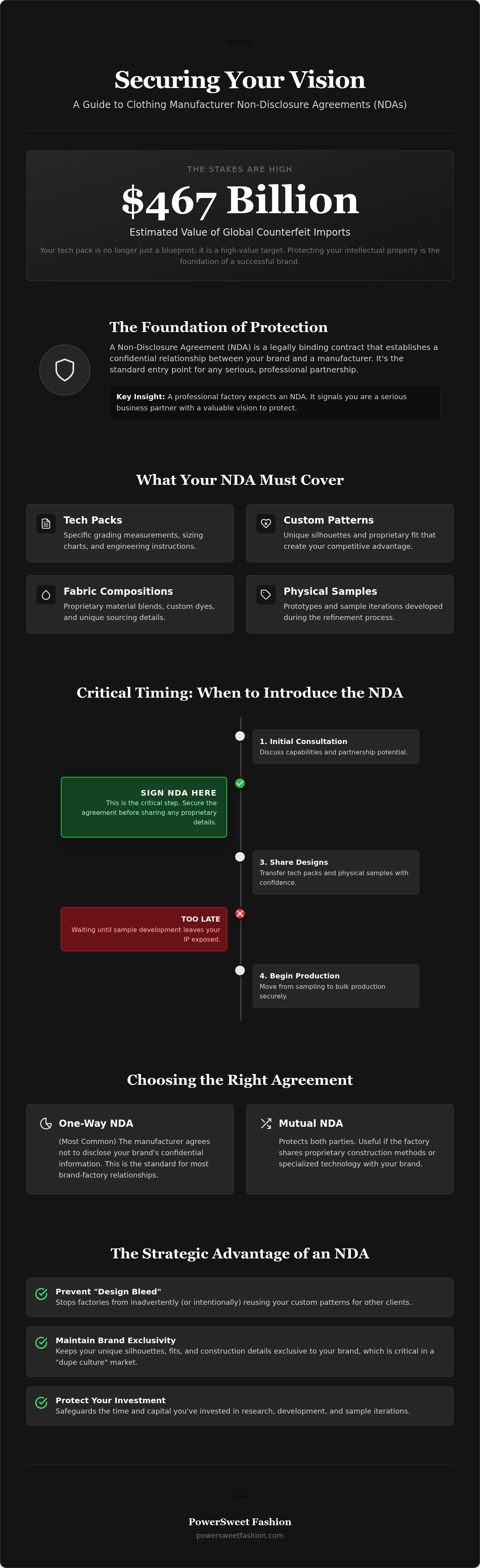
With global counterfeit imports now estimated at $467 billion, your tech pack is no longer just a production blueprint; it is a high-value target. Sending your original designs into the world without a clothing manufacturer non-disclosure agreement is essentially leaving your brand's future to chance. You've likely spent months perfecting every stitch, sourcing the right fabrics, and refining your fit. It's natural to feel a sense of hesitation when it's time to share those details with an external partner, especially when manufacturing offshore.
We understand that protection is the foundation of a successful production run. You deserve the peace of mind that comes from knowing your intellectual property is legally shielded before a single sample is cut. This guide provides a clear framework for securing your designs and establishing a professional partnership built on transparency. You'll learn exactly what a robust NDA should cover, the ideal moment to introduce legal documents in your production timeline, and how to choose a trustworthy manufacturer that treats your vision with the meticulous care it requires. By the end of this article, you'll have the tools to move from concept to bulk production with total confidence.
Table of Contents
What is a Clothing Manufacturer Non-Disclosure Agreement?
At its core, a Non-Disclosure Agreement (NDA) is a legally binding contract that establishes a confidential relationship between your brand and a factory. In the garment industry, this document ensures that any proprietary information you share stays within the production line. It's the standard entry point for any serious custom women’s clothing manufacturer relationship. Relying on a verbal handshake is a common mistake that leaves your intellectual property vulnerable. A professional factory actually expects a clothing manufacturer non-disclosure agreement; it shows you're a serious business partner with a valuable vision to protect.
You'll typically encounter two types of agreements. A one-way NDA is most common, where the manufacturer agrees not to disclose your designs. A mutual NDA protects both parties, which is useful if the factory shares proprietary construction methods or specialized machinery details with you. While trust is the goal of any partnership, a legal framework provides the safety net required to operate at scale. We view the NDA as a professional alignment tool that clarifies expectations from day one, ensuring both sides are committed to a secure, transparent workflow.
The Scope of Protection in Fashion
Your clothing manufacturer non-disclosure agreement must cover every technical detail of your collection. This includes tech packs with specific grading measurements, unique fabric compositions, and custom-engineered patterns. If you've spent months perfecting a specific fit for a niche audience, that grading is your competitive advantage. Without a signed document, those grading secrets could easily leak into a competitor's collection. Protecting these assets ensures that your investment in pattern making remains your exclusive property.
When to Introduce the NDA
Timing is critical. You must secure the agreement before you hand over a single PDF or physical sample. Many brands wait until they're deep into the sample development clothing manufacturer phase, but that's often too late. We recommend introducing the document during the initial consultation. This approach sets a professional tone immediately. It ensures that your creative ideas are safe from the moment you start discussing fabric sourcing or pattern adjustments. Balancing urgency with due diligence is the hallmark of a mature fashion brand.
Why Fashion Brands Prioritize Confidentiality Agreements
Exclusivity is the lifeblood of a fashion brand. In an era where "dupe culture" dominates social media, your unique silhouettes and construction details are your most valuable assets. A clothing manufacturer non-disclosure agreement prevents the phenomenon of "design bleed," where a factory might inadvertently reuse your custom patterns for other clients. This isn't always intentional; a busy factory might assume a specific block is a generic industry standard if no legal boundary is in place. By formalizing your ownership, you ensure that your creative labor doesn't become a free resource for your competitors.
Protecting your investment in sample iterations is just as critical as protecting the final product. Every sample round costs time and capital. By securing the key elements of an NDA, you ensure that the specific refinements made during development stay within your brand's ecosystem. This is particularly vital for private label assets where the value lies in the "secret sauce" of your fit and fabric choices. Maintaining this competitive advantage allows you to scale without the fear of your best-sellers appearing on a discount site before you even launch.
Protecting the Technical Advantage
In the manufacturing world, tech packs are far more valuable than artistic sketches. A sketch is an inspiration, but a tech pack is a set of engineering instructions that includes your specific grading standards and sizing charts. These documents represent years of market research and fit testing. A clothing manufacturer non-disclosure agreement safeguards these technical specifications from being shared or sold. A properly drafted agreement includes clauses that strictly prohibit the factory from selling surplus production, defective units, or "seconds" to unauthorized retailers or liquidators.
Building Professional Credibility
Requiring a legal agreement isn't about lack of trust; it's about establishing a professional standard. It signals to a manufacturer that you are a high-growth brand with serious intellectual property to manage. Factories that handle bulk production for global labels are accustomed to these documents. This transparency is the cornerstone of successful end to end clothing production, where every step from fabric sourcing to quality control is documented and protected. It creates a "safe pair of hands" environment where you can share ideas freely.
Clear communication protocols are easier to maintain when the legal ground rules are set. It allows for a more open exchange of ideas during the creative process. If you are looking for a partner that respects these boundaries, consider how a transparent factory can streamline your workflow. You can discuss your production needs with a team that prioritizes your IP security from the very first consultation.
Key Elements Every Clothing Manufacturer NDA Must Include
A generic legal template often fails to address the specific logistical realities of garment manufacturing. To be effective, a clothing manufacturer non-disclosure agreement must define "Confidential Information" with extreme precision. This definition shouldn't just cover digital files like tech packs; it must include physical patterns, fabric swatches, and pre-production samples. If a factory possesses your physical grading blocks, they hold the DNA of your brand's fit. You must ensure every physical and digital asset is explicitly listed as protected information.
The non-use clause is your primary defense against unauthorized production. It explicitly forbids the factory from using your designs, measurements, or sourcing secrets for any other customer. Equally important is an ownership rights clause. It must state that all intellectual property created during the development process, including improvements made by the factory's pattern makers, remains the sole property of your brand. Finally, ensure the agreement includes a term and termination clause. Confidentiality obligations should typically persist for three to five years after the partnership ends to protect your designs through several market cycles.
Clauses for Global Production
When manufacturing across borders, jurisdiction and governing law become critical. You need to decide which country's courts will handle potential disputes. Additionally, your clothing manufacturer non-disclosure agreement should include a subcontractor clause. This ensures that any third-party fabric mills or trim suppliers the factory uses are also bound by the same confidentiality standards. A return of materials protocol is the final step. Since the EU ban on the destruction of unsold apparel took effect on July 19, 2026, it's often more legally compliant to require the physical return of surplus goods or patterns rather than their disposal. This ensures you maintain control over your inventory while adhering to international sustainability regulations.
Remedies for Breach
Legal documents are only as strong as their enforcement mechanisms. Liquidated damages clauses are helpful because they pre-define a specific financial penalty for breaches, avoiding the need to prove exact market losses in court. You should also include a provision for injunctive relief, which allows you to legally stop the production or sale of infringing goods immediately. Finally, a "No License" clause clarifies that sharing information for production purposes doesn't grant the factory any right to use your trademarks or sell your designs independently. These layers of protection transform a simple piece of paper into a robust shield for your creative vision.
Beyond the Paper: Protecting Your Designs During Production
While a clothing manufacturer non-disclosure agreement provides a legal safety net, the physical reality of your production environment truly protects your intellectual property. A legal document is an essential deterrent, but enforcement can be complex and costly. The most effective way to safeguard your vision is to partner with a factory that views your long-term success as their own. Trust is built through consistent action, not just signatures. A factory that values its professional reputation won't risk losing a client over a short-term gain from design theft.
One strategic way to verify factory integrity is through a phased approach. By starting with a low MOQ women’s clothing manufacturer, you can test their professionalism on a smaller scale before committing to high-volume bulk runs. This initial stage reveals how they handle your tech packs and whether they respect the boundaries established in your clothing manufacturer non-disclosure agreement. Additionally, watermarking your digital files with your brand name and a confidentiality warning serves as a constant visual reminder to every technician handling your patterns. It signals that these specifications are private property, creating a psychological barrier against misuse.
Operational Security Measures
Physical security within the facility is a critical layer of IP protection. Professional manufacturers implement systems to ensure your data stays secure:
Limiting digital file access to only the specific technicians and production managers assigned to your project.
Implementing rigorous quality control checks at every stage to ensure every unit is accounted for, preventing unauthorized "leakage" of samples.
Maintaining a secure storage area for physical patterns and grading blocks when they aren't on the cutting table.
The Power of Transparency
Transparency is the ultimate deterrent to IP misuse. Factories that welcome in-person visits and third-party quality control oversight demonstrate they have nothing to hide. Direct factory visits allow you to see the meticulous care applied to your designs first-hand. Establishing a rigorous "paper trail" for every pattern revision and sample approval creates an empirical record of ownership. A dedicated production manager acts as your eyes and ears on the factory floor, ensuring that your specific fit standards and construction methods are never shared with unauthorized parties.
If you're ready to move from a legal document to a secure production reality, our team is here to help. You can start your production journey with a transparent partner who values your intellectual property as much as you do.
How PowerSweet Fashion Ensures Your IP Security
Security is not just a legal requirement; it is a fundamental part of our operational culture. We recognize that your brand's growth depends on the exclusivity of your designs. This is why we actively welcome and respect a standard clothing manufacturer non-disclosure agreement before any proprietary data is exchanged. By establishing these legal boundaries immediately, we create a foundation of mutual respect that allows our partnership to move at the speed of the 2026 fashion market. A professional factory should never hesitate to sign a confidentiality agreement, and we view it as a necessary step in a mature B2B relationship.
Our workflow is designed for both speed and stability. We provide a 10-day sample turnaround and 15-20 day bulk production, ensuring your designs reach the market while they are still at the peak of their trend cycle. Throughout this process, we maintain an open-door policy. We invite you to oversee the bulk garment production process in person at our facility. This level of transparency ensures that every stitch aligns with your vision and that your intellectual property is handled with the meticulous care it deserves. Seeing the work in person bridges the gap between digital communication and the physical reality of the factory floor.
Our Production Protocol
We manage your intellectual property through a centralized, end-to-end service model. By handling everything from fabric sourcing and pattern making to final quality control in-house, we significantly reduce the risk of third-party IP exposure. Your tech packs and grading specifications are managed within a closed internal system, accessible only to the technicians directly responsible for your project. This "safe pair of hands" approach ensures that your proprietary data never leaves our controlled environment. Our strict quality control standards further protect your brand reputation by ensuring that every unit produced meets your exact specifications, with no unauthorized surplus or "seconds" entering the market.
Starting Your Production Journey
Initiating a partnership with us is a streamlined and professional process. The first step involves a consultation where we discuss your production goals and scale requirements. You can share your clothing manufacturer non-disclosure agreement for our team to review alongside your initial project brief. Once the legal groundwork is established, we move quickly to the quote and sample development phase. This methodical progression allows you to transition from an initial concept to global bulk production with total confidence. We are here to act as the engine for your creative vision, providing the industrial stability you need to scale your fashion brand securely.
Scaling Your Vision with Total IP Security
Your creative vision is the most valuable asset your brand owns. Protecting it requires a combination of legal diligence and a trustworthy production partner. A robust clothing manufacturer non-disclosure agreement ensures that your custom patterns and grading specifications remain your exclusive property. It sets the professional standard for your relationship from the very first sample development phase. However, the document is only the beginning. True security comes from operational transparency and a factory that welcomes direct oversight.
We specialize in providing a "safe pair of hands" for growth-stage brands. As low MOQ specialists, we offer a 10-day sample turnaround and allow you to oversee production in person to ensure your standards are met. It's time to stop leaving your intellectual property to chance and start working with a partner dedicated to your long-term success. Partner with a manufacturer that respects your IP—Contact PowerSweet Fashion today. We are ready to help you bring your designs to life with the security and precision your brand deserves.
Frequently Asked Questions
Do I really need an NDA if I am just starting a small clothing line?
Yes. Small brands are often more vulnerable to design theft because they lack the legal resources to fight established competitors. A clothing manufacturer non-disclosure agreement protects your initial patterns and tech packs, which are the foundation of your brand. Even with low MOQs, your intellectual property is valuable. Securing it early ensures your unique fit remains exclusive to you as you scale.
Will a manufacturer refuse to sign my non-disclosure agreement?
A professional, reputable factory will rarely refuse to sign a standard NDA. Refusal is often a red flag indicating a lack of professional standards or a desire to reuse client patterns. Manufacturers accustomed to bulk production for global brands see NDAs as a routine part of the B2B onboarding process. If a factory declines, it's usually better to find a partner that respects your intellectual property rights.
Is an NDA legally binding if the factory is located in another country?
Yes, provided the document includes a clear "Jurisdiction" or "Governing Law" clause. This specifies which country's laws apply and where disputes will be settled. While international enforcement can be challenging, the existence of the agreement acts as a significant deterrent. It signals that you take your IP seriously. Many brands choose to include liquidated damages to make the consequences of a breach clear and quantifiable.
When is the best time to ask a clothing manufacturer to sign an NDA?
You should introduce the NDA during the initial consultation, before sharing any proprietary tech packs or detailed sketches. This ensures your designs are protected from the very first interaction. Integrating legal steps into the early sample development phase demonstrates brand maturity. It allows you to vet the factory's professionalism before investing time and money into physical prototypes or custom fabric sourcing.
What happens if a manufacturer breaks the NDA?
If a breach occurs, you can pursue the remedies outlined in your agreement, such as liquidated damages or injunctive relief to stop production. You would typically start by issuing a cease-and-desist letter through your legal counsel. Because litigation is expensive, many brands focus on prevention by using a clothing manufacturer non-disclosure agreement as a deterrent and conducting regular quality control audits to monitor factory activity.
Can I use a free online NDA template for my fashion brand?
You can use a template as a starting point, but it must be customized for the garment industry. Generic templates often overlook physical assets like patterns, grading blocks, and fabric swatches. A fashion-specific NDA should explicitly define tech packs as confidential information. Ensure the document covers subcontractors, such as fabric mills, to prevent your sourcing secrets from leaking through the factory's supply chain partners.
Does an NDA protect me from other brands copying my designs?
No, an NDA only protects you from the specific manufacturer you have signed it with. It prevents the factory from sharing your data or using your patterns for other clients. To protect against other brands or the general public copying your aesthetic, you would need to explore design patents or trademarks. The NDA is specifically designed to secure the technical information required for production.
What is the difference between a trademark, a copyright, and an NDA in fashion?
These tools protect different parts of your business. A trademark secures your brand name and logo. Copyright can protect unique surface prints or lace patterns, though it rarely covers the functional shape of a garment. An NDA is a contract that protects the technical "how-to" of your brand, such as your proprietary tech packs and construction methods. Together, they form a comprehensive shield for your fashion brand's intellectual property.


Comments