%20(1).png)
Mastering Dress Manufacturing Consistency: 2026 Guide

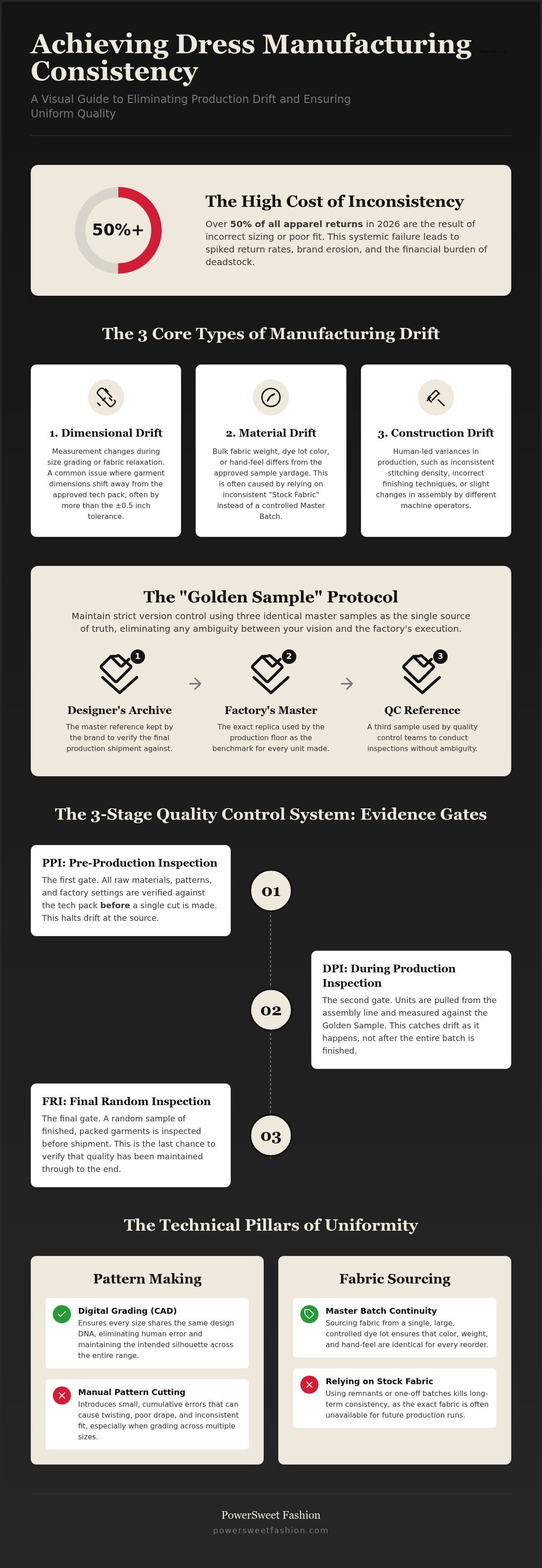
Over 50% of all apparel returns in 2026 are the result of incorrect sizing or poor fit. This data highlights a systemic failure in the transition from design to delivery. Achieving dress manufacturing consistency is not a matter of luck; it is a structural byproduct of integrated pattern making and disciplined material sourcing. You know the frustration of approving a flawless sample only to find that the bulk production suffers from process drift, where colors vary or dimensions shift. It is a common pain point that leads to costly rework and eroded customer trust.
We believe your supply chain should be a predictable engine, not a source of anxiety. This guide will show you how to eliminate those discrepancies and build a brand rooted in uniform quality. You'll discover the specific quality control protocols and structural systems required to ensure every garment in your production run matches your approved sample perfectly. We'll also examine the technical workflows and 2026 ISO standards that turn a creative vision into a reliable, high-quality reality.
Table of Contents
Why Manufacturing Consistency is the Foundation of Fashion Brand Scalability
The Technical Pillars of Uniformity: Pattern Making and Fabric Sourcing
In-Line Quality Control: Containing Production Drift Before It Scales
A Strategic Framework for Designers: Managing Version Control and Master Samples
How PowerSweet Fashion Delivers Production Consistency from Sample to Bulk
Why Manufacturing Consistency is the Foundation of Fashion Brand Scalability
Dress manufacturing consistency is the degree to which bulk units mirror the approved master sample. It's the silent engine behind every successful fashion brand. When consistency fails, the costs are immediate and punishing. You face spiked return rates, brand erosion, and the financial burden of deadstock that cannot be sold. In 2026, social media transparency means customers share fit issues instantly. One bad production run can damage a reputation it took years to build.
We often see "production drift" occur when small changes accumulate. Minor fluctuations in factory heat, humidity levels, or the varying skill of different machine operators can pull a garment away from its original design. Without a rigorous system of quality control, these tiny variances snowball into noticeable defects by the time the shipment reaches your warehouse. Success requires moving beyond hope and into a structured, evidence-based manufacturing process.
The Psychology of the Consumer: Why Fit Uniformity Wins
Inconsistent sizing is the primary reason brands fail to build customer lifetime value. If a customer buys a medium dress that fits perfectly, they expect that same medium to fit regardless of the color or fabric choice. The "First Impression" rule is vital here. Your first bulk shipment defines the manufacturer relationship and your brand's reliability in the eyes of the market. Sizing tolerance is the predetermined range of allowable deviation from the tech pack measurements, typically restricted to plus or minus 0.5 inches in professional dress production.
Identifying the 3 Core Types of Manufacturing Drift
To maintain dress manufacturing consistency, you must monitor three specific categories of drift. First is Dimensional Drift, which involves measurement changes during size grading or fabric relaxation. Second is Material Drift, where the bulk fabric weight or hand-feel differs from the sample yardage. Finally, Construction Drift covers human-led variances in stitching density or finishing techniques. Partnering with a professional pattern making garment manufacturer ensures these variables are locked down before the first cut is made. Additionally, working with a low MOQ women's clothing manufacturer allows for more manageable oversight, making it easier to catch drift before it scales.
The Technical Pillars of Uniformity: Pattern Making and Fabric Sourcing
True dress manufacturing consistency isn't something you inspect into a garment at the end of the line. It's something you engineer into the process before the first roll of fabric is even unrolled. Achieving this level of precision requires a professional pattern making garment manufacturer who understands that a pattern is a living technical document. If the foundation is flawed, every subsequent step in the production chain will amplify those errors.
Digital Grading vs. Manual Pattern Cutting
Manual cutting introduces human error that CAD systems simply eliminate. Computer-aided design ensures that a Size S and a Size XL share the exact same DNA, maintaining the intended silhouette across the entire range. Marker making is equally critical. It dictates how pieces are laid out on the fabric. If the grainline isn't consistent across all units, the dresses will twist and drape differently on the body. A helpful technical tip is to always request a "Jump Size" sample. If your base size is a Medium, seeing a Small and an Extra-Large allows you to verify that the grading logic holds up in reality.
Sourcing for Continuity: Dye Lots and Fiber Consistency
Fabric is the most volatile variable in production. Relying on "Stock Fabric" is a common mistake that kills long-term consistency because these materials are often remnants or one-off batches. When you need to reorder, the exact weight and hand-feel may no longer exist. Within the broader apparel manufacturing industry, leading brands prioritize the "Master Batch" concept. This involves sourcing all fabric for a specific run from a single dye lot to avoid shading issues.
Before the bulk cut begins, we recommend rigorous testing for color fastness and shrinkage. Pre-shrinking and fabric relaxation—allowing the cloth to rest for 24 to 48 hours after unrolling—ensures final garment dimensions remain stable. Effective fabric sourcing is about securing a supply chain that can replicate results season after season. If you're looking for a partner to manage these technical variables, our team at PowerSweet Fashion can help you build a more resilient production model.
In-Line Quality Control: Containing Production Drift Before It Scales
Dress manufacturing consistency depends on your ability to catch "process drift" before it scales. While pattern making sets the blueprint, in-line quality control (QC) manages the human and mechanical variables of the factory floor. We utilize three distinct inspection stages to maintain this control. Pre-Production Inspection (PPI) verifies that raw materials and machine setups match the tech pack. During Production Inspection (DPI) occurs when 20% to 30% of the run is complete, allowing us to identify recurring errors. Finally, the Final Random Inspection (FRI) serves as the last gate before shipment.
Establishing "Evidence Gates" is a critical strategy for brand protection. If the first 50 units fail to meet your specifications, the production line should stop immediately. It's far more efficient to recalibrate a machine or retrain a team early than to face the logistical nightmare of reworking an entire bulk order. This proactive approach is often tested during a "Pilot Run," where a small portion of the order is processed to identify construction bottlenecks like complex lining attachments or difficult hem leveling.
The 'First Piece' Approval Process
The first garment off the line is the most important unit in the factory. It acts as a bridge between the sample room and the mass production floor. We compare this unit to the Master Sample in real-time to ensure that the transition to scale hasn't compromised the design. The AQL 2.5 Standard is a globally recognized statistical sampling method that determines whether a production lot meets quality requirements based on a specific number of allowable defects. Adhering to these protocols, along with mandatory CPSC clothing manufacturing standards for flammability and safety, ensures your garments are both consistent and compliant.
Dress-Specific Inspection Points
Dresses present unique challenges that require specialized oversight. Bias-cut garments are notorious for "growing" on the hanger, so stability checks are essential to ensure the hem stays level over time. Symmetry is another non-negotiable point; inspectors must verify that patterns and seams align perfectly across the center-front. We also pay close attention to hardware and trim. Zipper fluidity, button strength, and uniform tension are checked across every size to ensure the customer experience remains identical whether they wear a Size 2 or a Size 16.
A Strategic Framework for Designers: Managing Version Control and Master Samples
Dress manufacturing consistency isn't just about the factory floor; it's about the data you provide. The "Golden Sample" protocol is the industry standard for 2026. You need three identical samples: one for the factory to use as a production guide, one for the designer to reference during quality control, and one for the archive. This archive sample remains untouched, serving as the ultimate source of truth if a dispute arises. Having these physical benchmarks prevents "memory drift" where the factory team might inadvertently move away from the approved aesthetic.
Tech pack hygiene is equally vital. We see many brands fail because they don't document their "Revision History" properly. When a change is made to a hemline or a zipper spec, it must be dated and highlighted. Standardizing your Point of Measurement (POM) charts ensures that factory inspectors measure from the same starting points you do. Additionally, clear "Tolerance Tables" define exactly how much variance is acceptable. For dresses, a +/- 0.5cm tolerance is standard for critical points like the bust or waist to ensure the fit remains uniform across the entire production run.
The Anatomy of a Consistency-Driven Tech Pack
A professional tech pack goes beyond simple sketches. It must include a comprehensive Bill of Materials (BOM) and specific stitch specifications, such as stitches per inch (SPI). Trims deserve their own "Reference Samples" because a slight change in button weight or zipper tension can alter how a dress drapes. Digital version control is non-negotiable. Ensure the factory floor has access to the latest PDF via a centralized system, rather than relying on printed versions that might be three revisions out of date. This digital transparency eliminates the risk of sewing the wrong version of a design.
The Feedback Loop: Handling 'Approved Rework'
Managing changes during the sampling phase requires a strict paper trail. Document every adjustment made during fit sessions directly into the tech pack for the bulk team to see. Verbal approvals are the primary cause of production errors; if it isn't in the PLM or the tech pack, it doesn't exist for the production line. If recurring issues emerge, establish a Corrective Action Plan (CAP) to address the root cause, whether it's a machine calibration issue or a training gap. This methodical approach turns the manufacturing process into a transparent partnership. If you need a partner who values this level of technical detail, PowerSweet Fashion provides the structured systems necessary to protect your designs.
How PowerSweet Fashion Delivers Production Consistency from Sample to Bulk
We position ourselves as the pragmatic industrial partner your brand needs to thrive. Achieving dress manufacturing consistency requires more than just a checklist; it requires an integrated ecosystem where every stage of production communicates with the next. By housing fabric sourcing, professional pattern making, and sewing under one roof, we eliminate the "hand-off" errors that typically occur when a project moves between separate facilities. This end-to-end integration ensures that the technical data in your tech pack translates perfectly into the final physical garment.
Transparency is the cornerstone of our operations. We maintain an "Open Door" policy, inviting brands to visit our facility and witness our quality control protocols in person. We believe that seeing the meticulous care our team puts into every seam builds a level of trust that digital reports simply cannot match. You aren't just outsourcing production; you're gaining a safe pair of hands to execute your creative vision.
Bridging the Gap: From 10-Day Samples to 15-Day Bulk
Speed is a powerful tool for maintaining quality. Our 10-day sample process allows for rapid version control and fit refinement before you commit to bulk production. When the transition to bulk happens within our standard 15 to 20 day window, we eliminate "Information Decay." The technical nuances of the design are still fresh in the minds of our specialized women's wear team. This rapid cycle is particularly vital for high-growth influencer brands that require both speed to market and absolute uniformity across every unit sold.
Your Partner in Scalable Quality
Many competitors overlook how small batches can actually drive higher quality. Operating as a low MOQ women's clothing manufacturer gives us a unique advantage in oversight. Smaller runs allow our inspectors to provide granular attention to every garment, catching minor deviations before they become systemic issues. This makes us the ideal partner for brands transitioning from boutique collections to larger, scalable production runs.
We remain committed to material transparency and consistent sourcing. Our team ensures that the fabric used in your bulk run matches the weight, hand-feel, and color of your approved prototype. We don't just manufacture clothes; we build supply chain stability. Contact PowerSweet Fashion to start your consistent production journey today and see how our systematic approach can protect your brand's reputation.
Building a Legacy of Reliable Quality
Success in the 2026 fashion market demands a shift from hope-based manufacturing to a data-driven technical approach. By integrating professional pattern making with rigorous "Evidence Gates" and master sample protocols, you protect your brand from the financial drain of returns and sizing discrepancies. Achieving dress manufacturing consistency is a structural achievement that transforms your supply chain into a competitive advantage. It allows you to build genuine trust with customers who know exactly how your garments will fit and feel every time they order.
We're ready to act as the engine behind your creative vision. Our team specializes in custom women's fashion with end-to-end QC, offering a 10-day sample turnaround for rapid fit perfection and 15-20 day bulk production to minimize drift. With low MOQ options to test quality before you scale, we provide a safe pair of hands for brands at every stage of growth. Scale your brand with a manufacturing partner who prioritizes consistency. Contact PowerSweet Fashion today. Let's build a production journey that is as stable as it is innovative.
Frequently Asked Questions
What is the most common cause of inconsistency in dress manufacturing?
The most common cause is "process drift" combined with poor pattern making. Small variations in machine calibration, operator skill, and environmental factors like humidity accumulate during a production run. Without a professional pattern as a rigid baseline, these minor shifts lead to significant dimensional changes. Maintaining dress manufacturing consistency requires a structural system that locks in measurements before the first cut is made.
How can a Tech Pack help ensure consistency across different production runs?
A Tech Pack serves as the ultimate technical blueprint for your design. It contains precise measurements, a Bill of Materials (BOM), and specific stitch requirements that eliminate guesswork for the factory team. By documenting every technical detail, you ensure that the second or third production run mirrors the first perfectly. It acts as a contract that prevents the factory from substituting materials or altering construction methods without your approval.
What is an 'Acceptable Quality Level' (AQL) and how does it affect my order?
AQL is a statistical sampling standard used to determine the maximum number of allowable defects in a production lot. For most fashion brands, the AQL 2.5 standard is the industry benchmark for major defects. This system allows us to inspect a specific number of garments to gauge the quality of the entire run. If the defect count exceeds the threshold, the entire batch is rejected for rework to maintain strict standards.
Does a low MOQ manufacturer offer better consistency than a mass-market factory?
Low MOQ manufacturers often provide superior consistency because smaller production volumes allow for tighter oversight. At PowerSweet Fashion, we use low MOQs to give our quality control team more time to inspect each garment individually. Mass-market factories prioritize speed and scale, which can lead to oversight errors. Smaller runs enable us to catch minor deviations early, ensuring that your dress manufacturing consistency remains high across every unit.
How do I handle a situation where the bulk order doesn't match the sample?
You should immediately compare the defective units against your "Golden Sample" and document the specific points of measurement (POM) that failed. Reference your Tech Pack to prove the deviation and request a Corrective Action Plan (CAP) from the factory. If you've established "Evidence Gates" early in the process, you can stop production after the first few dozen units to resolve the issue before the entire order is finalized.
Why do different fabric colors sometimes result in different garment fits?
Different dye lots and chemical treatments can alter the physical properties of the fabric, leading to varied shrinkage rates. Even if the base material is the same, a dark dye might cause more fiber contraction than a light one. This is why we recommend testing every color for shrinkage before the bulk cut. Proper fabric relaxation and pre-shrinking are essential steps to ensure that a black dress fits exactly like its white counterpart.
How often should I update my master samples?
You must update your master samples every time a technical revision or material change occurs. Relying on an old sample while expecting a new construction method is a primary cause of production errors. At PowerSweet Fashion, our 10-day sample process ensures that you can rapidly refine and finalize a new "Golden Sample" before bulk commitment. Keeping your physical benchmarks current prevents the factory from using outdated patterns or finishing techniques.
Can I visit the factory to oversee the quality control process myself?
Yes, we encourage an "Open Door" policy where brands can visit our facility to witness our QC protocols firsthand. Meeting the production team and seeing the end-to-end integration of our services builds long-term trust. It allows you to verify that our specialized women's wear team is handling your complex dress draping correctly. Direct oversight is the ultimate transparency tool for ensuring your creative vision is executed with absolute reliability.


Comments