%20(1).png)
Mastering Clothing Manufacturer Communication 2026

Clarity is a currency in garment production. Subjective descriptions are the primary cause of production failure. You've likely felt the frustration of opening a sample box only to find a garment that doesn't match your vision. It's a common industry pain point where technical gaps and language barriers lead to expensive revision cycles and stalled momentum. Achieving effective communication with clothing manufacturers requires moving beyond vague requests and adopting the specific protocols used by high-scale factories.
This article provides the precise communication frameworks and technical protocols you need to eliminate production errors and protect your brand's margins. We'll show you how to build a 2026-ready tech pack that accounts for new global regulations, including the EU Digital Product Passport and U.S. CPSC eFiling requirements. You'll learn how to leverage tools like 10-day sampling to iterate faster and move into bulk production with total confidence. We've developed a systematic roadmap to bridge the gap between digital design and physical reality, ensuring your vision is executed with industrial precision and meticulous care.
Table of Contents
Why Effective Communication with Clothing Manufacturers Dictates Your Profit Margins
The Tech Pack: Your Universal Translator for Apparel Production
Establishing Protocols: Tools and Timelines for Seamless Collaboration
Feedback Frameworks: How to Review Samples and Manage Revisions
Partnering with PowerSweet Fashion: Streamlined Communication for Global Brands
Why Effective Communication with Clothing Manufacturers Dictates Your Profit Margins
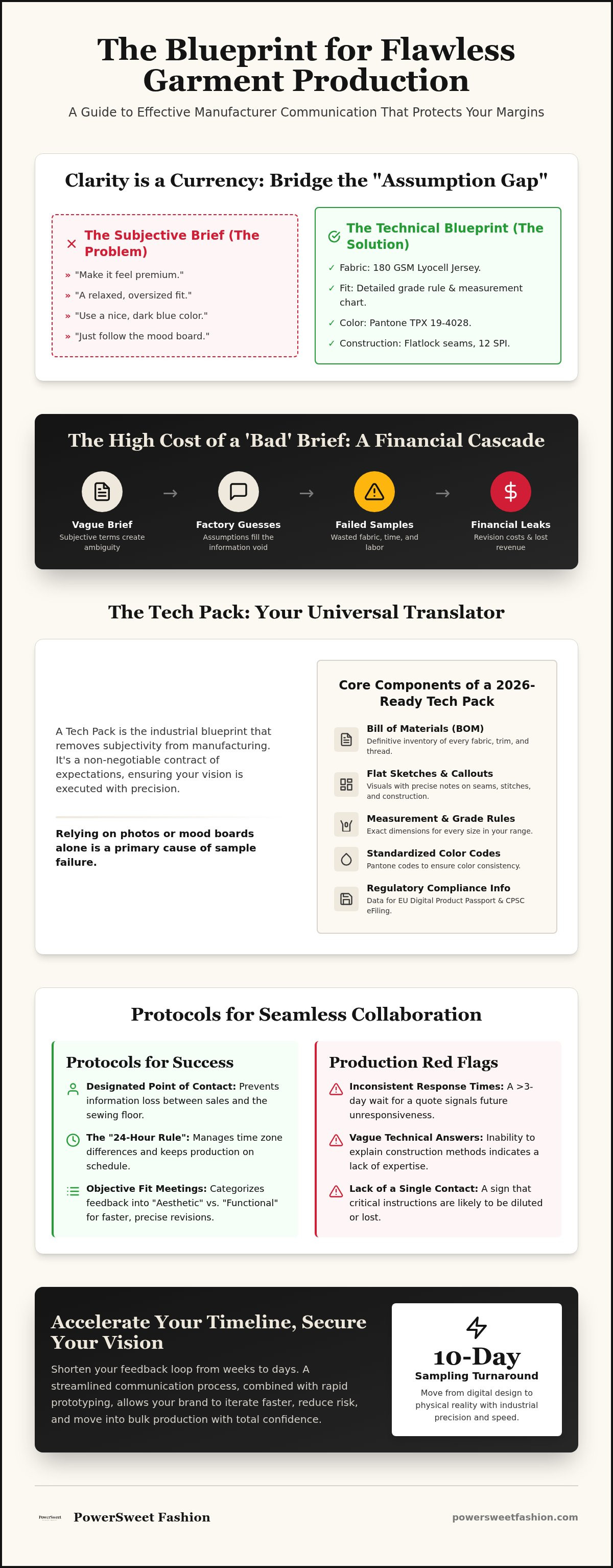
Ambiguity in a production brief is more than a minor hurdle; it's a financial liability. Every subjective term you use, such as "premium feel" or "relaxed fit," creates a vacuum that the factory must fill with assumptions. In the garment industry, assumptions lead to wasted fabric and failed quality checks. Effective communication with clothing manufacturers ensures that your design intent is translated into a physical product without costly detours. When instructions are precise, you eliminate the "Assumption Gap" where factories guess your requirements to keep the machines moving.
Factory prioritization is often misunderstood. Manufacturers don't just prioritize based on volume; they prioritize based on efficiency. A brand that provides a universal language for apparel production through precise technical specs is a low-risk partner. These brands move to the top of the queue because their projects are less likely to stall due to back-and-forth emails or sample rejections. Clear communication acts as a risk management tool. It protects your brand's reputation by ensuring that the final product meets the safety and quality standards required for global retail.
The True Cost of a 'Bad' Brief
A poorly defined brief triggers a cascade of financial leaks. Each sample revision cycle can add weeks to your timeline and hundreds of dollars to your development costs. If you miss a seasonal market window because of a third or fourth sample iteration, the loss isn't just the sampling fee; it's the entire projected revenue for that collection. Beyond the numbers, inconsistent instructions have a psychological impact on the factory team. When workers receive contradictory feedback, their attention to detail drops, and the likelihood of human error during bulk production increases significantly.
Communication Red Flags to Watch For
Identifying communication gaps early can save your brand from a disastrous production run. Inconsistent response times during the initial quoting phase are a primary warning sign. If a manufacturer takes three days to answer a simple pricing query, they'll likely be unresponsive when a critical production issue arises. Watch for vague answers to technical questions. If a factory cannot explain their specific construction methods for a complex seam or finish, they may lack the expertise to execute your design. Finally, ensure you have a designated production manager. Without a single point of contact, your instructions will likely get lost between the sales office and the sewing floor.
The Tech Pack: Your Universal Translator for Apparel Production
A tech pack is the industrial blueprint that removes subjectivity from the manufacturing process. While mood boards are useful for conveying a general aesthetic, they lack the technical data required for production. Relying on photos alone is a primary cause of sample failure. A factory cannot sew a "vibe" or a "feeling"; they need exact measurements and construction methods to deliver a high-quality product. This document serves as a contract of expectations between your brand and the production floor.
The Bill of Materials (BOM) within your tech pack acts as the definitive inventory for your garment. It must specify every fabric, trim, and thread count with absolute precision. Aligning with Good Practices in the Global Apparel Industry, a comprehensive BOM prevents the factory from using substitute materials that could compromise your brand's quality. Effective communication with clothing manufacturers depends on these annotations. Your flat sketches should include clear call-outs for seam types, stitch density, and reinforcement points to ensure nothing is left to chance during the assembly process.
Eliminating Subjective Language
Subjectivity is the enemy of scale. You must replace vague descriptors with empirical data to ensure your vision is executed correctly. Instead of requesting a "soft feel," specify a fabric composition like 180 GSM Lyocell or a 120-count Oxford cloth. An "oversized fit" should be defined by a detailed grade rule and a measurement chart that accounts for every size in your range. To maintain color consistency across different lighting conditions, always use standardized Pantone codes rather than descriptive names like "sky blue" or "deep red" which can be interpreted differently by different teams.
The Role of Professional Pattern Making
Digital patterns bridge the gap between design intent and physical reality. They ensure that every piece of fabric is cut with mathematical accuracy, which is vital for maintaining sizing consistency across the entire production run. We've found that mastering sample development starts with a technical pattern that can be easily shared and modified. This digital-first approach allows for rapid iterations and keeps your production journey moving forward without the delays of physical shipping. If you're ready to move from concept to creation, our team at PowerSweet Fashion can help translate your vision into production-ready specifications that minimize errors and maximize quality.
Establishing Protocols: Tools and Timelines for Seamless Collaboration
Establishing clear protocols is the foundation of a stable manufacturing partnership. Without a defined system, even the best tech pack can fail during the execution phase. Effective communication with clothing manufacturers requires a set of "Rules of Engagement" that dictate how and when information is shared. You need to designate specific points of contact on both sides to prevent message dilution. This structure ensures that technical queries reach the production manager while logistical updates go to the shipping coordinator without getting lost in a cluttered inbox.
Managing time zone differences is often the biggest hurdle for global brands. We recommend implementing a "24-hour rule" for critical production decisions. This means that any query sent by the factory must be answered within one business day to avoid halting the sewing lines. A delay in your response doesn't just push back your delivery date; it can cause the factory to reassign your labor team to another client's project. This creates a ripple effect of delays that are difficult to recover from later in the season.
Visual communication has become a non-negotiable tool in 2026. Video calls allow for real-time factory walkthroughs and 3D sample reviews, providing a level of detail that static photos can't match. Seeing a garment on a fit model during a live stream allows you to point out tension lines or drape issues immediately. However, remember the documentation hierarchy. While instant messaging is great for quick updates, every critical decision must be confirmed in writing via email or an ERP system. This creates a paper trail that protects both parties in case of a dispute.
Choosing the Right Communication Channels
Selecting the correct platform for each task is vital for organization. Use instant messaging for rapid-fire logistics, but keep formal approvals and tech pack updates in a centralized, cloud-based system. This ensures version control and prevents the factory from working off an outdated architectural blueprint for an item of clothing. Successful end to end clothing production relies on this single source of truth to keep designers, sourcers, and factory teams aligned.
Respecting the Production Clock
You must understand the factory's internal schedule to communicate effectively. The production floor moves through distinct phases: the cutting room, sewing lines, and finally the QC stations. If you request a change when the fabric is already in the cutting room, the cost and time implications are severe. Effective communication with clothing manufacturers means avoiding "ASAP" as a deadline. Provide specific dates for every milestone. Late approvals disrupt the factory's rhythm and can lead to your brand losing its slot in the production queue, resulting in missed market windows.
Feedback Frameworks: How to Review Samples and Manage Revisions
Receiving your first sample is a milestone, but it's also a critical test of your communication system. The "Fit Meeting" is the protocol where you objectively measure the physical garment against your tech pack’s spec sheet. Effective communication with clothing manufacturers during this phase prevents subjective opinions from derailing production. You must categorize your feedback into two distinct buckets: Aesthetic changes and Functional or Fit corrections. Aesthetic changes, like a slightly different shade of thread, are often negotiable. Fit corrections, such as a shoulder seam that sits too low, are non-negotiable requirements for quality assurance.
The "Photo-Markup" method is the most efficient way to communicate these changes. Use digital visual overlays to draw exactly where a pocket should be moved or where a hemline needs shortening. This removes the need for long, descriptive paragraphs that are easily misinterpreted. When you reach the end of your review, you face a critical decision: Approval or Rejection. If the sample meets your core specs, move to bulk production. If major construction issues exist, you must request a second prototype. This prevents expensive errors from being multiplied across hundreds of units.
Step-by-Step Sample Review Process
Step 1: Verify measurements against the tech pack chart immediately upon receipt. Use a professional measuring tape and document any deviations.
Step 2: Document the fit on a live model or dress form. Take high-resolution photos from the front, side, and back to show how the fabric drapes.
Step 3: Create a consolidated Comment Sheet. Send one comprehensive document rather than multiple piecemeal emails that can confuse the factory team.
Step 4: Request a Counter-Sample if major construction changes are required. This ensures the factory has corrected the issue before you commit to bulk production.
Giving Constructive Feedback to Factory Teams
Your tone during revisions dictates the future of the partnership. Be firm on technical specifications while remaining respectful of the factory's craftsmanship. If a construction issue arises, ask for the factory's advice. Questions like "How would you recommend we solve this seam tension issue?" often lead to better results than demanding a specific fix. This collaborative approach builds trust and utilizes the factory's expertise. Finally, avoid "Feature Creep." Adding new design elements during the sampling phase will blow out your production timeline and increase costs. Stick to the original brief to ensure a smooth transition to bulk manufacturing. If you need a partner that prioritizes precision, start your production journey with PowerSweet Fashion today.
Partnering with PowerSweet Fashion: Streamlined Communication for Global Brands
At PowerSweet Fashion, we recognize that effective communication with clothing manufacturers is the engine that drives a successful brand. Our operational model is built to eliminate the technical gaps that often lead to production errors. By offering a 10-day sampling turnaround, we enable rapid feedback loops that allow you to iterate quickly and move into the market with confidence. This speed isn't the result of shortcuts; it's the outcome of a synchronized system where your design intent is immediately translated into a physical prototype.
One of our core strengths is the Direct Factory Access advantage. You aren't communicating with a third-party agent or a disconnected sales office. You're talking directly to the team overseeing your production. This transparency ensures that every detail, from fabric sourcing to final quality control, is handled with meticulous care. We also specialize in low MOQ women's clothing manufacturing, which allows emerging brands to scale their communication and production protocols as they grow. Whether you're producing 50 units or 5,000, our commitment to industrial precision remains constant.
The PowerSweet Communication Advantage
Our system is anchored by dedicated account managers who bridge the gap between creative vision and industrial reality. These professionals speak the language of both design and production, ensuring that your tech pack is fully understood before the first cut is made. We utilize a standardized onboarding process to review your specifications and identify potential construction hurdles early. Additionally, our proactive sourcing team communicates material options directly from our local supply chain, providing you with real-time data on fabric availability and lead times.
Starting Your Production Journey
Preparing for your first consultation is a straightforward process. We recommend having your tech pack or initial design sketches ready, as these serve as the foundation for our technical review. Once the sampling phase is approved, we move into our 15-20 day bulk manufacturing phase. During this time, you'll receive regular updates on production milestones, ensuring you're never left in the dark about your collection's status. We act as a safe pair of hands, managing the logistical complexities so you can focus on growing your brand. Contact PowerSweet Fashion today to start your next collection.
Elevating Your Production Strategy for 2026
Industrial precision starts with clear dialogue. In 2026, the success of your collection depends on your ability to translate creative vision into technical data. We've explored how a robust tech pack acts as your blueprint and how structured feedback cycles prevent the hidden costs of revision. Effective communication with clothing manufacturers is the most reliable way to protect your profit margins and ensure your brand's growth in a competitive global market.
Transitioning from concept to bulk production requires a partner that values speed without sacrificing stability. PowerSweet Fashion specializes in custom women's apparel, providing Red Dot design-standard production and a rapid 10-day sample turnaround. We act as your authoritative facilitator, offering the transparency and direct factory access you need to stay in control of your supply chain. Ready to scale your brand? Contact PowerSweet Fashion for professional manufacturing support. Your vision is ready for the world, and we have the industrial engine to power it.
Frequently Asked Questions
What is the most common communication mistake brands make with manufacturers?
The most common mistake is relying on subjective descriptions rather than technical data. Brands often send mood boards or photos and expect the factory to guess the construction details. This leads to the "Assumption Gap" where the factory fills in the blanks. To achieve effective communication with clothing manufacturers, you must provide a comprehensive tech pack that specifies fabric weight, stitch types, and exact measurements to remove all guesswork.
How do I ensure my manufacturer understands my sizing requirements?
Ensuring sizing accuracy requires a detailed measurement chart and a professional grade rule. You shouldn't just ask for a "Medium"; you need to provide specific dimensions for every size in your range. We recommend using digital pattern making to bridge the gap between design and physical reality. This ensures that every piece of fabric is cut with mathematical precision. High-resolution photos of samples on a live fit model also help verify the drape.
Do I really need a tech pack for a simple design?
Yes, a tech pack is essential even for the simplest designs. Even a basic t-shirt has dozens of variables, including seam allowance, stitch density, and fabric composition. Without a tech pack, you leave these details to the factory's discretion. This document serves as your contract of expectations. It removes ambiguity from the production line and protects your brand's margins by ensuring the first sample is as close to your vision as possible.
How often should I communicate with my manufacturer during bulk production?
You should communicate at every major production milestone. This includes the start of fabric sourcing, the completion of the cutting phase, and the final quality control checks. We suggest following a "24-hour rule" for any queries the factory sends. Fast responses keep the sewing lines moving and prevent your project from being reassigned to another slot. Regular updates provide transparency and ensure that any minor issues are caught before the entire run is finished.
What should I do if my sample arrives and it's completely wrong?
If a sample is incorrect, immediately verify the physical garment against your tech pack’s spec sheet. Document the discrepancies with high-resolution photos and digital markups. Categorize the errors into aesthetic changes versus functional fit corrections. If the construction is fundamentally flawed, you must request a counter-sample before proceeding. This step is vital to effective communication with clothing manufacturers because it ensures the factory corrects the pattern before you commit to bulk production.
How can I overcome language barriers when working with an overseas factory?
Overcoming language barriers is best achieved through visual communication and simplified technical terms. Use flat sketches with clear annotations rather than long paragraphs of text. Video calls for 3D sample reviews allow for real-time feedback that transcends language. At PowerSweet Fashion, our account managers bridge this gap by speaking the language of both design and production. This ensures your vision is accurately translated onto the factory floor without any linguistic misunderstandings.
Is it okay to use WhatsApp or WeChat for professional production communication?
Instant messaging is useful for quick logistical updates, but it shouldn't be the primary source of truth. Critical decisions, such as final sample approvals or tech pack revisions, must always be confirmed in writing via email or a formal ERP system. This creates a documentation hierarchy that protects both parties. Messages can be easily lost or misinterpreted; a formal email provides a clear paper trail that is essential for managing global supply chains effectively.
How do I handle a situation where the manufacturer says a design feature is impossible?
When a factory says a feature is impossible, it's often a signal of a construction or durability risk. Instead of demanding the original design, ask for their professional recommendation. Use questions like "How would you suggest we achieve a similar aesthetic while maintaining seam strength?" This collaborative approach utilizes the factory's expertise to find a pragmatic solution. It builds trust and often results in a more stable, production-friendly garment that meets your brand's quality standards.


Comments