%20(1).png)
Manufacturing Payment Terms: 2026 Fashion Brand Guide

A payment schedule is useful only when each payment has a clear production milestone behind it. Understanding manufacturing payment terms means knowing not just when a deposit or balance is due, but which work, materials, or goods the payment covers. Linking payments to documented stages makes cash-flow planning and order coordination clearer.
If you’re unsure whether an early payment should cover sample development, materials, or the start of bulk production, begin by defining the scope and sequence of the order. Payment structures vary by project, so no single schedule suits every brand or production run. Clear milestones and written records help both sides understand what is due and when.
This guide compares common payment structures and their trade-offs, then explains how to document terms for sourcing, sampling, production, quality control, and shipment. Use it to prepare for an apparel order and align payment expectations with your manufacturing partner. PowerSweet Fashion provides custom womenswear production, from fabric sourcing and sample development through bulk manufacturing and quality control, with project details tailored to the order.
Table of Contents
What do manufacturing payment terms mean for an apparel order?
Common manufacturing payment structures and when brands use them
Are advance payments risky? How to weigh protection and production needs
How to review and agree manufacturing payment terms before production
How PowerSweet Fashion coordinates payment terms with apparel production
What do manufacturing payment terms mean for an apparel order?
Manufacturing payment terms are the agreed conditions for when and how a buyer pays for an order. They set expectations for both sides: a brand can plan cash flow, while a manufacturer can coordinate the work needed to move garments from development into production.
Payment terms govern the money. Delivery terms govern how and where goods are delivered, while production lead time describes how long the goods take to make. A payment schedule sets when payments are due. A payment method explains how funds are transferred, such as by bank transfer or through a letter of credit, a bank-mediated arrangement that pays against specified documents. These are related decisions, but they answer different questions.
For a brand, understanding manufacturing payment terms means looking beyond the due date. The terms affect when working capital is needed, what evidence shows that a production stage is complete, and how clearly the buyer and manufacturer can coordinate the next step.
Which details make up manufacturing payment terms?
Write the payment arrangement into the order documents clearly enough for both teams to follow. Include:
Due dates and triggers: State when each payment is due, using a calendar date or a specific event.
Amounts and currency: Record the amount or proportion for each stage and the currency of payment.
Transfer method: Name the agreed way to send funds and include the relevant payment instructions.
Supporting records: Identify documents that accompany or support a payment, such as an invoice, sample approval, or production update.
An order might separate charges for sample development, materials, bulk production, and a final payment. The stages and amounts depend on the project. Record them in the order agreement or other written order documents, rather than relying on an informal understanding that could be interpreted differently later.
Why do payment milestones matter in clothing production?
Apparel production involves connected activities. Fabric and trim sourcing needs to match approved specifications; sample development helps confirm the garment before bulk work; production then moves through quality checks. A milestone-based schedule can link payment timing to these agreed stages, making it easier to track what is complete and what comes next.
This clarity supports planning on both sides. The buyer can forecast cash needs and track order progress, while the manufacturer can coordinate sourcing, sampling, production, and inspection around documented expectations. If a stage changes, written updates help keep the payment record and production plan aligned. For a broader view of how these activities fit together, see our guide to end-to-end clothing production.
Common manufacturing payment structures and when brands use them
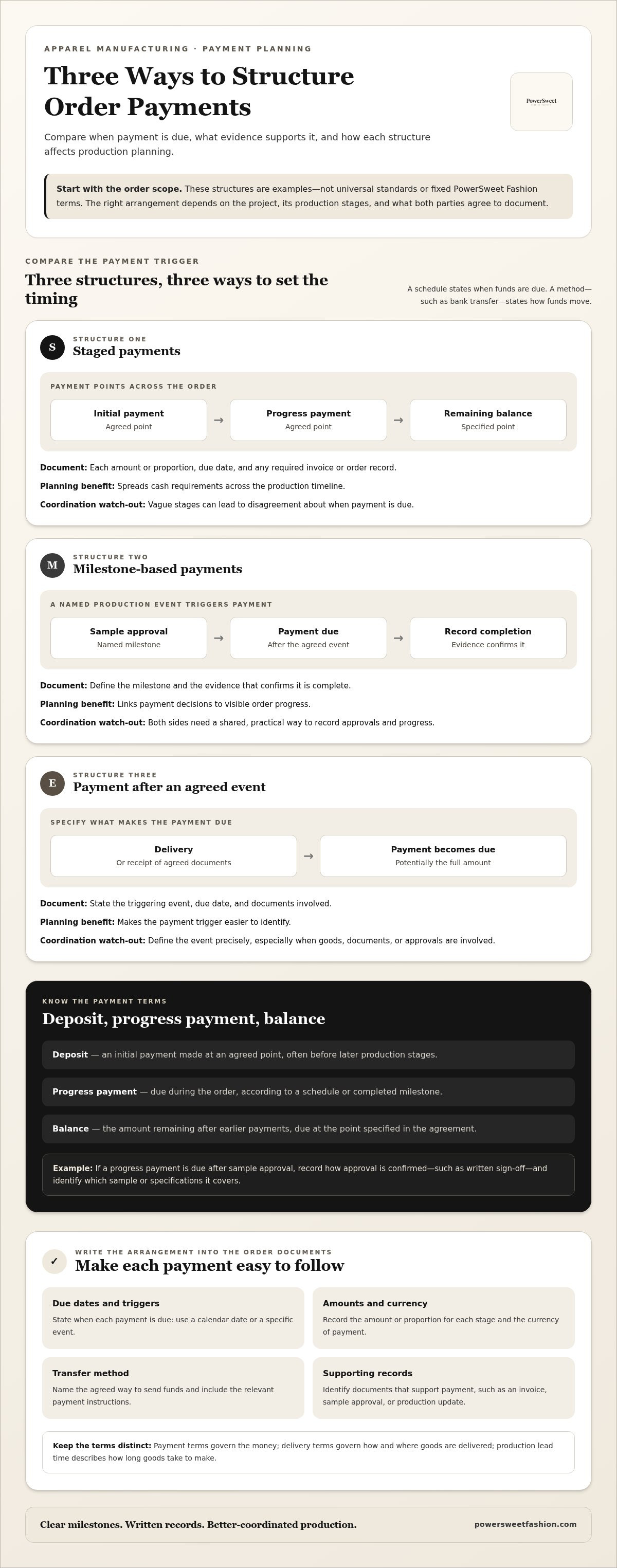
No single payment schedule suits every apparel order. The structures below are examples, not universal industry standards or fixed PowerSweet Fashion terms. The right arrangement depends on the project scope, production stages, and what both parties agree to document.
How do deposits, progress payments, and balances differ?
A deposit is an initial payment made at an agreed point, often before later production stages. A progress payment is due during the order, according to a schedule or completed milestone. The balance is the amount remaining after earlier payments, due at the point specified in the agreement.
For example, an order could make a progress payment due once the buyer approves a sample. The agreement should say how approval is recorded, such as through written sign-off, and which sample or specifications the approval covers. Define evidence for every milestone so neither side has to guess whether the payment trigger has been met.
How should brands compare payment methods?
The schedule says when payment is due; the method says how funds move. A bank transfer is direct, but the parties should account for processing time, bank details, and any transfer charges. A letter of credit involves banks and specified documents, adding administrative steps while setting out conditions for payment. The U.S. International Trade Administration describes it as a trade finance tool used in international transactions.
Compare methods by considering payment security, paperwork, transfer timing, and transaction costs. Suitability depends on the transaction, the parties, bank requirements, and the contract. Keep the method distinct from the schedule: a bank transfer or letter of credit does not define production milestones or due dates. For project-specific apparel production planning, learn about PowerSweet Fashion’s production services.
Are advance payments risky? How to weigh protection and production needs
It’s reasonable to consider the risks of paying before garments are complete. An advance payment can help a manufacturer prepare for an order, including coordinating materials and production resources, but it is not automatically unsafe or right for every project. The buyer also needs visibility into progress and a schedule that fits available working capital.
Risk management depends on clear obligations and records, not timing alone. An early payment can be easier to manage when the order scope, payment trigger, and evidence of progress are documented. A later payment can still create uncertainty if the agreement leaves those details vague. Understanding manufacturing payment terms means assessing what each payment commits both parties to do and how that commitment will be recorded.
What should a buyer document before making a production payment?
Before authorizing payment, match the amount due to the written order and a specific trigger. Keep the record practical and easy for both teams to reference:
Order scope: Identify the garments and approved specifications covered by the payment.
Payment details: Record the amount, currency, due date, and event that makes the payment due.
Supporting evidence: Connect the payment to relevant purchase orders, invoices, sample approvals, or agreed production updates.
Changes: Keep written records of revisions, approvals, and schedule adjustments, including their effect on the order and payment plan.
For example, if payment is linked to sample approval, define how approval is recorded and which specifications the approved sample represents. This gives the buyer and production team a shared reference if details change later.
What safeguards improve visibility without delaying production?
Agree on review points that fit the workflow, such as sample approval, material readiness, a defined production update, and quality checks. At each point, clarify what information will be shared, who records approval, and what needs to happen before work proceeds. The aim is visibility, not unnecessary sign-off delays.
Plan for exceptions before they occur. State how the teams will document a delay, a quality issue requiring rework, or a change to the agreed scope. Record the issue, the proposed response, any revised milestone, and any resulting change to payment timing. This keeps production decisions connected to the commercial record.
International transactions can involve different payment arrangements, and the International Trade Administration summarizes the primary methods of payment. Whichever arrangement the parties choose, document its role in the order and keep it distinct from production approvals. No single safeguard or payment instrument suits every order. Clear expectations and consistent records help both sides understand their obligations.
How to review and agree manufacturing payment terms before production
Put payment expectations into a shared order record before authorizing production. Link each payment to the agreed garments, a production stage, and evidence of progress. This helps prevent the buyer and manufacturer from working from different assumptions.
Use this sequence:
Define the scope: Record garment styles, quantities, approved specifications, and what the order includes.
Map milestones: Identify relevant stages, such as sample approval, material readiness, production progress, quality checks, or shipment documentation.
Document each payment: State the amount or proportion, currency, due date, and specific event that triggers payment.
Confirm records: Agree what document or approval shows that each milestone is complete.
Approve revisions: Specify who can authorize changes and how approved updates affect the order and payment schedule.
What should the purchase order and invoice specify?
The purchase order should identify the product scope, quantities, approved specifications, currency, payment stages, and due dates. Invoices should refer to the same order identifier and, where applicable, name the milestone being billed. Consistent references make it easier to match an invoice to the right order, approval, and production record.
Set a straightforward change process. If a specification changes after sample review, for example, record the revised detail, who approved it, and whether it affects the order or payment timing. Keep the updated approval with the purchase order and related invoice records so the current agreement is clear.
How can brands connect terms to quality and delivery checkpoints?
Choose checkpoints that are observable and relevant to the order. Sample sign-off can be recorded as written approval of the sample and its specifications. This gives the brand and production team a shared reference for pattern adjustments and sample development before bulk production. For more context on this stage, see our guide to sample development and pattern making.
Production status updates, quality-control records, and shipment documents can also support agreed payment triggers. Avoid loose phrases such as “once progress is satisfactory.” Name the record or event instead, and clarify how exceptions, rework, or delays will be reported and approved.
Before authorizing production, check:
Does the order match the approved scope and specifications?
Are payment amounts, dates, and triggers written clearly?
Do invoices and approvals use consistent order references?
Is there a named process for approving and recording revisions?
Clear records make collaboration easier from development through quality checks. Learn about custom apparel production with PowerSweet Fashion, where project details and payment arrangements are tailored to the order.
How PowerSweet Fashion coordinates payment terms with apparel production
Payment planning works best when it reflects the production work behind the order. PowerSweet Fashion coordinates custom womenswear production with fabric sourcing, sample development, and quality-control services. Considering these stages together helps define project milestones and clarify what information or approval records progress. Payment arrangements are tailored to the order rather than based on a fixed schedule.
For brands focused on understanding manufacturing payment terms, the practical goal is a shared plan. A payment trigger can align with an agreed project milestone, while the corresponding record gives the brand and production team a clear reference. The stages depend on the order scope and the work involved.
What production information helps shape a clear project schedule?
Planning starts with the details that shape the garments and production sequence. Design specifications and a tech pack help establish what is being made. Fabric and trim requirements inform sourcing, while target quantities define the scope of bulk production. Clear approval contacts identify who can sign off on samples, specifications, and revisions.
Sample approval is a useful alignment point before bulk production begins. It gives the brand and production team a shared reference for garment construction and approved details. If the sample or specifications change, recording the revision helps keep the production plan and related payment milestones in step.
Clear communication matters at every stage. A documented update about material readiness, sample approval, production status, or quality checks helps both sides understand what has happened and what comes next. This makes payment expectations easier to coordinate with the physical work, instead of treating the schedule as a separate administrative task.
What is the next step for brands planning an order?
Prepare the information that will make an initial project discussion productive. Gather your tech pack or design specifications, target quantities, material preferences, and the names or roles of people responsible for approvals. Note decisions that are still open, such as fabric selection or sample revisions, so they can be included in the planning conversation.
From there, the brand and production team can map the order scope, identify relevant milestones, and document the agreed payment details and supporting records. This creates a practical starting point for coordinating custom womenswear from development through quality control, with terms shaped around the actual project.
Discuss your custom apparel production project with PowerSweet Fashion when you’re ready to plan your next order.
Put Clear Payment Terms Into Your Next Production Plan
Strong manufacturing payment terms do more than set due dates. They connect each payment to a documented milestone, helping the brand and manufacturer plan cash flow, track progress, and coordinate production. The schedule and payment method are separate decisions, and neither should be left to assumption.
As you prepare an order, define its scope, link payment triggers to observable stages, and keep purchase orders, invoices, approvals, and revisions aligned. Advance payments can support production readiness, but clear records and agreed review points help both parties maintain visibility as work progresses.
PowerSweet Fashion coordinates fabric sourcing, sample development, production, and quality control for custom womenswear. Project details and payment arrangements are tailored to the order, so planning can reflect the work involved rather than a fixed schedule.
Ready to apply these principles to your next apparel order? Discuss your custom apparel production project with PowerSweet Fashion. Clear expectations are a practical first step toward a confident production partnership.
Frequently Asked Questions
What are manufacturing payment terms?
Manufacturing payment terms are the agreed conditions for paying for an order, including when payments are due, their amounts, and any required records. Understanding manufacturing payment terms means connecting each payment to a clear date or production milestone, such as sample approval or a defined stage of bulk production. Written terms help the buyer and manufacturer plan cash flow, track obligations, and coordinate the order without relying on assumptions.
What is a typical payment schedule for clothing manufacturing?
There’s no single schedule that applies to every clothing order. Parties may agree on staged payments, payments tied to named production milestones, or a remaining balance due after an agreed event, such as before shipment. The suitable structure depends on the order and the parties’ agreement. Document each amount, due date, payment trigger, and supporting record in the order terms so expectations are clear.
Is a deposit required when placing a manufacturing order?
A deposit is required only if the buyer and manufacturer agree to it in the order terms. If included, the agreement should state its amount, due date, and purpose, such as supporting an agreed early production stage. Don’t assume a deposit percentage or that every order uses one. Link the payment to the documented scope and specify what activity or milestone comes next.
What does balance before shipment mean?
“Balance before shipment” means the remaining amount due after earlier payments must be paid before the goods are shipped, as specified in the agreement. The written terms should identify how the balance is calculated, its due date or trigger, and any records required before payment. Distinguish this payment point from quality approval or delivery terms, which need their own clear definitions in the order documents.
How can a fashion brand reduce risk when paying a clothing manufacturer?
Reduce uncertainty by documenting the order scope, approved specifications, payment amounts, due dates, and evidence for each payment trigger. Keep purchase orders, invoices, sample approvals, production updates, and revision approvals connected through consistent references. Agree how delays, rework, or scope changes will be recorded and handled. These steps give both teams visibility into progress and obligations without assuming that one payment schedule or safeguard fits every order.
What is the difference between payment terms and payment methods?
Should payment milestones be included in a clothing purchase order?
Yes, include the agreed milestones in the purchase order or a clearly referenced written attachment. Specify each payment amount, due date or trigger, and the record that confirms completion, such as written sample approval or an agreed production update. Use consistent order references on invoices and approval records. Also define who can approve revisions and how changes update the order, so the buyer and manufacturer share the same current terms.


Comments