%20(1).png)
Manufacturing My Own Clothing Line: 2026 Founder Guide

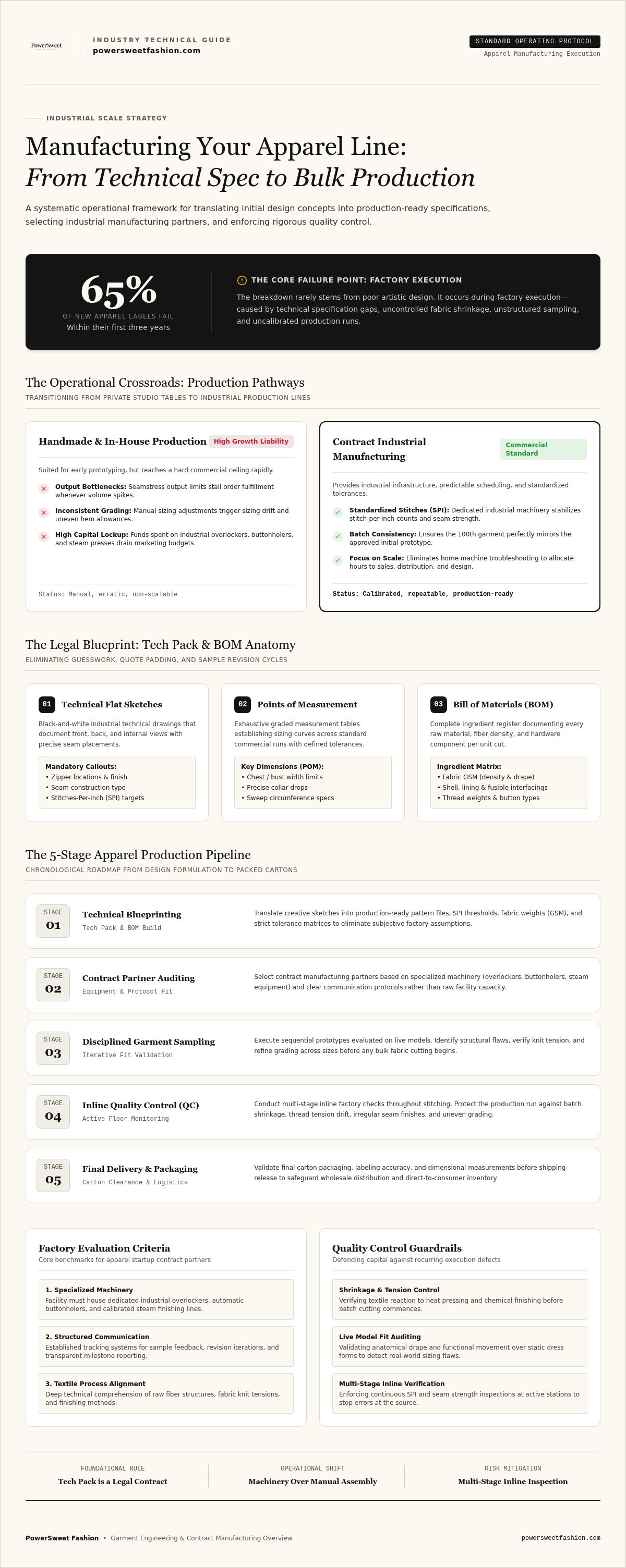
Roughly 65% of new fashion brands fail within their first three years, and the breakdown rarely stems from poor design. It happens during factory execution. When you decide that manufacturing my own apparel line is the next step for your brand, the friction between a creative sketch and bulk delivery can feel overwhelming. Technical packs, fabric shrinkage, and sample revisions quickly replace aesthetic mood boards.
You shouldn't have to risk your capital on guesswork or fear getting locked into unmanageable production runs. You need clear technical specifications, transparent sample iterations, and dependable turnaround times so your sizing and fit remain consistent from the first prototype to the final carton.
This guide shows you how to master the step-by-step process of manufacturing your own apparel line from initial tech pack to full-scale bulk delivery. We walk through translating design concepts into production-ready patterns, sourcing reliable contract manufacturing partners, and establishing rigorous quality control checks across your entire pipeline.
Table of Contents
Manufacturing My Own Product Line: In-House Production vs. Contract Manufacturing
Preparing for Production: Developing Tech Packs and Technical Specifications
Selecting the Right Factory Partner: Criteria for Apparel Startups
The Garment Sampling Process: From First Prototype to Production Approval
Managing Bulk Production, Quality Control, and Final Delivery
Manufacturing My Own Product Line: In-House Production vs. Contract Manufacturing
Every independent apparel label reaches a clear operational crossroads. Handcrafting garments in a private studio works during early prototyping, but it quickly caps your commercial momentum. When the goal shifts toward manufacturing my own line at scale, internal cutting tables must give way to industrial supply chains.
This transition marks the boundary between an artisanal workshop and a scalable enterprise. Hand-sewing keeps control close, yet it consumes the hours you need for customer acquisition, wholesale outreach, and creative direction. Partnering with an industrial facility converts erratic manual labor into a predictable, repeatable production schedule. While commercial production demands industrial speed, bespoke cut-and-sew work remains ideal for individual specialty projects—for instance, you can learn more about Just T-Shirt Quilts to see how custom textile craftsmanship turns individual t-shirts into personalized quilts.
The Limitations of Handmade and In-House Production
In-house operations hit a hard physical ceiling very quickly. Studio floor plans run out of square footage, cutting tables become bottlenecked, and single-needle domestic machinery can't match commercial throughput. Scaling manually introduces distinct operational liabilities:
Output bottlenecks: A single seamstress can only stitch a finite number of garments each week, delaying customer order fulfillment whenever sales spike.
Inconsistent grading: Manual adjustments across size runs frequently lead to sizing drift and irregular hem allowances between individual garments.
High capital lockup: Purchasing specialized equipment like industrial overlockers, buttonholers, and steam presses drains capital that belongs in marketing and fabric procurement.
Why Contract Manufacturing Unlocks True Brand Scalability
Contract manufacturing delivers the infrastructure needed for volume, speed, and technical standardization. Industrial facilities operate specialized production lines with dedicated machinery for every stitch type. This equipment stabilizes stitches-per-inch (SPI) counts and seam strength, ensuring your hundredth unit matches your initial approved sample.
Working directly with an industrial floor also improves your technical understanding of the broader textile manufacturing process, helping you align raw fiber structures and knit tensions with proper finishing techniques. Instead of troubleshooting thread tension on home machines, you rely on calibrated industrial tooling run by dedicated operators.
Collaborating with an established custom women's clothing manufacturer shifts your focus from manual labor to executive growth. You secure precise construction tolerances, protect delivery timelines, and free up critical hours to build your distribution channels.
Preparing for Production: Developing Tech Packs and Technical Specifications
A tech pack is not an artistic mood board. It is the legally binding industrial blueprint for your garment. When taking the decisive step of manufacturing my own apparel line, leaving details open to interpretation invites immediate production errors. Without precise technical sheets, factories must guess your stitch tensions, seam allowances, and grading curves. This guesswork drives up quote buffers and forces expensive, unnecessary sampling rounds.
Building an Actionable Tech Pack for Garment Factories
Clear documentation starts with black-and-white technical flat sketches. These illustrations must show front, back, and interior views, explicitly calling out seam construction, zipper placements, and stitch-per-inch (SPI) targets. Alongside these flats, build an exhaustive graded measurement table spanning your size curve. Define every point of measurement (POM) clearly, including chest widths, collar drops, and sweep circumferences, paired with strict manufacturing tolerances.
Creating a Comprehensive Bill of Materials (BOM)
Your Bill of Materials functions as the complete ingredient register for every single unit cut on the factory floor. It details every component down to the raw fiber blend and thread weight:
Textiles and linings: Document the shell fabric, lining weight, and fusible interfacings, specifying target fabric density using grams per square meter (GSM) to lock in garment drape.
Hardware and trims: Identify exact zipper teeth dimensions, button compositions, and specific thread types.
Color standards: List standardized Pantone codes to maintain seasonal color matching across different dye lots.
Labeling requirements: Specify care labels, fiber contents, and placement points to comply with international standards highlighted by the United States Fashion Industry Association.
Standardizing these technical inputs protects you from uneven sizing and material substitutions. If you want to streamline this preparation phase, working directly with specialists in pattern making and sample development helps eliminate expensive sampling iterations before your cut tickets are issued.
Selecting the Right Factory Partner: Criteria for Apparel Startups
Selecting a production partner is an operational commitment, not just a price negotiation. When taking on the challenge of manufacturing my own clothing collection, factory specialization dictates product viability. A facility geared for heavyweight denim will struggle with lightweight silks. You need a dedicated partner whose machinery, feed dogs, and pressing stations match your exact silhouettes and fabrications.
Founders generally choose between Cut, Make, and Trim (CMT) or Full-Package Production (FPP). CMT requires you to supply all fabrics, thread, and labels directly, leaving sewing to the plant. FPP handles the entire lifecycle under one roof, managing fabric sourcing, grading, cutting, and assembly. For emerging brands, FPP drastically reduces logistics friction and eliminates supplier finger-pointing.
Evaluating Minimum Order Quantities and Production Flexibility
High production thresholds tie up liquidity before your collection proves market demand. Working alongside a low MOQ women's clothing manufacturer allows you to test market reception with focused batch sizes rather than warehousing unsold seasonal inventory.
Flexible volume requirements protect your working capital. They enable disciplined, test-and-learn rollouts, letting you analyze real customer sizing data and color preferences before committing capital to full replenishment runs.
Assessing End-to-End Capabilities and Material Sourcing
Fragmented supply chains introduce unnecessary bottlenecks. If an external mill delivers yardage late, your sewing schedule collapses. Partnering with an end to end clothing production facility centralizes raw material sourcing, technical pattern drafting, and grading within a single unified workflow.
Beyond capacity, audit each facility's operational agility and communication standards:
Dedicated sample lines: Confirm the facility has a distinct sample room capable of returning development pieces within a 10-day turnaround.
Bulk lead times: Verify whether established assembly lines can reliably execute bulk orders within 15 to 20 days.
Inspection procedures: Ensure the facility enforces structured protocols aligned with proven quality control in garment manufacturing standards.
Fast responsiveness and technical clarity turn an external supplier into an integrated operational engine for your brand.
The Garment Sampling Process: From First Prototype to Production Approval
Sampling is the engineering phase where paper specifications confront physical textiles. When manufacturing my own line, treating the prototype review as a casual visual check guarantees expensive errors during bulk runs. You must evaluate each iteration systematically through three milestones: the initial proto sample for silhouette, the pre-production (PP) piece for construction and trims, and the top-of-production (TOP) garment pulled directly from early factory cutting lines.
To avoid bleeding weeks into development, partner with a responsive sample development clothing manufacturer capable of delivering a fast 10-day turnaround on development samples. Quick physical iterations keep your launch calendar on track and eliminate prolonged downtime between fit revisions.
Conducting a Thorough Sample Fit and Measurement Audit
Never rely solely on dress forms. Static mannequins hide mobility restrictions and stress points. Put every sample on a professional fit model who matches your target demographic's exact body measurements, then run dynamic movement tests: sitting, walking, raising arms, and bending forward.
Audit the physical sample against your spec sheet using a calibrated tape measure:
Tolerance compliance: Check each POM against your allowed limits. Flag any deviation exceeding 5 millimeters.
Seam behavior: Inspect armholes, side seams, and crotch curves for drag lines, balance twisting, or micro-puckering.
Structural balance: Ensure collars stay flat without curling and hem circumferences hang parallel to the floor during motion.
Consolidate your feedback into a single, annotated digital fit report. Pair clear, pinned fit photographs with millimeter-specific adjustment instructions so pattern makers know exactly how to alter the cutting blocks.
Approving the Golden Sample for Bulk Manufacturing
Once all corrections are executed, the final approved prototype becomes the "golden sample." This finished garment represents the absolute legal standard for full production runs. If the bulk output deviates from this physical reference, you have enforceable recourse with your factory.
Produce two identical versions of the golden sample. Both you and the factory manager sign the master tags, keeping one copy at the plant floor and one in your studio. This locks in stitch densities, seam construction, and required fiber-content label placements before cutting begins.
Ready to validate your patterns with expert oversight? Submit your designs to PowerSweet Fashion to initiate your professional sample run.
Managing Bulk Production, Quality Control, and Final Delivery
Once the golden sample receives final sign-off, your project transitions into mass manufacturing. Meticulous floor management replaces development edits. When manufacturing my own designs at scale, the factory floor shifts through four synchronized phases: fabric spreading and relaxing, automated cutting, progressive bundle line assembly, and final press finishing.
Agile supply chains rely on predictable throughput. Well-managed production lines complete bulk production within 15 to 20 days, letting you react quickly to seasonal sales velocities without accumulating dead stock.
Implementing Rigorous Multi-Stage Quality Assurance
Defects compound exponentially if unmonitored. High-standard facilities implement multi-stage quality control checks at critical manufacturing gates rather than relying solely on end-of-line reviews:
Raw material verification: Fabric bolts undergo inspection for shading, snags, and post-wash shrinkage before cutting begins.
Inline checks: Roaming inspectors monitor seam alignment, thread tensions, and stitch-per-inch counts while panels are joined, preventing structural errors before garment closure.
End-line finishing: Finished pieces pass through sensitive needle detection equipment, loose thread shears, and final measurement audits using accepted quality limit (AQL) statistical sampling before polybag packing.
Coordinating Packaging, Freight, and Customs Clearance
Garment assembly represents only half the journey. Transporting packaged cartons into your distribution center demands structured logistical planning. Prepare documentation early to prevent customs bottlenecks. Every consignment requires clear commercial invoices, itemized packing lists, and correct harmonized tariff schedule (HTS) classifications.
Select your transport tier based on transit time versus landed margin goals:
Air express: 3 to 5 business days for fast inventory restocks or urgent press drops.
Standard air freight: 7 to 10 days, offering a pragmatic balance between transit speed and shipping spend.
Ocean freight: 25 to 35 days, providing the most economical freight rates for planned volume deliveries.
Streamlining each production phase protects your balance sheet from costly delays. When you are ready to scale without logistical guesswork, partner with PowerSweet Fashion for reliable, end-to-end custom apparel manufacturing.
Transform Your Apparel Vision into Scalable Commercial Reality
Successfully manufacturing my own apparel collection comes down to operational discipline rather than creative guesswork. Standardizing your tech packs, conducting rigorous live-model fit audits, and enforcing multi-stage quality inspections protect your working capital and eliminate sizing inconsistencies across every seasonal drop.
You don't have to navigate industrial production floors in isolation. The right contract manufacturing partnership provides professional pattern development and comprehensive fabric sourcing right from day one. Rapid 10-day prototype sample turnarounds keep your development calendar agile, while 15 to 20 day efficient bulk manufacturing ensures your finished inventory arrives on schedule without draining your cash reserves.
Ready to move from initial design sketches to high-performing inventory? Partner with PowerSweet Fashion to manufacture your custom women's wear line and build a resilient production engine designed for long-term brand growth.
Frequently Asked Questions
How much does it cost to start manufacturing my own clothing line?
Starting costs depend on your order volume, fabric choice, construction complexity, and sampling rounds. When manufacturing my own line, overall capital requirements hinge heavily on whether you choose small-batch testing or high-volume cut tickets. Founders allocate capital across initial fabric procurement, sample development iterations, pattern grading, and logistics fees. Selecting a low-MOQ production partner significantly limits upfront capital risk.
What is a tech pack and do I need one before contacting factories?
A tech pack is a comprehensive blueprint containing technical sketches, graded measurements, stitching specs, and a bill of materials. You should prepare one before requesting quotes, as factories rely on exact measurements to estimate fabric consumption and sewing time. If you don't have a completed pack, full-service manufacturing partners can assist by converting basic concept artwork into technical grading sheets and production-ready pattern files.
What is the typical minimum order quantity for custom apparel manufacturing?
Minimum order quantities (MOQs) for custom apparel vary based on factory capacity and fabric mill minimums. Traditional industrial facilities often require several hundred pieces per style or colorway. However, agile specialist manufacturers offer flexible, low-MOQ programs designed specifically for emerging labels. These smaller thresholds allow you to validate target market demand and fit preferences without taking on substantial excess inventory liabilities.
How long does the entire garment sampling and manufacturing process take?
The entire production journey typically takes between four to eight weeks from finalized sketch to completed bulk shipment. Fast development sample creation takes approximately 10 days per iteration, allowing quick fit reviews. Once you approve the final golden sample, bulk production completes within 15 to 20 days. Factoring in transit times ensures your seasonal drop reaches the warehouse exactly on schedule.
Can I manufacture custom garments if I cannot sketch or draft patterns?
Yes, you can manufacture custom apparel without professional technical sketching or pattern drafting skills. When embarking on manufacturing my own apparel brand, you only need reference garments, clear mood boards, and detailed dimension notes. An end-to-end contract manufacturer provides in-house pattern makers who translate rough visual concepts into digital grading files, standardizing every seam and hem before bulk cutting begins.
What is the difference between OEM and ODM clothing manufacturing?
OEM (Original Equipment Manufacturing) produces garments built entirely from your proprietary designs, tech packs, and custom fabric specifications. ODM (Original Design Manufacturing) offers pre-designed catalog styles where the factory modifies minor details, branding tags, or fabric shades for your label. Emerging brands seeking unique silhouettes, custom sizing, and proprietary brand equity generally require full custom OEM production. To explore an example of how specialized, milestone-based garment design comes together in a proprietary product range, discover Baby Loves Sleep.
You protect proprietary designs by executing bilateral non-disclosure agreements (NDAs) and clear manufacturing master service agreements before sharing tech packs. Work exclusively with vetted contract manufacturers who maintain transparent client rosters and dedicated production floors. Retaining countersigned golden samples and maintaining legal ownership of all digital CAD pattern files prevents unauthorized reproduction or pattern sharing across outside facilities.


Comments