%20(1).png)
How to Overcome Language Barriers with Chinese Factories for Seamless Production

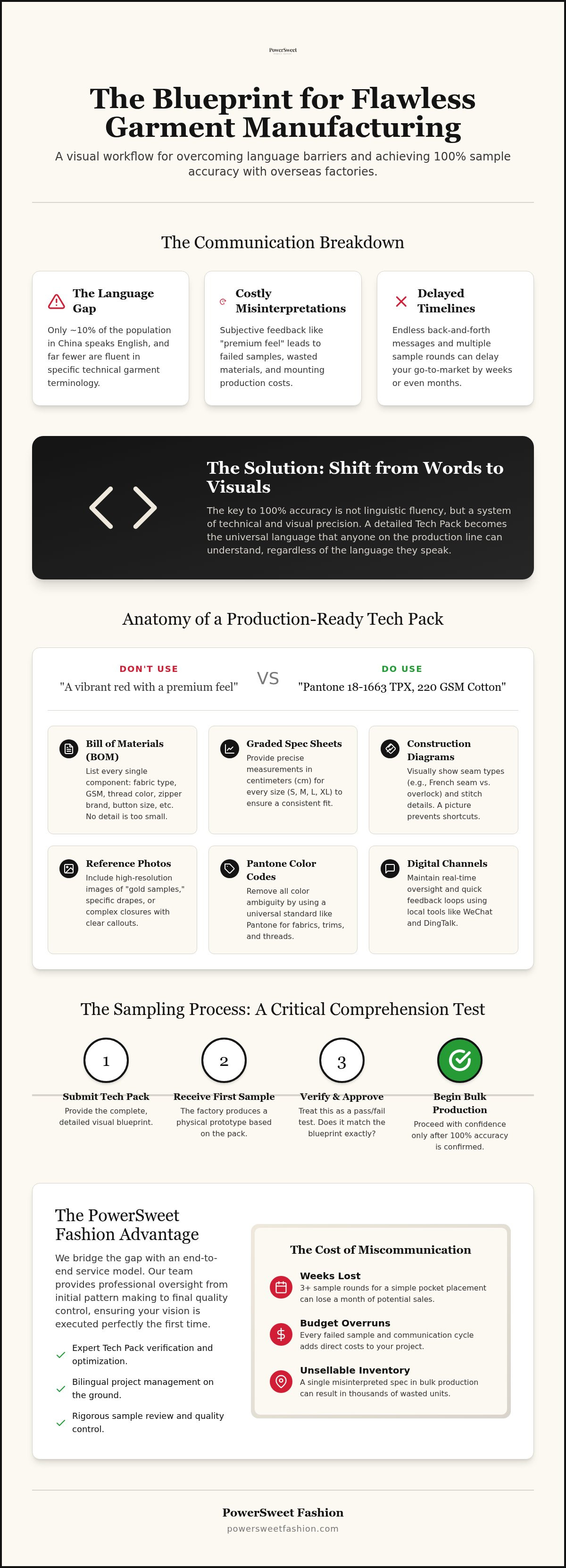
Did you know that while English is a global business language, only about 10% of the population in China speaks it; and even fewer are fluent in technical garment terminology? This reality often leads to the industry's biggest headache: receiving a production sample that looks nothing like your original sketch. You've likely felt the frustration of endless back-and-forth messages that only result in more confusion and mounting costs. Overcoming language barriers with Chinese factories is not just about translation; it's about building a system that relies on visual precision and technical clarity.
We understand that your brand's reputation depends on the accuracy of every stitch and seam. Mastering clear communication ensures your fashion designs are manufactured exactly as envisioned, without the fear of hidden costs or misinterpreted requirements. In this guide, we provide a streamlined communication workflow to help you achieve 100% accuracy in your garment samples. We'll cover the essential digital tools like WeChat and DingTalk, the importance of detailed tech packs, and the cultural nuances that foster a reliable, long-term manufacturing partnership built on trust.
Table of Contents
The Reality of Communication in Global Garment Manufacturing
Verbal communication is the weakest link in the supply chain. When instructions are spoken rather than documented, the risk of technical drift increases with every handoff. In a fast-paced production environment, relying on casual chat messages or phone calls creates a high risk of error. Success in managing language barriers requires shifting from conversational English to a technical, logic-based framework. This is the foundation of overcoming language barriers with Chinese factories; it's about ensuring that what you say is exactly what the production line executes.
Misunderstandings usually happen when brands use "soft" descriptions. Terms like "premium feel" or "vibrant red" are subjective and open to interpretation. A production manager might view a specific shade of crimson as vibrant, while the designer envisioned a bright poppy. Without objective benchmarks, these linguistic gaps lead to expensive mistakes in fabric weights, trim colors, and sizing. We treat every production run as a technical project where precision is the only acceptable standard.
Linguistic vs. Technical Barriers
Linguistic translation converts words from one language to another, but it doesn't guarantee technical comprehension. For instance, using industry-standard terminology such as GSM (Grams per Square Meter) for fabric density or specific Pantone codes for color removes all ambiguity. Another challenge is the cultural tendency to say "yes" to avoid "losing face" or causing offense. This "yes" often means "I hear you," not "I understand the technical requirement." We prioritize transparent, evidence-based confirmation to ensure every specification for custom women's clothing is locked in before the first cut.
The Cost of Miscommunication
The financial impact of miscommunication is substantial. Every failed sample cycle adds time to your go-to-market strategy. If a factory requires three rounds of sampling to get a pocket placement right, you've lost weeks of potential sales. In bulk production, a misinterpreted requirement can lead to thousands of unsellable units. Building a "first-time-right" culture involves rigorous documentation. By establishing a systematic approach to overcoming language barriers with Chinese factories, brands can respect their 15-20 day bulk production window by eliminating the need for reactive troubleshooting. We view communication as a technical blueprint, not a casual conversation.
Using Tech Packs as a Universal Visual Language
A tech pack is the single most important document in your production cycle. It functions as a technical blueprint that translates your creative vision into a physical reality. When overcoming language barriers with Chinese factories, you can't rely on descriptions alone. A well-constructed tech pack provides a universal visual language that bypasses linguistic confusion. It ensures that every pattern maker and seamstress understands the construction requirements without needing to translate a single word of English.
High-performing tech packs for women's apparel go beyond simple sketches. They include flat drawings, precise measurements, and material specifications. This level of detail is a core part of any professional guide to sourcing from Chinese suppliers, as it sets clear expectations from day one. By standardizing your measurements in centimeters and using clear callouts, you eliminate the guesswork that leads to sizing discrepancies and production delays. Precise documentation is the only way to guarantee consistency across a full production run.
Anatomy of a Production-Ready Tech Pack
A comprehensive Bill of Materials (BOM) is the backbone of your tech pack. It must list every component, from the primary fabric GSM to the specific brand of zippers and the color of the thread. Graded spec sheets are equally vital; they ensure that a size small fits with the same intended silhouette as an extra-large. We also recommend including detailed seam construction diagrams. Showing a French seam versus a flat-felled seam visually prevents the factory from choosing the easiest method over the correct one. Detailed diagrams remove the ambiguity that often plagues international manufacturing.
Visual Callouts and Reference Photos
Reference photos and "gold samples" provide an aesthetic benchmark that words cannot match. If you want a specific drape or a particular internal lining finish, show it. Use high-resolution images to diagram complex closures or hidden pockets. When annotating these images, use a consistent system of arrows and labels to point directly to the feature you're describing. This visual precision is why our sample development services focus on technical accuracy over artistic interpretation. A single, clear diagram of an internal lining is more effective than a page of translated text. This methodical approach ensures your designs are executed with 100% accuracy, making overcoming language barriers with Chinese factories a manageable part of your growth strategy.
Optimising Digital Communication Channels and Tools
Efficiency in garment production relies on selecting the right platform for the specific task. While formal emails serve as a permanent record for contracts and tech pack approvals, daily production needs happen in real-time. Overcoming language barriers with Chinese factories requires adopting the tools they use every day. Platforms like WeChat (Weixin) and DingTalk are not just social apps; they are essential business infrastructure. Because Western tools like Slack or Google Chat are often unreliable due to connectivity restrictions, staying within the local digital ecosystem ensures your messages are actually received and read.
Managing time zone differences is a logistical hurdle that requires a proactive schedule. A 12 or 13-hour gap means your evening is their morning. We recommend sending consolidated updates at the end of your business day so the factory team can address them first thing. To minimize confusion, use structured formatting in every message:
Use numbered lists for sequential steps or priority tasks.
Use bullet points for independent requirements or material specs.
Keep sentences under 15 words to improve translation accuracy.
Avoid idioms, slang, or cultural metaphors that don't translate well.
Mastering Real-Time Communication
WeChat is the pulse of Chinese manufacturing. It allows for instant photo sharing from the sewing floor and quick video calls for quality control (QC). If a pattern adjustment is needed, don't just type it. Use screen-recording tools to narrate design changes while pointing to the digital pattern on your screen. This visual-audio combination provides context that text alone lacks. Voice messages are common in China, but we suggest using them sparingly unless your Mandarin is fluent. Translation software handles text much more reliably than audio, so typing your instructions is always the safer choice for precision.
Translation Tools and Their Limitations
Translation apps have improved, but they still struggle with the technical vocabulary of custom women's clothing. When sending a critical instruction, always "reverse translate" it. Take the Chinese output, paste it into a different translator, and see if it returns to your original English meaning. If the meaning changes, simplify your English and try again. Ultimately, the most efficient route is partnering with a factory that provides a dedicated, English-speaking production team. This human layer of oversight ensures that technical nuances aren't lost in a digital algorithm, providing a safe pair of hands for your creative vision. This collaborative approach is a cornerstone of overcoming language barriers with Chinese factories while maintaining a fast-paced production schedule.
The Sampling Process: Physical Verification of Understanding
The first sample is more than a prototype; it's a diagnostic tool for your communication system. It reveals exactly where your technical documentation succeeded and where it was misinterpreted. When overcoming language barriers with Chinese factories, you must treat this stage as a "comprehension test." If a pocket placement is off or a seam construction is incorrect, it indicates a gap in the visual instructions provided. Identifying these errors early prevents them from being repeated during the bulk production run.
Providing feedback requires a disciplined, non-ambiguous approach. We recommend the "Red Pen" method. This involves physically marking the sample with corrections, taking high-resolution photos, and providing side-by-side comparisons with your original tech pack. Partnering with a specialized sample development clothing manufacturer ensures that fit issues are diagnosed technically rather than descriptively. Instead of saying a waist is "too tight," specify "increase waist circumference by 3cm." Precise numbers eliminate the risk of subjective adjustments.
Feedback Loops and Iteration
Video fit sessions are essential for demonstrating movement and drape. A static photo doesn't show how a skirt moves or how a sleeve pulls during activity. We use standardized feedback forms to track every change between versions. This ensures that a correction made on the first sample isn't forgotten by the third. While we aim for a 10-day sample turnaround, we don't rush the approval. If the second sample isn't perfect, we request a third. Quality is non-negotiable.
Verifying Fabric and Trim
Accuracy extends beyond the cut to the materials themselves. You must approve strike-offs for prints and lab dips for solid colors before production begins. This ensures your fabric sourcing aligns perfectly with your brand's color standards. We follow a "Master Sample" protocol where both the client and the factory keep an identical, approved copy of the final prototype. This acts as the physical contract for quality control. If you're ready to start your next collection with a partner who prioritizes technical clarity, explore our sample development services today.
PowerSweet Fashion: Bridging the Gap with End-to-End Support
PowerSweet Fashion acts as the authoritative facilitator in your production journey. We've built a systematic approach that eliminates the ambiguity typically associated with overseas manufacturing. Our professional production team doesn't just translate words; they interpret technical specifications to ensure your creative vision remains intact. By managing the entire process in-house, we remove the friction of overcoming language barriers with Chinese factories. This allows you to focus on design and growth while we handle the mechanics of the factory floor.
Our end to end clothing production model is designed for speed and precision. We provide a transparent timeline featuring a 10-day sample turnaround and 15-20 day bulk production cycles. This reliability is built on a foundation of open-door transparency. We frequently bridge the gap between digital communication and physical reality by highlighting the people involved in your work. We invite our clients to meet the team and oversee quality control personally, ensuring every garment meets your exact standards.
A Partner-First Approach to Manufacturing
Small brands often struggle to find manufacturing partners who value their business. Our low MOQ model changes this dynamic by encouraging deep, technical communication from the start. Our internal QC team acts as your advocate, interpreting your brand standards at every stage of the sewing and finishing process. We simplify the complexities of working with a custom women's clothing manufacturer by providing a single point of contact for sourcing, pattern making, and production. This collaborative "we" approach frames the manufacturing process as a joint venture between our facility and your brand.
Getting Started with Confidence
Confidence begins with the first inquiry. When you contact a professional factory, provide your tech pack and specific material requirements immediately to receive an accurate, empirical response. During your initial consultation with PowerSweet, we'll review your designs and discuss the most efficient production path for your specific scale. We're here to be the engine that powers your creative vision. Start your production journey with PowerSweet Fashion today to experience a manufacturing partnership built on trust and technical excellence.
Scale Your Fashion Brand with Technical Precision
Successful garment production relies on moving beyond casual conversation. By implementing detailed tech packs and leveraging the right digital tools, you transform subjective design ideas into objective manufacturing blueprints. Physical verification during the sampling phase remains the ultimate safeguard for your quality standards; it ensures that your final product matches your original vision perfectly. Mastering these systems is the most effective way of overcoming language barriers with Chinese factories while maintaining your brand's creative integrity.
PowerSweet Fashion provides the end-to-end material and production management you need to succeed in a competitive industry. As a specialist in women's fashion, we offer a 10-day sample turnaround to keep your brand moving at the speed of the global market. Our team acts as your technical advocate, ensuring that every stitch meets your requirements without the frustration of repetitive misunderstandings. Your creative vision deserves a manufacturing partner that prioritizes clarity, speed, and reliability. Request a Production Quote from PowerSweet Fashion today and take the first step toward a seamless production experience. We're ready to build a long-term partnership based on trust and empirical results.
Frequently Asked Questions
What is the best way to send design files to a Chinese factory?
Use high-resolution PDFs and professional tech packs sent through established digital channels. While email is standard for formal records, using WeChat for immediate design queries allows for real-time clarification between your design team and the factory floor. This approach ensures your technical blueprints are viewed instantly by the pattern making team, reducing the delay between submission and the start of sample development.
Should I learn Mandarin to work with clothing manufacturers in China?
No, learning Mandarin is not a requirement for successful production. Most professional factories employ account managers who are fluent in both English and technical garment terminology. Success in overcoming language barriers with Chinese factories depends more on your ability to provide clear, logic-based technical documentation than on your conversational linguistic skills. Precision in your tech pack is the most effective communication tool you can possess.
How do I know if a factory actually understands my Tech Pack?
The first physical sample serves as the ultimate proof of comprehension. If the prototype matches your measurements and construction callouts perfectly, the factory has correctly interpreted your technical language. Discrepancies in the sample highlight specific areas where your instructions may need more visual detail or clearer technical benchmarks. Treating the sampling phase as a technical audit ensures that all parties are aligned before bulk production begins.
What happens if the bulk production doesn't match the approved sample?
Use the "Master Sample" as your physical contract to resolve discrepancies. If the bulk output deviates from the approved prototype, your retained identical sample provides the empirical evidence needed for corrections. Partners like PowerSweet Fashion prioritize this level of transparency to ensure your 15-20 day bulk production cycle remains consistent with the pre-approved technical standards and quality benchmarks established during the sampling phase.
How can I manage quality control from a different country?
Leverage digital transparency through live video sessions and detailed photo reports. You can oversee the final quality control process remotely by requesting high-resolution images of critical seams and specific measurements. We also encourage brands to visit the facility in person to meet the production team, which strengthens the human element of the partnership and reinforces your brand's specific quality expectations for every order.
Can I use automated translation tools for technical garment specs?
Use automated tools only for basic correspondence, as they often struggle with technical fashion jargon. Terms like "smocking" or "interlining" may translate incorrectly, leading to expensive production errors. It is safer to use universal industry standards such as Pantone codes and GSM values. These provide a precise, numerical language that requires no translation and is understood by manufacturing professionals worldwide.
Why do misunderstandings happen even with clear English instructions?
Ambiguity often arises from subjective adjectives like "soft" or "durable." Even if the English is clear, different people interpret these qualities differently based on their industrial experience. Overcoming language barriers with Chinese factories requires shifting from descriptive language to quantitative data. By ensuring that every design element is defined by a measurable standard, you eliminate the guesswork that leads to misinterpreted requirements.
How does a low MOQ manufacturer handle communication differently?
Low MOQ manufacturers typically offer a more personalized, partner-focused communication style. Because they cater to emerging and influencer-led brands, they are often more flexible and responsive to detailed design queries. This model fosters a collaborative environment where the production team works closely with you to refine patterns and sourcing requirements. This high level of engagement is essential for maintaining accuracy during the initial stages of brand growth.


Comments