%20(1).png)
How to Expand Your Clothing Line with New Products: A Practical Guide

The next product in your clothing line shouldn’t be a guess. If you’re weighing a new category against the risk of unsold inventory, the answer isn’t simply to launch more. Look for the product your customers already have a reason to buy. Learning how to expand your clothing line with new products starts with evidence, not a larger production commitment.
It makes sense to be cautious. A new product can add work across design, sourcing, sampling, and launch planning, especially when demand is uncertain. But you don’t have to choose between standing still and investing in a large run. Customer feedback, preorders, and small-batch testing can help you assess an idea before scaling it.
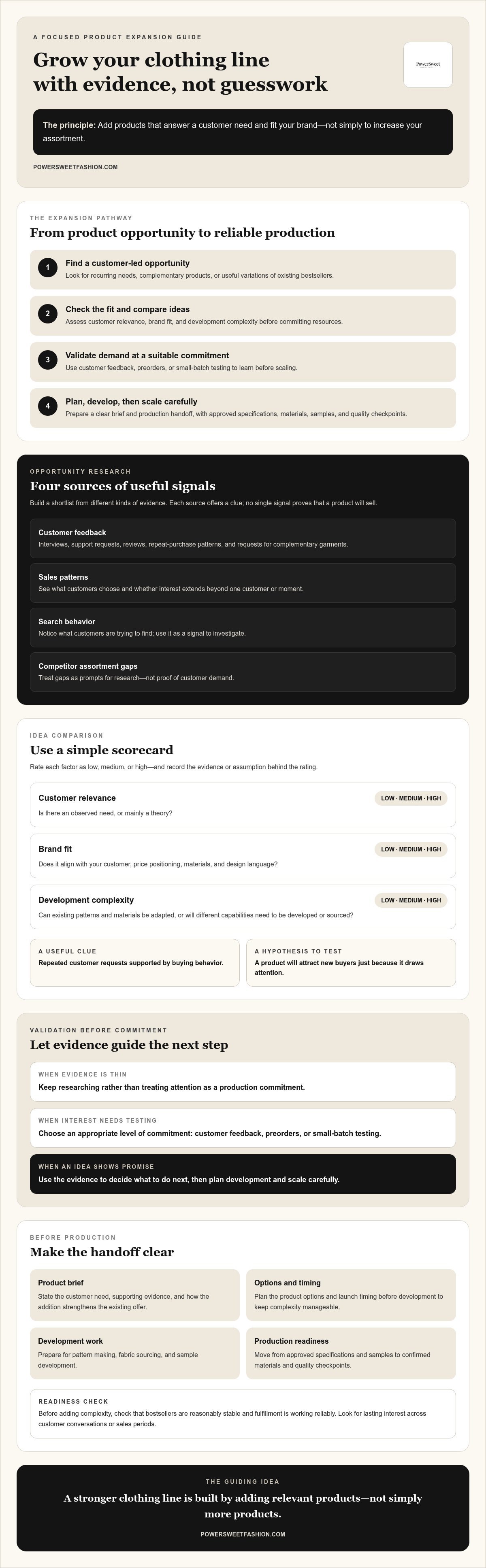
This guide takes you from product opportunity to production planning. You’ll learn how to assess fit with your brand and customers, validate demand, and prepare a clear handoff for pattern making, fabric sourcing, sample development, and quality control. The aim is a focused expansion plan that gives promising products room to grow while keeping avoidable risk in check.
Table of Contents
How to Expand Your Clothing Line with New Products Without Losing Focus
A new product can create room for growth, but adding items without a clear customer need can tie up time and production capacity in the wrong direction. The goal of learning how to expand your clothing line with new products isn’t simply to increase your assortment. It’s to add relevant products, variations, or categories that give existing customers a stronger reason to choose your brand.
This is the practical idea behind a product line extension: build on an existing offer with additions that make sense for your brand and customers. A strategic extension might answer a recurring request or help customers complete an outfit. A higher SKU count alone doesn’t make a line stronger, and a short-lived trend may attract attention without creating lasting demand.
Use a clear sequence: identify opportunities, validate demand, plan development, then scale carefully. Before investing in samples or production, check whether your business is ready and whether the proposed product belongs in the line.
When is your clothing line ready to add products?
Look for patterns in repeat purchases, customer questions, returns, and requests for complementary items. A single request is a clue, not proof. Repeated questions about a coordinating piece or recurring feedback about fit can point to a more consistent need. Compare these signals with sales patterns to see whether interest extends beyond one customer or moment.
Check your operating foundation too. Bestsellers should be reasonably stable, and fulfillment should be working reliably before your team takes on additional product complexity. To distinguish a lasting need from a temporary spike, check whether interest continues across customer conversations or sales periods. If the evidence is thin, keep researching rather than treating attention as a production commitment.
What makes a product extension a good brand fit?
Assess each idea against the customer you serve, your price positioning, the materials you use, and your design language. A complementary garment may be a natural next step if it serves the same customer and works with the existing assortment. An idea that requires a different customer, material approach, or visual identity needs more scrutiny before it earns a place in the line.
Write a short rationale for every proposed addition. Name the customer need, the evidence behind it, and how the product could strengthen your existing offer. This helps distinguish a focused extension from a trend-led detour. It also gives design and production partners a clear basis for assessing feasibility once you’ve established that the idea fits.
How to Find and Compare New Product Opportunities for Your Clothing Brand
Once an idea has a customer rationale, compare it with other options before committing design and production resources. Build a shortlist from four sources: customer feedback, sales patterns, search behavior, and gaps in competitor assortments. Each source offers a different clue. Customer questions can point to unmet needs, sales patterns show what people choose, and search behavior can indicate what they’re trying to find. Competitor gaps are prompts for investigation, not proof of demand.
Which customer signals can reveal the next product opportunity?
Look across interviews, support requests, reviews, and repeat-purchase patterns. Note whether customers ask for complementary garments or different versions of existing bestsellers, then compare those requests with observed buying behavior. Social comments, saves, and likes can help identify themes, but they’re research signals, not evidence that someone will purchase.
Keep observed evidence separate from assumptions. “Customers repeatedly ask for a coordinating piece” is an observation if customer records support it. “This category will attract new buyers” is a hypothesis to test, not a fact.
How do you compare adjacent products with new categories?
A complementary product may be easier to assess because it serves an established customer. A move into a broader category can address a new need, but may require unfamiliar materials, patterns, suppliers, or production knowledge. Check what can transfer from your current range and what needs to be developed or sourced differently.
Use a simple scorecard for each candidate. Rate each factor as low, medium, or high, and note the evidence or assumption behind the rating:
Customer relevance: Is there an observed need, or mainly a theory?
Brand fit: Does it align with your customer, price positioning, materials, and design language?
Development complexity: Can existing patterns and materials be adapted, or will the product need new development?
Operational readiness: Can your team and production partner support the sourcing, sampling, and quality checks required?
Prioritize ideas with a clear customer rationale and manageable execution requirements. If a women’s apparel category has distinct sourcing or construction needs, review guidance on specialized women’s fashion production, then confirm feasibility for the specific product with a production partner.
This comparison turns “how to expand your clothing line with new products” into a decision process your team can explain and revisit. For a potential extension in women’s apparel, you can also review custom women’s clothing production as a possible production resource.
How to Validate Demand for a New Clothing Product
Before moving from a promising idea to product development, test whether customers want the specific garment you plan to make. Don’t rely on one enthusiastic comment or a busy social post. Combine clear questions, observable actions, and a decision rule set before results come in. This is how to expand your clothing line with new products without turning an unproven idea into an oversized production commitment.
How can you test a product concept with customers?
Show a clear concept visual and explain who the garment is for, how it will be used, and what you know about its materials and fit. Ask focused questions: Would the customer consider buying it? Which details matter most? What might stop them from buying? What alternative would better meet the need? Compare answers from people in your target customer group rather than relying on friends or broad social engagement.
Use a structured sequence:
State the hypothesis. Describe the customer, need, and product benefit you’re testing.
Test interest. Gather concept feedback, invite customers to join a waitlist, or offer preorders if you can clearly explain what’s being offered and when it’s expected.
Review the evidence. Separate comments and sign-ups from actions that require a firmer commitment. Look for consistent reasons customers want the product, along with recurring objections about fit, features, or materials.
Decide. Choose whether to proceed, revise the concept, or pause based on the evidence and your team’s capacity.
How should you interpret early demand signals?
Signals carry different weight. Positive concept feedback shows interest; a waitlist sign-up shows willingness to hear more; a preorder or deposit represents stronger commitment, though it doesn’t remove production or fulfillment risk. Interpret each signal based on what the customer actually did, not what you hope it means.
Set a decision threshold before reviewing results. There’s no universal number that guarantees success, so define what would be convincing for your business. That might mean repeated interest from your intended customer group, a consistent preference for a particular product benefit, or enough committed demand to justify the next development step. Also decide what evidence would trigger a revision or pause. This keeps the team from moving the goalposts to justify a favorite idea.
Once demand is credible, discuss feasibility and order terms with a production partner before confirming a larger run. Low-MOQ production planning can help you consider a measured launch, but confirm current minimums, capacity, and product-specific requirements rather than assuming the same terms apply to every garment.
How to Plan Product Development, Assortment, and Launch Readiness
After choosing an opportunity, turn it into a product brief that connects the customer need to clear design and production decisions. Include the intended customer, purpose, key features, fit, materials, and target launch. A focused brief gives design and production partners a shared reference, so they can assess feedback against agreed requirements rather than personal preference.
What should a new product brief include?
Document the information needed to develop and assess the garment: measurements, construction details, materials, trims, intended fit, and reference visuals. Record the required size range, proposed color options, labeling needs, and quality acceptance criteria. Name who can approve each stage and explain how revisions will be reviewed. Clear ownership reduces conflicting feedback and keeps decisions moving.
Keep the first assortment deliberate. Map possible color, size, and style options, then separate essential choices from ideas that can wait for stronger demand evidence. Every option can add development and inventory complexity, so avoid multiplying SKUs simply to make a launch look larger.
Map dependencies before setting a launch target. Material selection affects sourcing; construction and fit guide pattern making; samples reveal where specifications need adjustment; quality criteria define what an approved garment must meet. Launch content also depends on confirmed product details and visuals. A delay in one area can affect the rest of the schedule.
For more detail on the development handoff, read this guide to sample development and pattern making.
How do samples help resolve product risks?
Review each sample against the approved brief. Check fit, construction, material behavior, and finishing, then record specific corrections instead of general comments such as “adjust the fit.” Confirm in writing whether the next step is another sample or approval. This creates a traceable decision and helps the production team work from the same version of the specifications.
Build realistic timing around the actual product. Confirm material availability, development complexity, and how revisions may affect the schedule with your production partner. PowerSweet Fashion states that samples are ready in 10 days; confirm timing for the proposed garment and any revision requirements. Before moving toward launch, review custom women’s clothing production support to understand how product specifications connect with sampling and production planning.
Moving from Validated Product Idea to Reliable Production
Customer interest is a reason to explore production, not a substitute for production readiness. Before authorizing a run, align the approved product details, materials, sample, quality expectations, and order terms. This handoff turns a validated concept into instructions a manufacturing partner can follow consistently.
What should you confirm with a manufacturing partner?
First, confirm that the partner can execute the garment’s construction, materials, finishes, and size requirements. Discuss minimum order quantities, sampling steps, production timing, and the quality checks expected during the run. Ask who will approve each milestone and how both sides will document changes, decisions, and production updates.
Then follow a clear release sequence:
Finalize specifications. Confirm the current measurement chart, construction details, materials, trims, and approved revisions.
Approve the sample. Check the garment against the specifications and record approval or required corrections in writing.
Confirm materials. Verify that the selected fabrics and trims are agreed for the order before production begins.
Authorize production. Proceed only after order terms, timing, responsibilities, and the approved product version are clear.
Quality checkpoints make this sequence practical. Agree what will be checked and when, then compare production with the approved sample and specifications. Clear approvals help prevent avoidable variation by ensuring design, sourcing, and production teams are working from the same requirements. For a broader view of how these stages connect, see this guide to end-to-end clothing production.
How can you scale a new product without losing control?
Keep reviewing performance after launch. Track sales alongside sell-through, returns, fit feedback, and quality issues. These measures can show whether demand is holding, a specification needs adjustment, or an option is adding complexity without serving customers. Use what you learn to inform future assortment and production decisions.
Scale in response to evidence and capacity, not optimism alone. Before increasing volume or adding more size, color, or style options, confirm that demand supports the move and that your team and manufacturing partner can handle the added requirements. If you’re planning a women’s apparel product, discuss your next women’s apparel product with PowerSweet Fashion and review the specifications, sample, materials, and production requirements together.
Build Your Next Product on Evidence and Clear Production Steps
A focused expansion starts with a product that fits your customer and your brand, not simply a trend or a larger assortment. Use customer feedback and sales evidence to compare opportunities, then test demand before committing to a larger run. Once an idea is validated, a clear product brief, approved sample, confirmed materials, and agreed quality checks help move it toward consistent production.
That sequence is the practical answer to how to expand your clothing line with new products: make decisions based on what customers show they want and what your team and production partner can reliably deliver. Review early sales, fit feedback, returns, and quality issues before increasing volume or adding more options.
PowerSweet Fashion supports brands with custom women’s apparel production, sample development, fabric sourcing, pattern making, and quality control. The stated sample and bulk production timelines are 10 days and 15-20 days respectively; confirm timing for the specific product and current requirements. Discuss your next women’s apparel product with PowerSweet Fashion and explore the steps from concept to production. With a measured plan and clear approvals, you can expand with confidence and give proven ideas room to grow.
Frequently Asked Questions
How do I decide which new product to add to my clothing line?
Choose the product that addresses a clear customer need and fits your brand, not simply the one attracting the most attention. Compare customer requests, repeat-purchase patterns, reviews, and search behavior, then assess each idea for brand fit and production complexity. Keep observations separate from assumptions. If you’re deciding how to expand your clothing line with new products, prioritize ideas supported by consistent evidence and define how you’ll test them before committing to a larger production run.
How can I test demand for a new clothing product before manufacturing it?
Test a clear product concept with the customers you want to reach before authorizing bulk production. Show visuals and explain the intended use, materials, and fit, then ask what they’d buy, what concerns them, and which details matter. A waitlist or positive feedback can indicate interest, while a preorder or deposit signals stronger commitment. Decide in advance what evidence would prompt you to proceed, revise the concept, or pause.
Should I add a new category or expand an existing product category?
Expand an existing category when customer feedback points to a related need and your current materials, patterns, or production knowledge may transfer. Consider a new category when it addresses a distinct customer need, but account for additional development and sourcing requirements. Compare both options for customer relevance, brand fit, and execution demands. A category move should strengthen your offer, not leave customers uncertain about what your brand stands for.
How many new products should a clothing brand launch at once?
There’s no universal launch quantity. Choose a scope your team can develop, sample, source, and monitor without disrupting current products. A focused launch can make it easier to identify which product features and options customers respond to. Consider your available capacity, production requirements, and the strength of demand evidence. If the idea requires many new styles or options, consider staging the launch so you can learn before adding further complexity.
Do I need samples before producing a new clothing product?
For a new custom garment, sample development lets you review fit, construction, material behavior, and finishing before approving production. Compare the sample with the product brief and record specific corrections, such as a measurement change or construction detail, instead of relying on verbal feedback. Approve the final version in writing so the production team has a clear reference. Confirm sample timing with your production partner, since requirements can vary by product.
How do I avoid adding too many SKUs when expanding my clothing line?
Start with the options customers need instead of offering every possible color, size, or style combination at launch. Map the proposed assortment and identify which variations are essential to serve the customer. Defer less-supported choices until sales and feedback provide a reason to add them. After launch, review demand, sell-through, returns, and fit feedback by option. This helps you refine the assortment using actual performance instead of carrying complexity without a clear purpose.
When should I involve a clothing manufacturer in product expansion?
Involve a manufacturing partner once you’ve established that the idea fits your customers, and before finalizing specifications or committing to production. Early feasibility input can clarify whether the construction, materials, finishes, and size requirements are workable. Discuss sampling steps, minimum order quantities, capacity, timing, quality expectations, and how approvals or changes will be recorded. PowerSweet Fashion supports custom women’s clothing production, sample development, fabric sourcing, pattern making, and quality control. Confirm current terms for your specific product.


Comments