%20(1).png)
How to Approve Pre-Production Samples: 2026 Checklist
- Powersweet Team

- 5 days ago
- 12 min read
Your pre-production sample isn't just a prototype; it's a legally binding contract in physical form that dictates every single stitch of your bulk run. It's the final gatekeeper between your creative vision and the terrifying possibility of receiving 500 unsellable garments. We know the friction that comes with overseas manufacturing, especially when vague feedback loops lead to delays that eat into your seasonal margins. Mastering how to approve a pre-production sample is the most critical skill for any fashion professional who demands precision over guesswork.
You need a systematic approach that removes emotion from the equation and focuses on technical reality. This article provides a clear, repeatable checklist to turn your sample into a 'Golden Sample' for total quality control protection. We'll walk you through the 2026 verification process, including mandatory CPSC eFiling requirements and the latest ISO 2859-1:2026 standards. By the end, you'll have the technical confidence to move into mass production knowing your final inventory will be perfect.
Table of Contents
The Pre-Production Sample: Your Final Safety Net Before Bulk Manufacturing
The 'Inside-Out' Inspection Checklist: 5 Pillars of Sample Verification
Navigating the Sampling Sequence: PPS vs. Fit and TOP Samples
Professional Feedback Loops: How to Red-Line Samples Without Delaying Production
Streamlining Your Fashion Cycle: From Approved PPS to Bulk Delivery in 15 Days
The Pre-Production Sample: Your Final Safety Net Before Bulk Manufacturing
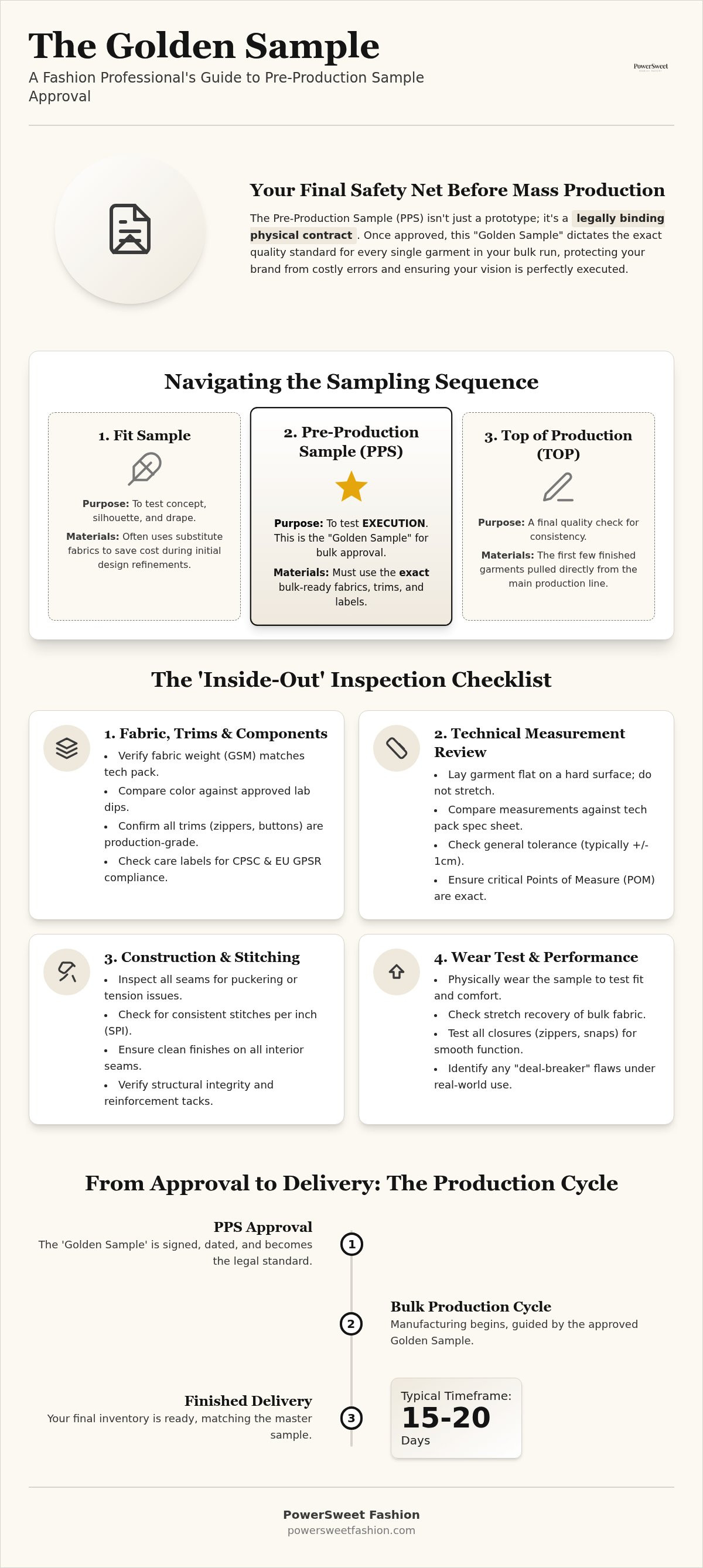
The Pre-Production Sample (PPS) represents the final technical milestone before your designs move into mass manufacturing. Unlike earlier iterations, this sample must use the exact bulk-ready fabrics, trims, buttons, and labels specified in your tech pack. It serves as the definitive physical manifestation of the pre-production phase, ensuring every component is sourced and ready for the factory floor. It's the moment where theory meets industrial reality.
Within the broader garment sampling process, the PPS is your ultimate safety net. If a pattern is off by just 2cm, that minor oversight scales into a catastrophe across a 500-unit run. We view the PPS as a "Golden Sample," a physical benchmark that dictates the quality standard for every piece that follows. Mastering how to approve a pre-production sample is the bridge that allows us to transition from final sign-off to a rapid 15 to 20 day bulk production cycle with total confidence.
PPS vs. Prototype: Knowing the Difference
Prototypes and muslins exist to test a concept or a silhouette. They often use substitute fabrics to save costs while refining the drape. A PPS is different; it tests the execution. You should never approve bulk production based on a Fit Sample alone. The PPS must align perfectly with your Bill of Materials (BOM). This ensures that the zippers, threads, and interlinings used are exactly what the end consumer will receive. If the BOM calls for a specific YKK zipper and the PPS arrives with a generic alternative, the sample must be rejected immediately.
The Legal and Quality Power of the 'Golden Sample'
Once signed and dated, the PPS becomes a legally binding contract between your brand and the manufacturer. It forms the basis of inspection under ISO 2859-1:2026 standards, which govern acceptance sampling by attributes. Learning how to approve a pre-production sample correctly gives you the leverage to reject bulk shipments that deviate from this master copy. If a dispute arises during final quality control, the Golden Sample is the only evidence that matters. Keep your master sample in a light-controlled, dust-free environment to prevent fabric fading, as this garment remains your primary reference for the entire production lifecycle.
The 'Inside-Out' Inspection Checklist: 5 Pillars of Sample Verification
Conduct your audit in a space with consistent natural lighting. Fluorescent bulbs often distort colors, leading to incorrect lab dip assessments that can ruin a seasonal palette. Understanding how to approve a pre-production sample requires more than a visual scan; it demands a technical interrogation of the garment's DNA. Use calibrated measuring tools and a digital scale to ensure your observations are rooted in data rather than subjective feeling.
Even if you've already "locked" your fit in previous rounds, you must wear-test the PPS. Bulk-ready fabrics often have different stretch recovery or weight than earlier prototypes. This final check ensures the garment performs under real-world conditions. Identifying a "deal-breaker" flaw now, such as a zipper that catches or a seam that puckers under tension, prevents a total loss during the bulk run. If you need a partner to manage this technical complexity, our Quality Control Services provide the oversight needed for a flawless production cycle.
1. Fabric, Trims, and Component Audit
Verify the fabric weight (GSM) to ensure it matches your sourcing requirements. Compare the color against your approved lab dip in multiple light sources. All trims, including zippers, buttons, and snaps, must be the final production-grade versions. Check the care labels and placement for compliance with 2026 CPSC eFiling regulations and EU GPSR standards. Any deviation here isn't just an aesthetic issue; it's a legal liability that could stall your shipment at customs.
2. The Technical Measurement Review
Lay the garment flat on a hard, level surface. Do not pull or stretch the fabric while measuring, as this produces false data. Compare the physical garment against your Tech Pack's spec sheet point-by-point. Most women's apparel allows for a "tolerance" of +/- 1cm on non-critical seams. However, critical Points of Measure (POM) like the bust, waist, and high-point shoulder (HPS) length must be exact to maintain sizing consistency across your collection.
3. Construction and Seam Integrity
Turn the garment inside out to inspect the hidden details. Check the stitch density; high-quality women's fashion typically requires 10 to 12 Stitches Per Inch (SPI). Look for clean overlocking and the absence of loose threads. Check for symmetry by folding the garment in half to ensure pockets, collars, and sleeve lengths are perfectly balanced. Stress test high-tension areas like armholes and crotches by applying firm pressure to ensure the seams won't fail during consumer use.
Navigating the Sampling Sequence: PPS vs. Fit and TOP Samples
Success in the fashion industry depends on a disciplined sequence. The PPS is the final gatekeeper within the end to end clothing production cycle, but it cannot exist in a vacuum. Skipping earlier stages like the Fit Sample or the Prototype increases your error rate exponentially. While a Prototype tests the initial design concept, the Fit Sample locks in the proportions. Only after these are finalized should you move to the PPS stage. Understanding the nuances of how to approve a pre-production sample ensures that you aren't trying to fix fit issues when you should be verifying bulk fabric quality.
Some brands attempt to use Salesman Samples (SMS) as a substitute for the PPS. This is a high-risk strategy. SMS are often made with "available" fabrics rather than the final bulk-ordered materials to meet marketing deadlines. The PPS must be the exact specimen the factory will replicate hundreds or thousands of times. If your collection requires complex grading, you should also request a "Size Set" sample. This ensures that the technical execution remains consistent from a size Small to an Extra Large, preventing fit discrepancies that lead to high return rates.
The Comparison Framework
To maintain a streamlined production journey, use this framework to categorize your sampling goals:
Prototype: Focuses on design and silhouette. Uses substitute fabrics.
Fit Sample: Focuses on body measurements and drape. Uses similar weight fabrics.
PPS (Pre-Production): Focuses on total execution. Uses 100% bulk-ready materials and trims.
TOP (Top of Production): Focuses on verification. These are the first units off the bulk line.
Combining the Fit and PPS stages is only advisable for simple silhouettes with low technical complexity. For intricate women's fashion, keep these stages separate to maintain a "Safe Pair of Hands" approach to your inventory investment.
The TOP (Top of Production) Sample
The TOP sample is the final bridge between the factory floor and your warehouse. Unlike the PPS, which is often made by a specialized sampling team, the TOP sample is pulled directly from the actual first run of bulk production. It represents the "real-world" output of the sewing line. Use the TOP sample to verify the final retail presentation, including polybagging, hangtags, and barcode placement. While the PPS is your aspirational standard, the TOP sample confirms that the factory's mass-production machinery can actually meet that standard at scale. Once the TOP is approved, your bulk order is ready for final shipment.
Professional Feedback Loops: How to Red-Line Samples Without Delaying Production
Vague feedback is the primary cause of communication friction with overseas manufacturers. It leads to unnecessary delays and increases the risk of receiving a bulk order that misses the mark. To maintain your production timeline, you must provide feedback that is actionable and unambiguous. The "Red-Lining" method involves taking high-resolution photos of the sample and using digital annotations to mark specific changes. This visual bridge ensures the factory floor sees exactly what you see. Mastering how to approve a pre-production sample relies on this level of technical transparency.
Implement a strict 24-hour feedback rule within your team. Once the sample arrives, your technical designers should review and comment within one business day. This keeps the production momentum alive and signals to the manufacturer that you are a high-priority partner. Sometimes, a "Partial Approval" is the most strategic move. If the garment construction is perfect but a minor trim needs a color adjustment, you can approve the cutting phase while the factory sources the corrected component. If you need assistance in establishing these rigorous standards, our Sample Development team can help streamline your workflow from the first prototype to the final sign-off.
The Anatomy of a Perfect Comment
Precision in communication prevents production errors. We recommend using the "Problem-Location-Solution" formula for every note you send to the factory. Instead of stating "the pocket looks weird," your comment should read: "Problem: Pocket is sagging. Location: Left front panel, 5cm below waist. Solution: Reinforce with stay tape and raise 1cm." This specific language removes guesswork for the sewing line. Always confirm receipt of your comments with the production manager to ensure the instructions are translated correctly into the final production plan. A photo with a digital ruler placed next to the error provides empirical evidence that words alone cannot match.
Avoiding the 'Resample Trap'
A second pre-production sample (PPS2) is often a "resample trap" that adds 7 to 14 days to your lead time. You should only request a PPS2 if there are major structural issues or if the fabric GSM is significantly off-spec. For minor adjustments, such as moving a label or changing a thread color, use the "Approve with Comments" status. This allows the factory to move straight to the fabric cutting phase while documenting the required changes for the bulk run. Balancing technical perfectionism with the reality of your fashion launch window is essential for maintaining a healthy, profitable retail cycle.
Streamlining Your Fashion Cycle: From Approved PPS to Bulk Delivery in 15 Days
A clean PPS approval is the engine that drives your entire manufacturing timeline. It's the definitive signal that triggers the release of raw materials and moves your project into the cutting phase. Knowing how to approve a pre-production sample with technical precision allows us to compress the production window significantly. At PowerSweet Fashion, we move from the 'Golden Sample' to finished bulk delivery in just 15 to 20 days. This speed gives your brand a competitive edge in a market that demands responsiveness and agility.
Scaling your brand doesn't require high-risk inventory bets. By partnering with low MOQ women's clothing manufacturers, you can test complex designs with smaller batches before committing to massive runs. This collaborative approach reduces overhead while maintaining the highest quality standards for women's apparel. It allows you to refine your product based on real-world sales data without the fear of receiving 500 unsellable units.
The Production Kick-off Protocol
The moment you sign the PPS, the factory initiates the Pre-Production Meeting (PPM). During this session, the production manager, quality control lead, and sewing line supervisors review your approved sample in detail. The protocol for how to approve a pre-production sample concludes when the factory translates your sign-off into a production-ready workflow. We set clear expectations for the final bulk lead time during this phase, eliminating the vague timelines that often plague traditional manufacturing relationships. Every member of the sewing line is briefed on the technical requirements of your 'Golden Sample' to ensure total consistency.
Why Partnership Matters
We position ourselves as an Authoritative Facilitator in your production journey. We don't just execute orders; we provide the logistical engine that powers your creative vision. Our open-door policy invites you into the process, using transparency as a tool for quality assurance. This partnership ensures that you are never left wondering about the status of your inventory. We believe that clear communication and meticulous care are the foundations of a successful B2B relationship.
Final Checklist: Are you ready to hit the 'Go' button?
Is the physical PPS signed and dated by both parties for legal protection?
Have all 'Approve with Comments' notes been added to the final production file?
Is the Bill of Materials (BOM) 100% accurate for the bulk run?
Has the final bulk delivery date been confirmed in writing?
Ready to develop your next collection? Start your 10-day sampling process with PowerSweet Fashion today.
Secure Your Production Future Today
The pre-production sample is the definitive boundary between a creative concept and a successful retail launch. By mastering how to approve a pre-production sample through a technical, "inside-out" inspection, you eliminate the fear of receiving unsellable inventory. The Golden Sample serves as your legal and quality benchmark. It ensures your bulk run matches the high standards of your original vision. This systematic approach doesn't just protect your investment; it accelerates your entire fashion cycle.
We specialize in bridging the gap between complex design and rapid industrial execution. Our team provides expert women's fashion construction with a 10-day sample turnaround, allowing you to move from approved PPS to finished goods in just 15 to 20 days. As a low MOQ specialist, we offer the transparency and agility needed to scale your brand with confidence.
Launch Your Collection with PowerSweet Fashion and turn your technical verification into a competitive advantage. We're ready to build your vision into a physical reality.
Frequently Asked Questions
What is the difference between a Fit Sample and a Pre-Production Sample?
A Fit Sample is designed to verify body measurements and silhouette using similar weight fabrics. In contrast, the Pre-Production Sample is the final technical benchmark made with 100% bulk-ready fabrics, trims, and labels. While the Fit Sample ensures the garment sits correctly on the body, the PPS confirms the factory's ability to execute the complete design with final materials. You must finalize the fit before requesting a PPS to avoid costly fabric waste.
How long does it typically take to receive a PPS after approving the Fit Sample?
Our standard turnaround for a PPS is approximately 10 days once the Fit Sample is finalized and bulk materials are sourced. This timeline accounts for the precision required in garment construction and component assembly. Factors such as fabric availability and the complexity of the design can influence this duration. Maintaining a clear communication loop during the transition from fit to pre-production ensures that your project stays within its 15 to 20 day bulk production window.
Can I approve a PPS if the color isn't 100% correct but the fit is perfect?
Yes, you can use the "Approve with Comments" status if the construction is flawless but a minor component like a thread color or lab dip is slightly off. This allows the factory to begin the cutting phase while sourcing the correct materials for the bulk run. It's a strategic way to manage how to approve a pre-production sample without stalling your momentum. However, you must document these required changes in writing to maintain your legal quality protection.
What happens if I find a mistake after I've already approved the PPS?
Finding a mistake post-approval requires immediate communication with the production manager to halt the sewing line. If the cutting phase has already begun, correcting a technical error can lead to significant material losses and production delays. This is why the inside-out inspection process is so critical. While we strive for transparency, an approved PPS acts as a physical contract; changing specifications mid-run often triggers additional costs and resets your delivery timeline.
Do I need to see a PPS for every single size in my range?
You generally only need a PPS for a single sample size, typically a Medium or the middle of your range. To ensure grading consistency, you should request a Size Set sample which includes one piece from each size in the collection. This verifies that the technical proportions remain balanced from Small to Extra Large. Reviewing a full Size Set prevents the common error where fit issues only appear in your largest or smallest sizes.
Is it possible to skip the PPS stage if I'm in a rush for my launch?
Skipping the PPS stage is a high-risk decision that often leads to receiving unsellable garments. Without this final safety net, you have no physical benchmark to hold the factory accountable during quality control. Even under tight deadlines, the PPS is the only way to verify that bulk-ready fabrics and trims perform as expected. Investing 10 days in this stage is far more efficient than risking the total loss of a 500-unit bulk order.
What are the most common reasons a Pre-Production Sample is rejected?
PPS rejections typically stem from fabric weight discrepancies, incorrect trim functionality, or construction failures like poor stitch density. If the fabric GSM does not match the tech pack or if a zipper fails during wear-testing, the sample must be rejected. Other frequent issues include poor symmetry in pockets or collars and non-compliance with care label regulations. Understanding how to approve a pre-production sample involves identifying these deal-breakers before they scale into bulk production errors.
How many rounds of sampling are considered normal in the fashion industry?
The industry average for sampling is between 4 and 5 iterations across the development cycle. However, using a high-quality tech pack can reduce these rounds to an average of 1.8. Efficiency in sampling depends on the clarity of your initial specifications and the responsiveness of your manufacturing partner. We focus on a streamlined system that moves you through the development phase quickly, aiming for a Golden Sample within two rounds of technical review.


Comments