%20(1).png)
How PowerSweet Makes Sure Production Matches Every Approved Sample
- Powersweet Team

- Aug 9
- 12 min read
The most expensive garment in your collection isn't the one with the highest material cost; it's the one that looks nothing like the sample you approved. You've likely felt that specific anxiety while waiting for a bulk shipment to arrive from overseas. It's the fear that your vision was lost in translation somewhere during the clothing manufacturing process. We understand that for a growing women's fashion brand, consistency isn't just a goal; it's the foundation of your reputation.
This article provides the clear roadmap you need to eliminate production delays and technical confusion. You'll learn how to master every stage of production, from perfecting tech packs to navigating the mandatory 2026 U.S. CPSC eFiling requirements. We'll show you how a reliable partnership reduces lead times and ensures that every piece in your bulk order matches the precision of your initial 10-day sample. We're going to break down the transition from sourcing to final quality control so you can scale your brand with total confidence in your supply chain.
Table of Contents
The Architecture of Apparel: Understanding the Clothing Manufacturing Process
Clothing manufacturing isn't a single event. It's a complex industrial journey that begins at the concept stage and ends only when the garment reaches the consumer. The global clothing industry relies on a series of technical hand-offs to ensure a design doesn't lose its integrity between the studio and the shelf. When you understand the architecture behind the garment, you can better manage the risks associated with scaling a fashion brand.
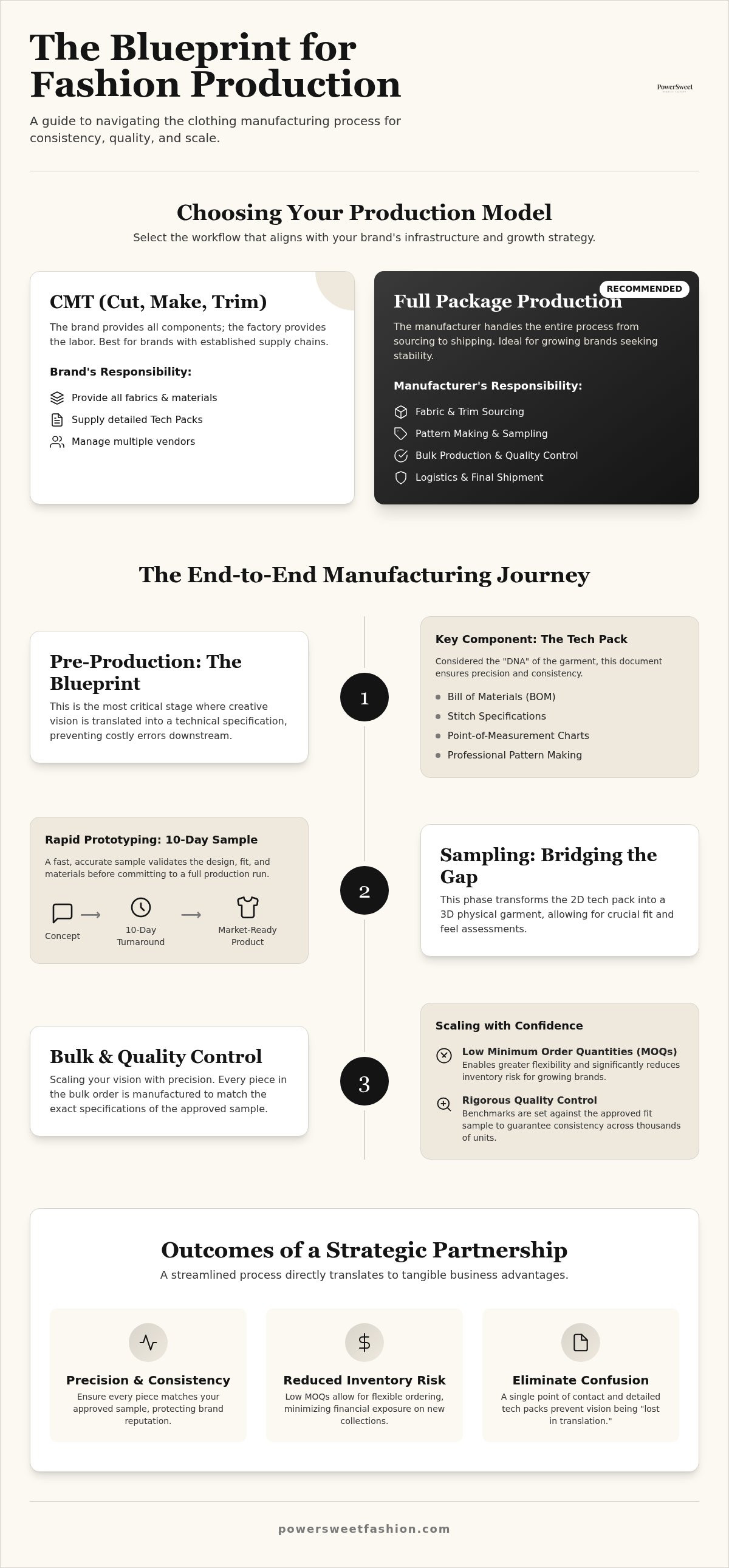
Brands typically choose between two primary models. Cut, Make, Trim (CMT) requires the brand to provide all materials and tech packs while the factory provides only the labor. Full Package Production is a more integrated approach. In this model, the manufacturer handles everything from fabric sourcing to final quality control. For most growing brands, the Full Package model offers the stability needed to scale without the headache of managing dozens of fragmented vendors. It's about finding a partner that takes ownership of the entire clothing manufacturing process, and for those managing corporate or healthcare facilities, you can explore Bulk Uniform Manufacturing and Supply Contracts to see how these end-to-end solutions work at scale.
Handling women's apparel requires a higher degree of technical precision than standard menswear or basics. Diverse silhouettes, complex drapes, and a wide variety of fabric weights mean that the production line must be highly adaptable. A factory that specializes in women's fashion knows that a slight shift in a seam can change the entire fit of a bias-cut dress. This specialized handling is what separates a premium product from a generic one.
Technical precision is even more critical when manufacturing functional garments designed for safety. To see how these high standards are applied to industrial workwear, you can visit SplitForce Global and discover their expertise in producing flame-resistant coveralls.
We believe the "End-to-End" philosophy is the gold standard for modern fashion. By keeping pattern making, sourcing, and sampling under one roof, you eliminate the communication gaps that lead to production errors. It creates a seamless transition from the initial sketch to the final shipping container.
Why the Process Matters for Brand Scalability
A structured process is your insurance policy. Without it, minor errors in a tech pack can lead to thousands of unsalable units in a bulk run. Speed is also a critical factor. In 2026, market trends move faster than ever. An efficient production cycle allows you to respond to consumer demand without the traditional 6-month lead times. Precision in manufacturing directly correlates to healthier profit margins by reducing material waste and customer returns.
Key Stakeholders in the Production Cycle
Success depends on collaboration between several key figures. The designer sets the vision, but the production manager ensures that vision is technically feasible for mass production. Pattern makers and sourcing agents work in tandem to find the right materials for the specific cut. Perhaps most importantly, a dedicated point of contact at the factory acts as your advocate on the floor. This single line of communication ensures that your standards are met during every shift, regardless of the order size.
Pre-Production: Designing the Blueprint for Success
Pre-production is the phase where a creative vision meets industrial reality. It is the most critical stage of the clothing manufacturing process because any oversight here multiplies once you reach the assembly line. We treat the Tech Pack as the garment's DNA. It is a comprehensive document that includes the Bill of Materials (BOM), stitch specifications, and point-of-measurement charts. Without this technical blueprint, a factory cannot guarantee consistency across a bulk run. The Apparel Manufacturing subsector relies on these precise specifications to bridge the gap between a designer's intent and a finished product.
The transition from a 2D sketch to a 3D form happens through professional pattern making. This requires a deep understanding of how different textiles behave when draped over the human body. For women's fashion, this is particularly complex due to the variety of silhouettes and the need for specific movement. If you're looking to refine your initial concepts into workable designs, our team provides expert pattern making to ensure your garments are technically sound before they ever touch a sewing machine.
Sourcing High-Quality Fabrics and Trims
Sourcing is more than just finding a color match. It involves identifying the right fiber composition for the garment's purpose. For example, choosing between the breathability of Lyocell and the durability of Polyamide depends entirely on the end use of the piece. We leverage local supply chain networks to procure specialized textiles and unique trims that set your brand apart. Sourcing agents navigate these networks to find high-grade zippers, custom buttons, and sustainable materials that meet 2026 environmental standards. This proximity to material hubs allows for faster adjustments and better oversight of textile quality.
Technical Design and Pattern Grading
Consistent fit across an inclusive size range is a hallmark of a professional brand. This is achieved through pattern grading. Grading is the systematic adjustment of a master pattern to create a range of sizes while maintaining the original fit and design proportions. In women's wear, simple scaling doesn't work. You must account for how body proportions shift as sizes increase. Professional grading ensures that a size Small and a size 2XL offer the same aesthetic appeal and comfort. This technical precision reduces return rates and builds long-term customer trust in your brand's sizing reliability.
The Sampling Phase: Bridging Concept and Bulk Production
Sampling is the first physical manifestation of your design. It acts as a critical "reality check" within the clothing manufacturing process, moving your vision from a digital tech pack to a tangible garment. The initial prototype, often called the Fit Sample, serves as the primary tool for design validation. It allows both the designer and the production team to assess how the chosen fabric interacts with the pattern. This stage is where you identify technical issues before they become expensive problems in a bulk run.
Success in women's fashion often hinges on the feedback loop between the designer and the factory floor. We prioritize transparent communication during this phase to ensure every adjustment is documented and executed perfectly. Beyond the fit, brands also utilize Salesman Samples (SMS). These high-quality prototypes are essential for marketing, lookbook photography, and securing pre-orders from retailers. By producing these early, you can generate revenue and market interest while the factory prepares for the full production cycle.
From Tech Pack to 10-Day Prototype
Speed is a strategic asset. While many manufacturers require four to six weeks for a first prototype, a 10-day turnaround has become the vital benchmark for fast-growing brands. This rapid workflow starts the moment the tech pack is finalized. It includes pattern printing, fabric cutting, and specialized assembly. Rapid sampling allows you to test more styles with significantly less financial risk. You can pivot quickly if a design doesn't meet expectations. If you're ready to optimize this stage, we recommend mastering sample development to better understand how to choose a partner that values your timeline.
Fit Testing and Final Design Approval
A garment that looks good on a mannequin must also perform on a human body. Fit sessions are conducted to ensure the piece moves naturally and retains its shape. Once the fit and aesthetics are perfected, the factory produces the Pre-Production Sample (PPS). This sample serves as the final contract for bulk execution. It is the absolute standard that the sewing line must replicate. Approved versions are often referred to as "Seal Samples." One stays with the brand for reference, and the other is "sealed" at the factory to serve as the master guide for quality control inspectors during the bulk run. This physical reference is what keeps the factory accountable during the transition to mass production.
Bulk Manufacturing and Quality Control: Scaling Your Vision
Bulk production transforms a single approved design into a market-ready collection. This phase of the clothing manufacturing process requires a synchronized effort between high-tech machinery and skilled labor. It begins with the cutting stage, where fabric is layered and cut using precision markers. We focus on maximizing fabric yield to reduce waste, which directly impacts your bottom line. In women's fashion, where fabrics like silk or intricate lace are common, this precision prevents the warping or misalignment that ruins a garment's silhouette.
Once cut, the pieces move to the sewing assembly line. Unlike a single tailor making a whole dress, mass production relies on specialized garment workers. Each operator focuses on a specific component, such as setting sleeves or finishing hems. This specialization ensures that every stitch is consistent across hundreds or thousands of units. It's the only way to maintain the high standards established during your sampling phase while operating at scale.
The Mechanics of Mass Production
Efficiency in the factory is measured by both speed and accuracy. We manage 15-20 day lead times for bulk orders by utilizing a streamlined workflow that eliminates bottlenecks. Specialized machinery, such as programmable sewing machines and automatic welters, is essential for high-quality women's wear construction. These tools allow for complex details that manual labor alone can't replicate with perfect consistency. For brands looking to understand the full scope of this journey, we offer a deep dive into end-to-end clothing production.
Implementing Rigorous Quality Assurance
Quality control isn't a final event; it's a continuous process. We implement "In-Line" inspections where supervisors check garments at various stages of assembly. This allows us to catch and correct errors before the entire batch is finished. We also use the industry-standard 4-point system for fabric inspection to identify defects in the raw material before it ever reaches the cutting table. This ensures that the foundation of your garment is flawless.
A comprehensive QC checklist is vital for maintaining brand trust. Our inspectors verify:
Precise measurements against the approved tech pack.
Stitching strength and seam security.
Trim security for buttons, zippers, and labels.
The final stage involves steaming, labeling, and packaging. Every garment is professionally pressed to remove wrinkles and then folded according to your retail specifications. This ensures that when you open your shipment, the clothes are ready for immediate sale. If you need a partner that prioritizes this level of detail, explore our Quality Control Services to see how we protect your brand's reputation.
Strategic Partnership: How to Navigate Global Manufacturing
Navigating the final stages of the clothing manufacturing process requires more than technical skill; it requires a strategic alliance. Many brands fail not because their designs are poor, but because their manufacturing partnership lacks transparency. A reliable factory shouldn't be a black box. It should be an extension of your own team. Whether you're managing your first collection or scaling a multi-national line, the strength of this relationship dictates your speed to market and your ability to pivot when trends shift.
The journey from a single sketch to a globally distributed fashion line is complex. It involves balancing the creative needs of your brand with the physical constraints of industrial production. By choosing a partner that offers end-to-end support, you ensure that no detail is lost during the hand-off between departments. This collaborative approach turns the manufacturing hurdle into a competitive advantage. It's the most effective way to protect your margins while maintaining the high quality your customers expect.
Scaling with Low MOQ Flexibility
Inventory is the biggest risk for any fashion startup. Low Minimum Order Quantities (MOQs) act as a vital safety net. While some industry critics claim small batches are inefficient, they're actually a sophisticated tool for market testing. They allow you to produce 50 to 100 units to gauge consumer interest before committing your entire budget to a massive bulk run. This agility reduces waste and keeps your cash flow healthy. If you want to learn more about this strategy, consider scaling small with low MOQ manufacturers to minimize your initial capital outlay and maximize your growth potential.
Building a Transparent Factory Relationship
Communication is the primary concern for brands working with overseas facilities. We solve this through open-door transparency. Digital tools now allow you to monitor production milestones in real-time. You can receive video updates and digital snapshots of your garments on the sewing line. As we move through 2026, this transparency is becoming a regulatory necessity. New requirements, such as the EU's Digital Product Passports and the mandatory U.S. CPSC eFiling for apparel imports, require precise documentation of every step in the supply chain.
Visiting the production team in person provides an even deeper level of assurance. Seeing the specialized machinery and meeting the garment workers builds a level of trust that digital communication cannot replace. It allows you to oversee quality benchmarks first-hand and ensures the factory understands the nuances of your brand's aesthetic. This proactive involvement is how you move from being just another client to becoming a priority partner. It ensures your vision is executed with the precision it deserves.
Building a Scalable Brand Through Production Precision
Scaling your fashion brand requires a deliberate shift from creative vision to industrial execution. We've explored how technical precision in your tech packs and the sampling phase prevents costly errors during the bulk run. You now have a clear roadmap for navigating the clothing manufacturing process with total confidence. Success in this industry isn't just about the design; it's about a partnership that prioritizes transparency and speed while maintaining the meticulous care your collection deserves.
We're ready to act as the technical engine for your creative vision. Our team provides samples ready in 10 days and completes bulk production in just 15 to 20 days. As a low MOQ specialist for women's fashion, we help you manage inventory risks while ensuring every piece matches your approved standard. Your brand's reputation is built on consistency, and we provide the stability you need to grow.
Start your production journey with PowerSweet Fashion today. Your vision is in a safe pair of hands, and we're excited to help you bring it to the global market.
Frequently Asked Questions
What is the standard lead time for the clothing manufacturing process?
Standard lead times vary, but our workflow prioritizes speed without sacrificing precision. We deliver samples in 10 days and complete bulk production within 15 to 20 days. This timeline includes material sourcing, cutting, and final assembly. Rapid turnaround is essential for women's fashion brands that need to capitalize on seasonal trends before they fade. Managing these timelines effectively is a core part of a professional clothing manufacturing process.
How do I start the production process if I only have a sketch?
You start by translating that sketch into a technical blueprint. Our team provides pattern making and sample development services to bridge the gap between art and industry. We take your initial drawing and create a detailed tech pack that defines every measurement and stitch type. This foundational step ensures that the final mass-produced garment remains true to your original creative vision and fits your target audience perfectly.
What is a Tech Pack and why is it mandatory for manufacturing?
A tech pack is a comprehensive document that acts as your garment's DNA. It includes a Bill of Materials (BOM), point-of-measurement charts, and specific construction details. This document is mandatory because it eliminates guesswork on the factory floor. It serves as the definitive guide for our production team, ensuring that every unit in a bulk order matches the quality and dimensions of your approved sample.
Can I manufacture custom clothing with low minimum order quantities?
Low Minimum Order Quantities (MOQs) are a strategic advantage for growing brands. We specialize in small-batch production, allowing you to launch collections with less capital risk. You can use these smaller runs to test market demand or offer exclusive, limited-edition styles. This flexibility is a vital tool for scaling your brand sustainably without the burden of excessive unsold inventory taking up warehouse space.
What is the difference between a fit sample and a pre-production sample?
A fit sample is an early prototype focused on dimensions and how the fabric drapes on the body. It's used for design validation and technical adjustments. The pre-production sample (PPS) is the final version created using the exact fabrics, colors, and trims intended for the bulk run. Once you approve the PPS, it becomes the seal sample that governs the quality of the entire clothing manufacturing process.
How does a factory ensure quality control for bulk women's clothing?
Quality assurance is integrated into every stage of our sewing line. We utilize in-line inspections to check seam strength and measurement accuracy while the garments are being assembled. Final inspections involve a rigorous review of every piece against the approved tech pack. This systematic approach ensures that complex women's wear, which often features intricate trims and delicate fabrics, meets your brand's high standards before shipping.
Is it possible to visit the factory during the production phase?
Direct collaboration is a cornerstone of a successful partnership. We welcome clients to visit our facility to oversee production milestones and meet the garment workers handling their collections. Seeing the specialized machinery and the meticulous care taken on the factory floor builds a level of trust that digital communication cannot replace. It provides you with firsthand evidence of our commitment to transparency and industrial excellence.
How do I choose between local and overseas clothing manufacturers?
The decision depends on your brand's specific needs for scale and material variety. Local manufacturing offers shorter shipping distances, but overseas production often provides superior access to specialized fabric hubs and lower per-unit costs. We combine the best of both worlds by offering the technical expertise of an international facility with the transparent communication you'd expect from a local partner. This ensures high-quality execution at a competitive price.


Comments