%20(1).png)
Handling Manufacturer Mistakes: Fashion Brand Guide

You open the final shipment for your new collection, expecting perfection, only to find the stitching is skipped and the fabric shade is three tones off. It's a nightmare scenario that contributes to why 20% of clothing startups close within their first year. When your investment arrives as unsellable inventory, the instinct is often to react with frustration or defeat. However, knowing exactly what to do when your manufacturer makes a mistake is the difference between a minor logistical hurdle and a total financial loss.
We understand that these moments are stressful. You need a partner who views production as a transparent, manageable process rather than a mystery. This guide outlines the professional protocol to resolve garment errors, protect your capital, and maintain a functional relationship with your factory. We'll examine how to document defects, negotiate for replacements, and implement the quality control standards required to prevent future production failures. By following a systematic plan, you can turn a manufacturing error into a data point for better future runs.
Table of Contents
Identifying Common Production Errors in Custom Apparel
Effective resolution starts with precise identification. You can't negotiate a refund or a re-run if you can't prove a deviation from your specifications. The "Golden Sample" serves as your physical contract in this scenario. It's the final approved version that represents exactly what the bulk production should look like. When discrepancies arise, this sample is your primary evidence for what to do when your manufacturer makes a mistake. Without it, you're relying on memory and subjective opinions, which rarely hold up in a professional dispute.
Critical vs. Major vs. Minor Defects
A foundational step in Understanding Quality Control is learning to categorize errors by their severity. Critical defects are non-negotiable. They include safety hazards like sharp edges or loose buttons on children’s apparel. With the US CPSC eFiling mandate effective as of July 8, 2026, these errors can lead to immediate legal and customs complications. Major defects are those that affect the garment's function or aesthetics enough that it cannot be sold at full price. Examples include incorrect grading that ruins the fit or visible stitching tension issues. Minor defects, like a single loose thread or a slightly crooked internal label, usually fall within the industry-standard 2.5% Acceptable Quality Level (AQL).
The Impact of Material and Trim Discrepancies
Material substitutions are a common source of frustration. If a factory swaps your specified 200 GSM cotton for a 160 GSM alternative to save costs, the final product will lack the intended drape and durability. These "hidden" defects also include poor colorfastness or excessive shrinkage, which may not be apparent until the consumer's first wash. Many brands mitigate these risks by working with end-to-end clothing production specialists who manage the supply chain from fiber to finished garment. This level of oversight ensures that the raw materials match the tech pack from day one.
Trim and hardware discrepancies are equally damaging. Incorrect zipper placement or using plastic buttons when metal was specified can fundamentally change a brand's perceived value. If you're wondering what to do when your manufacturer makes a mistake regarding materials, your first step is to verify the tech pack against the delivered goods. If the materials don't match your documented requirements, the factory is liable for the error. Documentation is your strongest tool for securing a replacement.
The Root Causes: Why Manufacturing Mistakes Happen
Production failures are rarely random. They usually stem from a breakdown in the chain of command or technical documentation. Understanding these triggers is essential when deciding what to do when your manufacturer makes a mistake. If you don't identify the root cause, you'll likely repeat the same error in your next collection. Most issues arise during the transition from design to the factory floor, where small oversights snowball into bulk disasters.
Tech Pack Failures and Specification Gaps
A Tech Pack is the ultimate contract of truth. When measurements are ambiguous or points of measure aren't clearly defined, sizing inconsistencies are inevitable. A detailed Bill of Materials (BOM) is equally critical because it prevents unauthorized material swaps. By specifying every thread, button, and zipper by brand and SKU, you remove the factory's ability to make "best guess" substitutions. Without these specifics, factories may prioritize speed over precision to meet tight deadlines.
Sampling Shortcuts and Their Consequences
Skipping the final pre-production sample is a high-risk move that often leads to total batch rejection. There's a fundamental difference between a fit sample, used for silhouette adjustments, and a production-ready prototype that uses final fabrics and trims. Partnering with a specialized sample development clothing manufacturer ensures every technical hurdle is cleared before bulk machinery starts. If you're struggling with what to do when your manufacturer makes a mistake, look back at your pre-production approvals to see where the deviation began.
Inadequate quality control checkpoints often allow minor errors to persist throughout the bulk run. This risk increases significantly if a factory sub-contracts your order to a smaller workshop without notice. These "shadow factories" rarely follow the same QC protocols as your primary partner. To maintain oversight, we recommend working with a transparent manufacturing partner that encourages factory visits and maintains strict internal audits. Shortened lead times further compound these risks, as operators may skip essential steps like thread trimming or heat-setting to keep pace. Controlled urgency is vital, but it should never come at the expense of meticulous care.
Evaluating Resolution Paths: Rework, Refund, or Credit?
Deciding what to do when your manufacturer makes a mistake requires a cold, analytical look at your timeline and cash flow. You shouldn't immediately default to an emotional confrontation; instead, weigh the logistical feasibility of each resolution path. Shipping defective bulk orders back to an overseas factory often incurs massive freight costs and customs delays that can double your initial lead time. Understanding the factory's perspective is also helpful for negotiation. Most garment manufacturers operate on relatively thin margins, so a complete batch rejection might end the relationship permanently. A balanced approach ensures you protect your investment without burning bridges.
The Logistics of On-Site Reworking
Sometimes, the fastest solution is a local one. If the errors are minor, such as loose threads, incorrect labeling, or small stitching tension issues, it's often more efficient to hire local garment technicians or a third-party QC team. This avoids the 15 to 20 day wait for a factory re-run and keeps your launch date on track. While you'll need to factor in the cost of local labor, you can often negotiate for the factory to cover these expenses directly or deduct them from your final balance. This "Safe Pair of Hands" approach prioritizes speed and responsiveness, ensuring your inventory reaches the market before the season ends.
Negotiating Future Discounts and Credits
If the inventory is sellable but doesn't meet the "Golden Sample" standard, accepting a partial refund is a pragmatic choice. You can sell these items as "seconds" at a lower price point or use them for influencer gifting and marketing. However, if you plan on a long-term partnership, securing a credit note for your next collection is often the strongest leverage. This ensures factory accountability while protecting your brand's cash flow during a difficult period. Since 20% of clothing startups fail within their first year, managing these financial hits is vital for survival. Use the documented error to negotiate better payment terms, such as a lower deposit or extended credit, on your next production run. This transforms a logistical failure into a strategic advantage for your brand's future scale.
When calculating the true cost of a mistake, remember to include more than just the unit price. You must account for lost marketing spend, delayed launch dates, and potential hits to your brand reputation. If the defect rate exceeds your agreed-upon AQL, the factory should be liable for these secondary costs. A professional protocol involves presenting these numbers clearly so the factory understands the physical reality of the loss they've caused. This data-driven transparency makes it much harder for a manufacturer to deflect responsibility.
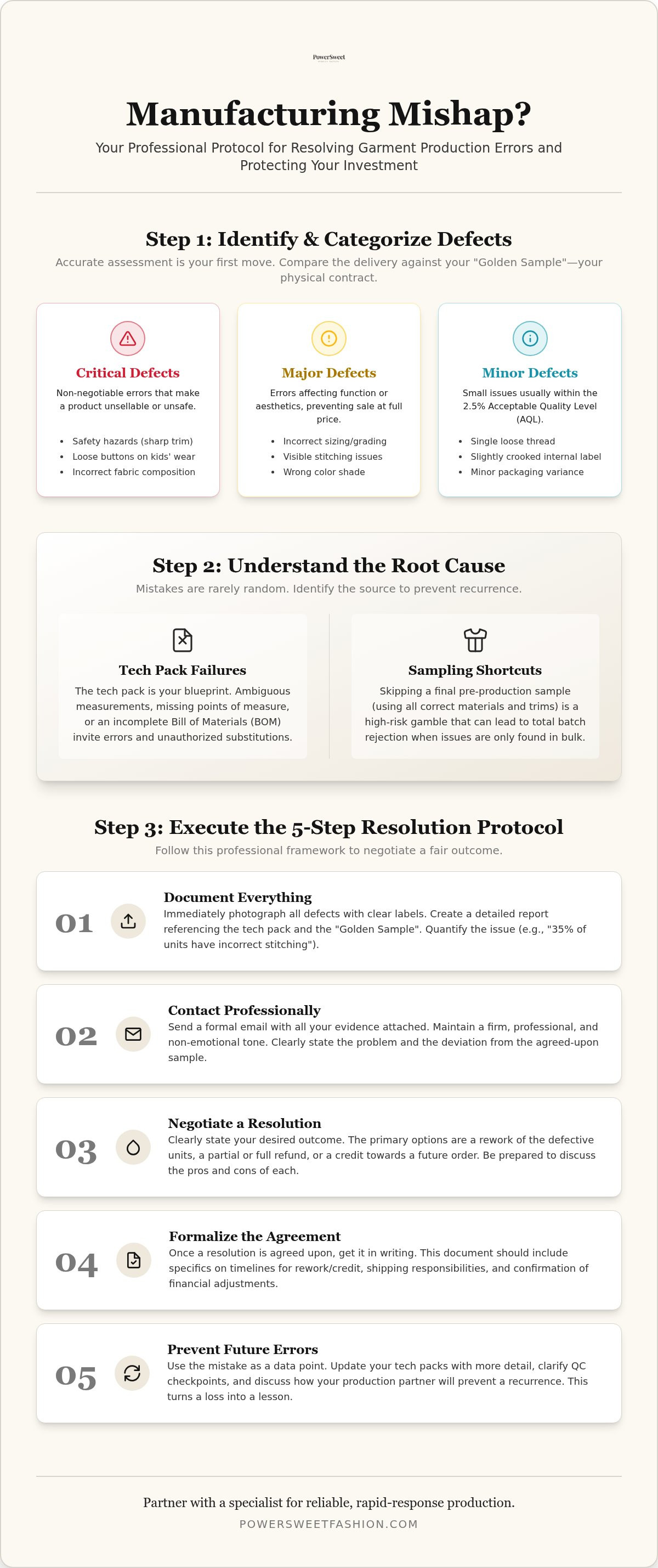
The 5-Step Protocol for Resolving Factory Mistakes
Resolving a production error requires a methodical approach to ensure you don't end up with a total loss. Following a structured protocol is essential for what to do when your manufacturer makes a mistake. This five-step process moves from physical evidence to contractual leverage, ensuring the factory takes responsibility for the deviation. By maintaining a paper trail, you transform a stressful negotiation into a professional logistical dispute.
Step 1: Immediate Documentation. Capture high-resolution photos and videos of the defects as soon as they are discovered.
Step 2: Statistical QC Audit. Conduct a random inspection of at least 10% of the batch to determine if the defect rate exceeds your agreed-upon AQL.
Step 3: Contractual Reference. Cross-reference the errors against your Tech Pack and signed Purchase Order (PO) to prove the deviation from specifications.
Step 4: Formal Notification. Issue a "Correction Request" document that clearly outlines the errors, the total quantity affected, and your required resolution.
Step 5: Timeline Agreement. Mutually agree on a firm deadline for rework or replacement, typically aiming for a 15 to 20 day turnaround for bulk re-runs.
Documenting Evidence Like a Professional
A factory manager cannot ignore a well-structured defect report. To create one, use side-by-side comparisons that show the "Golden Sample" next to the defective production item. Highlight the specific area of failure, such as a grading inconsistency or a stitching tension issue, with clear annotations. It's vital to use timestamped evidence in international trade to prevent disputes over when the damage occurred. This level of meticulous care makes it difficult for a manufacturer to claim the errors are within acceptable variances.
Initiating the Formal Dispute Process
When you communicate the failure, maintain a professional, collaborative tone to avoid factory "ghosting." Position the issue as a shared logistical challenge that needs a solution rather than a personal failure. Set firm deadlines for a response; a 24 to 48 hour window for an initial acknowledgement is standard. If the factory denies the error despite your evidence, it's time to involve a third-party inspection service to validate your claims. These independent reports carry significant weight in B2B negotiations and often trigger a faster resolution. If you need a partner that prioritizes transparency and rigorous oversight, explore our Quality Control Services to secure your next production run.
The goal of this protocol is to reach a mutually beneficial agreement that protects your brand's reputation. Knowing exactly what to do when your manufacturer makes a mistake allows you to act with controlled urgency. This systematic approach ensures that even if a production run fails, your business remains a "Safe Pair of Hands" for your customers. Professionalism during a crisis often strengthens the long-term partnership with your factory by establishing clear boundaries for quality.
Preventing Future Errors with Better Production Partners
Proactive vetting is the most effective long-term solution for brand stability. While knowing what to do when your manufacturer makes a mistake is a vital survival skill, building a system that minimizes these occurrences is better for your bottom line. Transitioning from a transactional vendor model to a strategic partnership allows for deeper integration of your quality standards into the factory’s daily operations. High-performance brands prioritize factories that offer open-door transparency, inviting oversight rather than hiding the production journey behind a digital wall.
Implementing Rigorous QC Checkpoints
Effective quality assurance isn't a single event at the end of a run. It requires inline inspections during the sewing process to catch errors before they're replicated across hundreds of units. Working with low MOQ women’s clothing manufacturers provides a distinct advantage here. Smaller production runs allow for tighter oversight and more frequent audits, making it easier to maintain the "Golden Sample" standard throughout the batch. Final inspections must always be completed before the balance payment is released, ensuring the factory remains accountable for the finished goods.
Choosing a Partner Built for Speed and Accuracy
Speed should never compromise precision. A 10-day sample turnaround is a powerful tool for catching technical errors early in the development cycle. This rapid feedback loop allows you to refine the fit and materials without delaying your entire launch calendar. Additionally, a 15 to 20 day bulk production cycle reduces the risk of rush-induced mistakes that typically occur when factories overbook their capacity and cut corners to catch up. By choosing end to end clothing production specialists, you benefit from a unified management system that handles everything from fabric sourcing to final packing.
Transparency remains the non-negotiable foundation for premium brands. Physical factory visits provide empirical evidence of a partner’s true capabilities and quality control rigor. This human element bridges the gap between a digital tech pack and a physical garment. When you view your manufacturer as the engine powering your creative vision, the entire process becomes a joint venture. This collaborative mindset is the ultimate safeguard against the financial loss and stress of manufacturing defects. If you're tired of wondering what to do when your manufacturer makes a mistake, it's time to partner with a team that treats your reputation with the same meticulous care as their own production floor.
Secure Your Brand’s Production Future
Navigating production hurdles requires a shift from emotional reaction to data-driven resolution. By mastering the professional protocol for what to do when your manufacturer makes a mistake, you protect your brand's capital and reputation. You now have the technical tools to categorize defects, leverage your Tech Pack as a contract, and negotiate resolution paths that preserve your essential factory relationships. Meticulous documentation and a systematic approach ensure that even a failed run becomes a learning point for future scale.
Your brand deserves a partner that operates as a "Safe Pair of Hands" during every stage of the journey. We invite you to partner with a manufacturer that prioritizes precision and speed to eliminate the stress of bulk errors. Our team provides the transparency you need to maintain oversight from the first stitch to the final delivery.
As a specialist in high-quality women’s fashion since 2008, we provide 10-day sample turnarounds to ensure perfection before bulk production begins. Our low MOQs allow for safer brand scaling, giving you the control needed to grow without unnecessary inventory risk. Your creative vision is the engine of your business; let us provide the reliable engineering to power it forward.
Frequently Asked Questions
Can I get a full refund if my clothing manufacturer makes a mistake?
Full refunds are difficult to secure in B2B custom manufacturing because raw materials and labor have already been consumed. You're more likely to receive a full refund if the batch is completely unsellable and violates critical safety standards. Most manufacturers prefer to offer a credit for future runs or a full replacement of the defective units. Clear contract terms regarding batch rejection are essential for protecting your capital in these nightmare scenarios.
What is an acceptable defect rate in apparel manufacturing?
The industry standard for an acceptable defect rate is typically defined by the Acceptable Quality Level (AQL) 2.5 for major defects. This means that in a statistical sampling, a small percentage of errors is expected and usually doesn't trigger a batch rejection. Minor defects often have a higher allowance, such as AQL 4.0. You should define these specific thresholds in your Purchase Order to ensure both parties understand when a mistake becomes a breach of contract.
Should I pay for the shipping of defective items back to the factory?
You shouldn't be responsible for the freight costs of returning defective goods if the factory is at fault. A professional manufacturer will typically cover these expenses or provide a credit to offset the loss. However, shipping bulk inventory overseas is often prohibitively expensive and time-consuming. It's frequently more pragmatic to negotiate a partial refund and sell the items as "seconds" or destroy the inventory locally while the factory sends a replacement shipment.
How do I prove the manufacturer made a mistake if I don’t have a tech pack?
Proving an error without a tech pack is challenging because you lack a "contract of truth." In this situation, your best evidence is the approved pre-production sample or detailed email correspondence that specifies measurements and materials. Knowing what to do when your manufacturer makes a mistake without documentation requires finding any physical or digital trail that shows a deviation. Moving forward, always develop a professional tech pack to avoid subjective disputes during quality control audits.
Is it better to fix manufacturing errors locally or at the original factory?
The decision depends on the severity of the error and your launch deadline. Minor issues like loose threads or crooked labels are often better fixed locally by a specialized garment technician to save time. This keeps your inventory in the market and avoids international shipping delays. If the errors are structural or affect the entire batch, a factory re-run is usually necessary. A 15 to 20 day bulk production cycle ensures the replacement meets your original standards.
How can I stop my manufacturer from using the wrong fabric again?
Prevention starts with a detailed Bill of Materials (BOM) within your tech pack that specifies the exact fabric brand, weight, and composition. You should also require the factory to send a fabric swatch for approval before they begin the bulk cutting process. Implementing inline quality control inspections allows you to catch material discrepancies while the garments are still on the sewing line. These checkpoints ensure the physical reality of the product matches your documented specifications every time.
What legal rights do I have when an overseas manufacturer fails to meet specs?
Your legal rights are primarily governed by the jurisdiction stated in your manufacturing contract. Pursuing legal action against an overseas factory is often costly and yields limited results for small brands. It's more effective to use trade assurance programs or escrow payment services that hold funds until quality is verified. These financial safeguards provide more practical leverage than international lawsuits when navigating what to do when your manufacturer makes a mistake during bulk production.


Comments