%20(1).png)
Guide to Verifying Ethical Factories for Fashion Brands

A factory’s audit certificate can look reassuring and still leave important questions unanswered. If you’re asking how to verify a factory is ethical, don’t rely on a supplier’s claims or a certificate alone. Documents can be outdated, limited in scope, or disconnected from workers’ day-to-day experience.
It’s reasonable to want clear evidence before placing an order, especially when you’re assessing a supplier remotely. A consistent process makes due diligence more manageable and helps you compare factories based on what they can demonstrate, not on polished marketing.
This guide explains which records and policies to request, how to check an audit’s date and scope, and what to ask about corrective actions and worker feedback. You’ll also learn how to use a factory visit as one part of due diligence, then follow up to see whether commitments are sustained. The goal is a fair, repeatable assessment that brings documents, worker-informed evidence, and ongoing communication together before production begins.
Table of Contents
How to Verify a Factory Is Ethical Before You Place an Order
A supplier’s assurance is a starting point, not verification. Before committing to production, compare what the factory says with its records, conditions, and the experiences of the people doing the work. A written policy sets expectations, but doesn’t prove those expectations are followed on the production floor.
Credible factory verification means comparing documented evidence with worker perspectives and observed conditions, then checking whether identified problems are corrected and stay corrected. This helps you make a more informed decision without treating any single document or visit as a guarantee. It also puts labor practices in the wider context of Sustainable fashion, which includes social concerns such as fair wages and safe working conditions.
What does ethical factory verification actually mean?
Verification means assessing how a factory’s labor practices work in reality. Consider working conditions, wages, hours, health and safety, and how workers are treated. Check whether evidence agrees across sources: do time records align with payroll, do safety procedures match observed conditions, and can workers raise concerns without pressure?
Legal compliance and broader responsible-business expectations are related, but not identical. Applicable laws set requirements; a brand may also expect transparent communication, respectful treatment, and a process for addressing risks. Be precise about what your evidence supports. Verification can reduce uncertainty, but it can’t guarantee that every practice is fair at every moment.
Why one certificate or visit is not enough
A certificate only tells you what its scope and conditions support. Check which facility it covers, which practices were assessed, who conducted the assessment, and whether the document is current. A certificate for one site or a limited assessment shouldn’t be treated as proof about every production location or labor issue.
A scheduled visit has limits, too. The factory may prepare for visitors, and a short walk-through can’t establish how workers are treated across shifts or during busy production periods. Ask whether workers can share feedback privately and without supervisors present, using a safe process appropriate to the facility.
Build a fuller picture by comparing records with worker perspectives, direct observation, and evidence of corrective action. For example, if an assessment identifies a safety concern, look for a documented response and follow-up evidence that the change was made. Inconsistencies aren’t automatic proof of misconduct, but they are a reason to ask focused questions before placing an order.
Keep conclusions evidence-led. Record what you reviewed, what remains unclear, and what the factory has agreed to address. This gives your team a clear basis for deciding whether to proceed, request more information, or pause while gaps are resolved.
Which Documents and Standards Help Verify a Factory’s Labor Practices?
Request evidence that helps you compare written commitments with how work is managed at the specific site making your order. Useful records include labor policies, anonymized time and wage records, health and safety documentation, training logs, and information about how workers can raise concerns. No single file answers every question. Check whether records are consistent with one another, and ask the supplier to explain gaps or restrictions.
Protect worker privacy as you review the evidence. Request anonymized or aggregated records where possible, and avoid collecting names, identity documents, or personal details you don’t need for your assessment. Agree on a secure way to share records and limit access to people who need them.
International reference frameworks can help shape your questions. The International Labour Organization’s conventions, the UN Guiding Principles on Business and Human Rights, and OECD guidance offer distinct reference points for labor rights and responsible business conduct. Check current versions, applicability, and terminology against the organizations’ own materials before relying on a specific requirement.
A standard is a framework; verification depends on the site, scope, methods, and evidence behind its application. A named framework can inform an assessment, but it doesn’t automatically prove that every worker’s experience meets your expectations.
How to assess audits, certifications, and assessment reports
Start with the details, not the logo. Check the issuing organization, assessment date, facility name and address, scope, and validity period. Confirm that the report covers the site intended for your order. Ask for findings, non-compliances, corrective-action plans, and evidence showing which actions have been closed and how closure was checked.
Keep different approaches distinct. SA8000, SMETA, and amfori BSCI have different frameworks or assessment methods; they aren’t interchangeable guarantees. Confirm current terminology and requirements directly with the relevant program, and interpret each report according to its actual scope and methods.
What factory records should a brand request?
Make a focused request that connects documents to the work being done:
Labor policies, plus anonymized time and wage records for relevant production periods.
Safety procedures, incident records where available, and safety training logs.
Grievance-handling procedures and anonymized information about how concerns are addressed.
A list of production sites used for the order and an explanation of how subcontracting is approved and monitored.
Record what’s missing, inconsistent, or restricted. Ask why, what alternative evidence is available, and whether the limitation applies to the whole site or only certain records. This structured review helps answer how to verify a factory is ethical without treating paperwork as proof by itself. If you’re preparing a production brief, you can also discuss women’s clothing production requirements with PowerSweet Fashion.
How to Judge a Factory Audit and Spot Gaps in the Evidence
An audit report is useful only if you understand what it assessed. A clean result may reflect a limited review at a particular site and time, not every production line, worker group, or shift. To judge its value, consider four things together: document-only assurance, an assessment by an independent party, evidence informed by workers, and follow-up on identified problems.
An audit is evidence about a defined assessment, not a continuing guarantee of ethical performance. Its strength depends on the scope, the assessor’s independence, the methods used, and whether findings are shared clearly and addressed. This distinction matters when deciding how to verify a factory is ethical without giving a report more weight than its evidence supports.
Questions that reveal an audit’s scope and credibility
Ask the supplier to clarify which facility and production processes were assessed, which worker groups were included, and what period the review covered. Confirm who conducted it and whether the assessor had a relationship with the factory that could affect independence. Find out which methods were used, including whether records were reviewed, conditions observed, and workers interviewed confidentially.
Then ask what the assessment found. Can the factory share the findings, explain any limitations, and provide evidence that corrective actions were completed? A summary that reports a pass but omits the scope or follow-up leaves important questions unanswered.
Warning signs that deserve a closer look
Some gaps call for clarification, not an immediate conclusion. Look more closely if records appear inconsistent, the supplier can’t identify all sites involved in your order, or access to relevant evidence is restricted without a clear explanation. Repeated findings, vague corrective plans, and documents with no clear date or facility scope also make it harder to judge the report.
Pressure to decide before you can review the evidence is another reason to slow down and confirm details. Ask focused questions and seek corroboration rather than assuming one warning sign proves misconduct.
Use a simple comparison when reviewing suppliers:
Scope: Does the assessment cover the site and work relevant to your order?
Methods: Is there evidence beyond the factory’s own statements, including worker-informed input?
Findings: Are limitations and concerns described clearly?
Follow-up: Can the supplier show what changed after issues were identified?
A scheduled factory visit can add useful context, but it won’t replace confidential worker input or follow-up. Together, these checks help you distinguish a polished report from evidence that is specific, transparent, and relevant to the production you’re considering.
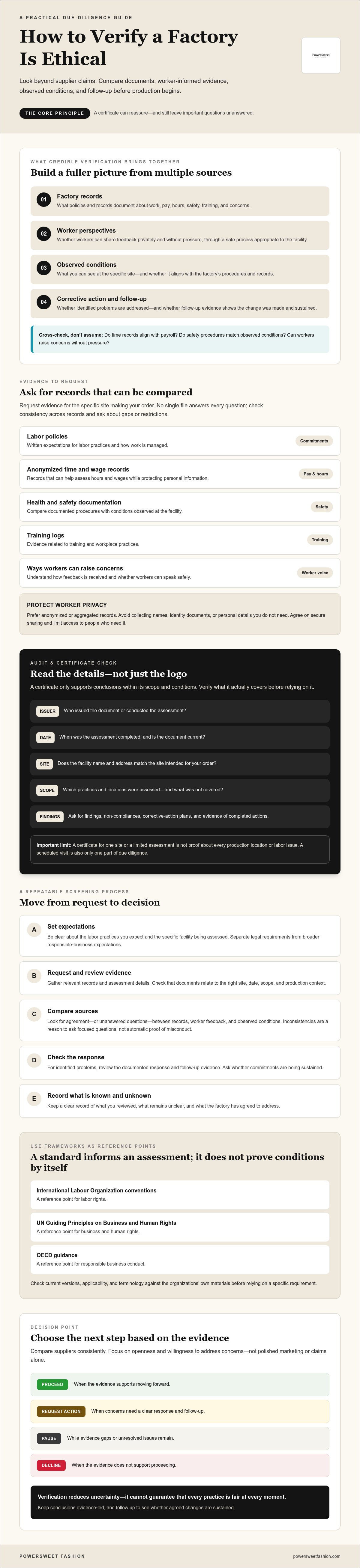
How to Verify a Factory’s Conditions: A Step-by-Step Checklist
A repeatable process makes it easier to compare suppliers and act on evidence before production begins. Use this workflow to organize what you request, what you verify, and what still needs attention. Agree in advance on access to relevant areas, evidence-sharing, worker privacy, and how serious concerns will be escalated.
Step 1: Screen the claims. List the factory’s labor commitments and identify which sites will make your order. Check whether any audit or certificate covers those specific facilities and processes.
Step 2: Request evidence. Ask for relevant policies and records covering pay, working hours, safety, training, and grievance channels. Request the materials early enough to compare them with the factory’s claims and any assessment findings.
Step 3: Assess the gaps. Note missing, inconsistent, or restricted information. Ask the supplier to explain each gap and identify what other evidence could clarify it. Keep unresolved issues visible rather than treating an explanation as proof.
Step 4: Verify conditions. Compare records with what you can observe at the production site. Where feasible, arrange respectful, private worker engagement through an appropriate independent process, so workers can share their perspectives without pressure.
Step 5: Follow up. Agree who is responsible for addressing each concern, what evidence will demonstrate progress, and when it will be reviewed. Recheck open issues rather than relying on a one-time assessment.
Before a factory visit or independent assessment
Prepare focused questions about worker protections, pay practices, working hours, safety, and grievance channels. Compare relevant records with stated policies and existing audit findings before you arrive, so you can use access time to clarify specific points. A visit offers a view of the facility, but it isn’t a substitute for worker input or documentary evidence.
During and after the verification process
Observe production areas and safety practices, noting whether visible operations align with the records and explanations you’ve received. Separate what you directly observed from what the supplier reported. Record each finding, its supporting evidence, any uncertainty, and the person responsible for corrective action. Set a proportionate follow-up plan based on the issue’s seriousness and recheck whether agreed changes are in place.
Keep a supplier assessment record with the facility and assessment dates, documents reviewed, access limitations, worker-engagement method, open questions, and decisions made. This creates a clear trail for your team and makes how to verify a factory is ethical a consistent part of supplier selection. For additional context on production checks, read about the quality control role in apparel manufacturing. If you’re planning a women’s clothing order, you can discuss production requirements with PowerSweet Fashion.
Choosing an Ethical Production Partner Through Transparent Due Diligence
Verification findings should lead to a clear decision, not a vague sense of confidence. Depending on the evidence, you may proceed, request corrective action before production, pause while key questions are answered, or decline the supplier. A factory’s production capability matters, but it shouldn’t outweigh unresolved concerns about worker protections or transparency.
How to compare factories without relying on marketing claims
Use the same evidence checklist for every supplier. Consistency makes differences easier to assess and helps your team avoid giving extra weight to polished presentations or familiar-sounding standards. Compare what each factory can demonstrate, what remains unclear, and how openly it responds when you ask for more detail.
Keep labor due diligence distinct from production capability. You might assess sampling, production capacity, and quality oversight in one part of your review, then separately assess evidence quality, worker protections, transparency, and willingness to improve. A supplier that identifies a gap and agrees to proportionate follow-up may offer stronger grounds for further consideration than one that makes broad claims but resists scrutiny.
Use a simple decision record for each factory:
Proceed: Evidence supports your requirements, with no unresolved issue that prevents the order.
Request corrective action: A concern is understood, and the supplier provides a clear response and evidence for review.
Pause: Important information or access is still missing, so you can’t make a sound decision yet.
Decline: The evidence or response doesn’t meet your requirements, or material concerns remain unresolved.
Record the basis for the decision, including what remains unverified and whether the factory will support follow-up. For more context on assessing suppliers, see this custom women’s clothing manufacturer guide.
What transparent collaboration should look like
Before production, align on which site will make the order, what access can be arranged, how relevant evidence will be shared, and how quality oversight will work. Set expectations for protecting worker privacy and escalating concerns. These practical agreements make it easier to keep communication clear as production moves forward.
PowerSweet Fashion reports that clients can visit its factory to meet the production team and oversee quality control. Confirm the current visit arrangements and what can be observed; a visit can inform due diligence, but it doesn’t establish ethical compliance. Likewise, the company’s production, sampling, fabric sourcing, and quality control capabilities don’t independently prove its labor practices. Review evidence directly before drawing conclusions. The end-to-end clothing production guide offers further context on the production process.
If you’re planning custom women’s clothing production, you can discuss your production requirements with PowerSweet Fashion and raise the evidence and access questions that matter to your supplier review.
Make Your Next Supplier Decision With Confidence
Strong due diligence brings several kinds of evidence together. Review policies and relevant records, check an audit’s site, date, scope, and follow-up, and compare those findings with worker perspectives and observed conditions. This gives your team a clearer basis to proceed, request corrective action, pause, or decline.
Knowing how to verify a factory is ethical doesn’t mean relying on a single certificate or visit. It means documenting what you’ve confirmed, what remains uncertain, and how concerns will be addressed as production moves forward.
PowerSweet Fashion offers custom women’s apparel production, sample development, fabric sourcing, and quality control. The supplied business summary also states that clients can visit the factory and meet the production team. These capabilities and visit access can support a transparent supplier conversation, but they don’t independently establish ethical compliance. Review relevant evidence directly and confirm any visit arrangements before relying on them.
Ready to discuss your production requirements? Discuss your production requirements with PowerSweet Fashion, and bring your questions about records, access, and quality oversight into the conversation. A clear process helps you move forward with care and confidence.
Frequently Asked Questions
How can I tell if a factory is ethical?
Look for consistent evidence across records, worker perspectives, site observations, and follow-up on identified issues. Review policies alongside anonymized records for hours, wages, and safety, then check whether the evidence covers the facility making your order. Ask how workers can raise concerns and whether corrective actions were completed. No single check can confirm every practice, but this evidence-led approach helps you make a better-informed supplier decision.
Are factory audit certificates enough to prove a factory is ethical?
No. A certificate or audit report applies to a defined site, scope, and assessment period, so check those details before relying on it. Confirm who issued it, which facility and processes it covers, when it was assessed, and whether findings and corrective actions are available. A favorable result doesn’t establish conditions beyond the assessment’s scope or prove that practices have remained consistent since the review.
What documents should I ask a clothing factory for?
Ask for relevant labor policies and anonymized records that help you assess working hours, wages, safety practices, and training. Request information on grievance channels, assessment findings, and corrective actions as well. Confirm which production sites will handle your order and how subcontracting is managed. Keep requests proportionate: avoid unnecessary personal data, and ask the supplier to explain records that are missing, restricted, or inconsistent with its stated policies.
Can I verify a factory’s working conditions remotely?
You can carry out meaningful checks remotely, but remote review has limits. Request current, site-specific records and assessment reports, then compare dates, facility details, and findings. A video tour or live call may help you understand operations, but it can’t independently confirm what happens across shifts or provide confidential worker perspectives. Where feasible, arrange independent assessment or worker engagement, and record what you couldn’t verify before deciding whether to proceed.
What should I do if a factory refuses an audit or worker interviews?
First, ask why access is restricted and whether the concern is about timing, confidentiality, or the assessment method. Explore reasonable alternatives, such as reviewing existing independent findings or arranging a suitable confidential process for worker feedback. Don’t treat refusal alone as proof of misconduct, but record the limitation and assess its impact. If you can’t verify material labor concerns, pause the order or decline rather than treating unsupported assurances as evidence.
How often should a fashion brand recheck a factory?
Set a review schedule based on the risks you’ve identified, the scope and date of available assessments, and the strength of the factory’s follow-up. Recheck sooner if production moves to another site, records raise new questions, a serious concern emerges, or agreed corrective actions need confirmation. There isn’t one interval that fits every supplier. Document your rationale and make sure unresolved issues have an owner and a planned review point.
Does a factory visit prove that its labor practices are ethical?
No. A visit gives you a useful view of the facility and visible processes, but it captures a limited period and may not show every shift or worker experience. Use it alongside site-specific records, assessment findings, and worker-informed evidence gathered through a respectful process. Record what you observed and what remains unknown. Treat a visit as one part of due diligence, not as a guarantee of ethical conditions.


Comments