%20(1).png)
Garment Manufacturing Compliance Standards: A Guide to Children's Clothing

A garment can pass a factory audit and still lack the product evidence required for its destination market. That’s why garment manufacturing compliance standards need to be planned as a connected process, not treated as a single certificate or inspection.
Product safety rules, factory audits, and supply-chain documentation serve different purposes. The checks required depend on where a garment will be sold, what it’s made from, and how it’s designed. A factory audit alone doesn’t establish that a specific children’s garment meets every product requirement.
This guide explains how the main layers fit together and how to map requirements to target markets, materials, and product details. You’ll learn what records and test evidence to organize, how to keep product specifications aligned with samples and production, and where quality-control reviews can catch gaps before bulk manufacturing begins. A clear evidence process makes compliance easier to manage and supports more reliable production decisions.
Table of Contents
What garment manufacturing compliance standards cover in children's clothing
How children's clothing rules differ by destination market and product
Factory compliance standards versus children's garment testing
A practical compliance workflow from design brief to bulk production
How a documented manufacturing partnership supports compliance readiness
What garment manufacturing compliance standards cover in children's clothing
Garment manufacturing compliance standards are the requirements and evidence used to assess a garment, the factory that makes it, and the supply chain behind its materials. These layers work together, but they answer different questions: Is the finished item suitable for its intended market and use? Are production systems controlled? Can the brand trace relevant materials and practices?
There isn’t one checklist for every children’s garment worldwide. The destination market, garment design, materials, and intended age group all help determine what needs review. A sleepwear item, for example, raises different design and material questions from a simple everyday top. Requirements also vary by market, so verify current rules and standards for each destination before production.
Product safety, factory systems, and social responsibility are different layers
Product safety concerns the finished garment and its components. Depending on the product and market, review may cover substances in fabric or trims, cords, small components, construction, and labeling. Factory systems concern how production is controlled, including workplace safety procedures, production records, and process checks. Social responsibility is a separate consideration focused on labour practices and working conditions across the supply chain.
Each type of evidence has a distinct role. A laboratory test report records results for a defined sample or material. A certificate or declaration states that a product meets specified requirements, but its meaning depends on the applicable scheme and supporting evidence. An audit assesses a facility or management practices within a defined scope. None substitutes automatically for the others: a factory audit doesn’t establish that every finished garment has passed applicable product testing.
For a U.S.-market review, applicable children’s-product requirements can include limits on lead or certain phthalates and third-party testing. The Consumer Product Safety Improvement Act (CPSIA) offers a broad overview of U.S. provisions relevant to children’s products. Identify the specific requirements and evidence applicable to each item.
Why children’s garments need product-specific review
Small design choices can change what needs assessment. Cords and drawstrings may create entanglement risks; detachable trims or small components may need closer review; and seams, closures, and other construction details can affect how a garment performs in use. The intended age group matters too. A design for very young children may require a different risk assessment from one for older children. Don’t assume a test or design decision for one age range covers every size and version.
EN 14682 is an example of a standard addressing cords and drawstrings on children’s clothing. Its relevance depends on the destination market, the garment, and the standard’s current scope and version. Treat it as a prompt for targeted review, not as universal approval or a substitute for checking local requirements.
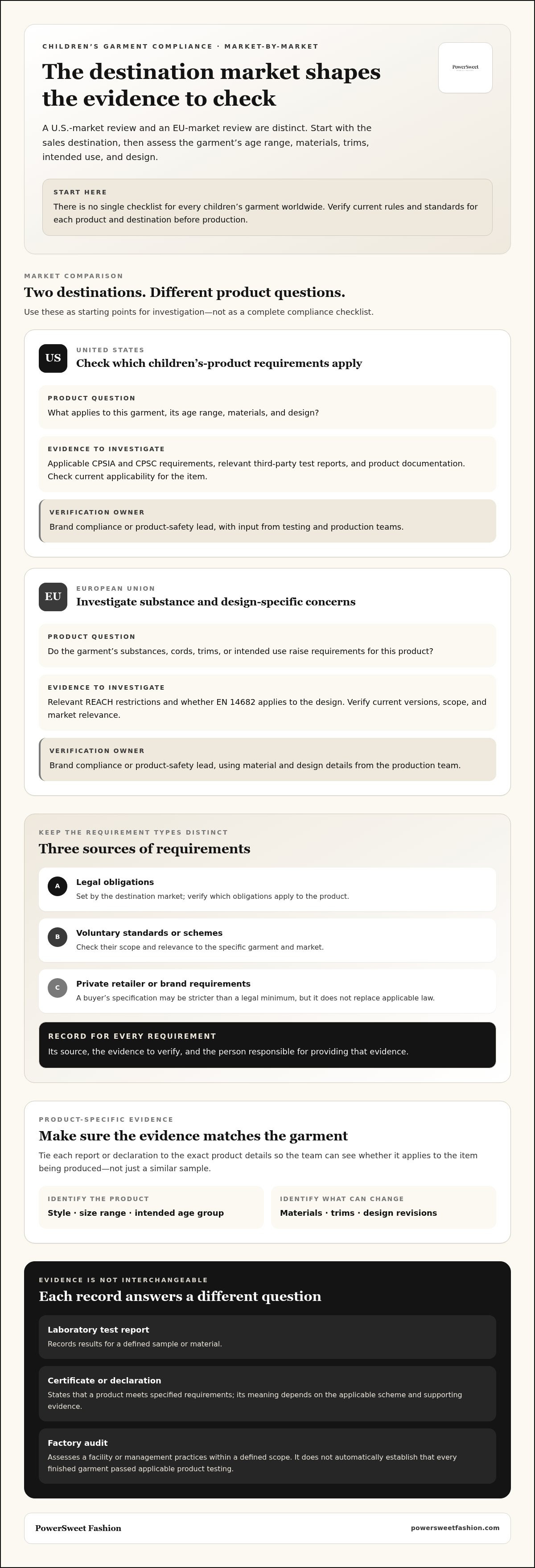
Tie evidence to the exact product details: style, size range, materials, trims, and design revisions. This makes it easier to see whether a report or declaration applies to the garment being produced, rather than to a similar but different sample.
How children's clothing rules differ by destination market and product
Start with the sales destination, not a generic certificate list. A garment intended for the United States may need a different compliance review from a similar item sold in the European Union. The product’s age range, intended use, materials, trims, and construction then shape which questions apply. Requirements and standards can change, so verify current rules and scope before approving a product or relying on an existing report.
Keep three types of requirements distinct: legal obligations set by the destination market, voluntary standards or schemes, and private requirements set by a retailer or brand. A buyer’s specification may be stricter than a legal minimum, but it doesn’t replace applicable law. Record the source and owner of each requirement so the team knows what needs verification and who is responsible for providing the evidence.
Map each market to its own product questions
The comparison below is a starting point, not a complete compliance checklist. Assign an owner to verify current rules for each product and market, then record the source and evidence reviewed.
These references aren’t interchangeable. CPSIA and CPSC belong in a U.S.-market review; REACH and EN 14682 are prompts for checking relevant EU requirements, not proof that a garment complies. Confirm the applicable rules for the exact product rather than assuming a report or certificate covers every market.
Turn product details into traceable review questions
Build a material and component inventory for each style. Include fibre content, dyes and prints, trims, fasteners, and parts that contact skin. For construction, flag cords, detachable components, and other features that may need assessment against market-specific rules or guidance. A change to a print, trim, or fabric can affect which evidence remains relevant, so link records to the approved product version.
OEKO-TEX is a separate materials-related scheme. It may provide evidence within its defined scope, but it doesn’t replace checks against legal requirements or buyer-specific criteria. Clear specifications and fabric-sourcing records help keep material details connected to samples and production. For apparel projects, fabric sourcing and sample development can support a more controlled review workflow.
Factory compliance standards versus children's garment testing
Factory evidence and product evidence answer different questions. A facility audit describes conditions and controls within its scope; a garment test report records results for a particular sample, material, or test. Neither should be treated as a substitute for the other. A factory may have documented procedures and still need separate evidence that a specific children’s garment meets the requirements of its destination market.
This distinction is central to applying garment manufacturing compliance standards. Organize records by what they demonstrate, who issued or reviewed them, which site or product they cover, and whether they apply to the production version being made. A certificate’s title alone doesn’t establish its scope.
What factory audits and management-system standards can show
A factory audit assesses the facility against a defined framework and scope. Depending on that scope, it may review workplace conditions, health and safety practices, production controls, and supporting records. Social-audit frameworks such as amfori BSCI focus on supply-chain social performance. Verify current programme terminology and the specific assessment coverage rather than assuming every audit addresses the same topics.
Management-system evidence describes how a business organizes and controls its processes. ISO 9001 is a quality-management-system standard. It can indicate that quality processes are managed within the certification’s scope, but it isn’t a product-safety approval for children’s clothing. Confirm the site, activities, and validity covered by a management-system certificate before using it in a supplier file.
What product tests and technical files can show
A laboratory report has a defined boundary. Read it alongside the sample identification, material or component tested, method used, date, and stated results. A result for one fabric or trim doesn’t automatically establish that a finished garment with different components or construction meets a product requirement. The testing plan should follow current destination-market requirements and the actual product risk profile.
A practical product file connects evidence to the approved design and production inputs. Depending on the garment and requirements, it may include:
Product specifications identifying the style, size range, construction, and intended age group.
Material and component records, including supplier details and relevant declarations.
Applicable laboratory test reports, linked to the tested sample or material and its result.
Product certificates or declarations, with the requirements they address and their supporting evidence.
Sample approval and quality-control records that help show production matches the documented specification.
Review changes before relying on existing evidence. If a fabric, print, trim, fastener, or construction detail changes after testing, document the change and assess whether the prior report still applies. The brand and production team can coordinate this review by keeping sample details, sourcing records, and inspection criteria aligned.
Use the records as a set, not as interchangeable badges. Audit findings help assess factory practices; management-system documents describe process controls; test reports provide defined results; and product files connect those results to the garment. Keeping these roles separate makes gaps easier to spot before bulk production.
A practical compliance workflow from design brief to bulk production
Compliance planning works best as part of product development, not as a document search at the end. Assign an owner to each open question and record its status. This makes requirements easier to track as the brief moves through sourcing, sampling, review, and production release.
Set requirements before sourcing and sampling
Start with a brief that defines where the product will be sold, its age range and intended use, and any buyer requirements. Add material composition, construction details, trims, and restricted-substance questions so the sourcing and sample teams know what information to capture. A clear tech pack keeps approved specifications and revisions aligned.
Define the markets and product. The brand compliance owner records destination markets, product category, age range, intended use, and buyer criteria in the brief.
Identify product questions. The product or compliance owner notes design features and material questions that need review. Record the applicable requirement or the issue requiring verification.
Source and document materials. The sourcing owner records fibre composition, supplier information, material declarations, and relevant supporting documents against the selected fabric and components.
Review the sample. The product development owner compares the sample with the current tech pack, checks that design details match the brief, and records approvals, required tests, and unresolved changes.
Review evidence and release. The brand compliance owner checks that the required documents apply to the approved product version. Release bulk production only when material, test, and specification questions are resolved or have a documented decision and owner.
Keep evidence controlled through production
Use a tracking matrix rather than relying on inboxes or memory. Include the requirement, responsible owner, evidence needed, document location, revision or review date, and status. For example:
Material composition: sourcing owner; supplier specification or declaration; linked to the approved material.
Product testing: compliance owner; applicable test report; matched to the relevant sample, material, and product version.
Sample approval: product development owner; signed-off sample record and current tech pack.
Production checks: quality-control owner; inspection record comparing production inputs and finished-garment checks with the approved specification.
Keep supplier documents, material records, test reports, approvals, and revision dates together in the product file. If a fabric or trim changes, log the revision and review whether existing evidence still applies before production continues. Quality-control records support traceability by showing what was checked and against which specification. They don’t replace legal assessment or prove compliance on their own.
For apparel projects that need clear specifications carried from sampling into production, discuss your brief and sample-development needs with PowerSweet Fashion.
How a documented manufacturing partnership supports compliance readiness
Compliance readiness depends on coordination. The brand defines target markets and product requirements; the production team works from clear specifications and keeps relevant sourcing, sample, and quality records connected to the garment. This shared workflow helps teams spot gaps early, but it doesn’t replace the brand’s responsibility to verify applicable requirements for each market.
Turn brand requirements into production-ready information
A useful brief translates design intent into actionable details: materials, construction, components, intended use, and review points. With these details in place, fabric sourcing and pattern making can follow the same approved direction, while questions about materials or construction can be raised before they become bulk-production issues.
Sample development creates a practical review point before bulk production begins. The brand can compare the sample with the brief, check that its details match the intended design, and record decisions or revisions. A tech pack and revision history help keep approved information consistent as the project moves between design, sourcing, sampling, and production. This is the connected sequence brands need from an end-to-end clothing production workflow.
Keep quality checks connected to approved specifications
Quality control is most useful when checks refer to agreed product details. The team can compare materials and construction with the approved specification, record inspection findings, and document how any variation is handled. These records support production traceability and show what was reviewed. They don’t replace legal assessment, product testing, or market-specific evidence.
PowerSweet Fashion’s apparel workflow includes fabric sourcing, sample development, pattern making, and quality control. These activities support communication between a brand’s requirements and production documentation. Clients can visit the factory to meet the production team and oversee quality control.
Clear documentation also makes it easier to connect a production question to its source. If a material changes, teams can identify the affected specification and records; if a sample is revised, they can track which version was approved. Keeping those decisions visible helps the brand and manufacturer coordinate without treating one document as proof of every requirement.
For brands applying garment manufacturing compliance standards across an apparel project, the practical goal is a shared record of what was specified, sourced, sampled, reviewed, and approved. That foundation supports controlled production while keeping market-specific compliance decisions tied to the correct product and evidence.
Explore how your production requirements can translate into a documented apparel workflow with PowerSweet Fashion’s apparel manufacturing services.
Make your next production brief compliance-ready
Turn market and product requirements into a clear apparel brief before sourcing and sampling begin. This gives your team and manufacturing partner a shared starting point for planning materials, development, and production reviews. Keep destination-market checks current, and treat each garment’s requirements as specific to its design and intended use.
PowerSweet Fashion supports apparel projects through fabric sourcing, pattern making, sample development, and quality control. Samples are ready in 10 days, and bulk production takes 15-20 days. These timelines can help you plan project stages while you organize the separate compliance reviews your products require.
Strong garment manufacturing compliance standards depend on clear coordination, not one document or checkpoint. Bring your production goals and requirements into the process early, and build a workflow your team can manage with confidence. Discuss your apparel production project with PowerSweet Fashion, and take the next step with a clear plan.
Frequently Asked Questions
Which compliance standards apply to children's clothing?
There’s no single worldwide standard for every children’s garment. Start with a market-by-market review for each product, including its age range, materials, construction, and intended use. A useful working document is a requirements matrix that separates legal obligations from voluntary schemes and buyer specifications, then assigns an owner to verify each item. This makes garment manufacturing compliance standards easier to manage without treating one checklist as universal.
Is a factory audit enough to prove a children's garment is compliant?
No. An audit covers a defined facility or management-system scope, while product evidence relates to the garment itself. For example, an audit report may describe a site assessment, but it won’t show whether a specific fabric or finished item meets a product requirement. Record the audit’s site, scope, and date separately from product specifications, sample approvals, and test evidence so the documents aren’t mistaken for one another.
Does OEKO-TEX certification mean children's clothing meets all legal requirements?
No. OEKO-TEX schemes have defined criteria and coverage, so understand a certificate within its stated scope rather than treating it as approval for every legal requirement. Review which scheme is named, what product or material the document covers, and whether it’s current. Then assess the garment against applicable market rules and buyer requirements. Avoid making broad product claims based only on a materials-related certificate.
What records should a brand keep for children's clothing production?
Keep a controlled product file that connects the approved design to its materials and production evidence. Depending on the product and market, this may include the specification, supplier and material details, relevant test reports, sample approvals, production checks, and revision history. Use consistent file names or a tracking system to identify the product version each record covers. If a component changes, log the change and review affected documents.
Do children's clothes need testing before bulk production?
Testing depends on the destination market, product design, materials, and applicable requirements. Identify testing questions during development, then plan reviews around the final intended materials and construction. For example, if a sample uses a different print or trim from the planned bulk garment, the existing report may not represent the production version. Match each report to its sample, material, method, and result, and verify requirements before deciding what testing is needed.
What is the difference between a compliance certificate and a test report?
A test report records results from a defined test on a specified sample or material. A certificate or conformity document makes a statement under a particular scheme or requirement, and its meaning depends on its issuer and scope. Check the document’s product identification, covered requirements, supporting evidence, and validity. A document’s title alone doesn’t establish that it applies to the version you plan to produce or sell.
Can one compliance certificate cover children's clothing sold in multiple countries?
Don’t assume it can. A certificate may cover a defined product, material, test, or voluntary scheme, while destination markets can have different requirements. Build a separate market entry in your tracking file for each sales destination, then map existing evidence to the requirements it actually addresses. A document may be relevant in more than one review, but confirm its scope and the current rules for each market before relying on it.
When should a brand begin compliance planning for children's clothing?
Begin during product planning, before committing to final materials and construction. At that stage, a brand can record intended markets, define the product and age range, and flag design or material questions for review. Add a compliance checkpoint to sample approval and another before production release. This creates time to resolve issues while design decisions can still be adjusted, rather than discovering a mismatch after bulk garments are complete.


Comments