%20(1).png)
CMT vs. FPP Manufacturing: What Should Your Fashion Brand Choose?

A production quote with a lower unit cost can require more work from your team overall. If you’re weighing “CMT vs FPP manufacturing what to choose,” look beyond price: who sources fabric and trims, coordinates production inputs, and checks quality?
You may want control over materials and product details without taking on extra workload or discovering gaps between supplier quotes. CMT typically leaves more sourcing and coordination with the brand, while FPP generally assigns more of those responsibilities to the manufacturer. Because the scope varies, the model name alone won’t tell you what a quote includes.
This guide compares the two approaches so you can match production responsibilities to your team’s resources and preferred level of oversight. You’ll see how sourcing, production and approvals can differ, what to clarify when comparing quotes, and how to choose a scope that suits your collection rather than simply the proposal that looks easiest.
Table of Contents
CMT vs. FPP manufacturing: what does each model mean?
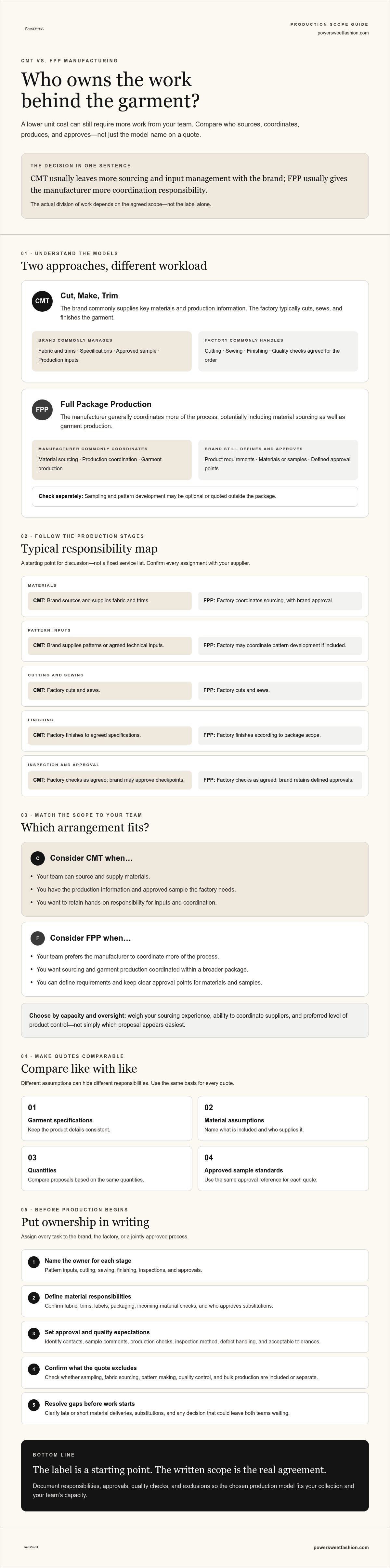
The main difference is who supplies and manages production inputs. In a typical CMT arrangement, the brand provides key materials and production information, while the factory cuts, sews, and finishes the garment. With FPP, the manufacturer commonly coordinates a broader package that may include material sourcing as well as garment production. The textile manufacturing process describes stages that turn fibers into fabric, which are separate from the later steps involved in making garments.
These labels describe common arrangements, not guaranteed service lists. One factory’s CMT scope may differ from another’s, and an FPP quote may include some services while listing others separately. To decide “CMT vs FPP manufacturing what to choose,” start by assigning each task to the brand, the factory, or a jointly approved process.
What does CMT manufacturing usually include?
Under CMT, the brand may supply fabric, trims, specifications, and an approved sample, along with the information the factory needs to make the garment. The factory typically handles cutting, sewing, and finishing, plus the quality checks agreed for the order. Confirm in writing who supplies labels and packaging, who provides each trim, and who checks incoming materials before production.
What does FPP manufacturing usually include?
FPP generally gives the manufacturer responsibility for coordinating more of the process, from material sourcing through garment production. The brand can still set requirements and approve materials or samples. A broader package does not automatically mean giving up product oversight. Ask whether sampling and pattern development are included or quoted separately, since they may be optional rather than part of the package.
In short: CMT usually leaves more sourcing and input management with the brand, while FPP usually assigns more coordination to the manufacturer. The order documents, not the label on a proposal, define the actual division of work. Review the purchase order and scope document for named responsibilities, approvals, quality checks, and exclusions. If something is unclear, agree on it before production starts.
How do CMT and FPP divide sourcing, production, and quality control?
Responsibilities can shift at each production stage, even within the same model. Use the table as a starting point, then confirm every assignment with your supplier. The CMT vs FPP manufacturing methods comparison also describes common differences, but your order documents should settle the details.
This is a typical division, not a fixed rule. A brand might source fabric while asking the factory to source trims, or both parties might share sample and inspection approvals. If no one owns a decision, production can stall while teams wait for material confirmation. Inconsistent approvals can also lead to a substitution or finish passing one review and being rejected at the next.
Who sources fabric, trims, and production materials?
When the brand supplies materials, confirm the required quality, colour, specifications, quantities, and delivery dates before cutting begins. When the factory coordinates sourcing, name who approves swatches and who must authorize substitutions. Record who responds if materials arrive short or late, and agree how the issue affects the production schedule. Clear inputs help prevent last-minute questions.
Who owns samples, production checks, and final approval?
Name a contact on each side for sample comments, production-stage checks, and final sign-off. Agree on the inspection method, defect-handling process, and acceptable tolerances before bulk production. Avoid relying on broad terms such as “approved quality” without defining what they mean. This sample development and pattern-making guide can help you identify what to review during development.
The contract’s scope, not the model name, defines accountability. For brands asking “CMT vs FPP manufacturing what to choose,” a responsibility matrix attached to the order makes ownership visible before work begins. If you’re defining a scope across sourcing, samples, patterns, and quality checks, you can review PowerSweet Fashion’s manufacturing capabilities and confirm which responsibilities fit your project.
CMT vs. FPP: which model fits your team and collection?
The right production model depends on the work your team can reliably own, not simply the size or stage of your brand. Consider four factors: access to suitable materials, time available to manage approvals, manufacturing experience, and how much supplier coordination you want to handle directly.
When considering “CMT vs FPP manufacturing what to choose,” assess how each arrangement would work for this collection. Your brand might have strong fabric relationships but limited capacity to track deliveries, or want close input on materials while relying on a partner to coordinate other stages. Decide where you need control and where you need support. For more supplier selection criteria, see this custom women’s clothing manufacturer guide.
When can CMT suit a fashion brand?
CMT may suit a brand with trusted fabric and trim suppliers, clear material requirements, and staff available to coordinate deliveries and approvals. Direct sourcing gives your team hands-on input, as long as it can keep decisions moving and provide clear specifications to the factory.
That control also brings operational responsibilities. Someone on the brand’s side must track material quantities, confirm that inputs arrive when needed, review samples, and respond to approval requests. If those tasks compete with other priorities, even small delays can affect production readiness.
When can FPP suit a fashion brand?
FPP may fit a team that wants one manufacturing partner to coordinate more stages, including sourcing and production. This can reduce the brand’s internal coordination workload and leave more time for design and commercial planning. It does not guarantee a smoother process or a particular result. Responsibilities and decisions still need to be agreed clearly.
Before choosing this route, ask how the supplier will present material options, what information will support sourcing decisions, and whether your team can approve fabric, colour, and substitutions. Review how the partner checks quality, shares progress, and handles issues that need your decision. A broader package should make responsibilities easier to see, not harder.
Neither model is universally cheaper or better. The right fit depends on the agreed scope, supplier execution, and your team’s capacity to manage its share of the work. Choose an arrangement that provides the oversight your collection needs without assigning critical tasks to a team that lacks the time or resources to complete them.
How to compare CMT and FPP quotes without missing hidden scope
A quote is useful only when you know which work and inputs it covers. To compare CMT and FPP proposals fairly, send each supplier the same garment brief and review their responses in the same order. This helps you see whether a lower quote reflects a different scope rather than a better fit.
What should a comparable manufacturing brief include?
Give every supplier the same information before requesting quotes. Include the tech pack, measurement chart, construction details, artwork, and target order quantity. Specify fabric composition, trims, labels, packaging, and any substitutions you’ll accept. Identify the approved sample standard and the milestones you want suppliers to address, including sampling, inspections, approvals, and delivery.
1. Align specifications. Check that each proposal covers the same garment construction, measurements, finish, and approved sample standard.
2. Compare inputs. Confirm who supplies fabric and trims, which material assumptions the quote uses, and whether substitutions need your approval.
3. Match services. Ask suppliers to itemize included work, exclusions, client-provided inputs, and services scoped separately.
4. Define checks and changes. Confirm which quality checks are included, how results are recorded, and how pattern or specification changes are reviewed and approved.
5. Review quantities and timeline. Compare proposals at the same order quantity. Check that sample, production, inspection, approval, and delivery milestones are clearly stated.
For example, a quote based on brand-supplied fabric and an approved pattern is not directly comparable to one that includes sourcing coordination or pattern work. Record the differences in a side-by-side scope sheet instead of assuming that missing details are included. For a broader view of production stages, see this end-to-end clothing production guide.
Which questions expose gaps in a supplier proposal?
Ask who owns material sourcing and approvals, pattern changes, and confirmation that all required inputs are ready before production. Clarify how quality checks are documented, who reviews the findings, and how issues are escalated. Request the process for changes after approval, including how a change affects the agreed scope and milestones.
Use the same questions for every supplier. When deciding “CMT vs FPP manufacturing what to choose,” compare responsibilities and approvals alongside the quote, not just the model label. If you’re preparing a garment brief, discuss your production scope with PowerSweet Fashion, including the services and inputs your project requires.
Choosing a manufacturing partner: turn your CMT or FPP decision into a clear scope
Once you’ve decided how much support your team needs, turn that decision into a garment-specific brief and written responsibility matrix. Name who provides each input, completes each production task, and approves decisions. This gives both sides a shared reference before work begins, beyond the broad labels “CMT” and “FPP.”
Brand: Materials or specifications it will supply, plus approval contacts.
Manufacturer: Confirmed services, production tasks, and quality checks.
Shared: Sample reviews, material approvals, changes, and sign-off points.
What should your first supplier conversation cover?
Start with the product category, technical documents, expected order quantity, and the production responsibilities you want the partner to handle. Share relevant specifications, such as a tech pack, measurement chart, construction details, and material requirements. Ask which services the manufacturer handles and which your team needs to source, coordinate, or approve.
Make timing specific to the project. Ask for proposed milestones covering development, sample review, material readiness, bulk production, quality checks, and final approval. Confirm the assumptions behind each timeline, including the decisions or client inputs needed to keep work moving. Don’t commit to dates based on a general estimate alone.
How can PowerSweet Fashion support a broader production scope?
For brands seeking support across several production stages, PowerSweet Fashion offers fabric sourcing, sample development, pattern making, quality control, and finished-garment production for custom women’s clothing. Discuss which services your garment requires and record what the agreed scope includes. These are available capabilities, not a defined CMT package, so confirm project-specific responsibilities directly.
PowerSweet Fashion reports sample readiness in 10 days and bulk production in 15-20 days. Treat these as reported timelines, not a commitment. Confirm current availability, conditions, and how the proposed schedule applies to your garment, order, and agreed services.
Before comparing manufacturers, give each the same brief and ask each to respond to the same responsibility matrix. That’s the practical answer to “CMT vs FPP manufacturing what to choose”: select an arrangement your team can support and the supplier can define clearly. Once your requirements are set, discuss your production requirements with PowerSweet Fashion and confirm the appropriate scope for your project.
Set a clear scope and move your collection forward
The choice between CMT and FPP depends on your team’s capacity and the responsibilities you want your manufacturing partner to manage. If you’re asking “CMT vs FPP manufacturing what to choose,” match sourcing, approvals, and production coordination to your team’s actual resources. Then compare supplier quotes using the same garment specifications, inputs, quality checks, and milestones.
A written scope helps prevent gaps between what your team expects and what a manufacturer has included. It should identify responsibilities for sampling, fabric sourcing, pattern making, quality control, and bulk production, with approval points agreed in advance.
PowerSweet Fashion supports custom women’s clothing production, with fabric sourcing, sample development, pattern making, and quality control among its capabilities. The company reports sample readiness in 10 days and bulk production in 15-20 days. Confirm current availability, conditions, and timelines for your project. Discuss your garment production requirements with PowerSweet Fashion to clarify the scope that fits your collection.
Frequently Asked Questions
What is the main difference between CMT and FPP manufacturing?
CMT (cut, make, trim) usually means the brand supplies key materials and production inputs while the factory cuts, sews, and finishes the garments. FPP (full production package) commonly assigns the manufacturer more sourcing and production coordination. The division varies by supplier. Before production begins, check the written scope for pattern inputs, inspections, labels, packaging, and approvals.
Is FPP manufacturing the same as full-package production?
Yes. FPP commonly refers to full-package production, where a manufacturer coordinates more of the work from material sourcing through garment production. The term does not guarantee that every service is included. Sampling, pattern development, quality checks, labels, or packaging may be included, scoped separately, or assigned to the brand. Review the supplier’s proposal and purchase order to confirm responsibilities.
Which is better for a small fashion brand, CMT or FPP?
Neither model is automatically better for a small brand. CMT may fit a team with established material suppliers and enough time to manage inputs, approvals, and production coordination. FPP may suit a leaner team that wants a manufacturer to coordinate more stages. To answer “CMT vs FPP manufacturing what to choose,” assess your sourcing capacity, desired control, and available staff time for the collection.
Can a manufacturer provide CMT if I source my own fabric?
A manufacturer may accept a project where you supply fabric, but that alone does not confirm that it offers CMT. Ask the supplier to define the proposed arrangement in writing. Confirm who checks fabric specifications and quantities, who supplies trims, and which cutting, sewing, finishing, and inspection tasks the factory handles. Also agree how shortages, late materials, or unsuitable fabric affect production readiness and approvals.
Does FPP manufacturing include sampling and pattern making?
Not necessarily. Some FPP proposals include sample development or pattern making, while others list these services as optional or separate. Ask for an itemized scope stating who develops the pattern, creates and revises samples, and approves the final version for production. Confirm that bulk-production specifications will follow the approved sample, and document how pattern changes are reviewed and approved.
How do I compare CMT and FPP manufacturing quotes fairly?
Send each supplier the same garment specifications, target quantity, material requirements, and approved sample standard. Compare who supplies fabric and trims, which services are included, what quality checks are specified, and what assumptions the timeline depends on. Request a clear list of exclusions, client inputs, and change procedures. Quotes with different scopes are not directly comparable, even if they use the same model label.
What should a fashion brand provide before starting garment production?
Prepare a tech pack, measurement chart, construction details, artwork, and expected order quantity. Include fabric composition, trim and label requirements, packaging instructions, and any acceptable material substitutions. Identify the approved sample and name the people responsible for approvals on both sides. Agree on sampling, inspection, production, and delivery milestones so the manufacturer can confirm required inputs and clarify the project scope before work starts.


Comments