%20(1).png)
Clothing Production Tolerances: A Guide for Brands (2026)

Why does a medium blouse fit perfectly in the sample phase but arrive three centimeters too wide in the bulk shipment? This measurement drift isn't just a minor annoyance. It's a direct threat to your brand's reputation and bottom line. We understand the frustration of reviewing production batches that simply don't match your tech packs. Inconsistent sizing often stems from a lack of clear clothing production tolerances. These standards aren't margins for error. They are technical guardrails that account for the organic behavior of textiles during the cutting and sewing process.
Mastering these technical standards ensures your production runs meet quality expectations every time. In this guide, we'll define the industry-standard plus or minus values you need to know for 2026. We will explore how to integrate these metrics into your sample development and quality control services to eliminate guesswork. You'll learn how to communicate these requirements to factories to reduce rejected runs and build a more reliable manufacturing partnership. Let's move from measurement uncertainty to industrial precision.
Table of Contents
What Are Clothing Production Tolerances and Why Do They Exist?
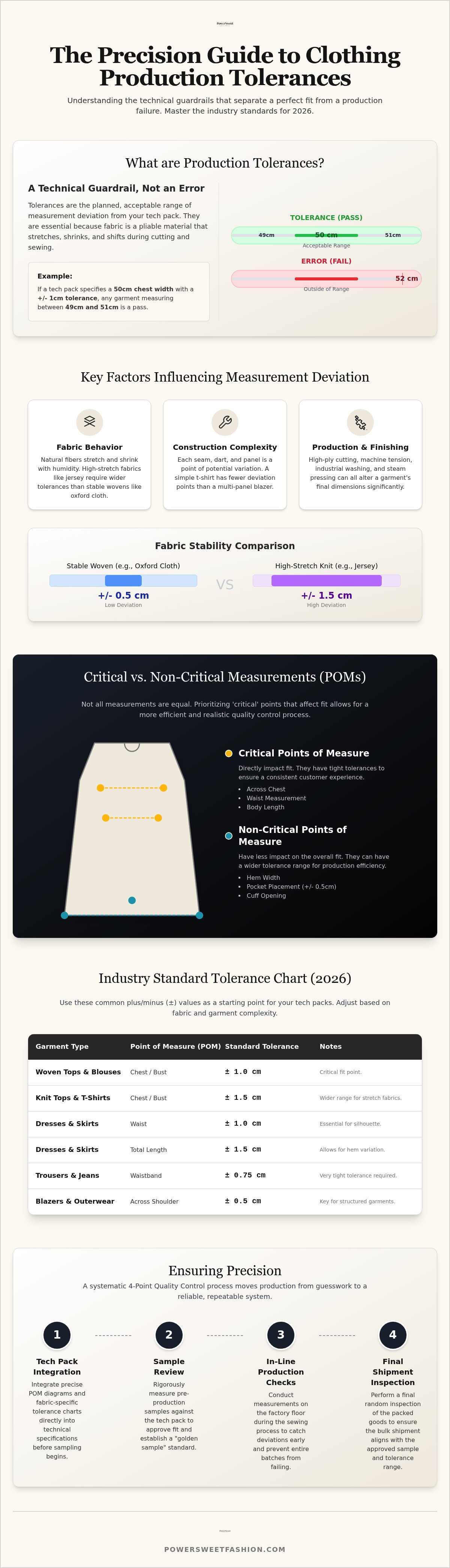
Think of clothing production tolerances as the technical boundary between a perfect garment and a rejected one. In the manufacturing world, a tolerance is the acceptable range of measurement deviation from the specifications listed in your tech pack. If your tech pack calls for a 50cm chest width, a +/- 1cm tolerance means any garment measuring between 49cm and 51cm is considered a pass. This range is essential because fabric is a pliable, organic medium. Unlike metal or plastic components, which can be machined to microscopic levels of accuracy by specialists like fongspl.com.sg, textiles stretch, shrink, and shift during every stage of the production journey.
Precision in sizing directly impacts your brand's reputation and long-term customer satisfaction. When a customer buys a size medium, they expect a consistent experience. If one batch is tight and the next is loose, your return rates will climb, and brand loyalty will suffer. We use these standards during our Quality Control Services to ensure that every piece leaving the factory floor aligns with the brand's vision. By establishing clear rules, you eliminate the ambiguity that often leads to friction between brands and manufacturers.
Not every measurement carries the same weight. We categorize these into 'critical' and 'non-critical' points of measurement (POM). A critical POM, such as the across-chest or waist measurement, has a direct impact on whether the garment fits the body. A non-critical POM, like the width of a pocket flap or the length of a side slit, might have a wider tolerance because a slight deviation won't ruin the customer's experience. Identifying these early in the Sample Development phase allows for a more efficient production flow.
The Difference Between Tolerance and Error
It is vital to understand that a tolerance is a planned technical range, while an error is a manufacturing failure. A Point of Measurement (POM) is the specific location on a garment where a measurement is taken to verify construction accuracy. When a garment falls within the tolerance range, it is a success of the system. When it falls outside that range, it's an error that requires correction. Setting these ranges protects both the brand and the factory by providing a grounded, empirical standard for what constitutes a quality product.
Why 100% Precision is Physically Impossible in Apparel
Garment manufacturing remains a deeply human process. Every piece is cut and sewn by hand, which introduces natural variation. Environmental factors like heat, humidity, and machine tension also play a role. A fabric might measure differently on a humid morning in the cutting room than it does in a dry warehouse. Additionally, measurements change based on whether the garment is 'relaxed' on a flat surface or 'stretched' during the check. These physical realities mean that absolute, zero-deviation precision is a myth in the apparel industry.
Technical Factors Influencing Measurement Deviations
Fabric choice is the foundation of measurement stability. While synthetic fibers like polyester offer high dimensional stability, natural fibers are prone to environmental shifts. The way a material reacts to tension during the cutting and sewing process determines the realistic clothing production tolerances you can expect. In the cutting room, variables like ply height play a critical role. If a factory stacks too many layers of fabric, the vertical "lean" of the stack can cause the bottom pieces to be slightly larger than the top ones. Similarly, high-speed cutting knives generate heat that can cause synthetic edges to fuse or shrink slightly before they even reach the sewing line.
Garment construction complexity also dictates the degree of measurement drift. A simple t-shirt with two side seams has fewer opportunities for deviation than a multi-paneled blazer. Each seam introduces a margin for human variation. Laundry and finishing processes are the final hurdle. Industrial garment washing, steam pressing, and chemical treatments can alter final dimensions by several millimeters. Managing these variables requires a partner who understands the physical reality of the factory floor. If you are looking for a reliable manufacturing partner, PowerSweet Fashion provides the technical oversight needed to navigate these production complexities.
Fabric Behavior: Stretch, Recovery, and Shrinkage
Stretch fabrics present the greatest challenge for measurement consistency. While a stable woven Oxford cloth might maintain a +/- 0.5cm tolerance, high-stretch knits or jerseys often require a wider +/- 1.5cm range. Materials like Lyocell and Crepe are particularly volatile due to their fluid drape and tendency to "grow" or "contract" based on how they are handled. To mitigate this, high quality materials are subjected to rigorous shrinkage testing before the bulk cutting phase begins. This ensures the pattern is adjusted to account for the fabric's specific recovery rate.
The Human Element in High-Speed Production
Precision at the needle is a matter of millimeters. A minor 1mm deviation in a seam allowance might seem negligible, but when multiplied across four or five vertical seams, it results in a 5mm deviation at the final hem. Consistency depends entirely on the skill of the operator and the quality of the technical preparation. Partnering with an expert pattern making garment manufacturer is essential for minimizing this drift. Professional pattern makers build "seam logic" into the digital files, ensuring that operators have clear, repeatable guides that maintain the integrity of the original design throughout the bulk run.
Industry Standard Tolerance Charts for Women’s Apparel
Establishing a baseline for clothing production tolerances is the only way to move from subjective "feel" to objective data. Without a clear chart, your quality control team has no benchmark to hold the factory accountable. We recommend using metric measurements for higher precision. While some brands still use inches, centimeters allow for tighter control over delicate seams. Below is a representative table of industry-standard tolerances for women's wear categories in 2026.
You'll notice that 'Across Chest' almost always has tighter tolerances than 'Sweep' or 'Hem.' This is because the chest is a primary fit point. If a blazer is 2cm too narrow at the chest, it won't close properly, rendering the garment unsellable. Conversely, a 2cm deviation at the hem of a flared maxi dress is often invisible to the consumer. As you scale from XS to XXL, your 'Grade Rules' dictate how these measurements grow. It's vital to maintain the same tolerance across all sizes to ensure that a size 16 customer receives the same level of precision as a size 4 customer.
Category-Specific Tolerance Benchmarks
Dresses require specific attention at the waistline, especially if the design features a seam or a zipper. A deviation here can shift the entire silhouette. For blouses and tops, we focus on neck width and sleeve length. A sleeve that is 1cm too short feels like a mistake, not a variation. Tailored items like blazers require the tightest tolerances in the factory. Because these garments use structured interlinings, there is less "give," meaning the sewing must be exact to prevent pulling or puckering.
Critical vs. Non-Critical Measurement Points
Critical POMs are those that directly affect the fit and function of the garment, such as the chest, waist, hips, and inseam. If these are 'Out-of-Spec,' the batch may need to be rejected or reworked. Non-critical POMs affect the aesthetics but don't necessarily ruin the fit. Examples include pocket placement, hem width, or the length of a decorative tie. When our Quality Control Services team performs an inspection, we prioritize these critical points to ensure the most vital aspects of your production run meet your brand's standards.
How to Set Realistic Tolerances in Your Tech Pack
Setting clothing production tolerances is a methodical process that starts long before the sewing machine turns on. You need a spec sheet that reflects the physical reality of your materials and the capabilities of your factory. A spec sheet without realistic tolerances is just a wish list. Follow these four steps to build a technical foundation that minimizes production risk.
Step 1: Analyze fabric properties. Before finalizing your spec sheet, test your fabric for shrinkage, stretch, and recovery. A material with 5% spandex requires a wider tolerance than a rigid denim.
Step 2: Define POMs with diagrams. Ambiguity leads to errors. Every Point of Measure (POM) in your tech pack must be accompanied by a clear illustration showing exactly where the measurement begins and ends.
Step 3: Assign +/- values. Use industry standards as your baseline, then adjust based on the garment category. Tailored pieces need tighter values, while oversized knits can afford more flexibility.
Step 4: Review sample results. Analyze the data from your first sample development clothing manufacturer. If measurements consistently drift in one direction, adjust your tech pack specs before moving to bulk production.
Visualizing POMs for Better Factory Communication
A 'Measurement Guide' image is an essential component of a professional tech pack. It bridges the language gap by showing, not just telling, the factory how to verify quality. Your diagrams should show the garment laying flat, with arrows indicating the precise start and end points for the tape measure. For 2026 standards, we recommend using digital tech pack tools that allow for high-resolution callouts and real-time updates. This transparency ensures that your internal team and the factory floor are always looking at the same data.
Negotiating Tolerances with Your Production Partner
A professional dialogue about what is achievable for your price point is a sign of a healthy partnership. If a factory promises 'Zero Tolerance,' consider it a red flag. This claim is physically impossible in apparel and usually leads to hidden costs or high rejection rates later. Instead, look for an end to end clothing production partner who can explain why certain tolerances are necessary for your specific design. If you need help establishing these technical guardrails, contact PowerSweet Fashion to learn how our systematic approach protects your brand's fit consistency.
Ensuring Precision: PowerSweet’s Quality Control Process
We don't leave precision to chance. Our local Guangzhou team operates as an authoritative facilitator on the factory floor, bridging the gap between your technical specifications and the physical reality of the sewing line. By maintaining a physical presence in the heart of the world's premier garment manufacturing hub, we provide a level of oversight that remote communication cannot match. Our team monitors every stage of the assembly line to ensure that clothing production tolerances are strictly maintained from the first cut to the final stitch.
To achieve this, we implement a rigorous 4-point inspection system during bulk production. This process begins with fabric inspection to identify tension or shrinkage issues before they reach the cutting table. We then conduct in-line inspections, mid-production checks, and a final pre-shipment audit. During these phases, our QC specialists use standardized measurement protocols to verify that every critical point of measure aligns with your approved tech pack. We invite our clients to visit our facility to see these systematic protocols in action and meet the technicians who protect your brand's standards.
From 10-Day Samples to Bulk Perfection
Success in bulk production is determined during the sampling phase. We use our 10-day sample development cycle as a technical stress test for your designs. If a specific fabric or construction method shows a tendency to drift beyond acceptable clothing production tolerances, we identify it here. This creates a vital feedback loop between our master pattern makers and the sewing teams. By solving these technical challenges early, we ensure that our high production speed never compromises the meticulous care required for complex women's wear. We refine the "seam logic" in your patterns during this stage to guarantee that bulk runs are a mirror image of your approved samples.
Transparency and Partnership in Manufacturing
Integrity in manufacturing requires total transparency, especially when challenges arise. Textiles are organic, and occasionally a batch may fall "Out-of-Spec" due to unforeseen fabric behavior. In these instances, we don't hide the data. We communicate the challenge immediately and work with you to determine the best path forward, whether that involves reworking the batch or adjusting the specifications for future runs. This collaborative approach ensures you are never surprised by the quality of a shipment. We view ourselves as the engine powering your creative vision, providing a safe pair of hands for your most ambitious designs. Ready to start? Contact PowerSweet Fashion for a professional production consultation.
Scaling with Precision and Consistency
Precision in garment manufacturing isn't a happy accident. It's the result of rigorous technical standards and transparent communication. By establishing clear clothing production tolerances, you move your brand away from the uncertainty of measurement drift and toward a model of industrial reliability. Remember that fabric is an organic medium. It requires specific guardrails to account for its natural behavior during the high-speed production cycle. Successful brands don't just hope for a good fit; they build it into their technical specifications from the very first sample.
We provide the technical expertise to turn your creative vision into a perfectly sized reality. With specialized experience in custom women's apparel and factory-direct quality control oversight, we ensure your brand's reputation remains secure. Our 10-day samples allow you to test these standards and adjust your tech packs before moving to bulk production. We are ready to act as the engine for your brand's growth by providing a safe pair of hands for your manufacturing needs. Partner with PowerSweet Fashion for Precision Manufacturing. Let's build a production journey that delivers excellence every time.
Frequently Asked Questions
What is the standard tolerance for women's clothing?
The standard tolerance for women's clothing typically ranges between +/- 1cm and +/- 2cm depending on the garment category and fabric type. Structured items like blazers often require a tighter +/- 0.5cm to +/- 1cm range to maintain the silhouette. High-stretch knits or oversized dresses usually allow for more flexibility. It's essential to define these values for every point of measure in your tech pack before production begins.
How do I measure a garment to check if it's within tolerance?
To measure a garment correctly, lay it flat on a smooth surface in a relaxed state without pulling or stretching the fabric. Use a flexible measuring tape and follow the specific Point of Measure (POM) diagrams provided in your tech pack. Ensure you're measuring from the exact start and end points defined during the sample development phase. Consistency in measurement technique is the only way to get an accurate reading.
Why does my sample measure differently than my tech pack?
Samples often measure differently than tech packs because of the organic nature of textiles and the human element of manual sewing. Fabric can shrink or expand during the steaming and pressing process. Additionally, the way a pattern is cut relative to the grainline can cause slight shifts in dimensions. We use the sample phase to identify these deviations early and adjust the tech pack to ensure bulk production remains consistent.
Does fabric shrinkage affect production tolerances?
Fabric shrinkage significantly impacts clothing production tolerances and must be accounted for before cutting the bulk order. If a fabric has a 3% shrinkage rate, a garment can easily drift out of spec after final industrial pressing. We recommend performing shrinkage tests on every new fabric batch. This data allows pattern makers to adjust the patterns slightly to ensure the finished, pressed garment matches your required specifications.
Can I set different tolerances for different sizes?
You can set different tolerances for different sizes, but most brands maintain a consistent +/- value across the entire size range. While the base measurements grow according to your grade rules, the acceptable margin for error usually stays the same to ensure quality consistency. However, for very large sizes, some manufacturers suggest slightly wider tolerances for non-critical points like the hem width to account for the increased fabric volume and handling.
What should I do if a production run is out of tolerance?
If a production run is out of tolerance, you must first determine if the deviation affects the fit or just the aesthetics. Critical errors in fit points like the chest or waist may require the factory to rework the garments or offer a discount. In extreme cases, the batch may need to be rejected. Clear communication during our quality control services helps identify these issues before the shipment leaves the factory floor.
How do I communicate my tolerance requirements to a new factory?
Communicate your requirements by providing a comprehensive tech pack that includes a dedicated tolerance table and visual POM diagrams. Don't assume a new factory knows your specific brand standards. Explicitly state your pass or fail criteria in your manufacturing agreement. Establishing these clothing production tolerances in writing early on prevents disputes and ensures the production team understands exactly what level of precision your brand expects for every order.
Is +/- 1cm a universal industry standard?
A +/- 1cm range is a common industry benchmark, but it is certainly not a universal law. Every brand has different quality expectations based on their price point and target market. Luxury brands often demand much tighter tolerances of +/- 0.5cm, while fast-fashion brands might accept +/- 2cm for basic items. You should set your standards based on your fabric's stability and the fit requirements of your specific customer base.

Comments