%20(1).png)
Clothing Production for Startups: 2026 Fashion Brand Guide

Updated: Sep 11
Most emerging fashion brands fail not because their designs lack soul, but because their supply chains lack speed. In a market where over 100 billion garments are produced annually, mastering clothing production for startups is the only way to scale without drowning in unsold inventory. You've likely felt the pressure of high minimum order quantities that drain your capital before you've even validated a concept. It's exhausting to navigate communication gaps with factories while seasonal trends slip through your fingers.
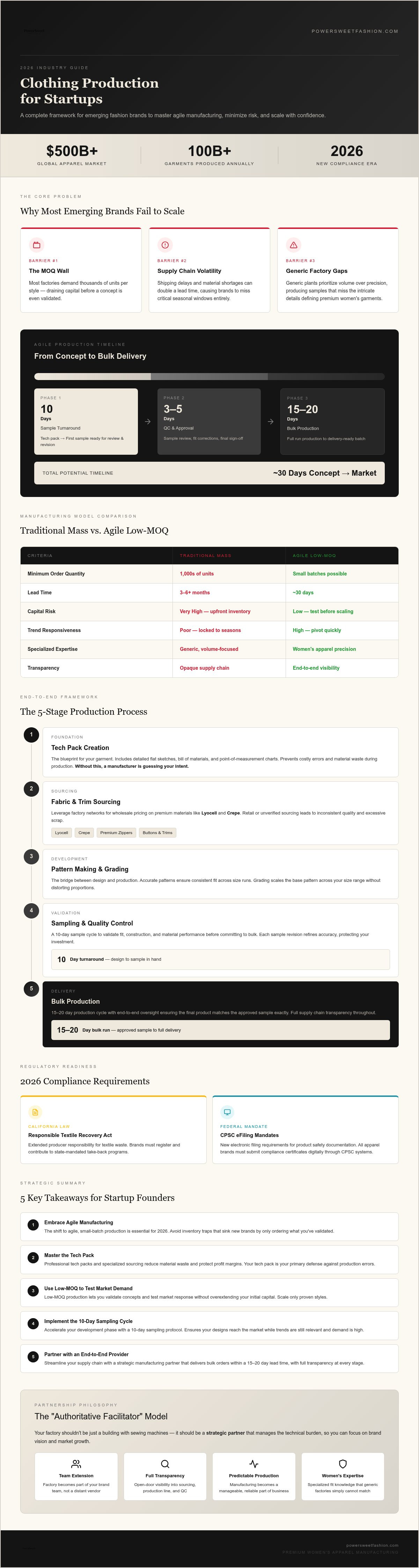
We understand that finding a reliable manufacturing partner is about balancing technical precision with operational pace. This guide provides a professional framework to master the complexities of garment manufacturing in 2026. You'll learn how to leverage 10-day sample turnarounds and 15-20 day bulk production cycles to stay responsive to market demands. We'll also walk through essential 2026 compliance requirements, from the California Responsible Textile Recovery Act to new CPSC eFiling mandates, ensuring your brand remains both agile and protected.
Table of Contents
The Landscape of Clothing Production for Startups in 2026
The global apparel manufacturing industry is valued at over $500 billion, but for a new brand, that scale often feels like a barrier rather than an opportunity. Historically, the industry favored massive volumes that prioritized cost over agility. However, The Landscape of the Clothing Industry has shifted significantly toward agile, small-batch manufacturing. This isn't just a trend; it's a survival mechanism for emerging labels. Traditional mass production models require massive upfront investment in inventory that often ends up in a warehouse. For founders, clothing production for startups in 2026 relies on logistical agility. You shouldn't have to choose between a huge order and no order at all.
The "all-or-nothing" approach is a legacy of the 20th century. It drains capital and ignores the reality of rapid trend cycles. Modern manufacturing thrives on the "Authoritative Facilitator" model. This means your factory isn't just a building with sewing machines; it's a strategic partner that manages the technical burden so you can focus on brand vision. Specialized women's apparel factories provide a "Safe Pair of Hands" by understanding the specific fit requirements and fabric behaviors that generic plants often overlook. By focusing on women's clothing, these facilities reduce market risk through specialized expertise and precision.
Current Challenges in Startup Garment Manufacturing
The "MOQ Barrier" is the most common reason brands never launch. Most factories demand thousands of units per style, which isn't sustainable for a brand testing its first collection. Beyond order size, supply chain volatility remains a persistent reality. Shipping delays and material shortages can turn a three-month lead time into six, causing brands to miss seasonal windows entirely. Finally, generic factories often lack the nuance required for fashion-forward designs. They prioritize volume over the intricate details that define a premium women's garment, leading to samples that don't match the original vision.
The Benefits of a Partnership-First Approach
Success comes from moving beyond transactional vendors. A strategic partner offers end-to-end support, from initial pattern making to final quality control. This collaborative approach turns the factory into an extension of your own team. Transparency is the foundation of this trust. Knowing exactly where your fabric is sourced and having visibility into the production line reduces the anxiety of offshore manufacturing. When you have end-to-end oversight, you ensure that the final product matches the sample perfectly. This "open-door" philosophy allows clothing production for startups to become a predictable, manageable part of the business journey.
From Tech Packs to Sourcing: The Technical Foundations
A tech pack is the essential communication tool between a designer and a factory. Think of it as the blueprint for your fashion brand. Without a detailed technical specification, a manufacturer is essentially guessing your intent. Precision here prevents costly errors during bulk production. A professional tech pack includes detailed flat sketches, a bill of materials, and point-of-measurement charts. For those engaged in clothing production for startups, this document is the primary defense against material waste and production delays. It ensures that the garment in your mind is exactly what comes off the sewing line.
Sourcing is where many founders lose their initial capital. Buying fabric at retail or from unverified wholesalers leads to inconsistent quality and excessive scrap. For brands starting with simpler designs, sourcing premium wholesale apparel from Blankstyle or exploring designer stock lots via StockFashionB2B can be an effective way to maintain quality while managing costs. Specialized sourcing fees actually save money by leveraging existing factory networks to secure wholesale pricing on premium materials. Managing this process through a production partner ensures that the fabric you choose is technically compatible with your garment's design and intended fit. It's about more than just color; it's about the technical performance of the fiber during the construction process.
Mastering the Fabric and Trim Sourcing Process
Selecting the right textiles is a technical decision, not just an aesthetic one. High-quality women's apparel often requires specialized fabrics like Lyocell or Crepe, which have unique drape and shrinkage properties. Accessing these materials through established factory networks provides a significant advantage. You can also consult Fashion Incubator Resources to understand how different fibers impact the sustainability and durability of your line. Don't overlook the hardware. Premium zippers, buttons, and trims must align with your brand's positioning to avoid a generic final feel. Outsourcing this management to experts ensures every component is fit for purpose.
The Pattern Making and Grading Phase
Pattern making is the bridge that translates 2D sketches into 3D garment structures. It's a highly technical skill that determines how a garment sits on the human body. In women's fashion, consistent sizing is non-negotiable for customer loyalty. This is where "Size Grading" becomes critical. Grading ensures that a size small and a size extra-large maintain the same silhouette and design proportions. This phase is the foundation of Mastering sample development, as it allows you to refine the fit before committing to bulk manufacturing. If you're ready to see your designs take shape, our team can help you start your production journey with professional pattern services.
The Strategic Advantage of Low MOQ Manufacturing
Low MOQ isn't just a starting point; it's a strategic layer in clothing production for startups. For emerging brands in 2026, a low minimum typically ranges from 50 to 150 units per style. This volume is small enough to protect your cash flow but large enough to provide a statistically significant test of market demand. While the per-unit cost for these smaller batches is often 50 to 100 percent higher than for mass orders, the total capital at risk is drastically lower. You avoid the inventory trap where thousands of units of a single style sit in a warehouse, tying up your working capital.
This agility allows for a "drop-based" collection strategy. Instead of betting your entire annual budget on two massive seasonal launches, you can release smaller, more frequent collections. This approach keeps your brand narrative fresh and allows you to pivot your design direction based on real-time sales data. If a particular silhouette fails to resonate, you've only produced 50 units rather than 500. By choosing low minimums, you're investing in market intelligence rather than just fabric and thread.
Scaling Small Batch Production into Bulk
Successful brands use small runs as a proving ground. Once a design shows high sell-through rates, you can transition into high-volume manufacturing to capture economies of scale. Moving from 50 units to 300 or more typically cuts your per-unit production fees significantly. Our framework for Scaling small with low MOQ women’s clothing manufacturers ensures that this transition is seamless. We maintain the same quality standards and technical specifications as you scale, ensuring your brand's reputation remains consistent through every growth phase.
The Economics of the Startup Production Cycle
The "True Cost" of a garment includes sourcing, sample development, and bulk manufacturing. Startups must budget for sample development fees as a fixed, non-negotiable cost of doing business. In the fast-moving fashion world of 2026, speed is a hidden currency. A 15-20 day bulk production lead time allows you to restock winning styles before the trend fades. This responsiveness is often more valuable than a lower per-unit price from a slower, high-volume factory. Reliable clothing production for startups prioritizes this speed to maximize your return on investment and maintain market momentum.
Navigating the Sampling and Quality Control Phase
Sampling is where the technical foundations of your brand meet physical reality. For those managing clothing production for startups, this phase represents the "proof of concept" required to justify bulk investment. Speed in prototyping is non-negotiable because fashion trends in 2026 move faster than traditional supply chains can handle. A 10-day sample turnaround allows you to validate fit and fabric before the market shifts. The sample approval process is the final gate before bulk capital commitment.
Effective feedback on prototypes requires technical specificity. Instead of saying a garment "feels off," provide measurements and photos of how the fabric drapes on a fit model. Rapid revision is only possible when communication is direct and rooted in the original tech pack. We implement a multi-stage quality control system that begins at the cutting table and ends at the shipping dock. This ensures that the technical specifications established in the sampling phase are maintained throughout the entire bulk run.
The 10-Day Prototyping Workflow
During a 10-day sampling window, the factory moves through a compressed lifecycle. The first three days focus on pattern translation and material preparation. Assembly occurs in the middle of the week, followed by rigorous internal finishing and quality checks. To keep this pace, your design team must be prepared for immediate iterations. You should ensure the fabric and trims used in the sample are identical to your bulk production expectations to avoid surprises during the final run. This "Safe Pair of Hands" approach ensures that what you approve is exactly what you'll receive in bulk.
Establishing Quality Standards for Bulk Production
Establishing Acceptable Quality Limits (AQL) is essential for maintaining brand reputation. AQL is a statistical standard that defines the maximum number of defects allowed in a batch before it's rejected. While digital oversight is powerful, the "Open-Door Transparency" of a factory allows for in-person visits that build deep trust. End-to-end production models minimize defects because the same team handles the garment from fabric sourcing to the final stitch. This continuity reduces the risk of communication gaps that often plague fragmented supply chains. If you're ready to move from sketch to sample, request your 10-day sample development today to see our precision in action.
Partnering for Growth: End-to-End Production Solutions
Startups often struggle with fragmented supply chains that drain time and resources. Managing separate vendors for sourcing, pattern making, and assembly creates communication gaps that lead to production errors. An integrated solution for clothing production for startups eliminates these risks by consolidating every stage under one roof. When a single partner manages the journey from initial fabric sourcing to final quality control, the result is a more cohesive product. This model provides the "Open-Door Transparency" needed to build a scalable brand in 2026.
Logistical speed is a primary differentiator in a crowded market. A 15-20 day bulk production lead time allows brands to react to viral trends or sudden stockouts without missing a beat. This responsiveness is critical for global influencer labels and boutique owners who need to maintain momentum without holding excessive inventory. By shortening the gap between design and delivery, we help brands capture market share that slower competitors miss. For a deeper look at this process, consult our End to end clothing production guide.
Reliability and Efficiency in Custom Women’s Apparel
We specialize in the technical construction of women’s dresses, tops, and sets. These categories require specific expertise in fit and drape that generic factories often lack. By leveraging industrial scale while maintaining startup-friendly accessibility, we offer a "Safe Pair of Hands" for executing complex fashion designs. Our facility is designed to handle the intricate details of custom women's garments, ensuring that every stitch aligns with your premium positioning. We treat your creative vision with the technical precision required for commercial success.
How to Start Your Production Journey
Moving from a design sketch to a finished production plan requires a methodical approach. It begins with an initial consultation where we evaluate your tech packs and material requirements. We help you set realistic timelines for your first collection launch, accounting for the 10-day sampling window and the subsequent bulk run. Taking this first step toward a scalable fashion supply chain is about more than just finding a factory. It's about securing a partner who understands the mechanics of growth. Whether you are an established boutique or a rising influencer, the transition to professional manufacturing is the foundation of your future success.
Scaling Your Vision with Technical Precision
Building a successful label in 2026 requires more than creative talent; it demands a supply chain that prioritizes agility over excess inventory. By mastering tech pack development and leveraging low-MOQ strategies, you protect your capital while testing market demand in real time. Reliable clothing production for startups is no longer about finding the cheapest factory, but about securing a strategic partner that can execute complex women's apparel with speed and transparency.
PowerSweet Fashion provides the infrastructure you need to transition from a single sketch to a global brand. With our specialized women’s fashion expertise, we offer 10-day sample readiness and 15-20 day bulk production to ensure you never miss a seasonal trend. We act as a safe pair of hands, managing the technical burden so you can focus on your brand's growth. If you are ready to build a responsive, sustainable supply chain, it's time to start your production journey with PowerSweet Fashion today. Your creative vision deserves a manufacturing partner as ambitious as you are.
Frequently Asked Questions
How much does clothing production for startups typically cost?
Costs depend on design complexity, fabric choice, and order volume. While startups should expect a small-batch premium for orders between 50 and 150 units, this investment protects against the risk of massive unsold inventory. You should budget for fixed sample development fees as a non-negotiable startup cost. Total production fees vary based on the intricacy of your construction requirements and the quality of materials selected during the sourcing phase.
What is the standard MOQ for a new clothing brand?
A standard low minimum order quantity (MOQ) for an emerging label typically falls between 50 and 150 units per style. This range allows founders to test market demand without overextending their initial capital. While mass production factories often require thousands of units, specialized facilities focus on clothing production for startups to facilitate faster growth. Choosing lower minimums helps you maintain a lean inventory and reduces the financial risk of unsold stock.
How long does it take to get a sample from a clothing manufacturer?
Sample timelines vary based on the factory's internal efficiency and material availability. While traditional manufacturers might take several weeks, we prioritize a 10-day sample turnaround for custom women's apparel. This rapid prototyping includes pattern making and initial construction to validate your design. Getting a physical prototype quickly is essential for staying ahead of seasonal trends and making necessary technical adjustments before the bulk production phase begins. Speed here is a critical competitive advantage.
What should be included in a fashion tech pack for a factory?
A professional tech pack acts as the blueprint for your garment. It must include detailed flat sketches, a bill of materials, and point-of-measurement charts for all sizes. You should also specify fabric types, trim details, and placement for labels or hardware. A comprehensive tech pack reduces communication gaps and ensures that the factory executes your vision accurately. This document is the primary tool for maintaining quality control throughout the manufacturing journey.
Can a clothing manufacturer help with fabric sourcing?
Yes, an end-to-end manufacturer provides specialized fabric and trim sourcing services. This involves leveraging established supplier networks to find high-quality textiles like Lyocell or Crepe at wholesale prices. By outsourcing material management to your production partner, you ensure that the chosen fabrics are technically compatible with your garment’s design. This process also includes procuring essential hardware like premium zippers and custom buttons to align with your brand's positioning and quality standards.
What is the difference between sample development and bulk production?
Sample development is the prototyping phase where you create a single garment to test fit and construction. This stage involves fixed fees for pattern making and material sourcing. Bulk production is the subsequent mass manufacturing of your approved design in multiple sizes and colors. While samples take 10 days to perfect, bulk runs typically require 15 to 20 days. Moving to bulk only happens after you've finalized the technical details during the sampling gate.
Is it better to use a local or overseas clothing manufacturer for a startup?
Local manufacturers often offer faster shipping, but overseas partners typically provide better scalability and end-to-end technical expertise. For clothing production for startups, an overseas partner with specialized women's fashion experience can offer lower per-unit costs and more comprehensive sourcing options. The key is finding a partner that prioritizes transparency and communication. Modern logistics and digital tools have closed the distance, making international partnerships a reliable and efficient choice for brands targeting global growth.


Comments