%20(1).png)
Clothing Manufacturing Cost Breakdown: 2026 Guide
- Powersweet Team

- Aug 16
- 12 min read
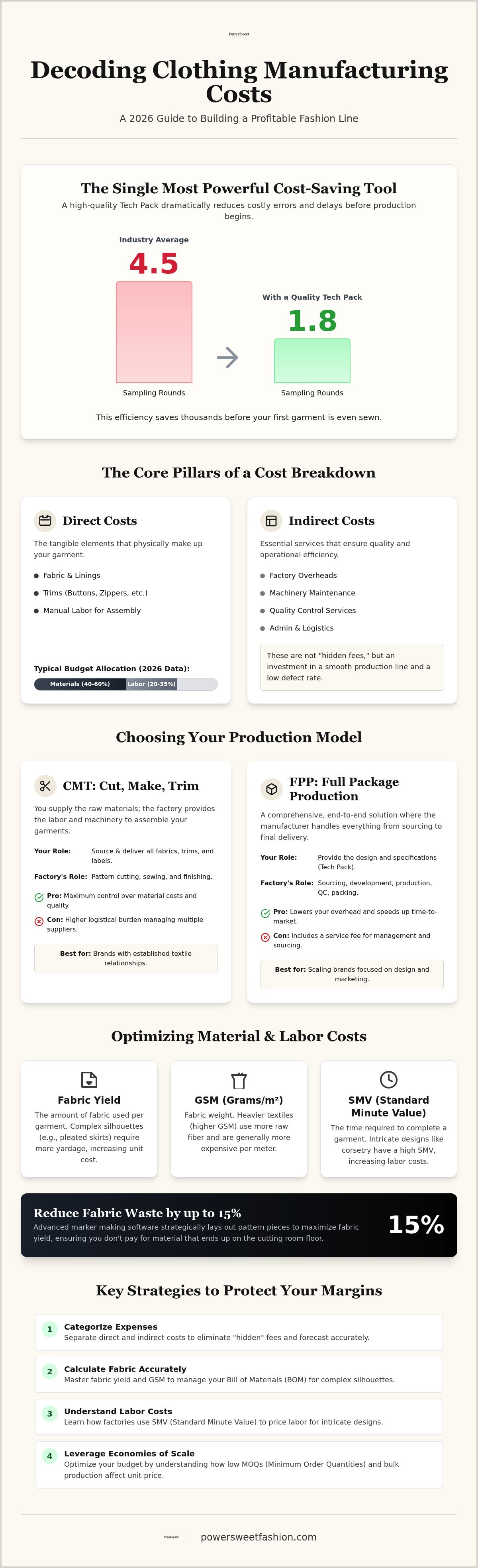
Did you know that a high-quality Tech Pack can reduce your sampling rounds from an average of 4.5 to just 1.8 in 2026? This single efficiency can save you thousands before your first garment even hits the sewing floor. Launching a women's fashion line often feels like a gamble because of hidden factory fees and the anxiety of miscalculating retail margins. It's frustrating to watch your profits disappear into a black hole of production errors. You deserve a transparent partner to help you regain control.
We've developed this 2026 guide and a comprehensive clothing manufacturing cost breakdown that transforms your budget from a guess into a precise roadmap. You'll master the economics of apparel production and learn how to manage everything from fabric sourcing to final quality control. We'll explain the critical differences between CMT and Full Package production costs while providing strategies to lower your unit price without sacrificing the quality of your collection. You'll also receive our professional budget template to ensure your margins remain protected as you scale and standardise your operations.
Table of Contents
The Core Pillars of a Clothing Manufacturing Cost Breakdown
A professional quote is more than a final price; it's a strategic document that outlines the health of your production cycle. Understanding your clothing manufacturing cost breakdown is the first step toward building a sustainable women’s fashion brand. When you see a per-unit cost, you're looking at the culmination of the entire Textile Manufacturing Process, from raw fibre selection to the final stitch. Transparency at this stage eliminates the "hidden fee" anxiety that often plagues designers during the transition from sampling to bulk production.
Direct vs. Indirect Expenses
Direct costs are the tangible elements that physically make up your garment. These typically include the main fabric, linings, trims, and the manual labour required for assembly. Based on 2026 industry data, raw materials often consume 40% to 60% of the total budget. Labour costs in domestic settings can account for 20% to 35% of the unit price. These figures fluctuate based on the complexity of your patterns and the specific textile weight used in your collection.
Indirect costs are less visible but essential for maintaining high standards. These include factory overheads, machinery maintenance, and quality control services. A professional manufacturer factors in administrative expenses and logistics to ensure the facility operates at peak efficiency. These fees aren't "extra" charges; they're the investment required to keep your production line running smoothly and your defect rate low. When these are clearly itemised, you can budget with confidence rather than fear.
CMT vs. Full Package Production
Choosing the right pricing model depends on your internal resources and scaling goals. Cut-Make-Trim (CMT) is a focused service where the factory provides the labour and machinery while you supply the fabric and trims. This offers maximum control over your material sourcing but increases your logistical burden. You're responsible for managing multiple suppliers and ensuring raw materials arrive at the factory on time. This model works well for brands with established textile relationships who want to manage every penny of their material spend.
Full Package Production (FPP) is a comprehensive solution where the manufacturer handles the entire journey, from fabric sourcing to final packing. While this involves a "convenience fee," it significantly lowers your development overhead and time-to-market. For scaling women's fashion brands, FPP is often the most efficient route. It allows you to focus on marketing while we manage the complexities of the global supply chain. This end-to-end approach ensures your Bill of Materials (BOM) is optimised through the factory's existing supplier network, often resulting in better raw material pricing than a startup could negotiate alone.
Raw Materials: Sourcing Fabrics and Trims for Women’s Wear
Fabric selection is the most significant variable in your clothing manufacturing cost breakdown. In August 2026, cotton prices rose to 84.80 USd/Lbs, while polyester FDY in Northeast Asia remains around $1.28/KG. These fluctuations directly impact your Bill of Materials (BOM). For complex women's silhouettes, calculating the fabric "yield" is critical. A floor-length pleated skirt requires significantly more yardage than a minimalist shift dress. Fabric weight, measured in GSM (Grams per Square Metre), also dictates price. Heavier textiles require more raw fibre, which increases the base cost per unit. Composition matters too; a silk-blend will always command a premium over a 100% synthetic alternative.
Effective sourcing is about more than just finding a pretty textile. The Economic Impact of the Fashion Industry shows how supply chain efficiency drives global output, and on a brand level, it protects your bottom line. Transitioning to end-to-end clothing production allows for better marker making. This precision reduces fabric waste by up to 15% compared to fragmented sourcing methods. We use advanced layout software to ensure you aren't paying for fabric that ends up on the cutting room floor.
The Bill of Materials (BOM) Essentials
A professional BOM lists every physical component, from the primary textile to the specific thread weight. You must specify exact Pantone colours and technical specifications for every item. This precision prevents costly re-dyeing rounds that can delay your launch by weeks. Choosing stock fabrics often lowers your initial investment and lead times. However, custom-developed textiles offer the exclusivity required for the luxury tier. If you're looking for expert guidance, our team can help you source high-performance materials that align with your specific budget goals.
Trims, Hardware, and Branding
Trims are often the "hidden" cost in women's wear. A standard YKK #5 aluminum zipper costs approximately $1.99 in 2026. If you move to gold-plated sliders or custom-branded pullers, that figure can triple quickly. High-quality lace, intricate buttons, or specialised hardware also add significant labour time to the assembly process. You should also budget for custom labels, hangtags, and sustainable packaging from the start. Bulk-buying these branding elements for multiple collections is a proven strategy to lower your per-unit price and maintain a consistent brand identity.
Labour and Construction: The Complexity of Women’s Fashion
Factories don't guess labour costs; they use a metric called Standard Minute Value (SMV). This represents the time required for a qualified worker to complete a specific task under standard conditions. In your clothing manufacturing cost breakdown, SMV is the engine driving the labour line item. While a basic jersey tee might have a low SMV, a structured blazer or a pleated skirt could require four times the assembly time. Understanding Fashion Industry Costing is essential here because intricate details like corsetry or hand-finished lace require specialised skill sets and significantly more time on the machine.
The choice of machinery also dictates the price. Using a standard lockstitch is more cost-effective than requiring a flatlock machine for activewear or an embroidery station for custom motifs. However, the most effective way to control these costs is through professional pattern making. A precise pattern ensures the fabric pieces fit together perfectly. This reduces sewing errors and cuts down the total labour time required for each unit during bulk production.
Technical Construction and Stitching
Seam finishes are a major cost driver in high-end women's wear. A standard overlocked edge is efficient, but luxury garments often demand French seams or bias-bound edges to ensure a clean interior. These finishes require multiple passes through the machine, effectively doubling the labour cost for those specific seams. Handling delicate fabrics like silk or chiffon also carries a premium. These materials are prone to slipping and snagging, requiring slower machine speeds and more experienced technicians. By "designing for production", such as standardising seam types across a collection, you can lower labour costs without compromising the aesthetic appeal of your designs.
Quality Control and Assurance Fees
Reliable manufacturing requires a multi-stage approach to quality. We recommend budgeting for both in-line inspections and a final Acceptable Quality Level (AQL) test. In-line checks catch errors while the garment is still on the sewing floor. This is far more cost-effective than discovering a batch-wide defect after the items are packed. Reworking a finished garment is a financial drain that can erode your entire profit margin. Rigorous QC isn't just an added expense. It's a protective measure for your brand’s reputation and retail margins. Investing in these oversight steps ensures that the final product matches your approved sample every time.
Sampling and Development: The Road to Production Readiness
Sampling is the primary tool for risk mitigation in your production cycle. In a professional clothing manufacturing cost breakdown, development is a fixed investment that prevents variable losses during bulk assembly. Industry data from 2026 shows that a high-quality Tech Pack can reduce sampling rounds from an average of 4.5 to just 1.8. This efficiency saves thousands in material and labour costs. Our 10-day sampling service provides the agility needed to test designs without a massive time-to-market overhead. Speed isn't just about being first; it's about reducing the financial burn of the development phase.
The Cost of Prototyping
You must allocate a specific budget for the initial prototype, fit samples, and salesman samples (SMS). These units are the physical proof of your technical specifications. While individual sample fees are higher than bulk unit prices, they serve as a blueprint for the factory floor. We often credit these development fees back to our clients during bulk production runs. This structure ensures that your initial capital is working toward your final inventory rather than disappearing into one-off prototypes. Rapid sampling also allows your brand to remain seasonally agile, which is a competitive necessity in the modern fashion landscape.
Grading and Tech Pack Development
Preparing a design for a full size range requires pattern grading. This is a technical expense that increases with the complexity of the garment’s silhouette. For women’s fashion, standardising size charts is a financial necessity to avoid the high cost of fit-related returns. An incomplete Tech Pack is the most common cause of budget overruns in the garment industry. If your documentation lacks detail on seam allowances or exact trim placement, the factory must make assumptions. These assumptions lead to errors that are expensive to fix during the bulk run. By investing in a professional Tech Pack, you ensure the first sample is the only sample you need before scaling.
Precision in the sampling phase is the only way to protect your margins. Partner with us for expert sample development and ensure your production is ready for the global market.
Strategies for Optimising Your Manufacturing Budget
Efficiency in production isn't about cutting corners on quality; it's about mastering the variables within your clothing manufacturing cost breakdown. One of the most effective ways to lower your per-unit price is by leveraging economies of scale. As your order volume increases, fixed costs like pattern development and machine setup are spread across more units. However, for many emerging brands, the challenge is balancing this lower unit cost against the risk of unsold inventory. A strategic approach to volume allows you to grow without overextending your initial capital.
Using a professional cost breakdown template is essential for negotiating transparent factory quotes. It allows you to see exactly where your money is going, from the Bill of Materials to the final quality check. By standardising your data, you can identify which design elements are driving up costs and make informed decisions about where to invest. This level of transparency builds a stronger partnership between the designer and the factory, ensuring both parties are aligned on the financial roadmap of the collection.
Navigating Minimum Order Quantities (MOQ)
Minimum Order Quantities often represent the biggest hurdle for new fashion brands. While high MOQs offer the lowest per-unit price, they also carry a higher capital risk. Partnering with a low MOQ women’s clothing manufacturer provides a distinct advantage for inventory management. It allows you to test the market with smaller batches and "mixed-size" runs before committing to a massive production cycle. This flexibility helps you avoid the "dead stock" trap that kills many startups. Over time, consistent and repeatable production runs with the same factory will naturally lead to long-term savings as the team becomes familiar with your brand’s specific technical requirements.
Logistics, Duties, and Hidden Fees
Your budget must account for the journey from the factory floor to your warehouse. Choosing between Air and Sea freight depends on your timeline and volume. While Air is faster, it can be significantly more expensive for heavy shipments. In 2026, international garment transport remains subject to fluctuating fuel surcharges, so we recommend budgeting a 5% buffer for logistics. Understanding Incoterms is also vital. Terms like FOB (Free on Board) or DDP (Delivered Duty Paid) dictate who is responsible for shipping costs and customs duties.
New regulations like the CPSC mandatory eFiling, effective July 8, 2026, require product safety information to be electronically available at the time of entry. Failing to account for these administrative steps can lead to costly delays at customs. To ensure you've covered every detail, Download our Free Cost Breakdown Template and get a quote for your collection. This tool will help you standardise your budgeting process and provide the grounded, empirical reliability needed to scale your women's fashion brand with confidence.
Mastering Your Production Economics for 2026
Success in the competitive women's fashion sector depends on moving from guesswork to grounded, empirical data. You now have the tools to evaluate every line item in your clothing manufacturing cost breakdown, from fabric yield calculations to complex labour fees. By focusing on technical precision in your Tech Packs and leveraging professional pattern making, you eliminate the hidden costs that often stall emerging brands. Precision at the development stage ensures your retail margins remain protected as you transition into bulk production.
We are ready to act as your pragmatic industrial partner throughout this journey. PowerSweet Fashion provides the reliability of end-to-end women’s fashion production combined with the agility of a 10-day sample turnaround. As low MOQ specialists, we ensure you can test new silhouettes and scale your brand with minimal financial risk. Our streamlined systems are designed to turn your creative vision into a physical reality with speed and transparency.
Get Your Professional Manufacturing Cost Breakdown Template to start building a collection that is as commercially viable as it is creative. We look forward to powering your next production run with industrial precision and a commitment to your brand's growth.
Frequently Asked Questions
How much does it typically cost to manufacture a custom dress?
Total costs depend on your design complexity, chosen fabric, and total order volume. A minimalist shift dress requires significantly less labour and material than a tiered evening gown with intricate pleating. Your budget must account for the fabric yield, the number of pattern pieces, and specialised trims like YKK zippers. While we don't provide fixed pricing without a technical review, most designers budget for raw materials, assembly labour, and factory overheads.
What is the difference between CMT and Full Package production costs?
CMT covers labour and machinery only, while Full Package includes end-to-end material sourcing and development. CMT (Cut-Make-Trim) requires you to supply all fabrics and trims, which increases your internal logistical burden. Full Package (FPP) is a comprehensive service where the factory manages the entire supply chain. While FPP includes a management fee, it often results in a more predictable clothing manufacturing cost breakdown by consolidating all sourcing under one roof.
Why are sample garments so much more expensive than bulk production?
Samples require individual attention from highly skilled technicians rather than an assembly line. Creating a single prototype involves manual pattern making, precise fabric cutting, and machine setup that isn't shared across hundreds of units. This development phase is a necessary fixed investment. In 2026, efficient sampling is about speed and accuracy; we offer 10-day sample development to help you reach the market faster and reduce seasonal overheads.
How do MOQs affect my final price per unit?
Minimum Order Quantities (MOQs) dictate how fixed setup costs, like machine calibration and fabric dyeing, are distributed. When you order a higher volume, these expenses are spread across more units, which lowers the per-piece price. However, low MOQ specialists allow you to balance this unit cost against the risk of excess stock. This flexibility provides a safer way to test new women's fashion designs without a massive initial capital outlay.
Should I pay for a professional Tech Pack before contacting a factory?
Yes, a professional Tech Pack is the most effective way to receive an accurate and transparent quote. Without detailed technical specifications, factories have to guess your requirements, which often leads to "hidden fee" anxiety. A complete pack includes your Bill of Materials, size grading, and specific stitch details. Providing this documentation upfront ensures your clothing manufacturing cost breakdown is precise from the start, reducing the likelihood of expensive production errors.
What hidden costs should I look for in a manufacturing quote?
Look beyond the unit price for expenses like quality control fees, specialised packaging, and international logistics. Some quotes omit the cost of custom labels, hangtags, or final AQL testing. You should also verify if the price is EXW (Ex Works) or FOB (Free on Board), as this determines who pays for transport to the port. Always ask for an itemised list of indirect costs to ensure full transparency before signing a contract.
How can I reduce my manufacturing costs without lowering quality?
Optimise your designs for production and standardise your raw materials across different styles. Using the same fabric or hardware for multiple garments in a collection allows you to buy materials in bulk. You can also reduce labour costs by simplifying construction methods, such as choosing standard overlocked seams instead of French seams where appropriate. Designing with production efficiency in mind ensures high quality while minimising the time required for assembly on the floor.
Do manufacturers include shipping and duties in their initial price quotes?
Initial quotes typically cover production costs only, unless you specifically request a DDP (Delivered Duty Paid) price. Most manufacturers provide EXW or FOB pricing, meaning the brand is responsible for freight, insurance, and customs duties. With new 2026 regulations like the CPSC mandatory eFiling, administrative costs for imports have become more complex. We recommend working with a partner who offers end-to-end support to help you navigate these logistical expenses successfully.


Comments