%20(1).png)
Choosing a Low MOQ Clothing Manufacturer for Startups in 2026
- Powersweet Team

- Aug 11
- 12 min read
In 2026, the biggest threat to your fashion startup isn't a lack of creativity. It's the 500-unit minimum order requirement that ties up your capital in unsold inventory. You've likely felt the frustration of finding a factory that loves your designs but demands a volume you aren't ready to sell. It's a common hurdle that keeps many talented designers from ever reaching the market. We understand that you need to test seasonal trends without the crushing weight of overstock.
This guide shows you exactly how to identify and partner with a low moq clothing manufacturer for startups that acts as a true production engine for your brand. You'll discover how to secure end-to-end support, from 10-day sampling to managing the new 2026 CPSC eFiling safety requirements. We'll walk through the mechanics of fabric sourcing, tech packs, and achieving a 15 to 20 day bulk production cycle. By the end of this article, you'll have a clear roadmap to launch your high-quality women's clothing line with minimal risk and maximum speed.
Table of Contents
The Startup Manufacturing Hurdle: Why Low MOQ is Essential in 2026
Launching a fashion brand once required massive upfront capital to meet the strict demands of large-scale factories. In 2026, that model is a liability for new entrants. Traditional manufacturing relies on high-volume runs to achieve economies of scale, but this often leaves startups with thousands of unsold units. A low moq clothing manufacturer for startups provides a necessary alternative by lowering the technical and financial barrier to entry. This flexibility allows you to produce only what you need, ensuring your cash flow remains liquid for other growth areas.
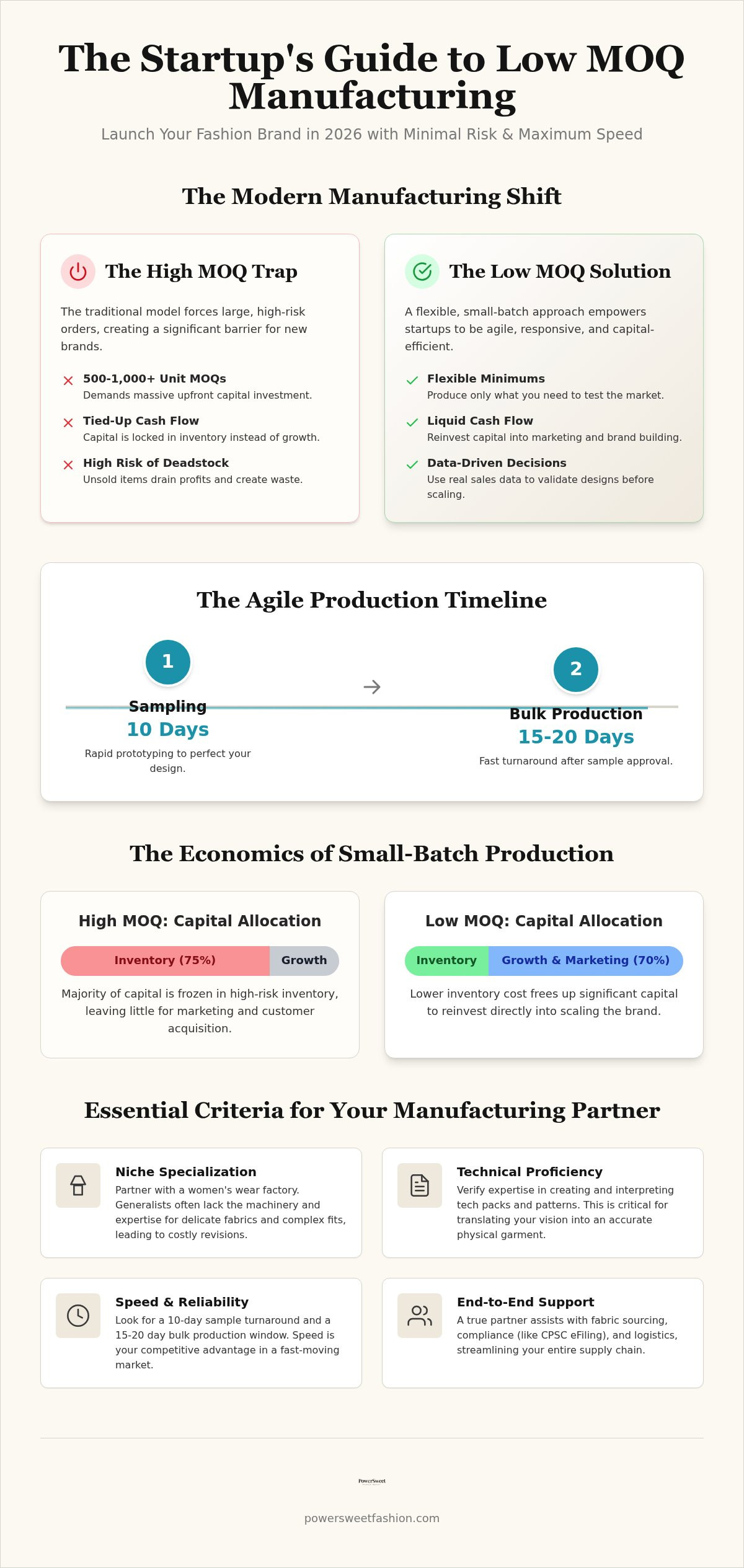
Minimum Order Quantity (MOQ) is the threshold that balances factory efficiency with brand affordability. While large factories may demand 500 to 1,000 pieces per style, small-batch production focuses on precision and speed over raw volume. This shift is essential because the modern market rewards brands that can iterate quickly. By partnering with a factory that accepts smaller orders, you avoid the risk of deadstock—inventory that fails to sell and eventually drains your profit margins. It's a pragmatic approach to building a brand that prioritizes stability and responsiveness.
Overcoming the Capital Barrier
Every dollar spent on excess inventory is a dollar taken away from your customer acquisition strategy. By choosing small minimums, you can shift your financial focus toward marketing and community building. This strategy significantly reduces the risk of being stuck with unsold garments. Starting small also offers a psychological advantage; it allows you to test market demand with real data before committing to larger production runs. You don't have to guess what your audience wants when you can produce a limited batch and observe their response in real time. This evidence-based approach makes your brand a "safe pair of hands" for investors and partners alike.
This strategic approach to production is equally valuable for those in the athletic sector; you can visit sUperstar to discover how specialized sports teamwear and club apparel are developed with a focus on quality and reliability.
Agility as a Competitive Advantage
The modern fashion cycle moves at the speed of social media. Trends can go viral and disappear within weeks, making large-scale production a burden rather than an asset. A low MOQ women's clothing manufacturer enables your brand to pivot quickly. You can launch small, diverse collections that respond to current aesthetics without being locked into a 1,000-unit commitment. This strategy isn't just about profit; it's a pillar of sustainable fashion. By producing smaller runs, you actively reduce the overproduction that plagues the industry. It's a pragmatic way to build a brand that's both responsive to customers and responsible toward global resources. Working with a low moq clothing manufacturer for startups ensures your supply chain is an engine for growth, not a source of stagnation.
Essential Criteria for Evaluating Low MOQ Clothing Manufacturers
Finding a reliable low moq clothing manufacturer for startups requires looking beyond the price per unit. You need a partner capable of translating technical sketches into physical reality without losing the nuance of your design. Reliability in this sector is built on transparency and specialized skill sets. A factory that understands the unique constraints of a new brand will offer more than just sewing; they'll act as a strategic production partner.
Assessing Technical and Specialization Fit
Working with a specialized women's wear factory is significantly safer than hiring a generalist. Generalist factories often lack the specific machinery required for delicate fabrics or the complex construction found in fashion-forward blouses and dresses. You should verify their capabilities by requesting images of their production floor and physical samples from previous runs. This allows you to inspect seam strength, finishing quality, and pattern accuracy firsthand. A factory that understands the unique drape and fit of women's apparel will save you months of revision cycles.
The Logistics of Speed and Reliability
In a market driven by rapid seasonal shifts, a 10-day sample turnaround is the industry gold standard for any low moq clothing manufacturer for startups aiming to capture fast-moving trends. If a manufacturer takes a month to produce a single prototype, you risk missing your seasonal launch window. Once the sample is approved, look for bulk production lead times within a 15 to 20 day window. Verification is key. Use video consultations to see the facility in real time or ask for a walkthrough of their quality control process. You must also distinguish between 'ready-to-ship' vendors, who sell pre-made blanks, and 'custom low MOQ' partners who build your unique designs from scratch.
Efficient communication is the foundation of a successful partnership. You need direct access to the production team to resolve technical hurdles as they arise. A true end-to-end partner manages everything from initial fabric sourcing and pattern making to final quality control. This consolidated approach eliminates the logistical friction that occurs when multiple vendors are involved. By keeping production under one roof, you ensure consistency across every garment in your collection. If you're ready to move from concept to creation, you can start your production journey with a partner that prioritizes your brand's growth and stability.
The Economics of Small Batch Production: ROI for New Brands
Choosing a low moq clothing manufacturer for startups is a strategic financial decision that prioritizes liquidity over raw volume. While large-scale factories promise lower per-unit prices, they often ignore the carrying costs that burden a new business. If you produce 500 units and only sell 200, your actual cost per sold unit doubles once you factor in the loss of the unsold goods. Small batch production eliminates this waste by allowing you to test the market with minimal exposure. This "test and scale" strategy ensures that you only invest heavily in designs that have already proven their value to your customers.
Low MOQ vs. Bulk Manufacturing: A Direct Comparison
The following table illustrates why small runs are the preferred entry point for agile brands in 2026. High-volume manufacturing may look cheaper on a spreadsheet, but the secondary costs of storage, insurance, and eventual liquidation of deadstock quickly erode those perceived savings.
Before launching a full run, you must account for the sample development fee. This isn't just an extra cost; it's a vital investment in the final product's success. Partnering with an experienced sample development clothing manufacturer ensures your patterns are perfected before the first stitch of bulk production is ever made. This precision prevents the costly returns and brand damage associated with poor fit or construction errors.
Calculating Your Initial Investment
When budgeting for your first collection, you must look beyond the sewing floor. A comprehensive unit cost includes fabric and trim sourcing fees, quality control inspections, and shipping logistics. Many startups fail because they only calculate the cut-and-sew price, leaving them underfunded for the final stages of delivery. By working with a low moq clothing manufacturer for startups that offers end-to-end services, you can consolidate these fees into a single, predictable line item. This transparency allows for faster reinvestment cycles, as you get your cash back from sales in weeks rather than months. The highest ROI for a startup comes from selling out of a small batch quickly, not from having the lowest theoretical unit cost on a mountain of unsold inventory. To further maximize your brand's impact during launch, BRAND NEW Promotions | Top Promo Supplier in North Texas provides insights into how promotional materials can complement your physical products and drive customer loyalty.
Preparing for Production: From Tech Pack to Finished Garment
Moving from a financial strategy to the factory floor requires a shift toward technical precision. A low moq clothing manufacturer for startups needs a comprehensive set of instructions to execute your vision accurately. Without a standardized blueprint, even the most skilled production team cannot guarantee consistency across your collection. This phase is where your creative concepts are translated into industrial specifications that ensure every garment meets your quality standards.
The Blueprint for Success: Tech Packs and Patterns
The tech pack is the most critical document in your production journey. It acts as a technical contract between your brand and the factory. To ensure accuracy, your tech pack must include detailed graded measurements, fabric weights, trim specifications, and specific stitching instructions. This level of detail eliminates ambiguity and reduces the need for multiple revision rounds. Professional pattern making then takes these specifications and creates the physical templates used for cutting the fabric. This step is vital for startups because precise sizing is the most effective way to prevent high return rates. During the sample development phase, the first prototype allows you to verify the fit and drape on a real fit model before any bulk cutting begins.
Material Management and Fabric Sourcing
Sourcing textiles and trims is a logistical challenge that can easily derail a production timeline. You can streamline this process by leveraging your manufacturer's local supply chain. A low moq clothing manufacturer for startups often has established relationships with fabric mills and trim suppliers, allowing them to procure high-quality materials faster than an independent brand could. Local sourcing also significantly reduces shipping costs and the risk of transit delays. This integrated approach is a cornerstone of end to end clothing production, where the factory manages everything from the initial thread count to the final zipper attachment.
Quality control should never be treated as an afterthought. It must be integrated into the production flow through specific milestones, including fabric inspection, in-line sewing checks, and final garment measurements. These interventions catch technical errors early, ensuring that your small-batch run is as perfect as a high-volume order. By maintaining this methodical approach, you protect your brand's reputation from the very first delivery. If you're ready to turn your sketches into physical samples, you can submit your tech pack to our team to begin the sourcing and pattern making process today.
Why PowerSweet Fashion is the Ideal Partner for Scaling Startups
Selecting the right low moq clothing manufacturer for startups determines the trajectory of your brand's first year in the market. PowerSweet Fashion positions itself as a "Safe Pair of Hands" by removing the logistical friction that often stalls new designers. We don't just offer manufacturing; we provide a streamlined production system designed for both speed and technical precision. Our 10-day sample guarantee is a market-leading feature that allows you to move from a tech pack to a physical prototype in record time. This responsiveness ensures you can capture seasonal trends while they're still relevant to your audience, giving you a competitive edge over brands locked into traditional, slow-moving supply chains.
A Specialized Factory for Modern Women's Wear
We focus exclusively on the custom women's clothing sector. Our team possesses deep expertise in complex garment construction, specifically for dresses, blouses, and fashion-forward pieces that require a high level of technical skill. Unlike generalist factories that produce everything from heavy workwear to basic accessories, our facility is optimized for the delicate fabrics and intricate patterns used in premium fashion. This specialization ensures that every stitch reflects a commitment to reliability and meticulous care. We act as an authoritative facilitator, guiding you through the technical steps of production so you never feel lost in the industrial process. Our understanding of current women's fashion trends means we aren't just following instructions; we're helping you execute a vision that resonates with modern consumers.
For entrepreneurs aiming to create a brand with a strong voice and unique aesthetic, it can be helpful to check out Sasshole® | Premium Graphic Apparel for Women with Attitude as an example of how bold messaging meets high-quality production.
Your Path to Launch: Starting with PowerSweet
Launching your collection with us follows a methodical, transparent process. You begin by submitting your designs for sample development. Our team then translates those sketches into high-quality prototypes within our 10-day window. Once you approve the fit and finish, our 15 to 20 day bulk production cycle ensures your inventory is ready for market without the typical three-month wait times associated with traditional factories. We maintain a "human-first" approach to manufacturing. This includes encouraging direct communication with our production team and offering factory visits to build trust through physical transparency. We manage the entire journey, from initial fabric sourcing to the final quality control check, allowing you to focus on marketing and brand growth. You can Start your fashion journey with PowerSweet Fashion today and secure a partner that treats your brand's success as a joint venture.
Scaling Your Vision with Strategic Production
Building a fashion brand in 2026 requires a shift from massive inventory to strategic agility. By partnering with a low moq clothing manufacturer for startups, you protect your capital and gain the freedom to test seasonal trends without the risk of deadstock. Success depends on technical precision, from high-quality tech packs to professional pattern making that ensures a perfect fit. You've seen how specialized expertise in women's wear and end-to-end support can streamline the transition from a creative sketch to a retail-ready collection.
PowerSweet Fashion acts as your industrial engine, providing the speed and transparency needed to scale. Our 10-day sample turnaround and 15 to 20 day bulk production window keep your brand moving at the speed of the market. We handle the complexities of end-to-end fabric and trim sourcing so you can focus on your customers. Ready to launch your brand? Contact PowerSweet Fashion for low MOQ custom manufacturing. The future of your collection starts with a single, well-executed sample. We're here to help you build it.
Frequently Asked Questions
What is considered a 'low MOQ' for a clothing startup?
A low MOQ typically ranges from 25 to 100 units per style. This is a significant shift from traditional factories that often demand 500 or more pieces to begin production. For a low moq clothing manufacturer for startups, these smaller thresholds allow brands to test market demand without heavy upfront capital. It's a pragmatic way to launch a collection while maintaining cash flow for marketing and other growth activities.
How long does it take to get a sample from a low MOQ manufacturer?
You should expect a 10-day turnaround time for a professional sample. This speed is essential for capturing seasonal trends and getting your designs to market before they lose relevance. Once the sample is approved, bulk production usually follows in a 15 to 20 day window. This rapid cycle ensures your startup remains agile and responsive to customer feedback, which is a key competitive advantage in the modern fashion industry.
Do low MOQ clothing manufacturers also handle fabric sourcing?
Most full-service manufacturers handle end-to-end fabric and trim sourcing. They leverage established relationships with local mills to procure high-quality textiles and components like zippers or buttons, while branding can be enhanced through specialized suppliers like Custom Patches Australia. This consolidated approach reduces shipping delays and ensures all materials meet your specific quality standards. By letting your partner manage sourcing, you simplify your supply chain and focus on the creative aspects of your fashion brand.
Can I visit the factory to oversee production for my startup?
Reliable manufacturers encourage factory visits to foster a sense of "Open-Door Transparency." If a physical visit isn't possible, many offer video consultations to walk you through the facility in real time. Seeing the production floor and meeting the team provides reassurance that your garments are being handled with meticulous care. It's a vital step in establishing a long-term, trust-based partnership with your production engine.
What documents do I need to provide to start production?
A complete tech pack is the most important document you'll provide. It serves as the technical blueprint for your garment and includes graded measurements, fabric specifications, and stitching details. Without this document, a low moq clothing manufacturer for startups cannot guarantee accuracy or consistency. Providing clear technical instructions at the start prevents costly revision rounds and ensures the final product matches your original design vision.
Is the per-unit cost higher when ordering small batches?
The per-unit cost is generally higher for small batches than for mass production. This is because the fixed costs of pattern making, fabric sourcing, and machine setup are spread over fewer garments. However, the higher unit price is offset by the reduced financial risk of unsold inventory. It's more cost-effective to sell out of a 50-unit run than to liquidate 500 units of deadstock at a loss.
How do low MOQ manufacturers ensure quality control for small orders?
Quality control is integrated into the production process through specific technical milestones. This includes inspecting raw fabrics before cutting, performing in-line sewing checks, and verifying final measurements against the approved sample. Every small batch receives the same rigorous attention as a larger order. This methodical approach catches errors early, protecting your brand's reputation and ensuring that your first delivery meets professional industry standards.
Can a low MOQ factory help with pattern making and grading?
Full-service partners offer professional pattern making and grading as part of their core services. They translate your sketches or tech packs into technical templates that ensure accurate sizing across your entire range. Professional grading is critical because it prevents the fit issues that lead to high return rates. Working with a factory that handles patterns under the same roof ensures that your design intent is maintained from concept to finished garment.


Comments