%20(1).png)
Chinese Clothing Factory: How to Choose the Right Partner in 2026

The most visible Chinese clothing factory isn’t always the right one for your brand. A directory listing can provide a name, but it won’t show whether a factory can make your garment, communicate clearly, or meet your production requirements.
If you’re comparing suppliers, start with product-specific experience and verifiable capabilities, not rankings or company size alone. This guide explains how to shortlist factories, compare their answers, and check key details before sampling and bulk production.
You’ll learn what to include in a first inquiry and what to confirm about materials, patterns, samples, quality control, timelines, and remote communication. PowerSweet Fashion supports custom womenswear production through fabric sourcing, pattern making, sample development, bulk production, and quality control. The company states that samples can be ready in 10 days and bulk production takes 15-20 days. Confirm whether those timelines apply to your garment, materials, and order scope before planning around them.
Table of Contents
Choosing a Chinese Clothing Factory: Start With Production Fit, Not Rankings
Assess a Chinese Clothing Factory’s Capabilities Before Shortlisting
Verify Quality, Communication, and Commercial Terms Before Committing
Move From Factory Inquiry to Approved Sample and Bulk Production
Choose a Chinese Clothing Factory Partner and Define the Next Step
Choosing a Chinese Clothing Factory: Start With Production Fit, Not Rankings
A long supplier list can feel like progress, but a polished profile or high directory position won’t tell you whether a factory can meet your construction requirements, order model, or approval process. Start by defining what your product needs, then use discovery tools to find candidates worth assessing.
A clothing factory is more than a listing or production floor. Its processes need to match your product and order needs, from development through quality checks. This overview of the world's largest textile industry provides broader context on China’s role in textile manufacturing. Industry scale, however, doesn’t establish whether an individual factory is right for your brief.
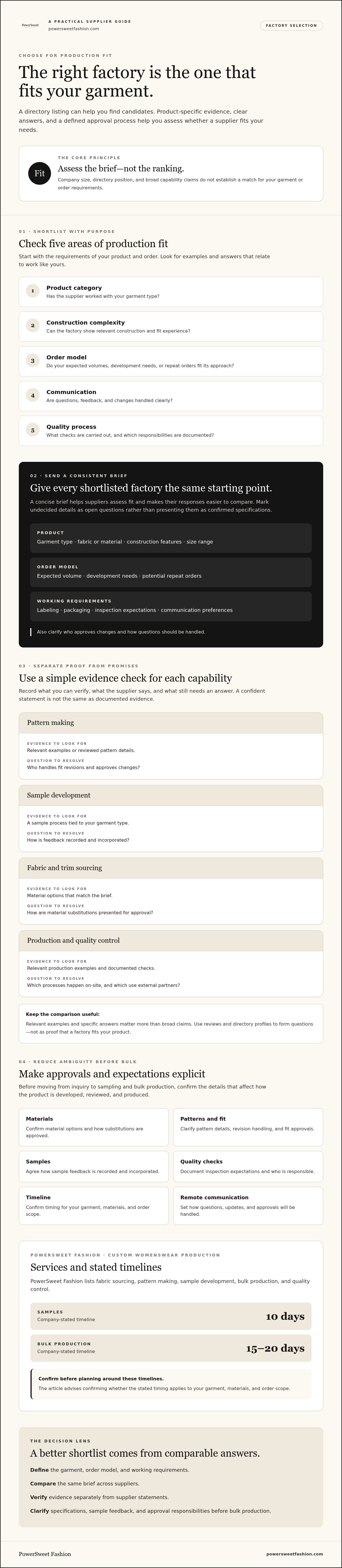
Before requesting a quote, assess five areas: product category, construction complexity, order model, communication, and quality process. A factory experienced in simple garments may not be the best match for a design with detailed construction or particular fit requirements. Look for evidence tied to work like yours, not broad claims about capability.
What should a clothing factory match before you request a quote?
Give each candidate a concise, consistent brief. Identify garment categories, materials, construction details, and size range. Clarify expected order volumes and whether you need development, repeat production, or both. Include labeling, packaging, and inspection requirements, along with who will approve changes and how questions should be handled. These details help a factory assess fit and make its response more useful.
Product: Garment type, fabric or material, construction features, and size range.
Order model: Expected volume, development needs, and potential repeat orders.
Working requirements: Labeling, packaging, inspection expectations, and communication preferences.
The first brief can be clear even if some specifications are still in development. Mark open decisions so suppliers can distinguish confirmed requirements from items that need discussion.
Why do directory rankings and reviews need context?
Reviews can help you identify questions and potential strengths, but check which products and projects they describe. Employee count, company profiles, and rankings may help with discovery. They don’t prove experience with your garment, construction, or order requirements. Compare each supplier’s relevant examples and answers against your brief rather than assuming the highest-ranked listing is the strongest fit.
Use directory information to build a shortlist, not to make the final decision. A relevant response that explains how the factory would approach your product is more useful than a general claim of broad experience. Record what’s evidenced, what’s only stated, and what you still need to verify. That distinction makes supplier comparisons more practical and fair.
Assess a Chinese Clothing Factory’s Capabilities Before Shortlisting
Once a supplier’s profile looks relevant, test each capability against your product brief. A factory may describe a broad service range, but you need to know what it can demonstrate for your garment and which parts of production it handles directly. A factory is a fit only when its evidence matches your product brief.
Record evidence separately from claims. This keeps a confident answer from being mistaken for a verified process and shows what still needs clarification before you commit to sampling.
Which production capabilities should a fashion brand verify?
Ask for examples that match your garment category, fabric behavior, and construction complexity. Clarify how pattern development connects to fit revisions, how sample feedback is recorded, and who confirms each change. For sourcing, ask who selects fabrics and trims, what alternatives may be proposed, and how you approve substitutions before they affect the sample or order.
Ask the same kind of questions about production and quality control. Find out which steps the factory performs directly and which involve outside partners. Don’t assume either arrangement. Record the answers and confirm who is responsible for coordination and approval.
How should buyers interpret certifications and standards?
Ask for the exact certificate or standard, its issuing organization, scope, and validity details. Names such as ISO 9001, OEKO-TEX STANDARD 100, and GOTS matter only when relevant to your requirements and supported by current documentation. A certification name alone doesn’t show that every product, material, facility, or process is covered.
Broader trade context can help frame supplier research, but it can’t verify an individual factory’s capabilities. The Chinese government’s overview of China and the World Trade Organization offers context on China’s trade position. Assess each supplier separately against your product and evidence needs.
For a practical reference point, review PowerSweet Fashion’s womenswear production capabilities alongside the services and proof your brief requires.
Verify Quality, Communication, and Commercial Terms Before Committing
A promising capability claim is only the start. Before bulk production, align on what the approved garment should look like, how it will be checked, and who can authorize changes. A sample gives both sides a physical reference. Written specifications and agreed approval points make that reference actionable rather than open to interpretation.
Document garment-specific measurement tolerances, defect categories, how issues will be reported and handled, who owns revisions, and which decisions need your sign-off. Avoid relying on vague phrases such as “good quality.” Define observable, measurable checks for your product, then agree when they will happen.
What quality-control evidence should you request?
Ask how the Chinese clothing factory checks incoming materials, work in progress, and finished garments. The aim isn’t to collect impressive-sounding claims. It’s to understand the actual checkpoints and what happens if a check identifies a problem.
Before production: Confirm how materials and the approved sample or specifications are checked.
During production: Ask what in-process checks are performed and how issues are recorded.
Before completion: Agree on garment-specific inspection points, reporting format, and approval responsibilities.
Remote evidence has limits. Photos and videos can show visible details, while a live call lets you ask questions in real time. Reviewing a physical sample gives you a more direct way to assess fit, fabric, and construction, though a sample can’t confirm how every bulk garment will be checked. An in-person factory visit can help you meet the production team and observe quality control. It still works best alongside documented criteria and clear reporting.
Don’t assume one compliance checklist applies to every product or destination. Verify the requirements relevant to your garment and intended market, and clarify what documentation the supplier can provide.
How can buyers reduce communication and order-term surprises?
Set up a simple communication structure before work begins. Name one decision-maker on each side, agree on channels for routine updates and approvals, and decide how often progress will be shared. Put specifications, sample revisions, production milestones, and change-approval steps in writing so a discussion doesn’t become an unclear instruction.
Review commercial responsibilities carefully. Confirm the agreed delivery terms, the applicable Incoterms rule and version, and the shipping details for the transaction. Make sure both parties understand who is responsible for each step and when responsibility transfers. Clear terms don’t remove every production risk, but they make expectations easier to manage before the order moves forward.
Move From Factory Inquiry to Approved Sample and Bulk Production
A consistent process turns supplier conversations into a decision you can act on. Send the same specifications to every shortlisted factory. Otherwise, differences in quotations or timelines may reflect different assumptions rather than different capabilities.
Prepare the brief. Summarize the garment, reference images, materials, size range, target quantities, and intended market. Attach a tech pack if you have one. If details are still open, list them and ask what information the factory needs to proceed.
Contact candidates. Send each factory the same brief and ask how it would approach development, sampling, quality checks, and production. Request clear assumptions behind any proposed timeline.
Assess the responses. Compare how directly each supplier addresses your requirements. Note unanswered questions, proposed material alternatives, who handles each process, and what needs your approval.
Develop and review a sample. Use the sample to assess the garment against the brief, then record any changes precisely.
Approve before production. Confirm the final sample and specifications in writing before authorizing bulk production. Keep the approved version and sign-off record accessible to both teams.
What should a first factory inquiry include?
Make the request specific enough for a useful reply without treating unfinished details as confirmed. Ask the factory to outline development steps, sample timing, quality checks, and production assumptions. This helps you distinguish an estimate based on your actual requirements from a general timeline that may not apply to the project.
For more detail on planning a sample, see a sample-development guide; use an end-to-end production guide for a deeper view of the full workflow. Add those resources when available to support buyers at each stage.
When is a sample ready for bulk approval?
Review the sample against the approved brief, not just its overall appearance. Check fit and measurements, material, construction, trims, labels, and finishing. List revisions, confirm who will make and review them, then secure written approval of the final sample and specifications before moving to bulk production.
PowerSweet Fashion states that samples can be ready in 10 days and bulk production takes 15-20 days. These are company-stated timelines, not guaranteed delivery dates. Confirm whether they apply to your specific garment, materials, and order scope before planning around them. For custom womenswear sampling and production, learn about PowerSweet Fashion’s services.
Choose a Chinese Clothing Factory Partner and Define the Next Step
Choose the supplier whose working process best matches your garment and gives you clear evidence at each stage. A final scorecard keeps the decision grounded in what matters to your project, rather than the strength of a sales pitch.
Product fit: Does the factory have relevant experience with your garment, materials, and construction needs?
Evidence: Can it support capability claims with specific examples, documents, or a clear explanation of its process?
Communication: Are answers direct, responsibilities clear, and approvals easy to track?
Quality process: Are inspection steps, issue reporting, and sign-offs defined?
Production plan: Do the proposed development steps and timing fit your confirmed order scope?
Use the scorecard to identify unresolved questions, not just to total ratings. A strong fit should be able to discuss both what it can handle and what needs further clarification.
When does an end-to-end manufacturing partner make sense?
A coordinated partner can simplify handoffs when fabric sourcing, pattern making, sample development, and bulk production need to align. Instead of relaying decisions across separate providers, your team can clarify how development choices affect the next production stage. This can be useful when a project needs several connected capabilities, though you should still confirm which processes the manufacturer handles directly and what falls outside its scope.
For broader supplier evaluation, consult a guide to choosing a custom women’s clothing manufacturer. An end-to-end clothing production guide can also help you compare service scope and understand where responsibilities sit across the process.
PowerSweet Fashion is a custom womenswear manufacturer offering fabric sourcing, pattern making, sample development, bulk production, and quality control. The company states that bulk production takes 15-20 days. Confirm whether that timeline applies to your product, materials, and order scope before using it in your schedule.
What should you prepare before contacting PowerSweet Fashion?
Gather your tech pack or design references, target quantities, preferred materials, and key dates. Note non-negotiable quality requirements, packaging needs, and who will approve samples or production changes. If some details aren’t final, identify them as open questions rather than leaving the factory to assume.
A clear brief makes it easier for both sides to assess fit and determine what information is needed next. For an overview of the company’s services, visit PowerSweet Fashion.
Make Your Next Factory Conversation More Focused
The right Chinese clothing factory is the one whose demonstrated capabilities match your product, quality expectations, and order plan. Use specific evidence rather than rankings alone, and put sample requirements, approval points, communication responsibilities, and production assumptions in writing before committing to bulk production.
A clear brief helps both sides assess fit. Include garment references, materials, target quantities, key dates, and open questions. Then compare responses and confirm timelines against the actual project scope before building them into your schedule.
PowerSweet Fashion supports custom womenswear production with fabric sourcing, pattern making, sampling, bulk production, and quality control. The company states that samples can be ready in 10 days and bulk production takes 15-20 days. Confirm whether those timelines apply to your garment, materials, and order scope.
Ready to discuss your custom womenswear production requirements? Contact PowerSweet Fashion to discuss your project.
Frequently Asked Questions
How do I find a reliable Chinese clothing factory?
Shortlist factories based on evidence that matches your product, not directory rank alone. Share a clear brief and ask for relevant garment examples, details of pattern making and sampling, material-sourcing arrangements, quality checks, and communication responsibilities. Keep confirmed evidence separate from supplier statements and unanswered questions. Then compare responses against the same requirements, develop a sample, and document approval criteria before deciding whether to proceed to bulk production.
What should I ask a clothing factory before placing an order?
Ask who handles each production step, how samples and revisions are managed, what quality checks are performed, and how issues are reported and resolved. Clarify expected quantities, production assumptions, materials, approval responsibilities, and timing for each stage. Before confirming an order, document specifications, tolerances, defect handling, change approvals, delivery terms, and the applicable Incoterms rule. Clear written answers make it easier to spot mismatched expectations before production begins.
Can a Chinese clothing factory produce low minimum order quantities?
Some factories can accommodate lower minimums, but the available quantity depends on the supplier, garment, materials, and production setup. PowerSweet Fashion states that it offers low minimum order quantities, but a specific minimum isn’t provided. Ask whether the minimum applies per style, color, or size range, and confirm what development or material requirements affect the order. Get the factory’s assumptions in writing before comparing proposals.
How long does clothing production take in China?
Timing depends on the garment, materials, order scope, sample approvals, and the factory’s production plan, so request separate estimates for development, sampling, and bulk production. PowerSweet Fashion states that samples can be ready in 10 days and bulk production takes 15-20 days. These are company-stated timelines, not guaranteed delivery dates. Confirm whether they apply to your specific project and clarify what each estimate covers before planning around it.
How can I check the quality of a clothing factory before bulk production?
Review a sample against written specifications, including fit, measurements, materials, construction, trims, labels, and finishing. Ask how the factory checks incoming materials, work in progress, and finished garments, and agree on measurable acceptance points before production. Confirm how inspection results and corrective actions will be reported, who handles revisions, and which decisions require your approval. A sample helps assess the product, while a documented quality process clarifies how bulk work will be monitored.
Do I need to visit a Chinese clothing factory in person?
No, an in-person visit isn’t essential for every buyer, though it can help you meet the production team and observe quality-control processes. Remote communication, live calls, photos, videos, and physical sample reviews can each provide useful evidence, but none replaces clear written specifications and approval records. If you can’t visit, ask who will manage your project, request updates at agreed stages, and confirm how inspection findings and production decisions will be shared.
What is the difference between a clothing factory and a sourcing company?
A clothing factory performs garment production, though the exact steps it handles directly can vary. A sourcing company generally helps buyers identify or coordinate suppliers, but its role and services also vary. Don’t assume a company’s title tells you who makes the garments or manages materials, sampling, and quality checks. Ask which processes happen in-house, which involve external partners, who is responsible for each stage, and who your contract is with.
What information should I send to a clothing manufacturer for a quote?
Send the garment type, design references or tech pack, material preferences, size range, target quantities, and intended market. Include construction details, trims, labels, packaging needs, key dates, and quality requirements where known. If a specification is missing, mark it as undecided and ask what’s needed to assess the project. Giving every shortlisted supplier the same information makes their assumptions and responses easier to compare.


Comments