%20(1).png)
Building a Long-Term Relationship with Your Factory: The Fashion Brand’s Guide

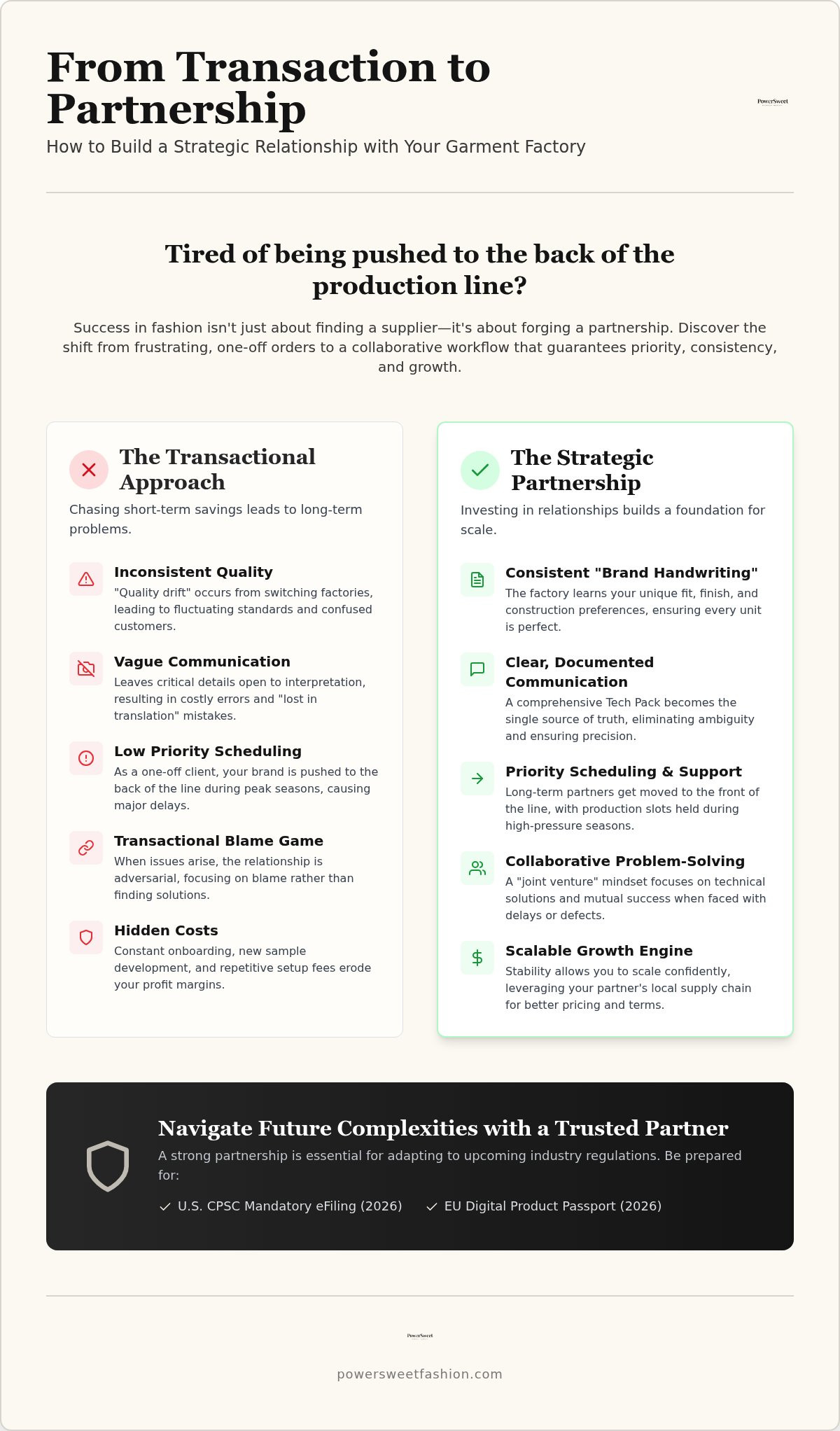
Why do some fashion brands always get priority scheduling while yours is stuck waiting for an email response? It's frustrating to feel like a small fish in a massive pond, especially when you're dealing with inconsistent garment quality or unexpected delays during peak seasons. You've likely felt the stress of being pushed to the back of the production line by larger clients. Success in the garment industry isn't just about finding a supplier. It's about building a long term relationship with your factory that evolves into a strategic partnership based on mutual trust.
We believe that your manufacturer should be a safe pair of hands, acting as an extension of your own team. This is particularly vital as the industry faces new regulatory complexities in 2026, such as the U.S. CPSC mandatory eFiling and the EU's Digital Product Passport requirements. This guide will show you how to move beyond transactional orders to secure a partner who offers priority scheduling and faster turnaround times. We'll break down the mechanics of clear documentation, the value of direct communication, and how to create a collaborative workflow that lowers defect rates. By the end, you'll know how to transform your production process into a scalable engine for your brand's growth.
Table of Contents
The Strategic Advantage of Long-Term Manufacturing Partnerships
Switching factories frequently creates a revolving door effect that erodes your brand's foundation. While chasing a lower unit price might seem logical, it often leads to quality drift. This happens when production standards fluctuate between different facilities; causing your customers to receive inconsistent garments. Onboarding costs are often hidden. You lose weeks on new sample development and pay repetitive setup fees every time you move. Building a long term relationship with your factory eliminates these friction points. It transforms your manufacturer from a distant vendor into a safe pair of hands that understands your specific construction requirements.
Effective supply chain management relies on stability and predictable outcomes. When you stick with one partner, you bypass the expensive learning curve associated with new machinery and different sewing teams. This stability allows you to scale without the fear that your next bulk run will look nothing like your original sample. Factories are businesses too. They prioritize clients who provide consistent, predictable volume over those who disappear after one order.
Quality Consistency and Brand Reputation
Factories learn your brand handwriting over multiple production cycles. This isn't just about following a tech pack; it's about understanding how you prefer your seams finished or how your specific fit standards apply across different fabrics. Reducing the learning curve for specialized sewing techniques ensures that your 500th unit is as precise as your first. Utilizing a consistent partner for end to end clothing production maintains customer trust. When shoppers know your sizing and quality won't change, they become repeat buyers. Reliability is the most valuable asset in the competitive women's apparel market.
Navigating Fashion Seasonality with Priority Support
The garment industry is dictated by tight deadlines and peak manufacturing windows. During pre-holiday rushes or Spring/Summer launch preparations, floor space is at a premium. Long-term partners receive priority scheduling because the factory values the established workflow. We've seen that brands with deep roots in a facility get moved to the front of the line when fabric sourcing shortages occur. Your partner understands your growth trajectory and is more likely to hold production slots for you during these high-pressure periods. This level of support is impossible to find when you're just another order number in a queue of transactional clients.
Establishing Clear Communication Channels and Documentation
Documentation is the heartbeat of manufacturing. A comprehensive Tech Pack acts as the ultimate source of truth for your brand. It ensures that every detail, from button placement to seam allowance, is recorded in a way that leaves no room for interpretation. Without this, you leave your brand's quality to chance. Building a long term relationship with your factory requires this level of technical transparency. When you share your sales goals and launch timelines early, you enable the factory to manage their workforce and capacity effectively. This proactive approach is a vital part of improving purchasing practices, fostering a partnership where both parties can thrive together.
Communication should follow a "collaborative we" rhythm. We suggest working through dedicated project managers to maintain a consistent, professional flow of information. When issues arise, provide constructive feedback that focuses on technical solutions rather than blame. This empowers the production team to fix the root cause rather than feeling demoralized by vague complaints. Clear dialogue transforms a distant vendor into a trusted teammate who understands your vision.
The Language of Professional Production
Precision requires a shared technical vocabulary. You must use standardized terminology for seams, trims, and fabric weights to avoid costly "lost in translation" errors. For example, specifying a 180 GSM jersey is much more effective than asking for "thick fabric." Professional sample development documentation serves as your blueprint for success. It defines the quality threshold before a single machine starts for bulk production. If you're looking for a partner to help refine these technical specifications, our custom women's clothing production services provide the expertise needed to bridge the gap between design and delivery.
Feedback Loops and Continuous Improvement
Success in fashion is iterative. We recommend implementing a structured Post-Production Review after every bulk delivery. This is the time to document fit issues or fabric performance observed during the run. Share these findings directly with the pattern making and QC teams to refine future iterations. This feedback loop ensures that each season is better than the last. By treating every challenge as a learning opportunity, you build a resilient production engine. It turns the manufacturing process into a shared journey of growth and constant refinement.
Navigating the Transition from Sampling to Bulk Production
The first bulk order acts as a stress test for any manufacturing partnership. It's the moment where technical communication translates into physical inventory. While a prototype is often handmade by a master tailor, bulk production relies on assembly line precision and machine-run consistency. Understanding this distinction is vital for managing expectations. Building a long term relationship with your factory allows you to navigate this shift without the friction that typically plagues new accounts. By utilizing 10-day sampling cycles, you can test a facility's technical capabilities in a low-risk environment before committing your entire season's budget to a large-scale run.
We view the Pre-Production (PP) sample as the final safeguard in the manufacturing journey. It represents exactly what will come off the machines during bulk production. Once this sample is approved, it locks in every construction detail and becomes the benchmark for all quality control checks. Rushing this approval stage is a common mistake that often leads to long-term relationship strain. Precision requires a methodical approach, and skipping steps here almost always results in costly errors during the main production run.
Step-by-Step Approval Framework
A systematic approval process ensures that nothing is left to chance. We recommend a four-step framework to maintain clarity between your brand and the production team:
Step 1: Prototype Review. Evaluate the initial sample for design intent, silhouette, and aesthetic appeal.
Step 2: Fabric and Trim Approval. Verify that the bulk materials are available and match the approved quality standards.
Step 3: Size Set Grading. Approve a full range of sizes to guarantee consistent fit across every SKU variation.
Step 4: Gold-Seal Sign-off. Sign and date the final PP sample to serve as the physical benchmark for the QC team.
Managing Lead Times for Sustainable Growth
Speed is essential, but it must be balanced with meticulous care. Planning for 15-20 day bulk production windows allows the factory to maintain high standards without the pressure of unrealistic deadlines. Partnering with low MOQ women's clothing manufacturers provides a strategic advantage for growing brands. It allows you to test the market with smaller batches before scaling into larger volumes. This phased approach reduces your financial risk and gives the factory time to perfect your brand's specific construction requirements. It's a pragmatic way to scale that prioritizes stability over erratic growth spurts.
Collaborative Problem-Solving: Handling Delays and Quality Issues
Manufacturing is a complex industrial process. Problems are inevitable. The difference between a brand that scales and one that stalls is how they handle these hurdles. Stop the blame game. Adopting a "Joint Venture" mindset is the secret to building a long term relationship with your factory. When challenges arise, view them as shared obstacles rather than grounds for conflict. This collaborative approach ensures that solutions are found quickly, keeping your production on track and your brand reputation intact.
Human trust accelerates problem-solving. We encourage clients to visit the production facility whenever possible. Meeting the sewing teams and project managers face-to-face builds a level of empathy that digital communication cannot replicate. It turns your brand into a human priority for the factory staff. When they know the person behind the tech pack, they're more likely to go the extra mile during a crisis. If you're looking for a transparent partner who prioritizes this level of collaboration, learn more about our Quality Control services and production standards today.
Transparency in the Supply Chain
Honesty prevents marketing disasters. If a fabric delivery is late, you need that information immediately to adjust your launch calendar. A strategic partner doesn't just deliver bad news; they provide alternatives. They might suggest a similar fabrication from their local supply chain to keep your timeline on track. This proactive approach identifies potential design flaws before the cutting machines even start. It saves you from wasting expensive materials on a construction that won't hold up in bulk production. Professional transparency is the only way to maintain a predictable delivery schedule.
The 'Safe Pair of Hands' Approach to QC
Trust but verify. You need a partner with a robust in-house Quality Control department. This team acts as your first line of defense against defects. Establish your Acceptable Quality Level (AQL) standards before production begins so everyone is on the same page. When defects occur, focus on professional resolution. Negotiating re-works or future credits is often better for the partnership than aggressive demands. Choosing an experienced custom women's clothing manufacturer significantly lowers your risk profile. Their specialized expertise ensures that construction issues are caught during the sampling phase, long before they reach your customers.
Scaling Your Brand with an Integrated Production Partner
Scaling demands a shift to a structured seasonal production calendar. This transition allows the factory to allocate dedicated lines for your brand months in advance. Building a long term relationship with your factory provides direct access to their established local supply chains. You gain the bargaining power of a major manufacturer when sourcing fabrics and trims. Integrating your operations reduces the logistical burden on your internal team. You can focus on creative vision while the factory handles the industrial heavy lifting.
The future of fashion belongs to brands that embrace agile manufacturing. A responsive supply chain allows you to react to market trends without the risk of massive overstock. End-to-end services, from initial sourcing to final shipping, significantly lower your operational overhead. You no longer need to manage multiple vendors for pattern making and quality control. This streamlined approach creates a "Safe Pair of Hands" environment where production flows predictably from one season to the next.
Expanding Product Categories Together
A deep partnership provides the technical safety net needed to explore new horizons. You can confidently move from basic jersey tops to complex outerwear or technical garments. Leveraging factory expertise is particularly essential when developing specialized lines like Resort wear. These categories often require specific machinery and finishing techniques that a new factory might struggle to master. Using your partner's existing pattern making library also accelerates development. You don't have to start from scratch for every new silhouette; you can build upon proven blocks that already fit your customers perfectly.
Efficiency Through Operational Integration
Repetitive production cycles create a rhythm that benefits everyone. As sewing teams become familiar with your construction methods, they achieve significant efficiency gains. This familiarity leads to lower defect rates and more predictable lead times. A trusted partner can even manage your fabric inventory and trim stock. This ensures materials are ready for the next run before you even place the official order. Transitioning from a standard client to a preferred partner status ensures you always have a seat at the table. It turns your supply chain into a competitive advantage that competitors cannot easily replicate.
Future-Proofing Your Fashion Production Strategy
Successful manufacturing isn't a one-off transaction; it's an evolving partnership that requires technical precision and mutual trust. By prioritizing clear documentation through Tech Packs and adopting a "Joint Venture" mindset, you eliminate the friction of quality drift and seasonal delays. Building a long term relationship with your factory transforms your supply chain into a competitive asset that supports rapid scaling and a consistent brand reputation. You move from being a "small fish" to a priority partner with a seat at the table.
Your brand's growth depends on the stability of your production engine. We invite you to partner with PowerSweet Fashion for reliable, end-to-end women's clothing production. Our team provides the speed and transparency you need to stay agile in 2026. With a 10-day sample turnaround and 15-20 day bulk production speeds, we handle the industrial heavy lifting. Our expert in-house pattern making and QC services ensure your creative vision is executed with meticulous care. Let's build a foundation that scales with your ambition and brings your designs to life with precision.
Frequently Asked Questions
How do I know if my clothing manufacturer is the right long-term fit?
Look for consistent communication and technical transparency during the sampling phase. A factory that provides 10-day sample turnarounds and offers direct access to their production team demonstrates the reliability needed for a lasting partnership. They'll act as a safe pair of hands, showing an understanding of your brand's specific construction standards. If they proactively suggest fabric alternatives or identify design flaws early, they're likely a strategic fit for your business.
Is it better to work with one factory or diversify my production?
Working with a single, integrated partner is often more efficient for growing brands because it eliminates the hidden costs of multiple onboarding processes. Concentrating your volume with one manufacturer helps in building a long term relationship with your factory, which leads to priority scheduling and better per-unit pricing. While diversification can spread risk, it often dilutes your influence. A deep, end-to-end partnership ensures that your quality standards remain consistent across all product categories.
How often should I visit my manufacturer in person?
We recommend visiting at least once a year or during the development of a major new collection. Face-to-face meetings build human trust and allow you to oversee quality control processes directly on the factory floor. Meeting the pattern makers and sewing teams turns your brand into a human priority rather than just an order number. These visits are essential for resolving complex technical issues and aligning on your brand's long-term growth trajectory.
What should I do if my factory makes a mistake on a bulk order?
Address the issue immediately with professional transparency and specific technical feedback. Avoid the blame game; instead, adopt a joint-venture mindset to find a solution, such as re-works or credits for future runs. Refer to your signed gold-seal sample and tech pack as the source of truth to identify where the deviation occurred. A reliable partner won't just ignore the problem; they'll work with you to fix the root cause and update their QC protocols.
Can a low MOQ manufacturer handle my brand as I scale to thousands of units?
Yes, a manufacturer that offers low MOQs is often the best partner for scaling because they understand the need for agility. They allow you to test the market with smaller batches before moving into large-scale production runs of thousands of units. This flexibility reduces your inventory risk while the factory scales their workforce to meet your growing demand. It's about finding a partner that can match your pace from startup to global brand.
How do I negotiate better pricing with my factory without hurting the relationship?
Negotiate based on volume commitments and operational efficiency rather than just squeezing margins. Offer the factory a predictable seasonal production calendar so they can optimize their labor and material sourcing. When you simplify your designs or use the factory's stocked fabrics, you reduce their internal costs. This collaborative approach allows for price reductions that benefit both parties, ensuring the relationship remains profitable. You don't have to sacrifice quality to achieve a better bottom line.
What is the most common reason factory relationships fail?
Communication breakdowns and poor documentation are the primary causes of failure. When a brand provides incomplete tech packs or vague feedback, it leads to quality drift and costly production errors. Lack of transparency regarding launch timelines also creates friction, as factories cannot manage their capacity without clear lead times. Building a long term relationship with your factory requires a shared technical language and a commitment to professional, proactive dialogue at every stage.
How can I get my factory to prioritize my smaller orders during busy seasons?
Establish yourself as a preferred partner by providing consistent, year-round business rather than sporadic orders. Factories prioritize clients who follow a predictable schedule and respect their lead times, such as our 15-20 day bulk production windows. Paying on time and maintaining clear, professional documentation also earns you priority status. When the factory views your brand as a reliable source of revenue, they'll move your smaller runs to the front of the line.


Comments