%20(1).png)
Avoiding Tech Pack Mistakes: The Ultimate 2026 Checklist for Flawless Production
- Powersweet Team

- 7 days ago
- 12 min read
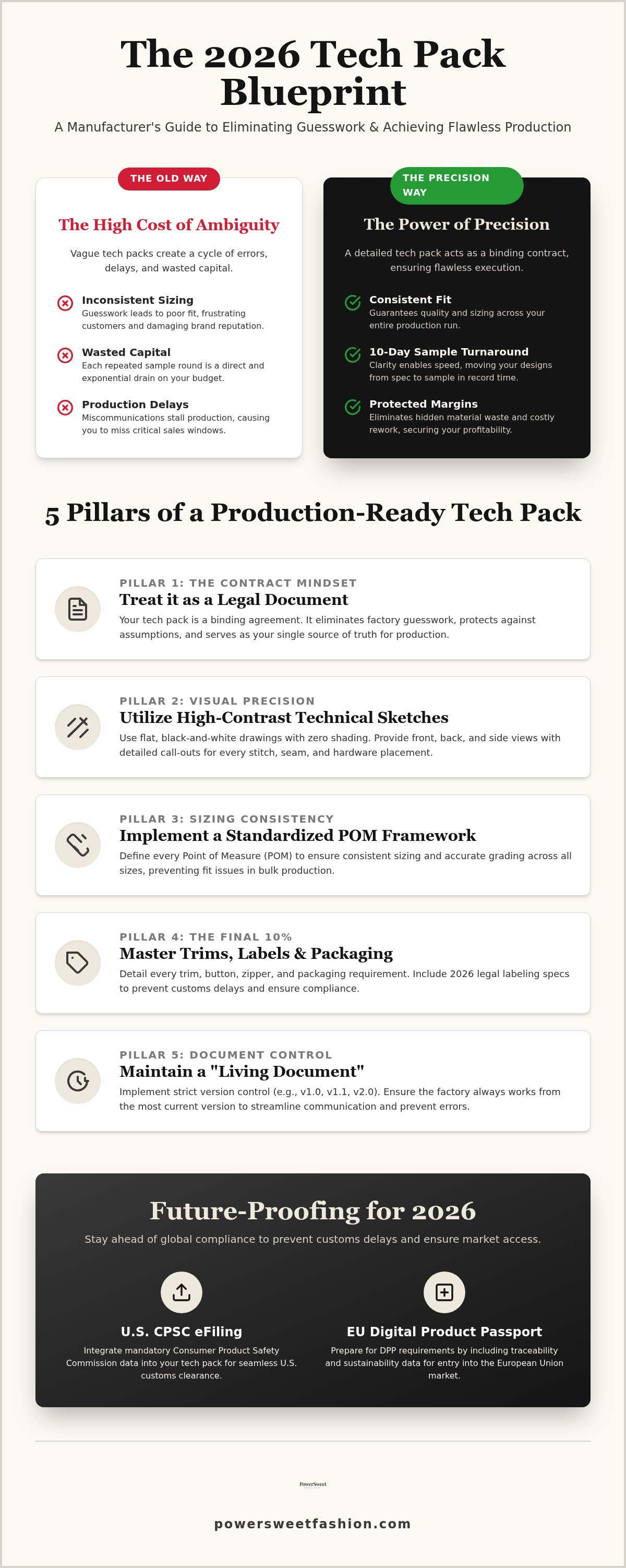
Your tech pack is not a creative mood board; it is a legally binding production contract that must eliminate every ounce of factory guesswork. If you've ever opened a sample box only to find inconsistent sizing or incorrect construction, you know how frustrating it's to feel like you're speaking a different language than your manufacturer. These miscommunications lead to expensive sampling rounds that stall your brand's growth. By focusing on avoiding tech pack mistakes, you can break the cycle of failed prototypes and ensure your factory delivers flawless bulk production every time.
We believe that precision is the engine of your creative vision. This ultimate 2026 checklist provides a systematic framework for your garment specifications. We'll cover the critical updates you need to stay compliant, including the new U.S. CPSC mandatory eFiling requirements and EU Digital Product Passport data. You'll learn how to build a tech pack that serves as a reliable roadmap, reducing manufacturing waste and helping you secure a professional, 10-day sample turnaround. Let's transform your technical drawings into a tool for speed, precision, and a more profitable partnership with your production team.
Table of Contents
Why Tech Pack Accuracy is Your Brand’s Most Valuable Asset
Your tech pack is the physical DNA of your garment. It's not just a sketch; it's a legally binding contract that dictates every stitch, seam, and button placement. For many founders, the biggest hurdle is the psychological shift from being a "designer" to becoming a "production manager." A designer dreams of the silhouette, but a production manager ensures that silhouette survives the reality of a high-speed sewing machine. By focusing on avoiding tech pack mistakes, you're protecting your brand's most valuable asset: its ability to scale without constant friction.
The Economic Impact of Sampling Errors
Every sampling round you repeat is a direct drain on your capital. While a single prototype might seem like a significant investment, the hidden costs of three or four correction rounds are exponentially higher. These delays often mean missing critical seasonal windows, which forces you to sell your stock at a discount just to clear the warehouse. Factories prioritize brands with clean, professional documentation because it lowers their own operational risk. Precise specs are the foundation of end to end clothing production. When the data is right from day one, we can maintain a 10-day sample turnaround and a 15-20 day bulk production schedule. Accuracy buys you speed.
What Your Factory Sees vs. What You See
Factories don't guess; they fill in the blanks. If your tech pack lacks detail, the factory will choose the fastest or cheapest path to complete the garment. This "assumption gap" is where most production failures happen. You might see a beautiful drape in your mind, but the factory only sees the technical data you provide. Understanding the Components of a Tech Pack is essential for bridging this gap. Consistency is the key to avoiding tech pack mistakes that lead to inconsistent sizing across different styles.
Using industry-standard terminology ensures that a "topstitch" in your office means exactly the same thing on the factory floor. This prevents the translation errors that often plague overseas partnerships. When you provide a professional document, you signal that you're an authoritative partner who respects the manufacturing process. This builds a foundation of trust. It moves the relationship away from a series of "requests" and toward a systematic execution of your vision.
Eliminating Visual Ambiguity in Technical Sketches and BOMs
Artistic flair has no place on a factory floor. While a beautiful fashion illustration might inspire a marketing team, it often confuses a pattern maker. The Golden Rule of avoiding tech pack mistakes is to use flat, black-and-white technical sketches with zero shading. Shading creates optical illusions that can hide seam lines or suggest fabric textures that don't exist. A clean line drawing ensures that every stitch type and hardware placement is visible to the naked eye. This clarity is the difference between a sample that fits perfectly and one that requires a total redesign.
Mastering the Technical Flat
Visibility must be absolute. Front, back, and side views are mandatory to provide 360-degree insight into the garment's construction. If a detail isn't drawn, it doesn't exist to the factory. Use call-outs and annotations to highlight complex areas like internal waistbands or gussets. We recommend using "close-up" boxes for intricate elements such as pocket finishes, custom embroidery, or specific topstitching patterns. These magnified views prevent the factory from filling in the blanks with their own assumptions. Precision here saves days of back-and-forth communication.
Structuring a Production-Ready BOM
The Bill of Materials (BOM) is your comprehensive shopping list. It must account for every single physical component that makes up your garment. A common error in avoiding tech pack mistakes is forgetting the "invisible" items like thread color, weight, and fiber content. If you don't specify a 40-weight polyester thread in a specific Pantone shade, the factory will use whatever is currently loaded on their machines. This leads to inconsistent quality and visible color mismatches under retail lighting.
Your BOM should include detailed sourcing specifications for every layer. This means listing the fabric weight in GSM, the exact fiber composition, and confirmed Pantone color codes. Don't just list "zipper"; specify the brand, such as YKK, the length, and the teeth material. How a professional sample development clothing manufacturer uses your BOM determines the speed of your sourcing phase. When your data is complete, we can source materials with surgical precision, keeping your 10-day sampling window on track. If you're ready to turn your sketches into physical reality, PowerSweet Fashion provides the technical expertise to audit your BOM for production readiness before the first cut is made.
Avoiding Measurement and Grading Errors that Kill Your Fit
A size "Medium" sketch is a ghost without a body. Numbers are the only language a sewing machine truly understands; therefore, your measurement chart must be the most precise part of your document. Many brands fall into the trap of assuming a factory knows their specific "fit," but every manufacturer has different default standards. If you don't define the exact coordinates of your garment, the factory will use their own. This is an essential step in avoiding tech pack mistakes that lead to inconsistent sizing across your collection.
The Point of Measure (POM) framework is the industry standard for standardizing these coordinates. It defines exactly where a measurement begins and ends. Without a POM code, a "waist" measurement could be taken at the narrowest part of the torso or at the top of the waistband, leading to a fit that is inches off. You must also define your tolerance levels. No factory can produce 10,000 units with zero variance. By specifying an acceptable margin of error, such as +/- 1cm for a bust measurement, you provide a clear quality control benchmark for the production floor.
Creating a Professional Measurement Chart
Your chart needs to be exhaustive. For women's apparel, you must include essential POMs such as the bust, waist, hips, and high-point shoulder (HPS). We recommend providing clear diagrams that use arrows to show exactly where each measurement is taken. This visual guide prevents translation errors and ensures the sample maker measures the garment exactly as you intended. Fit samples are your best tool for validation; use them to test your chart in the real world before committing to bulk production. Precision at this stage is critical for avoiding tech pack mistakes during the transition from sample to scale.
The Logic of Garment Grading
Grading isn't a simple math problem. The "Grading Trap" occurs when designers simply add a fixed amount, like two inches, to every dimension for the next size up. This ignores the reality of human proportions. Complex women's wear, particularly tailored blazers or structured dresses, requires non-proportional grading to maintain the design's integrity. A size Large shouldn't just be a wider version of a Small; it needs adjusted armhole depths and shoulder slopes to sit correctly on the body. Expert pattern-making ensures your grade rules respect the original silhouette while providing a comfortable fit for every customer in your size range.
The Final 10%: Mastering Trims, Labels, and Packaging Specs
The final stage of your garment's development often determines the success of the entire production run. While designers focus on silhouettes, the technical reality of trims, labels, and packaging is what moves a product through customs and onto retail shelves. Neglecting these specifications is a primary cause of bulk production delays. In 2026, compliance is more digital and rigorous than ever. Avoiding tech pack mistakes in your labeling isn't just about aesthetics; it's about avoiding the $51,744 penalty for U.S. labeling violations that can occur if your data is incomplete.
Precision in these details is non-negotiable. As of July 8, 2026, the U.S. CPSC requires mandatory electronic filing of safety data for apparel imports at the time of entry. This means your tech pack must serve as a repository for all compliance data, including fiber content, country of origin, and standardized wash symbols. If this information isn't clearly documented and shared with your factory, your shipment could be seized at the border.
Labeling and Branding Details
Main labels and care labels serve two different but equally vital purposes. Your main label carries your brand's identity, but your care label carries your legal liability. You must specify the material, such as woven damask or printed satin, and the exact attachment method. Heat-transfer labels are ideal for comfort in activewear, while sewn-in labels are standard for structured women's fashion. Every care label must be accurate. By the end of 2026, many of these details will also need to be accessible via the EU's Digital Product Passport. Ensuring your branding aligns with custom women's clothing manufacturer standards ensures that your factory knows exactly where to stitch each component without asking for clarification.
Packaging for Logistics and Retail
Packaging is no longer an afterthought. With California's Responsible Textile Recovery Act (SB 707) in full effect as of July 1, 2026, fashion brands are now part of an Extended Producer Responsibility framework. Your tech pack must specify eco-friendly polybags or biodegradable alternatives to meet these new sustainability standards. Logistics also require precision. You must provide detailed folding instructions so your garments arrive at the warehouse in pristine condition. Carton marking requirements are equally critical. Each carton should have clear labeling for international shipping, including weight limits and SKU counts. If you want to ensure your production is compliant and retail-ready, partner with PowerSweet Fashion to audit your packaging and labeling specs before you hit the "go" button on bulk production.
Implementing Version Control and Streamlining Factory Communication
A tech pack is never truly finished until the final bulk order leaves the factory floor. It's a living document that must evolve with every fit adjustment and material substitution. The most dangerous phrase in garment production is "Final_Final_v3.pdf." This naming convention creates a vacuum of accountability where old data can easily contaminate new production runs. By adopting a rigid version control system, you're not just organizing files; you're avoiding tech pack mistakes that could lead to thousands of dollars in wasted fabric. Precision in communication is the final hurdle between a great design and a successful product launch.
Your "Change Log" is the most important page in a revised document. Factories handle hundreds of styles simultaneously; they don't have the time to hunt for a 2cm adjustment in a 30-page PDF. You must highlight exactly what was modified in every revision. This transparency prevents the factory from repeating errors from previous sample rounds. A formal "Tech Pack Handover" meeting ensures that your production team and the factory are aligned on every update before the machines start running again. This proactive step replaces guesswork with certainty.
A 5-Step Workflow for Revision Management
Managing updates requires a systematic approach to ensure no detail is lost in translation. Follow this workflow to maintain a clean production trail:
Step 1: Document fit sample feedback using high-resolution photos and side-by-side measurement comparisons.
Step 2: Update the master tech pack immediately and increment the version number using a standardized format like V1.1 to V1.2.
Step 3: Use a high-contrast color, such as red or bright blue, to highlight every specific change in the text or diagrams for the factory's attention.
Step 4: Distribute the updated file to all production stakeholders through a centralized platform to ensure everyone has the same "source of truth."
Step 5: Archive all previous versions in a separate folder to prevent accidental use on the factory floor.
Communication Best Practices with Global Partners
Language barriers are a reality of global manufacturing, but visual aids are universal. Use annotated photos and clear diagrams instead of long paragraphs of text. A "Sample Comment" sheet is a critical component of the feedback loop; it allows the factory to respond to your fit notes with their own technical observations. This collaborative approach is what powers our 10-day sampling turnaround. As a specialized low MOQ women's clothing manufacturer, we've refined these communication cycles to support rapid scaling. Avoiding tech pack mistakes through disciplined version control ensures that your brand remains agile, professional, and ready for the next production milestone.
Mastering Your Production Pipeline
Your tech pack is the single most important document in your supply chain. It bridges the gap between a creative concept and a retail-ready garment. By focusing on avoiding tech pack mistakes through clear technical flats and rigorous version control, you eliminate the guesswork that leads to costly manufacturing waste. Precision in your measurements and compliance data doesn't just improve your fit; it ensures your brand remains agile in an increasingly regulated global market. This document is your blueprint for success.
We understand that the transition from design to delivery is complex. Our team provides end-to-end production management to ensure your vision is executed with surgical accuracy. We specialize in expert pattern making for women's fashion and offer a 10-day sample turnaround to keep your brand moving at the speed of the industry. Ready to turn your tech pack into a reality? Partner with PowerSweet Fashion today. Let's build a reliable, professional relationship that powers your brand's growth. Your flawless production run starts with a perfect specification.
Frequently Asked Questions
Can I use a simple fashion sketch instead of a full tech pack?
A sketch is a visual concept, but it lacks the technical data required for a sewing machine. Avoiding tech pack mistakes begins by moving beyond basic drawings. A full document includes seam types, stitch counts, and tolerance levels. This precision prevents the factory from guessing your intent. Without these details, you risk receiving samples that look right but fail in construction or durability.
What is a Bill of Materials (BOM) in a tech pack?
The Bill of Materials (BOM) is a comprehensive list of every physical component in your garment. It covers everything from primary fabrics and linings to "invisible" items like thread weight and interlining. Each entry must specify the material, color code, and supplier if applicable. A complete BOM allows our sourcing team to secure every trim with precision. This ensures your 10-day sample turnaround stays on track.
How many sample rounds should I expect if my tech pack is perfect?
You should expect one or two sampling rounds if your documentation is professional. The first round validates the basic fit and pattern. The second round confirms minor aesthetic adjustments or trim placements. If your tech pack is incomplete, you may face four or more rounds as the factory "learns" your style through trial and error. Accuracy at the start protects your production timeline.
Who is responsible for creating the tech pack: the designer or the factory?
The brand is responsible for providing the tech pack, though PowerSweet Fashion acts as an "Authoritative Facilitator" during the development process. Providing your own specs ensures you own the intellectual property and fit standards. If you lack technical staff, we assist with pattern making and technical design. This collaborative approach ensures your vision is translated into a production-ready document that any factory can execute with confidence.
What are the most common measurement errors in women's apparel tech packs?
Most measurement errors stem from inconsistent Points of Measure (POM). For example, measuring a bust at the wrong height can change the garment's fit by several inches. Another common mistake is failing to define tolerance levels for the production floor. By specifying an acceptable margin of error, you give the factory a clear quality benchmark. Standardizing these metrics is the best defense when avoiding tech pack mistakes in women's apparel.
How do I handle updates to my tech pack once production has started?
Updates must be handled through a formal version control process. Once production starts, you should issue a revised tech pack with a clearly updated Change Log. Highlight every modification in a high-contrast color so the factory floor staff can identify updates instantly. We recommend a brief handover meeting to confirm the factory understands the change. This proactive communication prevents the use of outdated patterns or incorrect trims.
Why do I need separate tech packs for different colorways of the same style?
Separate tech packs are vital because different dyes affect fabric shrinkage and hand-feel differently. Your BOM also changes for each colorway to account for matching thread colors, zipper tapes, and buttons. Using one document for multiple colors often leads to trims being mixed up during bulk production. Dedicated files provide a clean roadmap for our end-to-end material management and prevent costly sorting errors.
What software is best for creating professional tech packs in 2026?
Professional tech packs in 2026 are typically created using PLM software or the AI Tech Packs V4 Editor released in July. These platforms automate size charts and construction notes, reducing the time spent on manual drafting. They also offer better version control than traditional spreadsheets. Adopting these modern tools ensures your documentation is compliant with new digital standards, such as the EU's Digital Product Passport requirements.


Comments