%20(1).png)
12 Critical Signs of a Bad Clothing Manufacturer: The 2026 Fashion Brand Checklist

Imagine opening your final production boxes three days before your seasonal launch, only to find that every seam is puckered and the sizing is three inches off. It's the nightmare scenario that keeps every fashion founder awake at night. You've invested your budget and your brand's reputation into a partnership, yet the physical results don't match the digital promises. Identifying the signs of a bad clothing manufacturer before you wire the first deposit is the only way to safeguard your business. We understand that the manufacturing world can feel like a black box of technical jargon and hidden risks, especially when you're under pressure to scale quickly.
Since 2008, we've seen how a single oversight can derail a collection, and we believe you deserve a partner that values transparency as much as your design vision. This guide provides a clear framework to help you vet factories with the precision of a seasoned industry veteran. We'll break down 12 critical red flags, from evasive communication to inconsistent garment samples, so you can sign your next production contract with total confidence. By the end of this checklist, you'll know exactly how to filter out unreliable suppliers and secure the high-quality women's apparel production your brand requires to thrive in 2026.
Table of Contents
Pre-Production Red Flags: Communication and Transparency
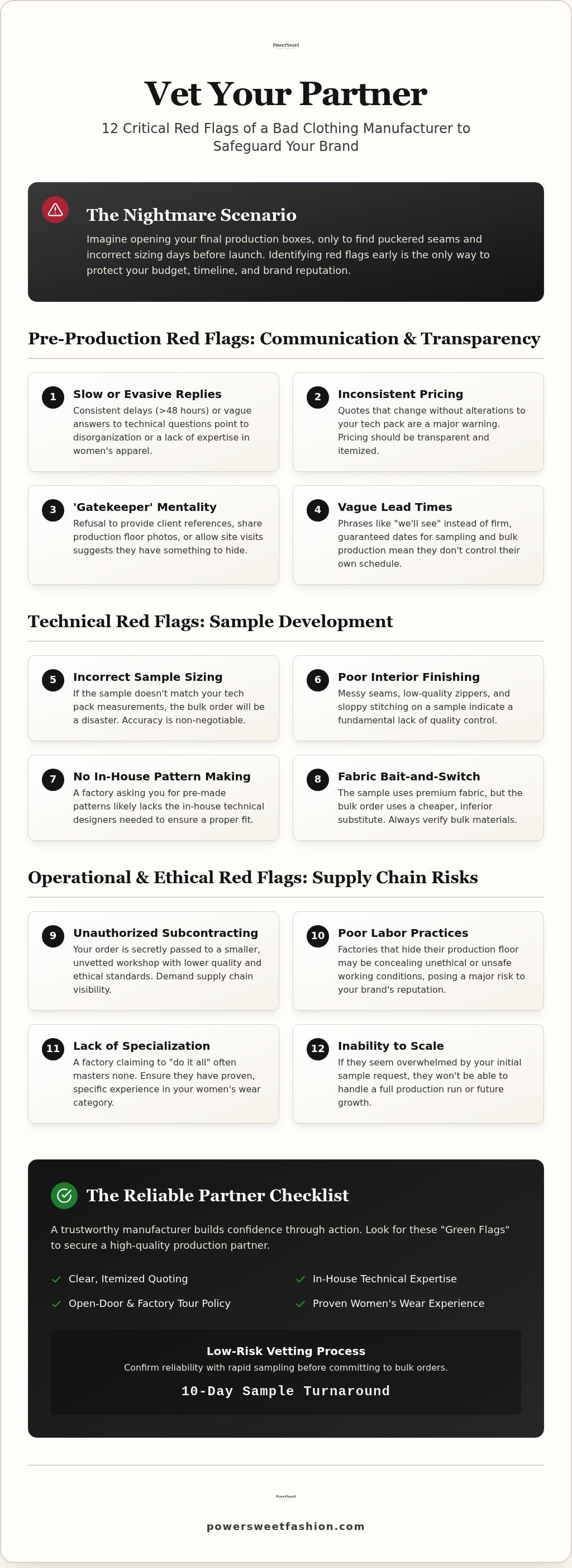
Trust begins before the first needle drops. If a factory is difficult to reach during the sales phase, they'll be impossible to find when production issues arise. Identifying early signs of a bad clothing manufacturer during the inquiry stage saves thousands in lost deposits and months of wasted time. Professionalism in the garment industry is measured by clarity and responsiveness. When a potential partner provides evasive answers regarding their specific experience with women's fashion categories, it's a signal they may lack the technical expertise required for complex draping or pattern making.
Communication should be fast and precise. We maintain a standard where initial inquiries receive detailed attention, yet many unreliable factories let emails sit for over 48 hours. This delay usually points to an overwhelmed staff or poor internal organization. Similarly, pricing should be transparent. Vague or inconsistent pricing structures that change without a logical explanation are major red flags. A reliable partner provides itemized quotes that reflect current fabric market rates and labor costs. If the numbers shift without a change in your tech pack, the manufacturer is likely testing your budget limits rather than providing an honest service.
The 'Gatekeeper' Mentality
Transparency is the hallmark of a secure supply chain. A manufacturer who hides their process is a significant risk to your brand's integrity. Warning signs include a flat refusal to provide references or case studies from previous clients. While every factory protects its specific technical secrets, there is a clear difference between protecting intellectual property and hiding incompetence. An "open-door" policy is essential. We welcome in-person factory visits because we have nothing to hide. Factories that won't share photos of the production floor or block site visits may be concealing poor clothing industry labor practices or subcontracting your orders to unvetted facilities.
Vague Lead Time Estimates
Ambiguity is the enemy of a successful fashion launch. When a manufacturer uses phrases like "we'll see" or "roughly a month" instead of providing firm dates, your timeline is in danger. These vague estimates often turn into three-month delays that miss your seasonal window entirely. Production lead time is the interval from order placement to final delivery. You need a partner who commits to specific windows for both samples and bulk production. For instance, we provide a 10-day sample turnaround and 15-20 day bulk production window to ensure your inventory arrives exactly when your marketing plan requires it. If a factory cannot guarantee dates, they don't have control over their own floor. This lack of control is one of the most common signs of a bad clothing manufacturer that every brand owner must avoid.
Technical Warning Signs in Sample Development
The sample is your physical proof of concept. It's the moment where digital tech packs become tangible reality. If a garment arrives with incorrect sizing despite clear instructions, you've identified one of the most undeniable signs of a bad clothing manufacturer. Accuracy at this stage isn't optional. A factory that ignores specific measurements during sampling will inevitably produce inconsistent results in a bulk run. Look closely at the interior finishing. Are the seams clean? Is the zipper high-quality? A lack of attention to detail in these small areas signals a lack of quality control that will plague your entire production timeline.
Pattern Making and Sizing Errors
Professional pattern making is the foundation of a successful collection. It dictates how a garment drapes and moves on the body. A major red flag occurs when a factory asks you to provide all patterns rather than offering development services. This usually means they lack in-house technical designers who understand the nuances of fit. For a deeper look at this process, check out our guide on Mastering Sample Development. We've found that poor pattern-making leads to garments that look great on a hanger but fail to fit correctly on real models. We prioritize technical precision to ensure your samples represent your brand's quality standards from day one.
Fabric Sourcing Inconsistency
The "bait-and-switch" is a common tactic used by low-tier producers to protect their margins. The sample might use premium silk, but the bulk production arrives feeling like a stiff polyester blend. Bad manufacturers cut costs by substituting inferior textiles once the contract is signed. High-quality custom women's clothing production requires absolute transparency in fabric sourcing. If your manufacturer cannot provide a verifiable material supply chain, they're likely sourcing from inconsistent, unvetted markets. Technical failures often stem from a workforce that is poorly managed or overworked. In some cases, unethical contractors have even denied them overtime wages illegally to maintain unrealistically low prices. These operational shortcuts inevitably lead to technical errors in your garments. When a factory prioritizes speed and cost-cutting over labor standards, your pattern-making and fabric consistency will always suffer. We maintain strict sourcing protocols and encourage factory visits to ensure the materials you approve are the materials we deliver.
Operational Instability and Scalability Issues
Operational stability is the backbone of any successful fashion partnership. When you encounter frequent changes in your primary point of contact or production manager, you're seeing one of the most subtle signs of a bad clothing manufacturer. This high turnover suggests internal management issues that will eventually lead to communication breakdowns and production errors. Every time a new manager takes over your account, the specific nuances of your brand's fit and finishing requirements risk being lost in the shuffle. A factory that lacks consistent leadership cannot provide the meticulous care your collection deserves.
Another major red flag is the pressure to pay your full balance before seeing any production photos or receiving a "Final Inspection" report. Transparent manufacturers encourage you to verify the work before the final wire transfer. If a factory is evasive about providing visual proof of the finished bulk order, they're likely hiding quality issues or delays. A factory that lacks these basic operational reports is demonstrating one of the clear signs of a bad clothing manufacturer. Reliability isn't just about the final product; it's about the systems that ensure the product arrives correctly every time.
The Low MOQ Trap
Many factories claim to offer low minimum order quantities (MOQs) to attract emerging brands, but they treat these smaller orders as low-priority filler. You might find that your production is constantly pushed back in favor of larger clients, or that quality drops significantly because the factory uses its least experienced workers for small runs. Identifying a partner truly equipped for small-batch production is vital for your growth. For a deeper dive into this strategy, read our guide on Scaling Small: Low MOQ Manufacturers. We've structured our facility to maintain the same high standards for small batches as we do for large-scale production, ensuring scalability doesn't come at the cost of your brand's reputation.
Disorganized Quality Control
A "hope for the best" approach to manufacturing is a recipe for disaster. If a manufacturer claims quality control is "included" but cannot explain the specific steps or provide documentation, they don't have a structured process. True quality control requires checkpoints at every stage, from fabric inspection to the final packing list. Relying on external certifications can also be risky, as recent reports have exposed a broken billion-dollar audit system that often fails to detect real operational flaws. We mitigate this risk by offering end-to-end quality control services and welcoming factory visits. Our 10-day sample turnaround and 15-20 day bulk production windows are backed by rigorous internal audits, because seeing the process in person is the only way to guarantee the stability of your supply chain.
Ethical and Supply Chain Visibility
Ethical standards aren't just moral choices; they're operational safeguards for your business. One of the most dangerous signs of a bad clothing manufacturer is a complete lack of transparency regarding their workforce and facility. If a factory provides vague answers when you ask about labor practices or environmental certifications, they're likely concealing risks that could damage your brand's reputation. Extremely low prices are another warning. When a quote falls significantly below industry averages, it often suggests unethical cost-cutting measures that compromise both garment quality and human rights. You need a partner that views transparency as a baseline, not a special request.
The Danger of Subcontracting
Unauthorized subcontracting occurs when your chosen factory sends your order to a different, unvetted facility without your consent. This practice is a major red flag because it completely dilutes quality control. You lose direct oversight, and the risk of production delays spikes as your garments move between locations. You must insist on working with the direct factory team. Signs that your "manufacturer" is actually just a middleman include an inability to answer technical questions about the machinery on-site or a refusal to allow in-person factory visits. Middlemen often prioritize their commission over your brand's specific technical requirements. They lack the specialized women's wear knowledge needed to troubleshoot complex pattern issues on the factory floor. Since 2008, we've focused on direct production to ensure every stitch happens under our meticulous care.
Supply Chain Traceability
Knowing where your buttons, zippers, and fabrics originate is now a requirement for global compliance. A good partner manages fabric and trim sourcing professionally, providing documentation for every component of the garment. If a manufacturer cannot tell you where they buy their raw materials, they lack control over their own supply chain. This ignorance leads to inconsistencies in your final product and potential legal issues. Professional sourcing means more than just finding a cheap zipper; it means ensuring that every trim is durable and color-fast. If your manufacturer treats sourcing as an afterthought, your garments will reflect that lack of care. Ethical manufacturing is a prerequisite for modern fashion brand longevity. We encourage you to vet your partners thoroughly to ensure they meet the high standards of custom women's clothing production that we've championed for over 15 years.
How to Transition to a Reliable Manufacturing Partner
Once you've identified the signs of a bad clothing manufacturer, the next step is pivoting toward a partner that aligns with your brand's growth. This transition isn't just about finding a new factory; it's about establishing a framework for accountability. Setting clear KPIs for communication and quality ensures that both parties understand the definition of success before a single garment is sewn. We recommend visiting the factory in person to verify ethics and production capabilities firsthand. Seeing the people and the machinery behind your collection is the ultimate way to replace anxiety with confidence. An "all-in-one" partner for custom women's clothing manufacturer needs reduces the friction of managing multiple vendors for fabric sourcing and pattern making.
The 10-Day Sample Stress Test
The sampling phase is your most powerful vetting tool. We use this stage to demonstrate our speed, accuracy, and communication style. By conducting a small-scale "test run" with a 10-day sample process, you can gauge how a manufacturer handles your specific technical requirements without committing your entire budget to a bulk order. Rapid prototyping allows you to iterate quickly and catch potential issues early. For a deeper look at this vetting process, consult The Professional Guide to Choosing a Manufacturer. We prioritize these fast turnarounds because we know that in the 2026 fashion market, speed to market is a competitive necessity. If a factory can't meet a sample deadline, they won't meet a production deadline.
Establishing a Long-Term Partnership
Successful brands move from a transactional mindset to a collaborative production venture. This shift requires a partner that acts as the engine for your creative vision, providing the technical expertise to bring complex designs to life. We've been refining our systems since 2008 to provide the stability you need to scale from low MOQ orders to full-scale bulk production. This partnership relies on "Open-Door Transparency," where every step of the journey is visible and documented. When you have a "Safe Pair of Hands" managing your production, you can focus your energy on marketing and brand building. If your current supplier is showing the typical signs of a bad clothing manufacturer, it's time to demand better. Schedule a factory visit or start your sample development today to experience a more transparent manufacturing process.
Securing Your Brand's Production Future
Your collection's success depends on the stability of your supply chain. By recognizing the early signs of a bad clothing manufacturer, you've taken the first step toward protecting your brand's reputation and budget. True reliability isn't found in the lowest quote, but in transparent communication, technical precision in pattern making, and ethical supply chain visibility. Every garment you release is a physical testament to your brand's standards, so choosing a partner that values quality as much as you do is essential for long-term growth.
We've spent over 15 years refining our custom women's apparel production to eliminate the risks associated with unreliable factories. Our dedicated quality control team and low MOQ specialization provide the meticulous care needed to scale your creative vision with confidence. It's time to move past the uncertainty of vague lead times and inconsistent samples. Start your production journey with a transparent partner; get your samples in 10 days. We're ready to act as the engine that powers your brand's next successful launch.
Frequently Asked Questions
How can I tell if a clothing manufacturer is legitimate before paying?
Verifying a factory's history and transparency is the most effective way to confirm legitimacy. Legitimate partners, like our team established in 2008, provide clear case studies and welcome in-person factory visits. Look for responsiveness to technical inquiries and a professional online presence. If a factory refuses to share photos of their production floor or provides evasive answers about their machinery, it's one of the undeniable signs of a bad clothing manufacturer.
What are the most common quality issues in mass-produced women's clothing?
Technical failures in women's apparel often include inconsistent sizing, puckered seams, and poor fabric drape. These issues usually stem from a lack of specialized knowledge in pattern making. You may also encounter fabric "bait-and-switch" tactics where the bulk order feels inferior to the initial sample. Working with a dedicated quality control team ensures that every garment matches your approved tech pack specifications before it leaves the facility.
Is a low price always a sign of a bad manufacturer?
Not necessarily, but an unrealistically low price often suggests unethical cost-cutting or unauthorized subcontracting. While production efficiency can lower per-unit costs, prices that fall far below market averages usually compromise labor standards or material durability. A reliable partner provides transparent, itemized quotes that reflect current textile costs and professional labor. Focus on value and transparency rather than just the lowest bid to safeguard your brand's reputation.
What should I do if my manufacturer misses a production deadline?
Review your contract for lead time guarantees and immediately request a revised production schedule with firm dates. Persistent delays are major signs of a bad clothing manufacturer and often indicate poor internal organization or floor management. We maintain a strict 15 to 20 day bulk production window to prevent these disruptions. If a partner cannot provide a logical explanation for the delay, you should begin vetting a more reliable manufacturer.
How do I know if a factory is subcontracting my order?
Look for communication gaps or sudden changes in garment quality that suggest your order has moved to an unvetted facility. If your primary contact is vague about the production status or cannot provide real-time photos of your items on the line, they may be acting as a middleman. We encourage factory visits so you can see our team handling your production directly. Direct oversight is the only way to ensure your order isn't outsourced.
Why is sample development the most important part of vetting a factory?
Sampling acts as a technical stress test for the manufacturer's accuracy and communication. It reveals their ability to translate complex tech packs into high-quality garments. Our 10-day sample turnaround allows brands to verify fit and finishing before committing to bulk orders. If a factory fails to deliver a precise sample, they'll likely fail during the production run. Use this phase to confirm their expertise and protect your budget from future errors.
Can I switch manufacturers in the middle of a production cycle?
Switching is difficult but possible if you own your patterns and tech packs. Pivoting during bulk production often leads to lost deposits and significant delays, so it's better to transition after a failed sampling phase. If your current partner shows signs of operational instability, start vetting a new manufacturer immediately. Having a reliable "Safe Pair of Hands" ready to take over ensures your brand's timeline remains intact despite a supplier transition.
What documents should a reliable manufacturer provide before bulk production?
A professional manufacturer should provide a finalized tech pack, an approved pre-production sample, and a detailed production timeline. You should also expect fabric test reports and structured quality control checklists. We prioritize transparency by offering "Final Inspection" reports so you can verify the order's quality before paying the final balance. These documents act as a roadmap for your collection and provide necessary protection for your brand's investment.


Comments