%20(1).png)
Why Quality Control Starts Before Production Begins
- Powersweet Team

- Jul 29
- 12 min read
Updated: Aug 10
Waiting until your bulk shipment arrives to catch a defect is the fastest way to erode your profit margins. In 2026, effective apparel quality control is no longer a reactive inspection; it's a preventative strategy built into your tech packs and sourcing phase. With new requirements like mandatory eFiling for product safety certificates now in effect, your technical precision is a legal and financial necessity.
You likely know the frustration of sizing inconsistencies or fabric quality that doesn't match your approved samples. These gaps in the production process lead to high return rates and manufacturing waste that your brand cannot afford. We're here to provide a reliable framework to manage your production journey with transparency and precision. This article outlines the end-to-end processes that protect your reputation and ensure every garment meets professional standards, giving you the confidence to scale from samples to bulk production without the typical rework costs.
Table of Contents
What is Apparel Quality Control and Why Does It Matter in 2026?
Apparel quality control is the systematic, multi-stage process of verifying that every garment aligns with your brand's specific safety, sizing, and aesthetic requirements. In 2026, this isn't a final check at the end of the line. It's a continuous loop that begins long before a single needle touches fabric. By establishing these standards early, you ensure that the physical product matches the creative vision you promised your customers.
The 2026 market doesn't forgive mediocrity. With the rise of "unboxing" culture and instant social media reviews, a single batch of ill-fitting dresses can go viral for the wrong reasons. A defect isn't just a lost sale; it's a permanent stain on your digital reputation. This is why we advocate for "Preventative QC." By embedding quality standards directly into your tech packs, you build a roadmap for success rather than hoping for it. It's about catching the error in the digital pattern before it becomes a thousand physical mistakes.
The Financial Impact of Poor QC on Fashion Brands
Poor quality is a silent profit killer. When a customer returns a garment due to a sizing error or a faulty zipper, you lose more than the retail price. You're hit with reverse logistics costs, the labor of processing the return, and the high probability of losing that customer's lifetime value. Unsold inventory from failed production runs eventually becomes dead stock, forcing you into deep discounting or "fire sales" that devalue your brand. Consistent quality eliminates the need for these desperate measures. Quality ROI is the ratio of inspection costs to saved return revenue.
Quality Control vs. Quality Assurance
Many brand owners use these terms interchangeably, but they serve different roles in your supply chain. Quality Assurance (QA) is the framework; it's the set of processes and standards you establish to prevent defects from occurring in the first place. Quality Control (QC) is the physical act of verification, such as the Fabric inspection process where raw materials are checked for flaws before cutting begins.
A reliable manufacturer uses both to maintain production stability. QA ensures the factory's machines are calibrated and the staff is trained, while QC catches the specific loose thread on a finished hem. Utilizing end to end clothing production simplifies this balance, as it integrates these checks into every phase from sample development to final shipment. This dual approach provides the "Safe Pair of Hands" you need to scale your brand with confidence.
The 3-Stage Apparel Quality Control Framework
Effective apparel quality control relies on a structured sequence that eliminates risk at every handoff. You cannot inspect quality into a garment at the final hour; you must build it through a three-stage filter. This framework moves from the technical precision of pre-production to the physical verification of bulk runs. For emerging brands, this structure provides the "Safe Pair of Hands" needed to manage offshore production without the fear of receiving unsellable inventory.
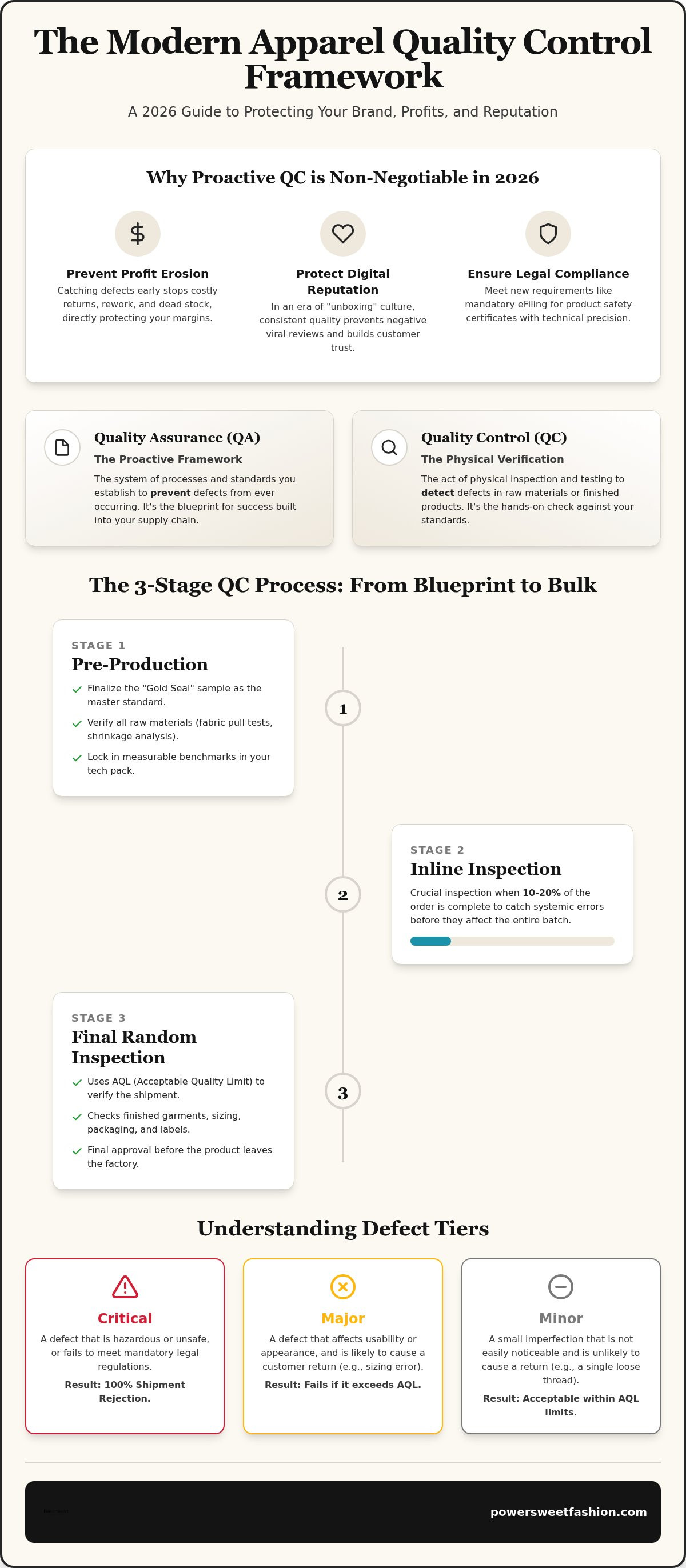
The framework consists of three distinct checkpoints. First is Pre-Production QC, where you finalize the "Gold Seal" sample and verify raw materials. Second is Inline Inspection, conducted when 10% to 20% of the run is finished. This stage is vital for catching systemic errors like incorrect thread tension before they affect the entire batch. Finally, the Final Random Inspection (FRI) uses AQL (Acceptable Quality Limit) standards to verify the shipment before it leaves the factory floor. Skipping the inline phase is a common mistake for new labels, but it's the only way to ensure the human element of sewing remains consistent across hundreds of units.
Pre-Production: The Foundation of Quality
Your tech pack serves as the master blueprint for every inspection. It must include measurable benchmarks such as stitch counts, seam allowances, and tolerance levels. Selecting the right sample development clothing manufacturer is the most critical quality decision you'll make, as this partner translates your digital specs into a physical "Gold Seal" standard. Before bulk cutting begins, we recommend rigorous fabric pull tests and shrinkage analysis. These tests prevent disasters where a garment fits perfectly at the factory but shrinks two sizes after the first wash. Our team at PowerSweet Fashion can help you establish these QC protocols during your initial sampling phase.
Inline and Post-Production: Catching the Human Element
During the sewing phase, inspectors focus on stitching consistency and seam strength. They look for puckering, skipped stitches, or raw edges that signal a breakdown in the production line. The "Measurement Spec" check is equally vital. It ensures that a size medium actually aligns with your grade rules, preventing the sizing inconsistencies that drive high return rates. Compliance with U.S. apparel safety standards, including flammability and small parts attachment, is also verified at this stage. Finally, QC extends to packaging and labelling. Correct barcodes and care labels prevent costly customs delays and warehouse processing errors, ensuring your product moves smoothly from the factory to the customer's door.
Sustainable Fabric Sourcing and Low MOQ Quality Challenges
Transitioning to eco-friendly materials introduces technical variables that standard synthetics don't share. Sustainable fabrics like organic cotton, Lyocell, and recycled polyester often exhibit higher volatility in color absorption and structural integrity. This makes apparel quality control more demanding at the material level. If you don't account for these differences during the initial sourcing phase, you risk high defect rates during bulk production.
Greige fabric inspection is your first line of defense in sustainable production. This involves checking the raw, undyed fabric for weaving defects, slubs, or contamination before it ever hits the dye vat. Once a sustainable fabric is dyed or finished, many structural flaws become permanent. By catching these issues in the "greige" state, you prevent the waste of expensive dyes and labor on substandard base materials. This proactive step is essential when managing multiple small-batch fabric mills that may have varying levels of consistency. For brands prioritizing material excellence, sourcing yarn from a heritage manufacturer like Hardings Specialist Fiber (HSF) provides a consistent foundation that reduces defects in the subsequent weaving and knitting stages.
Managing QC for Eco-Friendly Materials
Recycled textiles often struggle with colorfastness and pilling compared to virgin fibers. We recommend rigorous testing against AATCC textile testing standards to ensure your eco-friendly choices don't compromise the garment's lifespan. Verifying certifications like GOTS or OEKO-TEX is a critical part of your Quality Assurance framework, but these labels don't guarantee physical durability. Sustainable sourcing is only 'green' if the garments are high-quality enough to last. Without physical durability, the environmental benefits of organic fibers are lost to the landfill.
Maintaining Standards in Low MOQ Women's Clothing Manufacturers
There's a common myth that small production runs are easier to manage. In reality, low MOQs require more precise QC because there's zero margin for error. If you order 50 units and five are defective, you've lost 10% of your inventory and potential profit. For these boutique scales, 100% individual garment inspection is often superior to the AQL sampling used for massive runs. Every piece must be verified by hand to ensure consistency across the entire batch.
Success at this scale depends on building a partnership with a factory that understands boutique quality. Our location in Guangzhou provides a significant advantage here. We leverage the local supply chain to secure high-quality trims, zippers, and buttons even for small runs. This proximity allows for "Open-Door Transparency," where we can verify the quality of every component before it reaches the sewing floor. This level of detail ensures that your small-batch collection maintains the same professional standard as a global luxury brand.
Common Apparel Defects and How to Prevent Them
A professional apparel quality control system categorizes defects into three distinct tiers to prioritize factory corrections. Critical defects include safety hazards like broken needles left in a hem or failing mandatory flammability standards. Major defects are issues that render a garment unsellable, such as a zipper that catches or a significant sizing deviation from the tech pack. Minor defects are aesthetic imperfections, like a slightly long thread end or a small removable stain, that don't impact function but might affect premium brand perception. Understanding these categories allows you to focus your inspection budget where it matters most.
Stitching defects often stem from mechanical oversight rather than human error. Skipped stitches usually indicate an improperly timed needle or the wrong needle size for the specific fabric weight. Puckering occurs when thread tension is too high, causing the seam to gather and distort. To fix these at the factory level, we ensure technicians calibrate machines for the specific fabric blend before the bulk run begins. This technical precision prevents the need for costly rework after the garments are finished.
Sizing deviations are the leading cause of customer returns in the fashion industry. These "out of tolerance" measurements happen when a factory doesn't strictly follow the grade rules established in your tech pack. We hold factories accountable by requiring a signed-off Point of Measure (POM) guide. This document standardizes exactly where and how a garment is measured. If a garment falls outside the agreed +/- 1cm tolerance, it's flagged as a major defect. You can partner with our Guangzhou team to implement these rigorous measurement standards and protect your profit margins.
The Technical Side of Construction Defects
Needle heat is a common but overlooked cause of puckered seams, especially in synthetic or recycled polyester blends. When a needle moves too fast, it generates friction heat that can slightly melt fibers, locking the seam in a distorted shape. Slowing down the machine speed or using specialized needles solves this issue instantly. For long-term durability, especially for specialized brands like White Wear that require heavy-duty performance, we conduct button and zipper pull tests on every batch. These tests ensure that trims don't detach under normal wear, protecting your brand from "faulty product" claims and negative reviews.
Color and Print Consistency
Color shading is a frequent challenge when sourcing from multiple fabric bolts. We use Light Boxes (D65) to verify color consistency across different lighting environments, ensuring your "Midnight Blue" doesn't look purple under retail LEDs. For prints, we check alignment and "hand feel" to ensure the ink is properly cured and won't crack after washing. Managing these details requires a pre-cutting fabric inspection to catch skewed grain lines or holes before the fabric is laid out. This systematic approach ensures that every piece in your production run is a perfect match for your approved sample.
Maximizing Quality with PowerSweet Fashion’s Guangzhou Factory
At PowerSweet Fashion, we operate as an "Authoritative Facilitator" for your brand. We bridge the gap between your creative vision and the physical realities of the factory floor. Our Guangzhou-based facility isn't a black box; we actively encourage in-person factory visits for QC oversight. Seeing the production line in motion builds a level of trust that digital reports alone cannot replicate. By meeting our production team in person, you gain a deeper understanding of the meticulous care we apply to every seam and stitch.
Our 10-day sample turnaround is a critical first step in the apparel quality control cycle. Rapid prototyping allows for multiple QC iterations before you commit to bulk production. If a fit issue or fabric drape problem appears, we catch it in the sample room, not the shipping container. This speed, combined with our 15-20 day bulk lead times, ensures your brand stays responsive to 2026 market trends while maintaining industrial stability.
Our On-Site Quality Control Process
We apply industrial-grade apparel quality control standards even to our low MOQ runs. Our internal inline inspection protocols for custom women's clothing involve checking machine calibrations and stitch consistency at the start of every shift. Because we're located in the heart of Guangzhou, we source directly from the region's top-tier mills to ensure material integrity. This proximity allows us to verify fabric quality at the source, ensuring the material we cut is the exact grade you approved in the lab dip phase. You get the advantage of low MOQ flexibility without compromising on the rigorous QC expected of large-scale manufacturing.
Partnering for Long-Term Brand Growth
We act as your "Safe Pair of Hands" in China, managing the complexities of offshore production so you can focus on growth. Our end-to-end service covers everything from initial sourcing to the final pre-shipment inspection. This comprehensive oversight reduces the stress of manufacturing and ensures your brand's reputation remains untarnished. We invite you into our process through "Open-Door Transparency," making the manufacturing journey feel manageable and systematic. The next step is simple: provide your Tech Pack, and we'll prepare a quality-first quote that prioritizes your brand's standards.
Ready to produce your next collection? Contact PowerSweet Fashion for a Quality-First Consultation.
Building a Scalable Quality Foundation
Mastering apparel quality control is about more than catching loose threads; it's about building a system that protects your brand's reputation and bottom line. By implementing a three-stage framework and prioritizing pre-production testing, you eliminate the systemic errors that drive high return rates. Technical precision in your tech packs and rigorous fabric inspections ensure that your final bulk run aligns perfectly with your "Gold Seal" standard every time.
We specialize in custom women's fashion production and offer 10-day rapid sampling to help you refine your designs quickly. Our direct factory access in Guangzhou provides the "Open-Door Transparency" you need to verify every detail of your collection. Whether you're working with sustainable fabrics or boutique-scale low MOQs, we provide the industrial expertise to ensure your vision reaches the customer without compromise. This methodical approach transforms manufacturing from a source of stress into a reliable engine for your brand's growth.
Ready to secure your supply chain with a partner you can trust? Request a Production Quote with PowerSweet Fashion today. Let's turn your creative concepts into high-quality physical reality.
Frequently Asked Questions
What is the AQL standard in apparel quality control?
The AQL (Acceptable Quality Limit) standard is a statistical sampling method used to determine if a production lot meets your quality requirements without inspecting every single piece. Most apparel quality control protocols use AQL 2.5 for major defects and 4.0 for minor defects. This means the shipment is accepted only if the number of defective garments found in a random sample stays below a predetermined threshold based on the total order size.
How do I perform a quality check on a garment sample?
You perform a sample check by comparing the physical garment against your master tech pack and the "Gold Seal" approved version. Focus on the Point of Measure (POM) to ensure the fit is within tolerance, and check the interior construction for clean finishing and secure seams. It's also essential to test the drape and hand feel of the fabric to confirm it matches your sourcing requirements before you authorize bulk cutting.
What are the most common stitching defects in women's clothing?
Common stitching defects in women's fashion include puckering at the seams, skipped stitches, and uneven hem lines. Puckering often results from incorrect thread tension or needle heat on delicate fabrics like silk or Lyocell. Open seams or raw edges are considered major defects because they compromise the garment's structural integrity and aesthetic appeal, making it unsellable at a premium price point.
Can I hire a third-party inspector for my China factory?
You can and should hire a third-party inspector if you cannot visit the factory yourself to oversee production. Professional inspection firms provide an unbiased report on the production status and quality levels before the goods leave the floor. We encourage this level of transparency at our Guangzhou facility because it provides our clients with an extra layer of reassurance and empirical data before they authorize final payment.
How does low MOQ production affect quality control costs?
Low MOQ production typically increases the per-unit cost of quality control because fixed inspection fees are distributed across a smaller number of garments. In many cases, small-batch orders require a 100% individual inspection rather than AQL sampling to eliminate the risk of even a single defect. This meticulous approach protects your profit margins when there is no room for inventory waste or high return rates.
What should be included in a quality control checklist for apparel?
A comprehensive checklist must include measurement tolerances, stitch-per-inch (SPI) requirements, and functional tests for zippers or buttons. You should also verify labeling accuracy, color consistency under D65 lighting, and packaging specifications. This document acts as the final authority during a apparel quality control check, ensuring the factory has no ambiguity regarding your brand's specific expectations.
How do I handle a shipment that fails quality inspection?
If a shipment fails inspection, you should immediately issue a "Hold" order and request a detailed corrective action plan from the factory. Depending on the defect severity, the factory must perform a full rework to fix the issues or replace the substandard units entirely. It's vital to have these terms clearly defined in your manufacturing agreement to avoid financial disputes during the resolution and re-inspection process.
Why is fabric shrinkage testing important before bulk production?
Fabric shrinkage testing is necessary to prevent garments from becoming unwearable after the consumer's first wash. Different fibers react differently to heat and moisture; for example, a 5% shrinkage rate can easily change a size Medium into a Small. Testing this before bulk production allows the pattern maker to adjust the grading accordingly and ensures the finished product maintains its intended fit for the end user.


Comments