
The Professional Guide to the Custom Clothing Production Process in 2026

Updated: Sep 18
The secret to scaling a fashion brand in 2026 isn't just the design; it's the industrial precision of your manufacturing workflow. You've likely felt the anxiety of a looming launch date while waiting for samples that don't quite match your vision. It's frustrating to face vague lead times and technical jargon like Tech Packs or MOQs when your business growth is on the line. Managing the custom clothing production process requires a partner who treats your collection with the same meticulous care you put into its creation.
We understand that predictability is the foundation of a successful collection. This guide provides a clear roadmap to master the journey from initial design to bulk delivery. You'll learn how to streamline sample development, which can take as little as 10 days, and manage bulk production within a 15 to 20 day window. By the end of this breakdown, you'll have the confidence to select the right manufacturing partner and the technical knowledge to ensure your production milestones are met without the typical industry delays.
Table of Contents
What is the Custom Clothing Production Process? An End-to-End Overview
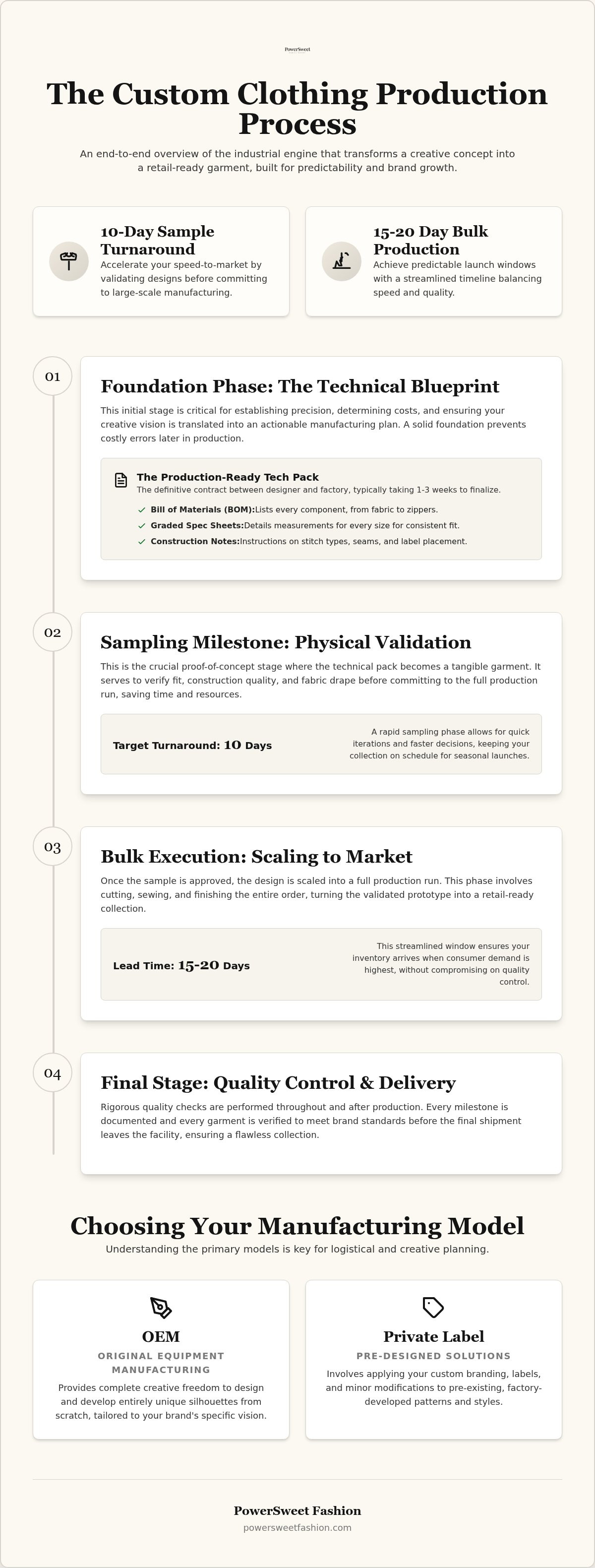
The custom clothing production process is the industrial engine that converts a designer's creative concept into a retail-ready garment. It is a structured, multi-stage workflow designed to eliminate guesswork and ensure every stitch aligns with a brand's specific identity. Rather than a fragmented series of tasks, modern manufacturing operates as a systematic transition through three foundational pillars:
Development: Creating the technical blueprints and sourcing the raw materials.
Sampling: Producing a physical proof of concept to verify fit and construction.
Bulk Execution: Scaling the approved design into a full production run for market delivery.
Understanding your manufacturing model is critical for logistical planning. Original Equipment Manufacturing (OEM) provides brands with the freedom to create entirely unique silhouettes from scratch, while private label services involve applying custom branding to pre-existing factory patterns. Choosing an end-to-end approach minimizes supply chain friction by housing fabric sourcing, pattern making, and quality control under one roof. This integration prevents the miscommunications that often occur when shifting garments between multiple vendors. By centralizing the custom clothing production process, brands gain better control over their timelines and quality standards.
The Lifecycle of a Fashion Collection
Success in fashion depends on timing. Aligning your production cycles with seasonal calendars ensures your inventory arrives when consumer demand is highest. Utilizing integrated end to end clothing production reduces overhead by streamlining logistics and cutting down on transit times between different service providers. We view the manufacturer not as a simple vendor, but as a strategic partner. This relationship acts as the engine that powers your creative vision, providing the stability needed to launch collections with precision and scale.
Why Process Transparency Matters for Brand Growth
Visibility into the factory floor prevents expensive errors like over-designing for a specific budget. When you understand the workflow, you can make informed decisions about fabric yields and construction methods that protect your profit margins. This level of production clarity also builds trust with investors and stakeholders who require predictable delivery schedules. Open-door transparency is our industry standard because it demystifies the manufacturing world. It provides a safe pair of hands for your brand, ensuring that every milestone is documented and every quality check is verified before the final shipment leaves the facility.
The Foundation Phase: Tech Packs and Fabric Sourcing
Every successful collection begins with a technical blueprint. In the custom clothing production process, the transition from a creative sketch to a physical garment requires absolute precision. This foundation phase determines your production costs, construction quality, and speed-to-market. Skipping steps here often results in expensive revisions during the bulk phase. By establishing a clear technical standard early, you protect your brand from the common pitfalls of garment manufacturing.
Creating a Production-Ready Tech Pack
A Tech Pack serves as the definitive contract between a designer and the factory to ensure every detail is executed with total accuracy. Without this document, factories are forced to make assumptions that rarely align with your vision. Finalizing these flat sketches and technical specifications typically takes one to three weeks. A complete pack must include several critical elements to be considered production-ready:
Bill of Materials (BOM): A comprehensive list of every physical component, from the primary fabric to the specific thread weight and brand of zipper.
Graded Spec Sheets: Detailed measurements for every size in your range to ensure consistent fit across small, medium, and large.
Construction Notes: Specific instructions on stitch types, seam allowances, and placement of internal labels or embroidery.
Errors in this document are the primary cause of production delays. Missing information regarding trim placement or fabric weight can stall a factory line for days while they wait for clarification. Our team focuses on refining these details early, acting as a safe pair of hands to prevent these logistical bottlenecks.
Strategic Fabric and Trim Sourcing
Fabric sourcing is where the technical meets the tactile. This stage involves finding the right texture, weight, and durability to match your design goals while balancing bulk manufacturing costs. According to The Textile Institute's Guide to Clothing Manufacturing, integrated planning between design and material procurement is vital for maintaining supply chain stability. Identifying and vetting the right materials can take one to four weeks depending on the complexity of your requirements.
Sourcing materials locally to the production site is a strategic move that slashes lead times. When a factory utilizes its existing supply chain network, it can procure buttons, zippers, and custom labels faster and at a lower cost than a brand sourcing independently. This proximity allows for rapid quality checks of fabric rolls before they are cut. Our team provides end-to-end fabric sourcing to ensure your materials meet rigorous industry standards before the first sample is even sewn. Pattern making then translates these materials into a physical shape, ensuring your sizing remains consistent across the entire collection.
The Sampling Milestone: Why 10-Day Turnarounds Change the Game
Sampling is the moment of truth where your technical blueprints meet the physical reality of the fabric. In the custom clothing production process, this milestone acts as a filter to catch construction issues before they reach the bulk sewing line. It's the stage where you verify that the drape of a silk-blend or the tension of a seam matches your original vision. While industry averages for overseas sampling often stretch to five weeks, a 10-day turnaround removes the traditional bottleneck that stalls most collection launches.
The Prototype vs. The Pre-Production Sample
There is a distinct difference between an initial design prototype and the final pre-production sample (PPS). The prototype is a rough draft used to check the basic silhouette and pattern accuracy. Once you've refined the fit through a feedback loop, the PPS becomes the "gold" sample. This piece remains in the factory as the absolute reference for the quality control team. Using a specialized sample development clothing manufacturer ensures that your patterns are adjusted with precision during this phase. This refinement provides a stable foundation for bulk readiness, ensuring that the final garments mirror the approved sample exactly.
Speed as a Competitive Advantage
For influencer-led brands and fast-fashion boutiques, speed is a survival requirement. A 10-day sampling window allows you to test emerging trends without the risk of heavy upfront investment in unproven designs. This agility reduces your overall time-to-market, enabling you to capture seasonal windows that competitors might miss due to long lead times. Partnering with a low MOQ women's clothing manufacturer allows you to iterate quickly and move from a confirmed sample to a retail-ready batch with total confidence. This rapid transition is the engine that powers modern, responsive fashion brands. By shortening the gap between design and delivery, you maintain a fresh inventory that responds directly to consumer demand.
Bulk Production Execution: 15-20 Day Lead Times and Quality Control
Bulk production is where your creative vision scales to meet market demand. In the custom clothing production process, the transition from an approved "gold" sample to a full production run requires a disciplined factory floor. We achieve a 15-20 day bulk lead time by integrating every stage of the workflow under a single management system. This eliminates the logistical delays typical of factories that outsource their finishing or quality control to third-party vendors. Predictable timelines allow you to plan your marketing campaigns with the certainty that your inventory will arrive on schedule. For specialized retailers like Adorb Custom Tees, this level of reliability is what makes time-sensitive, themed product launches possible.
Step 1: Fabric Inspection and Bulk Cutting. Every roll of fabric undergoes a rigorous check for color consistency and structural defects before it reaches the table. Once verified, we use the approved pattern to execute precision cutting across all sizes in your range.
Step 2: The Sewing Line. Garments move through specialized stations where our team balances high-speed output with construction integrity. This phase is the heart of the manufacturing journey, where the technical specs from your tech pack are physically realized.
Step 3: In-line Quality Control. We perform inspections at multiple stages of assembly, such as checking seam tension and zipper placement before the garment is fully closed. This prevents small errors from becoming systemic issues across the entire batch.
Step 4: Final Finishing. The process concludes with professional steam ironing, hang-tagging, and individual packaging. This ensures every piece is retail-ready the moment it arrives at your warehouse.
The Mechanics of Mass Production
The complexity of your fabric and the total order volume are the primary factors that dictate your final per-unit cost. Managing low MOQs alongside bulk efficiency requires a factory that can pivot quickly between styles without losing momentum. The transition from sample approval to the cutting table is a critical window; any delay here ripples through the entire production schedule. We maintain a tight feedback loop to ensure that as soon as you sign off on your pre-production sample, the materials are staged for immediate execution. This streamlined approach is how we maintain the speed-to-market advantage that modern brands require. For brands looking to extend this professional image to their promotional materials, corporategiftprinting.sg offers custom-designed gifts that align with your business identity.
We utilize the AQL (Acceptable Quality Level) standard to ensure every batch meets professional retail requirements. This statistical sampling method allows us to maintain high-speed output while keeping defect rates well below industry averages. A final inspection is the last line of defense before your goods leave the floor. It protects your brand's reputation and significantly reduces return rates, which is essential for maintaining healthy profit margins. If you're ready to scale your collection with a partner that prioritizes precision, you can start your bulk production with our expert team today.
Choosing an End-to-End Partner for Women's Fashion
Managing the custom clothing production process for women's apparel requires a level of technical nuance that generic manufacturers often lack. Unlike menswear or basic jersey production, women's fashion involves a vast array of silhouettes, complex fabric drapes, and intricate detailing that demands specialized handling. Selecting a partner who understands these variables is the difference between a collection that fits perfectly and one that requires costly, late-stage revisions. An end-to-end manufacturer acts as an authoritative facilitator, removing the logistical stress that often overwhelms designers during a launch window.
Working with a specialized custom women's clothing manufacturer provides you with a safe pair of hands for your creative vision. We prioritize transparency and efficiency, ensuring that your transition from a digital design to a physical product is seamless. This partnership model allows designers to focus on their brand strategy while we manage the mechanics of the factory floor. By centralizing every stage from sourcing to shipping, we eliminate the communication gaps that lead to quality drift.
Specialized Expertise in Women's Apparel
Women's wear often utilizes delicate materials like silk, chiffon, or crepe that require specific machine settings and expert handling. A factory specialized in these categories understands how to manage fabric tension and seam integrity to prevent puckering or damage. Pattern making is also more nuanced in this sector. It requires precise grading to ensure consistent sizing across diverse body types and silhouettes. Brands that utilize techniques from a specialized resort wear manufacturer often see higher success rates because these producers are accustomed to the high-quality finishes and lightweight fabrics essential for premium fashion collections.
The PowerSweet Advantage: Speed and Reliability
Predictability is our core value proposition. Our 10-day sample turnaround and 15-20 day bulk production lead times serve as the ultimate growth engine for your brand. These figures are the result of a streamlined industrial system designed for speed and precision. We view our production team as an extension of your own office. This human element bridges the gap between digital communication and the physical reality of the sewing line. We encourage maximum transparency throughout the custom clothing production process. We invite you to meet our team and oversee the quality control milestones in person. This open-door policy ensures that you remain in control of your collection's standards from the first stitch to the final delivery.
Scale Your Collection with Predictable Manufacturing
Mastering the custom clothing production process is the difference between a collection that launches on time and one that misses its seasonal window. You now have a clear roadmap from the technical foundations of a tech pack to the final quality control checks on the sewing line. By prioritizing transparency and speed, you can move from a creative vision to physical inventory without the traditional friction of fragmented supply chains. This systematic approach ensures that every garment meets your brand's standards while maintaining a competitive speed-to-market.
We provide the industrial infrastructure to power your brand's growth. Our system is built on reliability; we deliver 10-day sample turnarounds and 15-20 day bulk production lead times to keep you ahead of market trends. Whether you're a boutique owner or a growing fashion brand, our low MOQ options ensure that you can test new designs with minimal risk. We invite you to treat our factory as an extension of your own office, where your creative goals are met with technical precision.
Ready to start your production? Contact PowerSweet Fashion for a quote today.
We look forward to building a lasting partnership and bringing your creative vision to life with precision and scale.
Frequently Asked Questions
How long does the entire custom clothing production process take?
Integrated timelines are significantly faster than traditional industry averages. Sample development typically takes 10 days, followed by bulk production in 15 to 20 days. This excludes shipping and the initial phase where your tech pack is finalized. By streamlining these stages, brands can move from concept to retail-ready inventory in approximately one month. This speed allows fashion labels to respond to trends in real-time without standard three-month lead times.
What is a Tech Pack and why do I need one for production?
A Tech Pack is the technical blueprint of your garment that serves as a contract between the designer and the factory. It contains the bill of materials, graded spec sheets, and specific construction notes for every size. You need one to ensure absolute accuracy during the custom clothing production process. Without this document, factories are forced to guess measurements or stitch types, which often leads to costly errors and production delays.
Can I start a clothing line with low minimum order quantities (MOQ)?
Yes, you can launch a collection using low MOQ options designed for growing brands and influencer labels. This approach minimizes upfront investment and allows you to test market demand before scaling. We specialize in these smaller runs to help boutique brands maintain lean inventory levels. It provides the flexibility to iterate on designs quickly while still accessing professional-grade manufacturing facilities and high-quality construction standards that were once reserved for major retailers.
What is the difference between sampling and bulk production?
Sampling is the creation of a single prototype to verify fit and design, while bulk production is the mass manufacture of the final approved garment. The sample acts as a proof of concept where you refine pattern details and fabric choice. Bulk production only begins after the "gold" sample is signed off. This phase focuses on efficiency and consistency across hundreds or thousands of units to ensure every piece is retail-ready.
How does a factory ensure the quality of my garments?
Quality is maintained through a multi-stage inspection system that includes fabric checks, in-line sewing reviews, and a final quality control audit. We utilize the Acceptable Quality Level (AQL) standard to monitor defect rates during assembly. Every garment undergoes a rigorous finishing process, including professional steaming and individual packaging, to ensure it meets retail standards. These systematic checks protect your brand's reputation and significantly reduce consumer return rates after your launch.
Do I need to source my own fabrics and trims?
You don't need to source materials independently if you work with an end-to-end partner. We provide comprehensive fabric and trim sourcing services to procure buttons, zippers, and textiles on your behalf. By leveraging our established supply chain networks, we can find durable materials that match your design vision at a lower cost. This integrated approach simplifies the logistics of the custom clothing production process and accelerates your overall timeline.
What happens if I need to make changes after the sample is made?
Changes are handled during the feedback loop after you receive your initial prototype. You can request revisions to the fit, fabric, or construction details before bulk production begins. Our pattern making team adjusts the technical blueprints based on your specific notes to create a revised pre-production sample. It's essential to finalize these adjustments during the sampling phase, as making changes after the cutting table stage is often impossible without restarting the run.
How do I calculate the per-unit cost of my custom designs?
Per-unit costs are calculated based on order volume, fabric complexity, and specific construction requirements. A basic garment with high order volume will have a lower unit price than an intricate design with low MOQs. We provide detailed quotes after reviewing your Tech Pack and material needs. This transparency helps you manage your production budget and set retail prices that protect your profit margins throughout the entire manufacturing journey.


Comments