
Is Starting a Clothing Brand Profitable? What Shapes Profit

Profitability is shaped long before the first garment reaches a customer. Starting a clothing brand can become profitable, but startup brands typically take 3 to 5 years to reach that point. Whether starting a clothing brand is profitable depends on how well sales cover production, fulfillment, marketing, and other operating costs.
It’s easy to focus on the selling price and underestimate what remains after an order is made and delivered. Strong demand matters, but so do the choices behind each product: how it’s manufactured, how much inventory you hold, and how quickly customers buy it.
This guide breaks down the main factors that affect clothing brand profitability, from customer validation and launch models to manufacturing and unit economics. You’ll see how these decisions shape cash flow and margins, and why a lower-cost launch isn’t always the most profitable route. The aim is to help you assess the numbers and build a production plan that suits your customers and investment capacity.
Table of Contents
1. Inventory, warehousing, manufacturing, and fulfillment costs
Choose a launch model before committing cash to inventory. These are different operating setups, not comparable profit forecasts.
Print-on-demand avoids buying stock before customers order.
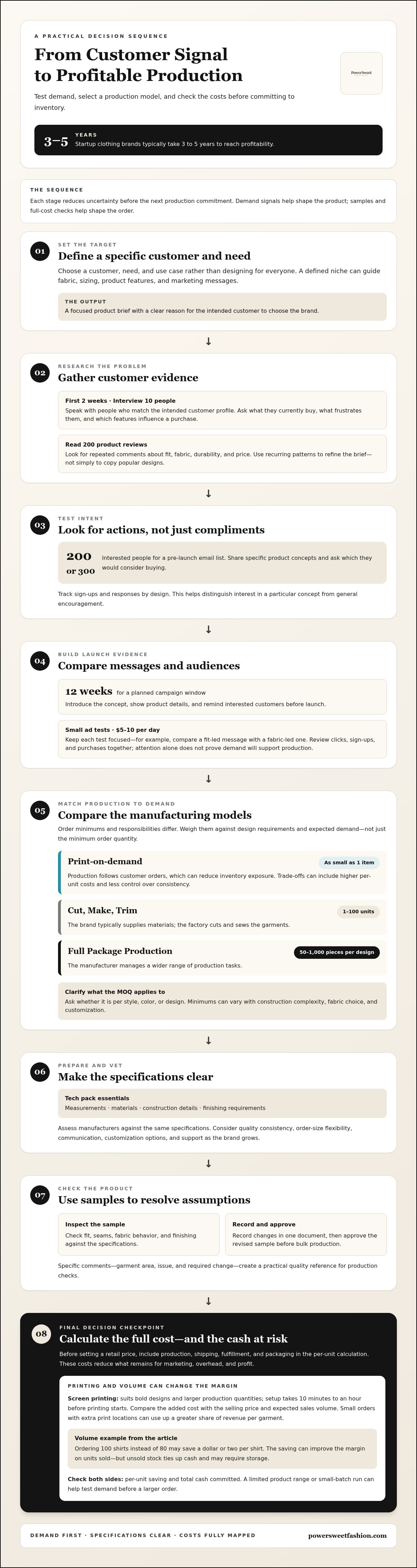
Calculate the cost to make and deliver each order before setting its price. Include production, shipping, fulfillment, and packaging in your per-unit calculation. These expenses reduce what remains to cover marketing, overhead, and profit.
Printing choices also change the margin. Screen printing suits bold designs and larger production quantities, but setup takes 10 minutes to an hour before printing starts. Compare that added cost with the selling price and expected sales volume before approving the design. Small orders with extra print locations can absorb a greater share of revenue per garment.
Volume can lower unit costs, but only if the extra inventory sells. In one example, ordering 100 shirts instead of 80 may save a dollar or two per shirt. That saving improves the production margin on sold units, yet unsold stock ties up cash and may require storage. Calculate both the per-unit saving and the total cash committed. A limited product range or small-batch run can help test demand before a larger production order.
2. Choosing a niche and validating customer demand
A defined niche gives product decisions a clear target. Rather than designing apparel for everyone, identify a specific customer, need, and use case. For example, a brand might focus on workwear for a particular profession or everyday pieces suited to a specific fit preference. This focus helps guide fabric, sizing, product features, and marketing messages. It also gives potential buyers a concrete reason to choose the brand.
Test the idea before building a full range. During the first two weeks, interview 10 people who match the intended customer profile. Ask what they currently buy, what frustrates them, and which features influence their purchase. Then read 200 reviews of products in the niche. Look for repeated comments about fit, fabric, durability, and price. Use those patterns to refine the product brief, not simply to copy popular designs.
Demand signals should involve action, not just compliments. Build a pre-launch email list of 200 or 300 interested people, then share specific product concepts and ask which they would consider buying. Track sign-ups and responses by design.
Plan marketing around a defined launch window. A 12-week campaign gives the brand time to introduce the concept, show product details, and remind interested customers before launch. Small ad tests at $5-10 per day can compare messages or audiences. Keep each test focused, such as contrasting a fit-led message with a fabric-led one. Review clicks, sign-ups, and purchases together; attention alone doesn’t prove that demand will support production.
Repeat sales depend on a product experience that delivers on its promise. Use feedback about fit, fabric, and construction to improve later releases, and give customers a reason to return with useful product updates or coordinated apparel. Customizing quality blank garments can also test a design without developing every garment from scratch. Add a logo, print, or embroidery, then assess customer response before expanding the range. This approach can reveal which details customers value before you commit to broader product development.
3. Manufacturing models and minimum order quantities
The manufacturing model determines how much control, customization, and inventory commitment a brand takes on. Print-on-demand manufacturers usually accept orders as small as one item. That can suit a first test, since production follows customer orders. Full Package Production manufacturers may set minimum order quantities from 50 to 1000 pieces per design. Cut, Make, Trim manufacturers may handle orders from one unit to 100 units.
Each model involves different production responsibilities. With Full Package Production, the manufacturer manages a wider range of production tasks. Cut, Make, Trim typically means the brand supplies materials while the factory cuts and sews the garments. Print-on-demand can reduce inventory exposure, but may mean higher per-unit costs and less control over consistency. Weigh these trade-offs against your design requirements and expected demand, not just the order minimum.
Minimum order quantities matter because they affect how much inventory you may need to plan for. A 50-piece minimum may work for a focused design test; a 1000-piece minimum requires a broader sales plan and more cash committed to stock. Ask how an MOQ applies: per style, color, or design. A factory’s minimum can also vary by construction complexity, fabric choice, and customization. Clarifying those details before sampling helps prevent a mismatch between your product plan and production capacity.
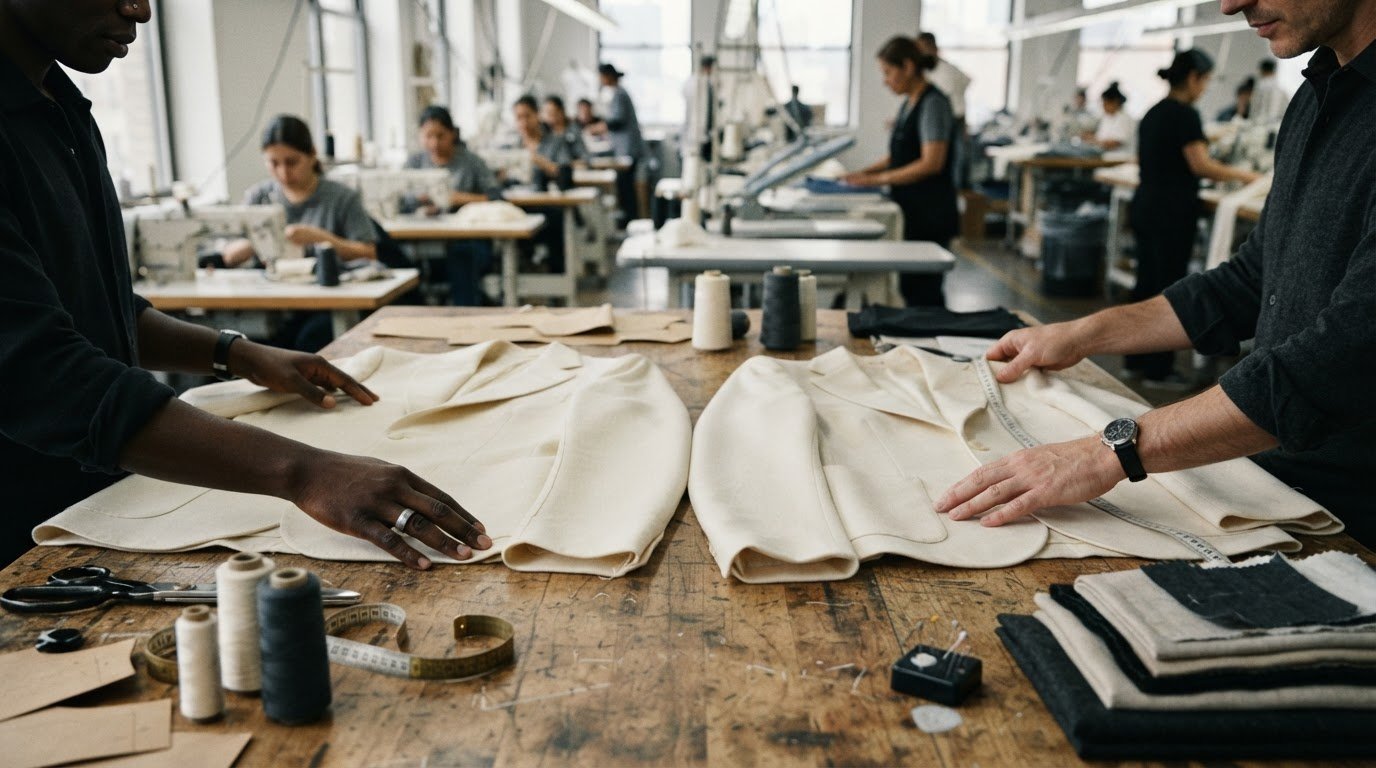
Use a structured vetting process. First, prepare a clear tech pack with measurements, materials, construction details, and finishing requirements. Then assess manufacturers against the same specifications. Consider quality consistency, order-size flexibility, communication, customization options, and support as your brand grows. These criteria help you judge whether a manufacturer can deliver your current design and adapt as your range develops.
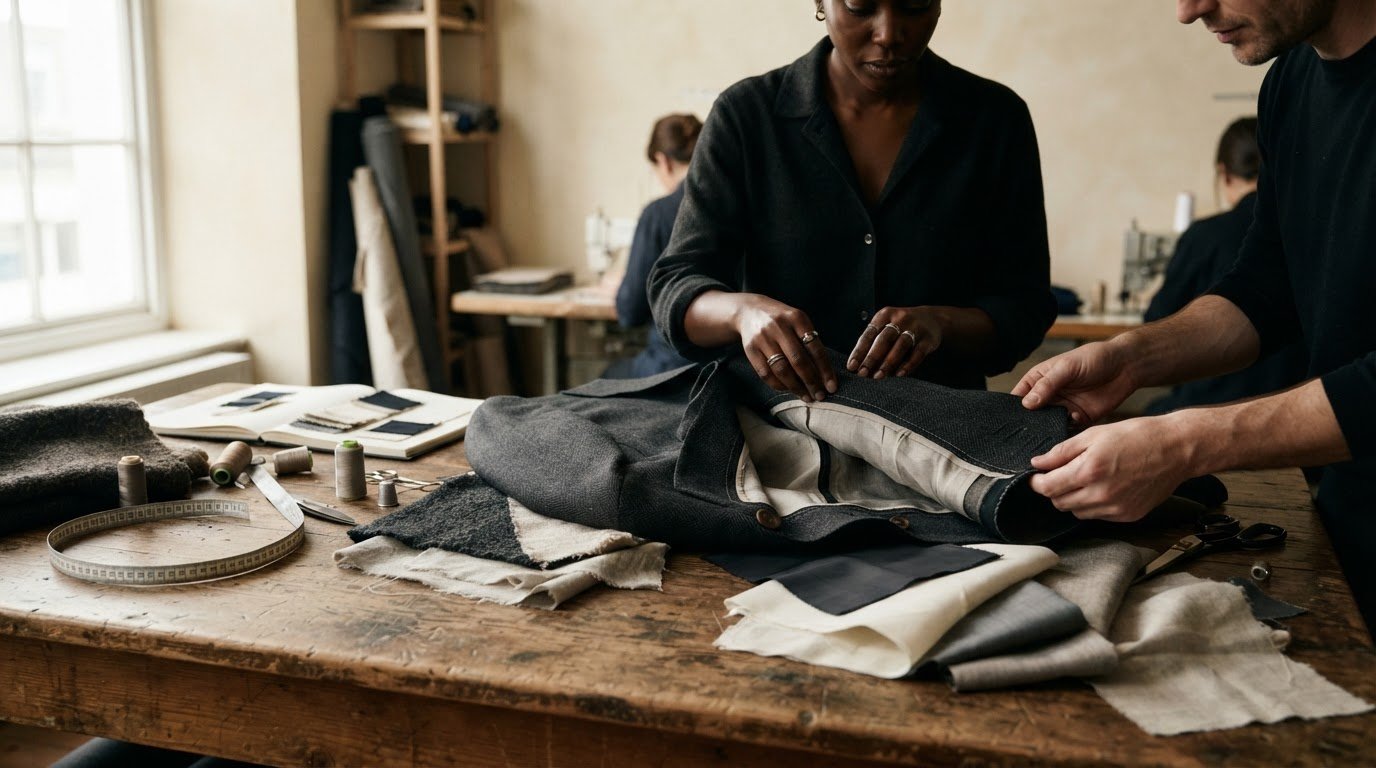
Samples turn assumptions into feedback. Check fit, seams, fabric behavior, and finishing against your specifications, then record required changes in one document. Approve the revised sample before bulk production. This gives you a practical quality reference for production checks and reduces the risk of unclear expectations. Make comments specific: identify the garment area, the issue, and the adjustment needed.
Decide what you can manage yourself before choosing a model. If you want close control over fabric and construction, compare full-package and CMT workflows. If you’re testing demand with minimal inventory, print-on-demand may be a better fit. Match the MOQ to realistic sales expectations, then confirm that the sample meets your product brief. Look for a manufacturing partner whose quality, order flexibility, communication, customization, and growth support fit your needs.
4. Selecting a business model and launch path
Your launch model determines how much cash is committed before the first sale. Print-on-demand brands may reach market in 1-3 weeks, while traditional clothing businesses may take 3-6 months. The faster route can help test product interest, while a longer production path allows more control over garment development. Choose based on your product requirements, audience, and capacity to fund upfront work.
An online-first model can keep the initial operation focused, but the sales channel still needs to suit your customers. Identify which channels your target audience already uses, then build the launch around them. A physical store requires a different level of setup than online selling.
Pre-launch demand can guide how much to produce. Build an email list of 200 or 300 interested people, then share the specific products, sizes, and launch timing. If the brand already has an audience, a capsule collection of 4-8 styles can give customers a focused first range. Another route is cut-to-order: test interest in the brand first, then make items in response to orders. These approaches connect production volume to clearer demand signals.
Keep early spending focused on learning. Customizing quality blank apparel can help you avoid developing every garment from scratch. Compare each activity by the audience it reaches and the response it generates, rather than treating reach alone as proof of sales potential.
Plan marketing across both sides of launch. Before release, show product details, collect sign-ups, and explain what makes the offer distinct. After release, use customer questions and order patterns to guide the next promotion or product decision. A 12-week campaign provides a planning frame, but assign each stage a clear job: build awareness, convert interest, then support follow-up purchases. Keep a record of campaign spend and sales so you can judge which channel contributes to revenue.
Before committing to a launch path, map the sequence: develop the offer, prepare the sales channel, promote it to likely buyers, then match production to observed interest. The right balance depends on how much product control the brand needs and how much upfront inventory it can carry. A lean test can limit initial commitments; a larger planned release can support a broader range when demand and capacity align.
5. Factors that affect clothing brand profitability
Profit depends on what remains after product and operating expenses, not sales alone. A startup clothing brand’s average gross profit margin is about 40%, compared with an apparel industry average gross profit margin of 51.93%. One estimate places a startup brand’s net profit margin around 3.15%. These figures describe different measures: gross margin focuses on product costs, while net margin also reflects broader business expenses. Founders asking, “Is starting a clothing brand profitable?” should first separate revenue, gross profit, and net profit in their forecasts.
Product complexity and customer expectations affect both production costs and acceptable prices. Before adding details, ask, “Is starting a clothing brand profitable if this audience won’t pay for the extra construction?” Each feature should reinforce the product’s identity or value to the customer.
Sales channels affect how much revenue remains per garment. Online sales avoid the wholesale split, but still involve customer-acquisition and order costs. Compare each channel’s contribution after its associated costs instead of treating the retail price as earnings. This distinction helps answer, “Is starting a clothing brand profitable through this channel?”
For U.S. clothing brands, plan for business registration and tax obligations, textile labeling, and trademark considerations. Applicable requirements depend on the business, products, and places where it sells. Include these obligations in operating plans alongside product development and sales. A clear identity also calls for careful name selection, since a brand name and its trademark status are separate considerations.
The biggest risks include committing too much cash before demand is clear, underpricing products, and producing designs customers don’t buy. One example describes 600 shirts left behind after a clothing-line owner abandoned the business. Track sell-through, returns, and repeat orders by style. If one design stalls, use customer feedback before expanding the range or placing another order. This helps limit the cost of carrying products that don’t match actual demand.
Early revenue also raises a choice between owner withdrawals and reinvestment. Compare immediate cash needs with planned spending on product improvements, marketing, or inventory, then set a decision rule. A useful final question is, “Is starting a clothing brand profitable when these choices are repeated over time?” The answer depends on whether demand supports the costs, pricing, and operating decisions as the brand develops.
PowerSweet Fashion: Custom Women's Clothing Production
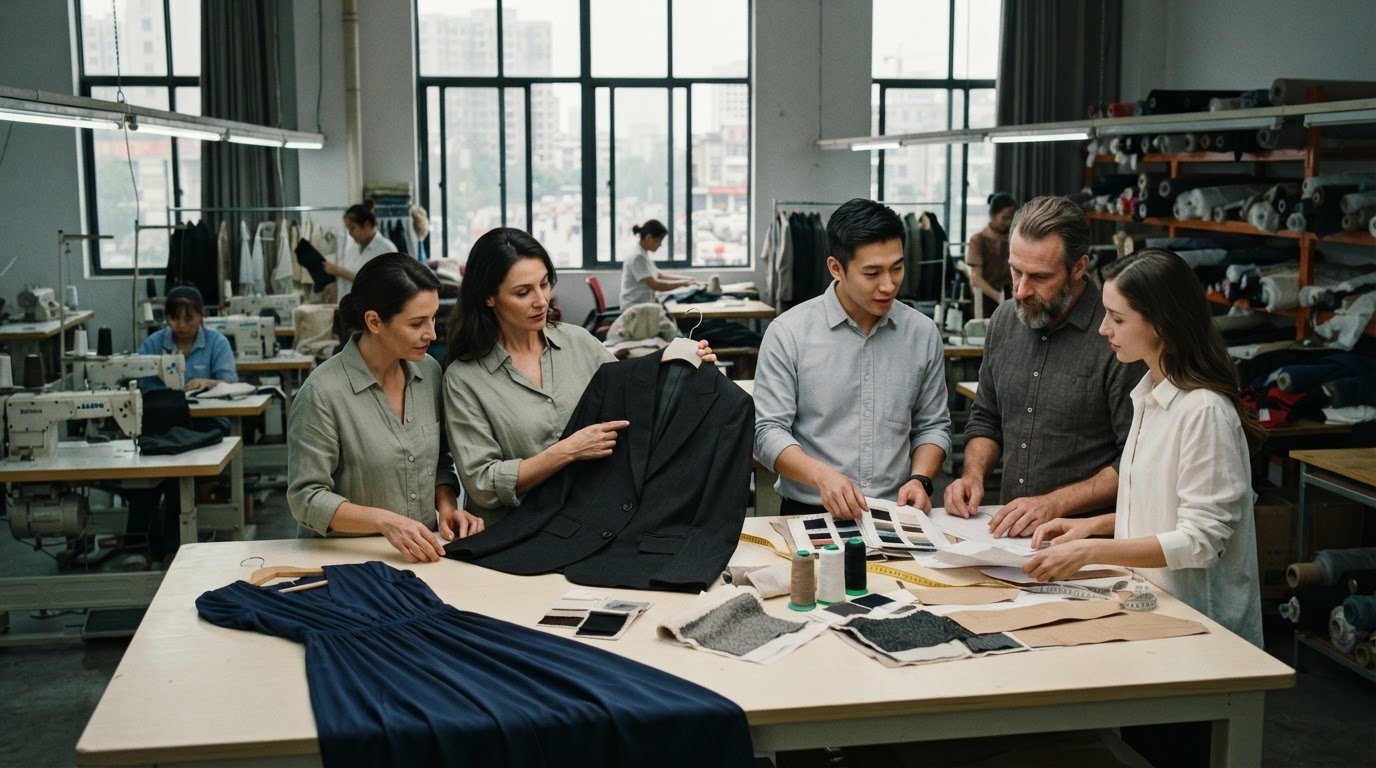
PowerSweet Fashion supports brands moving from product planning to custom women's clothing production. Turn to the team for garment development, fabric sourcing, and quality control for your clothing line. These production services connect your design brief with the finished product and help clarify decisions before scaling.
Sample Development lets you assess a garment before bulk production. Samples are ready in 10 days, and bulk production takes 15-20 days. Low minimum order quantities can also help brands plan production around their launch needs. Together, these options give you a practical way to progress from concept to production while keeping product decisions grounded in the sample.
Contact PowerSweet Fashion to discuss your clothing production needs and next steps.
Turn your concept into a workable production plan
Profitability is easier to manage when creative decisions connect with production choices early. Before expanding a clothing line, define the customer, specify the garments, and decide what you need to learn from the first release. Whether starting a clothing brand is profitable depends on building a model that fits your audience and your capacity to execute it.
That planning stage is where production support can make the next step more practical. PowerSweet Fashion offers custom women’s clothing production, sample development, and fabric sourcing to help turn a product direction into garments ready for review. A clear brief gives the production process a stronger starting point and keeps design choices tied to the brand’s goals.
Discuss your clothing brand with PowerSweet Fashion and explore a production path for your next collection. With a focused plan and the right product decisions, you can move forward with greater clarity.
Frequently Asked Questions
How profitable is a clothing brand?
A clothing brand can be profitable, but revenue alone doesn’t show what the owner keeps. Startup brands typically take 3 to 5 years to become profitable, so plan for the time between launch and positive net earnings. Track gross profit, operating expenses, cash tied up in stock, and owner withdrawals separately. That view helps distinguish a business with strong sales from one that consistently generates usable profit.
How profitable are clothing brands on average in the United States?
There isn’t one average that describes every U.S. clothing brand. Startup clothing brands typically generate $10,000 to $75,000 in first-year revenue, but revenue is not take-home income. Profit depends on what remains after production, selling costs, and operating expenses. Use industry figures as context, then build a forecast from your own planned products, expected order mix, sales channels, and ongoing costs.
What are typical profit margins for clothing brands and apparel retailers?
Gross and net margins measure different things. A startup clothing brand’s average gross margin is about 40%, compared with an apparel industry average gross margin of 51.93%; one estimate places a startup brand’s net margin around 3.15%. Gross margin reflects product costs against sales, while net margin accounts for broader business expenses. Compare like with like, and calculate both for your own sales channels.
How much does it cost to start a clothing brand in the U.S.?
These ranges describe different scopes. Before choosing a budget, identify whether it needs to cover product development, sales-channel setup, marketing, inventory, and fulfillment.
What are the main startup and ongoing costs for an independent clothing brand?
Startup costs can include product design, samples, initial inventory, a sales channel, and launch promotion. Ongoing expenses may include replenishing stock, storing and fulfilling orders, customer acquisition, packaging, and operating the sales channel. Separate one-time setup costs from recurring expenses in your forecast. Then update the plan as actual orders show which products need replenishment and which marketing activities bring in buyers.
How much can clothing brands earn per product or order after production and shipping costs?
Calculate what remains per order by subtracting production and shipping costs from the revenue collected. Then account for expenses such as packaging, marketing, and channel costs before calling the remainder profit. The result varies with product construction, selling price, shipping arrangements, and sales channel. Track this contribution by style and order type: even a strong seller can generate little net profit if its costs are high.
What sales volume does a clothing brand need to break even?
Calculate break-even sales by dividing fixed costs for the period by contribution per unit. Contribution is the revenue per unit minus variable costs, including production, shipping, and fulfillment. If a brand sells through both wholesale and online channels, calculate each channel’s contribution separately before combining them. This gives a more useful target than one overall sales figure because channel economics can differ.
Which clothing brand business models are most profitable: print-on-demand, private label, or custom manufacturing?
No model is automatically the most profitable. Print-on-demand can limit inventory exposure, while private label can use existing garment designs with brand customization. Custom manufacturing offers more control over garment specifications but requires careful planning for development and production. Compare each model by contribution per sale, customer demand, product differentiation, and cash tied up before orders arrive. Choose the one that fits your sales plan and product identity.
Comments