%20(1).png)
Scaling Small: The Strategic Power of Low MOQ Women's Clothing Manufacturers in 2026

In 2026, the most successful fashion brands aren't the ones with the largest warehouses; they're the ones with the fastest reaction times. Stalling your launch because a factory demands a 500-unit minimum is no longer a necessary rite of passage. You likely recognize the frustration of being ignored by high-volume plants or dealing with poor quality from small-batch facilities that don't take your brand seriously. Finding a reliable low MOQ women's clothing manufacturer that applies luxury-level technical precision to a 50-unit order is the key to surviving a volatile market.
We agree that tying up your capital in unproven inventory is a strategic mistake that limits your ability to pivot when trends shift. This article will teach you how to launch a professional-grade collection with as few as 50 to 100 units per style while maintaining the agility of a digital-first brand. We'll break down the mechanics of 10-day sample development and 20-day production cycles. You'll also learn how to navigate new 2026 compliance standards, such as the EU Digital Product Passport, without sacrificing speed or your bottom line.
Table of Contents
What is a Low MOQ Clothing Manufacturer and Why is it the 2026 Standard?
Minimum Order Quantity, or MOQ, is the baseline volume a factory requires to initiate a production run. For decades, the industry standard sat at 500 units per style; a figure dictated by the rigid setup times of traditional garment machinery. Today, that threshold has collapsed. A modern low MOQ women's clothing manufacturer now operates profitably at 50 to 100 units per style. This shift isn't just about smaller numbers. It represents a fundamental change in how garments are engineered, utilizing modular production lines that allow for rapid transitions between different designs without the heavy downtime costs of the past.
It's vital to distinguish between Stock Low MOQ and Custom Low MOQ. Stock options involve purchasing pre-existing "white label" designs and adding your branding. While fast, it lacks the unique DNA required for a competitive brand in a crowded market. Custom Low MOQ (OEM) production allows you to develop original patterns, source specific fabrics, and maintain total creative control over the final product. This precision-focused approach integrates Lean manufacturing principles into the fashion cycle. By producing only what the market demands, brands effectively eliminate the financial drain of deadstock and overproduction, which is the most effective way to practice sustainable fashion in 2026.
The Rise of the Agile Boutique Brand
The traditional four-season fashion calendar is dead. It's been replaced by a continuous cycle of social media "drops" where speed is the primary currency. Influencers and digital-native designers can't wait six months for a bulk shipment to arrive. They need a boutique clothing manufacturer that functions as a high-speed partner. This transition from "Fast Fashion" to "Responsive Fashion" means brands produce small batches, gauge real-time customer feedback, and restock only the winners. It's a strategy that prioritizes relevance over sheer volume, ensuring every piece you produce already has a waiting buyer.
Lowering the Barrier to Entry for Designers
Starting a fashion line used to require massive capital expenditure (CAPEX) that locked out talented creators. Committing to 1,000 units of an unproven design was a high-stakes gamble that often led to bankruptcy before a brand even found its voice. By partnering with a low MOQ women's clothing manufacturer, you drastically reduce your initial financial exposure. You can launch a full collection of five distinct styles with the same budget previously required for a single bulk order. This allows you to test market fit with precision and pivot based on actual sales data. There's a significant psychological benefit to this approach; it removes the "fear of failure" associated with massive inventory and replaces it with the confidence of data-backed, incremental scaling.
The Economics of Agility: Why Small Batch Wins Over Bulk
Many new designers fall into the "Unit Price Trap." It's the common belief that a lower per-piece cost always leads to a healthier bottom line. While a mass-production factory might offer a lower price for an order of 1,000 units, the upfront investment is massive. A low MOQ women's clothing manufacturer might charge a higher price per item, but the total financial risk is significantly lower. You aren't just paying for a garment; you're paying for the ability to keep your capital liquid and your brand responsive.
You must calculate the "Cost of Carry." This includes warehouse storage fees, insurance, and the inevitable depreciation of styles that don't sell. Apparel is effectively a perishable good. Every month a garment sits on a shelf, its market value drops as trends shift. By choosing custom clothing production small batch, you keep your inventory lean. This improves your annual cash flow because you aren't waiting six months to recoup a massive initial investment. You can turn your inventory into cash, then reinvest that cash into your next production run within weeks.
Unit Cost vs. Total Business Risk
Let's look at the numbers. If you produce 1,000 units and only sell 600 at full price, you're forced to discount the remaining 400. These heavy discounts often wipe out your entire profit margin. Conversely, producing 100 units allows you to achieve nearly 100% sell-through at full retail price. The Economics of Agility demonstrates that scarcity drives demand. A 15% higher unit price is a small trade-off for a 40% higher net profit caused by avoiding fire sales. Small batches protect your brand's perceived value by ensuring your products are never seen as "clearance" items.
Reinvesting Capital into Marketing
When you don't bury your capital in warehouse boxes, you can spend it on customer acquisition. Use those saved inventory funds for high-impact social media ads or influencer partnerships. This model lets you develop more styles per year. Instead of betting everything on one deep style, you can launch five different silhouettes to see what resonates. This speeds up your "Design-to-Dollar" cycle. It ensures your brand stays fresh and relevant to your audience's changing tastes. If you're ready to optimize your margins and reduce waste, you can consult with a production partner that understands these financial metrics. Starting small isn't a limitation; it's a strategic move to maximize your marketing reach and product diversity.
Vetting a Low MOQ Partner: 4 Critical Quality Benchmarks
Selecting a low MOQ women's clothing manufacturer is a high-stakes decision that dictates your brand's reputation. Small-batch production often attracts facilities with limited technical capabilities; this makes it essential to verify their expertise before signing a contract. You need a partner that treats a 50-unit run with the same industrial rigor as a 5,000-unit order. High-quality execution isn't a byproduct of volume; it's a result of disciplined systems.
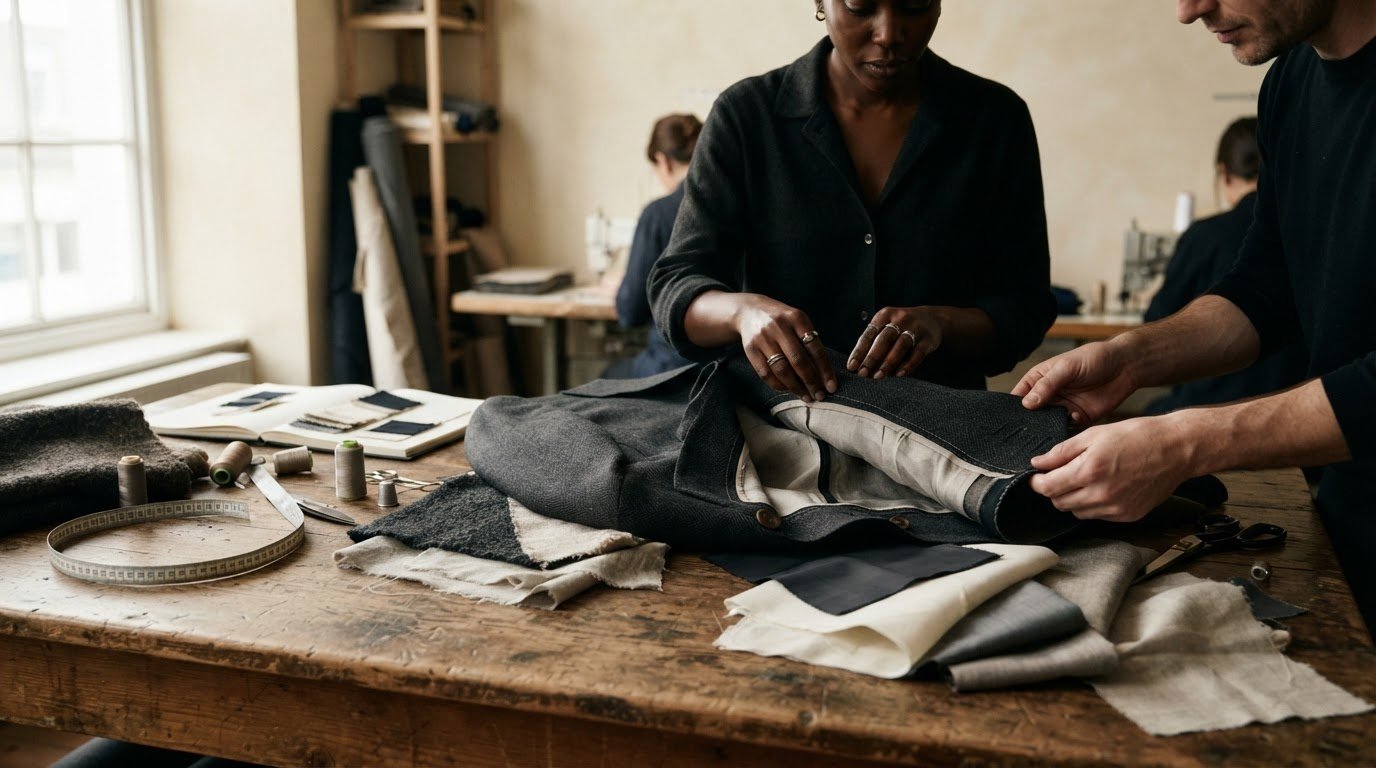
Technical Proficiency: High-end women's fashion requires specialized skills in draping, silk handling, and structured tailoring. Ask to see previous work involving complex silhouettes or delicate textiles to ensure they can execute your vision without compromising the garment's integrity.
Communication Speed: In a fast-paced market, a 24-hour response time is the gold standard. Delays in communication often lead to production bottlenecks and missed launch dates. A responsive partner acts as an extension of your own team.
Sourcing Power: A factory's proximity to major textile hubs is a massive competitive advantage. Direct factory access in Guangzhou ensures they can secure high-quality fabrics and unique trims quickly, often within the same city.
Sample Accuracy: The first sample is the ultimate test. It should arrive within 10 days and match your tech pack specifications precisely. If the first sample is flawed, the bulk production will likely follow suit.
Identifying Real Factories vs. Trading Companies
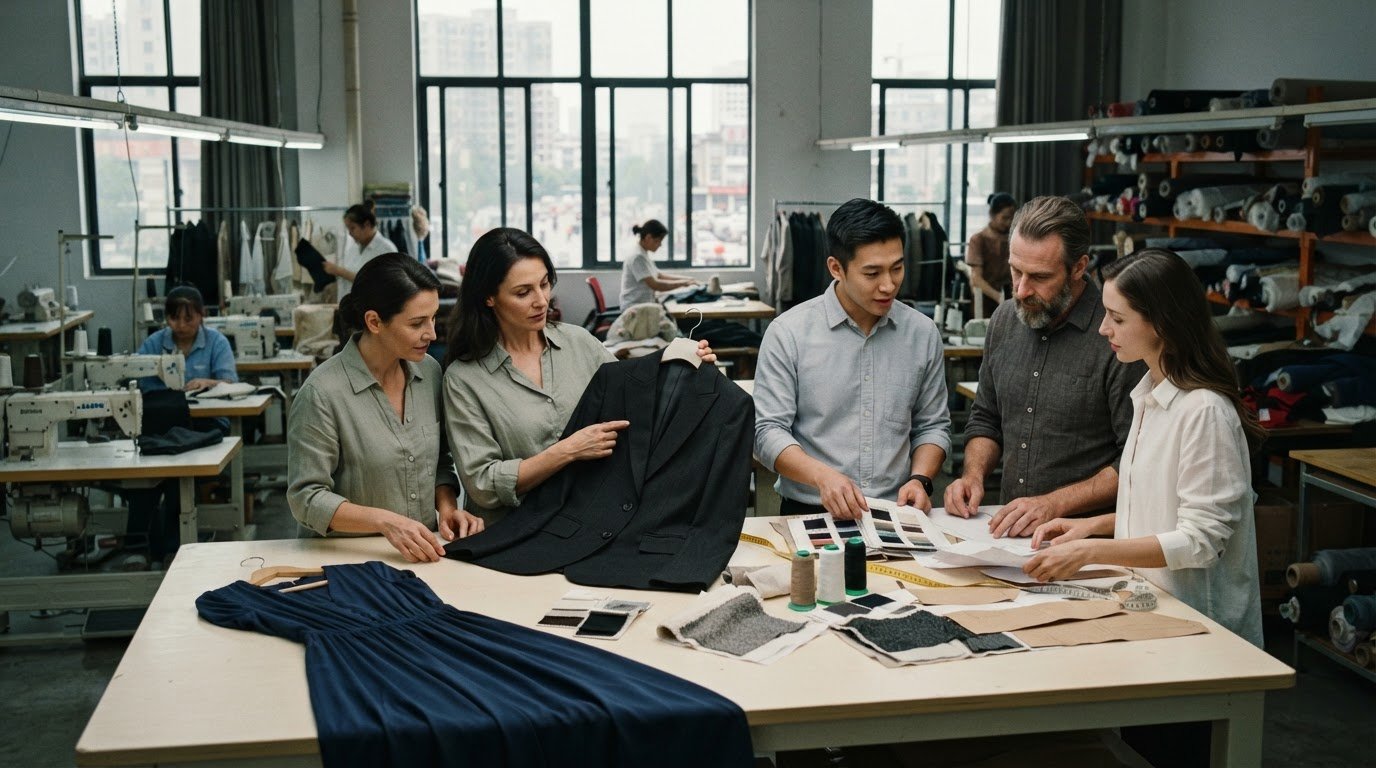
Many "manufacturers" online are actually trading companies that outsource your order to third-party workshops. This adds unnecessary cost and dilutes quality control. We believe in "Open-Door Transparency." A reliable partner should welcome on-site visits or provide live video tours of their production floor. Dealing directly with the factory ensures you're communicating with the people actually sewing your garments. This streamlines the feedback loop and keeps your costs competitive by removing the middleman.
Quality Control Protocols for Small Runs
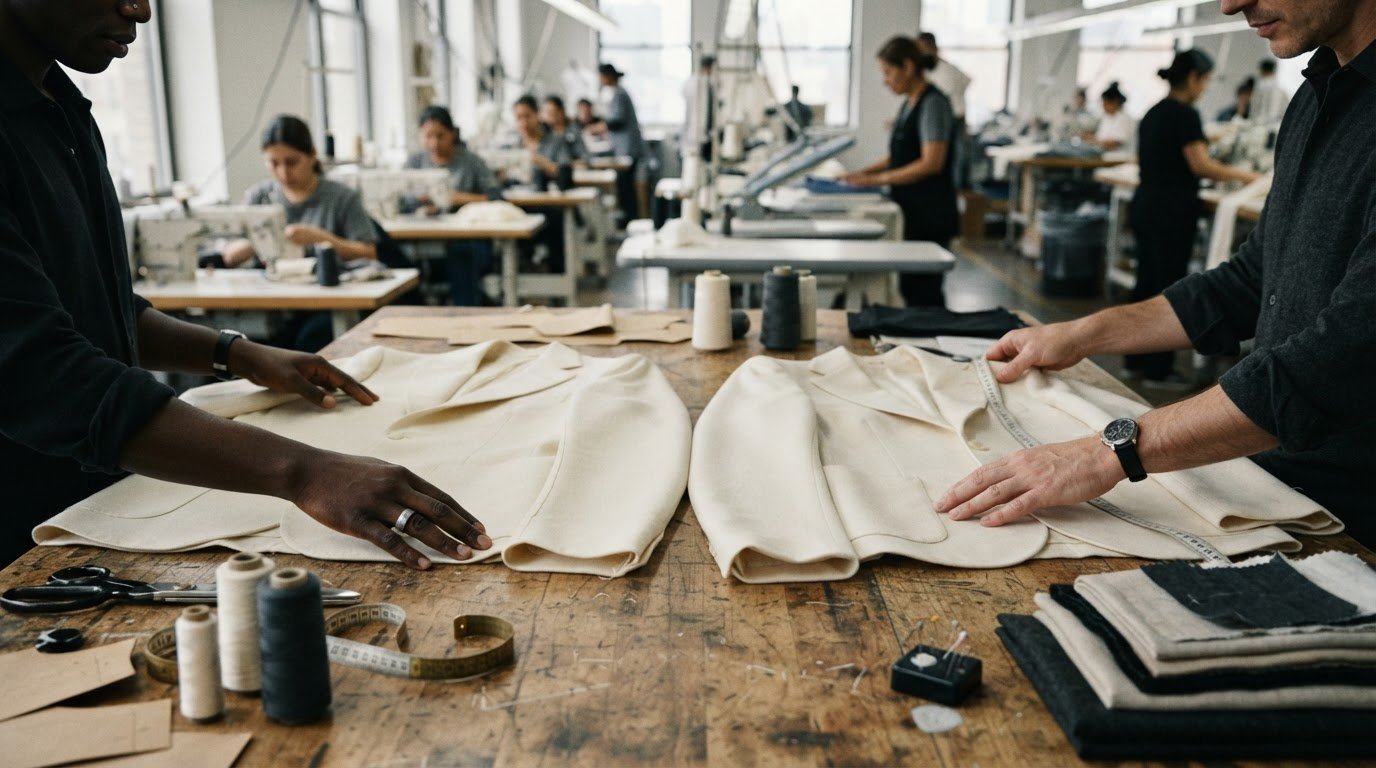
Quality shouldn't be a luxury reserved for large orders. Even for a 50-unit run, a professional low MOQ women's clothing manufacturer must implement inline inspection processes. This involves checking garments at multiple stages of construction rather than just at the end. Standardizing your sizing begins with professional pattern making. This ensures every piece in a small batch fits exactly like the approved sample. Consistency across different fabric batches is another benchmark; your partner must verify that the hand-feel and color of the bulk fabric match your sourcing requirements exactly. This meticulous care transforms a simple production run into a luxury-grade collection.
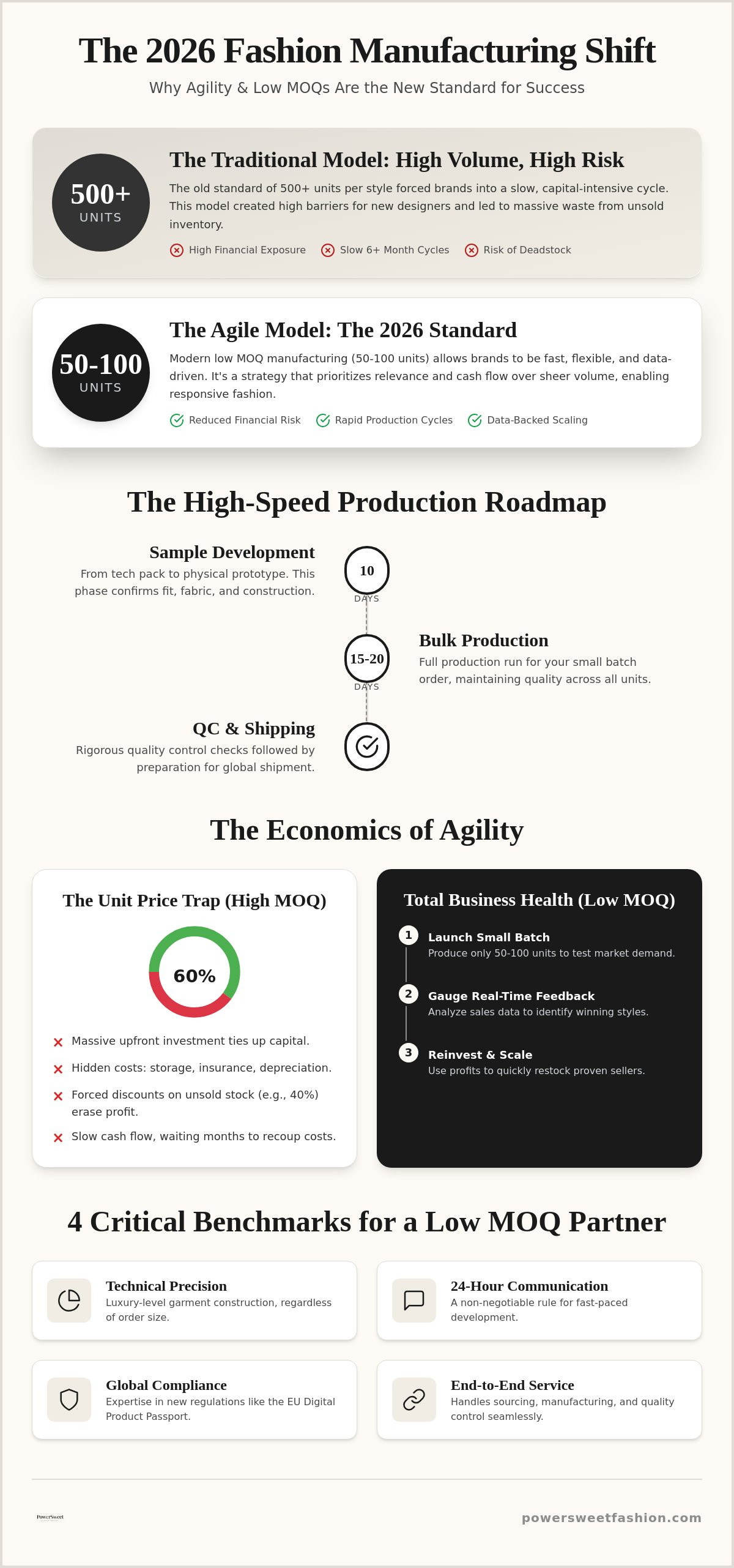
The Production Roadmap: From Tech Pack to 15-Day Bulk
Launching a collection requires a structured sequence. It begins with design finalization and the creation of a comprehensive tech pack. This document acts as the technical blueprint for your low MOQ women's clothing manufacturer, detailing every seam, measurement, and material. Without a precise tech pack, production speed is lost to guesswork and costly errors. We treat this document as a contract of quality that ensures the final product matches your creative vision exactly.
Once the blueprint is ready, we move into fabric sourcing and trim selection. Having direct factory access in Guangzhou provides a significant sourcing fee advantage. We procure high-quality materials locally, removing the markups associated with third-party sourcing agents. This phase ensures your custom designs aren't limited by what's "in stock" but are built from the exact textiles your brand identity requires. We leverage our deep local network to find specialized trims and sustainable fabrics that meet 2026 regulatory standards.
The execution phase is where speed becomes your primary competitive advantage. We prioritize a 10-day sample development cycle, allowing you to see and feel the physical garment quickly. Following sample approval, bulk production and final quality control are completed within a 15 to 20-day window. This rapid turnaround is what allows boutique brands to respond to viral trends before they fade. It transforms your supply chain from a slow moving boat into a responsive, digital-first engine.
Mastering the Sampling Phase
The sampling phase is often where projects stall due to "Sample Iteration Fatigue." To avoid this, provide clear, consolidated feedback on the first prototype. Professional pattern makers play a critical role here; they translate your 2D sketches into 3D reality, ensuring the drape and fit match your technical requirements. A 10-day turnaround isn't just a goal; it's a necessity for fashion-forward brands that need to maintain market momentum. We focus on getting the fit right the first time to keep your production moving toward the finish line.
Logistics and Global Distribution
For small batches, air freight is typically the most strategic choice. While sea freight is cheaper for massive containers, the speed of air delivery preserves the agility gained during production. You should prepare for customs and import requirements early, such as the mandatory CPSC eFiling for US apparel imports that began on July 8, 2026. Timing your marketing launch to coincide with the production finish date ensures you aren't paying for storage on goods that could already be in your customers' hands. If you are ready to start this journey, you can request a production consultation to map out your specific timeline.
Scaling Your Fashion Vision with PowerSweet Fashion
PowerSweet Fashion operates as your Authoritative Facilitator in the heart of Guangzhou. We've built our systems to bridge the gap between creative vision and industrial reality. By choosing us as your low MOQ women's clothing manufacturer, you gain more than a supplier; you gain a strategic partner committed to your brand's stability. We remove the mystery from overseas manufacturing by providing a transparent, end-to-end service that prioritizes your growth.
We provide a comprehensive end to end clothing production service that handles every logistical hurdle. From initial pattern making to final export, we manage the complexity so you can focus on building your community. Our 10-day sample development and 15-to-20-day bulk production cycles are designed for the high-velocity requirements of 2026. This speed ensures your brand remains at the forefront of the market without being weighed down by slow supply chains.
We don't just cater to startups. While we welcome small batches, our facility is equipped to scale with you as your demand grows. We've successfully supported brands moving from their first 50-unit drop to consistent monthly runs of 5,000 units or more. This scalability ensures you never have to switch manufacturers and lose quality consistency just because you've found success. We provide the safe pair of hands you need to navigate the transition from a boutique label to a market leader.
Our Specialized Focus on Women's Apparel
Our expertise is rooted in the specific construction needs of women's apparel. We specialize in custom dresses, intricate blouses, and contemporary fashion that requires a delicate touch and precise tailoring. Our location in Guangzhou gives us immediate access to the world's most diverse fabric markets. This local supply chain power means we source the best materials at the best prices for your brand. Our dedicated QC teams apply the same meticulous inspection protocols to a 100-unit order as they do to 10,000 units. We believe that quality is the only way to ensure long-term customer loyalty.
Start Your Production Journey
Ready to transform your sketches into a physical collection? The process begins when you submit your designs for a professional consultation. We believe in "Open-Door Transparency" and invite you to meet our team in person or via live video to see our facility in action. Every partnership starts with a clear understanding of your goals and a commitment to meeting them. The PowerSweet guarantee is simple: precision in construction, speed in delivery, and a partnership built on trust. We are the engine that will power your vision from the first stitch to the final delivery.
Future-Proof Your Brand Through Responsive Manufacturing
Success in 2026 requires brands that prioritize speed over massive inventory. We've explored how a strategic partnership with a low MOQ women's clothing manufacturer eliminates financial deadweight while keeping your designs relevant. By focusing on technical vetting and mastering the production roadmap, you turn your supply chain into a competitive weapon rather than a logistical burden. It's about making data-backed decisions that protect your cash flow and brand equity.
PowerSweet Fashion brings specialized women's wear expertise since 2008 to every partnership. We offer a 10-day sample turnaround and 15-to-20-day bulk production cycles to keep you ahead of the curve. Start your custom women's collection with PowerSweet Fashion and experience the transparency of direct factory access. Your vision deserves a production partner that's as fast and precise as your market demands. We're ready to help you build something lasting.
Frequently Asked Questions
What is considered a 'low' MOQ for custom women's clothing?
A "low" MOQ in 2026 typically ranges from 50 to 100 units per style. This volume provides the ideal balance between production efficiency and inventory agility. While some domestic factories offer as few as 25 units, 50 units is the standard for high-quality overseas manufacturing. This allows you to test multiple colorways or sizes without committing to massive bulk shipments that tie up your capital.
Can I get custom brand labels and tags on a small order?
You can absolutely include custom brand labels and tags on orders as small as 50 units. We handle the integration of your specific branding elements during the sewing and finishing stages. This ensures your garments arrive retail-ready and professionally branded. Providing your own labels or having us source them locally simplifies your logistics chain and maintains a consistent brand identity across your collection.
Why is the per-unit price higher for low MOQ orders?
Per-unit prices are higher for small batches because fixed costs like pattern making and machine setup are distributed across fewer items. Fabric waste is also typically higher when cutting smaller quantities. However, a higher unit price is often more profitable than a lower bulk price because you avoid the "cost of carry." You won't face the heavy discounts required to move 1,000 units of unsold inventory.
How do I ensure my designs are protected when manufacturing overseas?
Protecting your intellectual property involves choosing a low MOQ women's clothing manufacturer with a proven track record of transparency. We recommend signing a formal manufacturing agreement that includes non-disclosure clauses. Dealing directly with an established facility in Guangzhou rather than a middleman provides better oversight. Our open-door policy allows you to verify our processes and ensures your designs remain exclusive to your brand.
What is the typical turnaround time for a small-batch production run?
Turnaround times for small-batch runs are significantly faster than traditional bulk production. You can expect sample development to take 10 days, followed by a bulk production cycle of 15 to 20 days. This accelerated timeline is designed for the 2026 fashion market, where speed to market is a primary competitive advantage. It allows your brand to launch new styles while a trend is still peaking.
Do I need a professional Tech Pack to start production?
A professional Tech Pack is mandatory to ensure production accuracy and quality consistency. It serves as the technical blueprint that our pattern makers and sewers follow to execute your design. Without a detailed Tech Pack, the risk of miscommunication regarding measurements or materials increases significantly. We can assist in the development of these documents to ensure your vision is translated perfectly into a physical garment.
Is it possible to source specific sustainable fabrics for low MOQ orders?
Sourcing specific sustainable fabrics is possible for low MOQ orders, though options may be limited by mill availability. We leverage our local supply chain to find eco-friendly textiles like organic cotton or recycled polyester that are available in smaller quantities. This approach helps you meet new 2026 regulations, such as the EU Digital Product Passport requirements, without needing to purchase thousands of meters of fabric upfront.
Can I visit the factory to oversee my small-batch production?
We strongly encourage factory visits to foster a transparent and collaborative partnership. Seeing the physical reality of the production floor allows you to oversee quality control protocols firsthand. If a physical visit isn't possible, we provide live video consultations to walk you through our facility. This level of transparency is a core trait of an authoritative facilitator and ensures you feel secure in your manufacturing choice.
Comments