%20(1).png)
Quality Control in Luxury Women’s Apparel Manufacturing: The 2026 Excellence Standard
- Powersweet Team

- Aug 14
- 11 min read
Updated: Aug 15
A single loose thread or a two-millimeter deviation in a side seam isn't just a minor error; it's a direct threat to your brand's reputation. Implementing rigorous quality control in luxury women's apparel manufacturing is the only way to ensure your customers receive the perfection they expect. You likely feel the frustration when high return rates due to sizing inconsistencies or fabric defects appearing post-production stall your growth and damage your bottom line.
This guide provides the technical roadmap you need to master multi-stage inspection frameworks and maintain flawless standards. We'll show you how to move beyond basic end-of-line checks to a system that prevents errors before they happen. You'll learn how to achieve a zero-defect standard and maintain a consistent fit across your entire size range. We'll break down the specific requirements for 2026 excellence, ensuring your production partner handles the technical heavy lifting so you can focus on your creative vision.
Table of Contents
The Strategic Importance of Quality Control in Luxury Fashion
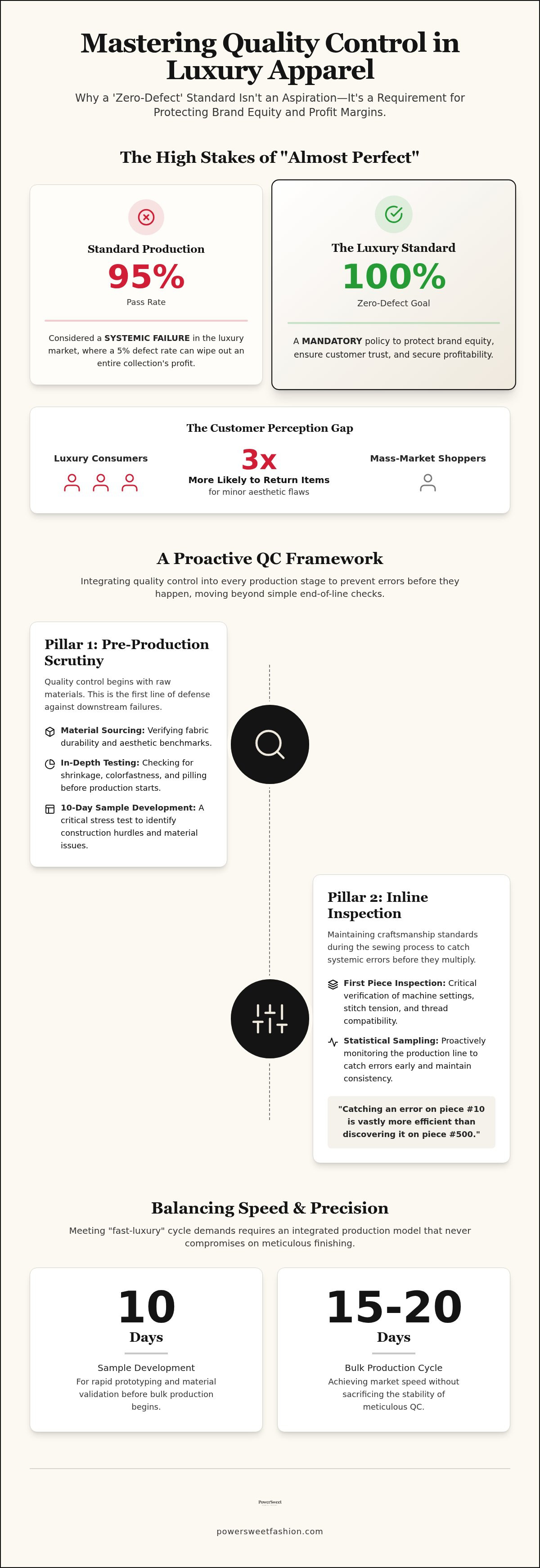
Luxury fashion is defined by its intolerance for error. In standard production, a 95% pass rate might satisfy a spreadsheet, but in high-end garments, that 5% margin represents a systemic failure. Quality control in luxury women's apparel manufacturing isn't just a final inspection stage; it's a strategic asset that protects your brand's bottom line. When a customer pays a premium, they aren't just buying a design. They're buying the assurance of technical perfection.
The economic reality of "seconds" and returns is brutal for premium labels. A single defective shipment can wipe out the profit margins of an entire collection. Beyond the immediate loss, the long-term damage to customer trust is often irreparable. Meticulous QC acts as the engine that allows a brand to scale from a small boutique operation to a global presence without losing the tactile excellence that built its reputation.
Protecting Brand Equity Through Zero-Defect Production
There's a deep psychological link between garment finishing and perceived value. A customer who notices a skipped stitch or a misaligned pattern immediately questions the authenticity of the luxury experience. Some industry reports suggest luxury consumers are three times more likely to return items for minor aesthetic flaws compared to mass-market shoppers. This makes a zero-defect policy mandatory rather than aspirational. Luxury QC is a preventive discipline that identifies potential points of failure before the needle ever touches the fabric.
The High Stakes of Luxury Women’s Apparel Construction
Constructing feminine silhouettes requires an advanced understanding of drape, tension, and fabric behavior. Whether it's a bias-cut silk slip or a structured wool blazer, the technical requirements are unforgiving. Maintaining sizing consistency across diverse global markets is one of the hardest hurdles for growing brands. It requires a manufacturing partner who understands how to translate a pattern into a repeatable, flawless reality.
Meeting the demands of the modern "fast-luxury" cycle adds another layer of complexity. Brands now expect bulk production within 15 to 20 days. Achieving this speed without compromising on the meticulous finishing details requires a highly integrated production team. Reliable quality control ensures that speed never comes at the expense of stability. By catching errors during the sample development phase, which we typically complete in 10 days, you prevent expensive mistakes during the bulk run.
The Three Pillars of a Robust Luxury QC Framework
A systematic framework is the only way to avoid the final-hour bottleneck that plagues many fashion brands. Instead of treating quality control as a secondary check at the end of the line, successful labels integrate it into every stage of end to end clothing production. This ensures the technical reality of the garment matches the designer's vision from the first cut. Balancing high scrutiny with modern speed requires a production team that acts as a safe pair of hands, managing the technical heavy lifting while maintaining a 15 to 20 day bulk production cycle. Robust quality control in luxury women's apparel manufacturing ensures that every shipment meets the excellence standards expected by global consumers.
Pre-Production: Sourcing and Material Scrutiny
Quality control in luxury women's apparel manufacturing starts with the raw materials. Sourcing is the first line of defense; if the fabric doesn't meet durability and aesthetic benchmarks, the final product will never reach luxury status. We test for material shrinkage, colorfastness, and pilling before production begins to prevent downstream failures. Our 10 day sample development phase serves as a critical stress test for these materials. These prototypes allow us to identify potential construction hurdles and refine the technical specifications before scaling to bulk orders. Identifying a fabric's tendency to fray or pull during this stage saves weeks of potential delays.
Maintaining these standards requires the same level of technical precision found in other high-stakes manufacturing sectors; for instance, the industrial screening and filtration expertise of Compass Wire Cloth Corporation illustrates how critical material consistency is to achieving a zero-defect outcome.
Inline Inspection: Maintaining Craftsmanship Standards
Inline inspection maintains craftsmanship standards while the machines are running. The "First Piece" inspection is vital for verifying machine settings, stitch tension, and thread compatibility. By conducting statistical sampling throughout the sewing process, we catch systemic errors early. This is especially important for complex women's tops and dresses where seam strength and alignment are non-negotiable. Catching a tension issue on piece ten is significantly more efficient than discovering it on piece five hundred. This proactive monitoring keeps the production floor moving without sacrificing the meticulous care your brand requires.
Post-Production: The Final Barrier to Entry
The final barrier to entry involves a rigorous measurement audit against the original tech pack specifications. Every garment undergoes a white-glove finishing process that includes meticulous trimming, professional pressing, and secure packaging. We implement industry-standard Acceptable Quality Limit (AQL) protocols for every bulk shipment to provide grounded, empirical reliability. This final check ensures that sizing is consistent across all units, which is the primary driver for reducing return rates. If you're looking for a reliable partner to handle these technical details, exploring PowerSweet Fashion can streamline your path to market with confidence.
Technical Challenges: QC for High-End Fabrics and Construction
High-end production thrives on precision. When you partner with a custom women’s clothing manufacturer, the technical setup determines the final quality. Specialized machinery like micro-needle feeders and variable tension footings are essential for luxury construction. These tools allow us to manage the delicate balance between a garment’s aesthetic drape and its structural integrity. For instance, silk requires an ultra-fine 60/8 needle to prevent permanent punctures, while the textured weave of crepe demands a 70/10 ballpoint needle to avoid snagging the fibers. Using the wrong gauge can ruin an entire production run before it leaves the sewing floor.
Handling Delicate Luxury Materials: Silk, Crepe, and Lace
Manufacturing with silk and lace requires a sterile, controlled environment. We implement strict protocols to prevent snags and oil spots, which are nearly impossible to remove from high-sheen fabrics. Technicians often wear gloves and use specialized table surfaces to maintain material purity. Quality control in luxury women's apparel manufacturing also requires specific checkpoints for lace. We focus on pattern symmetry and scalloped edge alignment across every seam to maintain the designer's intent. Crepe presents a different challenge because of its inherent "give" and elasticity. Our cutting teams use specialized weights and anti-slip surfaces to ensure the fabric doesn't shift during the pattern making phase. This precision ensures the final garment hangs correctly and maintains its silhouette through repeated wear.
While textile cutting requires a manual touch, many designers explore Custom CNC Cutting when they need the same level of industrial precision for shop fittings, signage, or accessory components made from wood and acrylic.
Performance Meets Luxury: Outdoor and Travel Apparel QC
Modern luxury often includes performance requirements. Travel-focused women's wear must meet rigorous wrinkle-resistance and breathability standards without losing its premium feel. Quality control in luxury women's apparel manufacturing extends to "stealth" features that aren't immediately visible. We inspect hidden pockets, reinforced stress points, and moisture-wicking linings with the same scrutiny as external seams. Hardware also undergoes durability testing to ensure longevity. We cycle zippers fifty times and stress-test buttons and toggles to ensure they won't fail during transit or heavy use. Key technical checks for performance luxury include:
Seam Sealing: Verifying waterproof integrity in outdoor luxury coats.
Tension Testing: Ensuring reinforced seams in travel trousers don't pop under stress.
Lining Alignment: Checking that moisture-wicking layers don't bunch or pull the exterior fabric.
This end-to-end technical oversight provides the grounded reliability luxury brands need to scale. This commitment to precision is common in all high-performance custom fields; for example, the engineering standards upheld by Fat Boy Design USA for specialized components mirror the meticulous attention to detail required in luxury garment construction. By addressing these technical challenges early, we act as a safe pair of hands for your most complex designs.
Auditing Your Manufacturing Partner’s QC Capabilities
Identifying a "Safe Pair of Hands" in a crowded market requires looking past marketing claims and into technical reporting structures. A reliable partner doesn't just promise excellence; they provide a transparent roadmap of how they achieve it. When evaluating potential factories, ask for specific details about their internal QC team size relative to their production lines. You need to know how often they generate reports and what specific AQL standards they follow. Leveraging low MOQs is a strategic way to test a partner's quality consistency before committing to large-scale orders. This iterative approach allows you to verify that their quality control in luxury women's apparel manufacturing meets your brand's specific technical requirements.
Evaluating Tech Pack Interpretation and Sample Accuracy
The tech pack is your legal and technical contract for quality. It defines every measurement, stitch type, and finishing detail. If a sample development clothing manufacturer cannot accurately translate these instructions into a physical prototype during the 10-day sample phase, they'll likely struggle with bulk production. Look for red flags such as substituted hardware without notice or deviations in seam allowances. Assessing pattern making precision through fit-testing prototypes is the only way to ensure the final product matches your vision. A factory that takes the technical heavy lifting off your shoulders will proactively point out potential construction issues during this initial phase.
Remote vs. In-Person Factory Inspections
Transparency is the foundation of a successful manufacturing partnership. An "Open-Door" policy for factory visits provides the highest level of reassurance. It allows you to see the human element behind the machines and verify that the production environment is organized and professional. If you're managing production remotely, virtual QC becomes your primary tool. Demand high-resolution video walkthroughs and detailed photo reports of inline inspections. Establishing a collaborative feedback loop ensures that minor deviations are corrected in real-time rather than at the end of the line. This level of oversight turns the manufacturing journey into a joint venture rather than a hands-off transaction. To see how we maintain these benchmarks, you can view our production transparency standards and book a consultation today.
Implementing End-to-End Quality with PowerSweet Fashion
PowerSweet Fashion streamlines the luxury production journey by acting as your authoritative facilitator. We combine a professional industrial approach with the personalized care of a boutique partner. Our system integrates every stage, from fabric sourcing to final finishing, to ensure that quality control in luxury women's apparel manufacturing is never an afterthought. This synergy allows us to maintain a 15 to 20 day bulk production commitment without sacrificing the technical precision your brand demands. We handle the technical heavy lifting, allowing you to focus on the creative direction of your label. Our local sourcing network provides immediate access to premium materials, reducing lead times and ensuring that every fiber meets our high-end benchmarks.
Transparency Through Our Open-Door Policy
Trust is built through empirical reliability and location-based transparency. Our open-door policy invites you into the heart of the process. You can meet the production team and oversee the standards yourself at our facility. We provide real-time updates on bulk manufacturing progress and reach specific QC milestones together. Transparency removes the mystery often associated with apparel production. It establishes a "collaborative we" where your success is our primary metric. Seeing the people behind the machines provides the reassurance that your designs are in a safe pair of hands.
Leveraging Low MOQ for Iterative Quality Excellence
Choosing a low MOQ women’s clothing manufacturer is a strategic decision that minimizes quality risk. Implementing quality control in luxury women's apparel manufacturing at a smaller scale allows our team to apply higher scrutiny to every single garment. This model is ideal for perfecting complex luxury designs before scaling to larger volumes. It enables iterative improvements based on real-world feedback and sample testing. By prioritizing precision over pure volume, we ensure that every piece in your collection meets the excellence standard for 2026. Small-batch production offers several technical advantages for quality assurance:
Iterative Fit Adjustments: Refining the silhouette based on early production feedback.
Precision Stitching Audits: Allowing for a 100% inspection rate on complex seams.
Individual Pressing Checks: Ensuring every garment receives the "white glove" finishing touch.
Such an approach allows smaller brands to enter the luxury market with the same technical advantages as established global labels. We bridge the gap between digital communication and physical reality by focusing on the mechanics of scale. Our 10-day sample phase serves as the foundation for this excellence, ensuring that your bulk run is executed with flawless precision.
Mastering the 2026 Standard for Luxury Production
Achieving excellence in the high-end market requires moving beyond reactive inspections. You now have the technical roadmap to integrate quality control in luxury women's apparel manufacturing into every step of your production cycle. Success depends on a systematic approach that bridges the gap between creative vision and technical execution. By prioritizing material scrutiny and inline audits, you protect your brand equity from the costs of returns and inconsistent sizing.
Reliability is the foundation of any growing luxury label. We provide the end-to-end oversight you need to scale with confidence, offering 10-day sample development and 15-20 day bulk production lead times. Our team handles the technical heavy lifting, from fabric sourcing to the final white-glove finishing, so you can focus on your brand's future. You don't have to navigate these industrial complexities alone. Partner with PowerSweet Fashion for Flawless Luxury Production and ensure your next collection meets the highest global standards. We're ready to help you turn your creative concepts into physical perfection.
Frequently Asked Questions
What is the difference between QC and QA in apparel manufacturing?
Quality Assurance (QA) is the process-oriented prevention of defects, focusing on the systems and standards set before production begins. Quality Control (QC) is the product-oriented detection of errors through physical inspections. In a luxury environment, QA involves refining your tech pack and pattern making, while QC happens on the factory floor to ensure every garment matches those established benchmarks.
How does a tech pack influence the final quality of a luxury garment?
A tech pack serves as the technical blueprint and legal contract for your production run. It specifies exact seam allowances, stitch counts, and hardware placements that the inspection team uses as their benchmark. Without a precise tech pack, maintaining consistency across bulk orders is impossible. It removes ambiguity and ensures the factory understands your design vision's technical requirements from the first cut.
Can high-speed production (15-20 days) maintain luxury quality standards?
High-speed production maintains luxury standards when you use an integrated, end-to-end manufacturing model. We achieve a 15 to 20 day bulk turnaround by identifying technical hurdles during the 10-day sample phase. Quality control in luxury women's apparel manufacturing remains rigorous because the production team manages the technical heavy lifting simultaneously with the sewing process to prevent any final-hour bottlenecks.
What are the most common defects found during inline garment inspection?
Common defects include skipped stitches, puckered seams, and uneven thread tension. In luxury women's wear, we also look for misaligned patterns on side seams and incorrect drape in structured garments. Catching these systemic errors during the sewing phase prevents them from affecting the entire run. This proactive approach ensures the entire shipment meets the zero-defect standard your customers expect.
How do you handle quality control for delicate fabrics like silk or lace?
Handling delicate fabrics requires specialized machinery and sterile environments. We use micro-needles to prevent punctures in silk and implement specific checkpoints for lace symmetry. Technicians often wear gloves to avoid oil spots, ensuring the material's high-sheen finish remains pristine from the cutting table to final packaging. Every step is designed to protect the fabric's integrity while maintaining its aesthetic drape.
Is it possible to manage quality control remotely for overseas production?
Remote oversight is highly effective when your partner provides transparent photo reports and high-resolution video walkthroughs. We offer an open-door policy for in-person visits, but we also maintain digital reporting for clients who can't travel. This collaborative feedback loop ensures you stay informed about every milestone in real-time. It bridges the gap between digital communication and the physical reality of the factory floor.
What is an AQL (Acceptable Quality Limit) and why does it matter for luxury brands?
Acceptable Quality Limit (AQL) is a statistical standard used to determine the maximum number of defects allowed in a bulk shipment. For luxury brands, we set lower AQL thresholds to ensure near-perfection in every box. It provides a grounded, empirical way to verify that your shipment meets the agreed-upon excellence standards. This mathematical approach to quality provides the reassurance needed for global distribution.
How does low MOQ manufacturing help in maintaining higher quality standards?
Low MOQ manufacturing allows for higher scrutiny per garment because the production run is more manageable for the technical team. Quality control in luxury women's apparel manufacturing benefits from small-batch runs where technicians can perform 100% inspection rates on complex seams. This iterative approach helps perfect your designs before you scale. It ensures that precision is never sacrificed for pure production volume.


Comments