%20(1).png)
Luxury Fashion Quality Standards: The 2026 Manufacturing Benchmark
- Powersweet Team

- Aug 13
- 11 min read
Updated: Aug 15
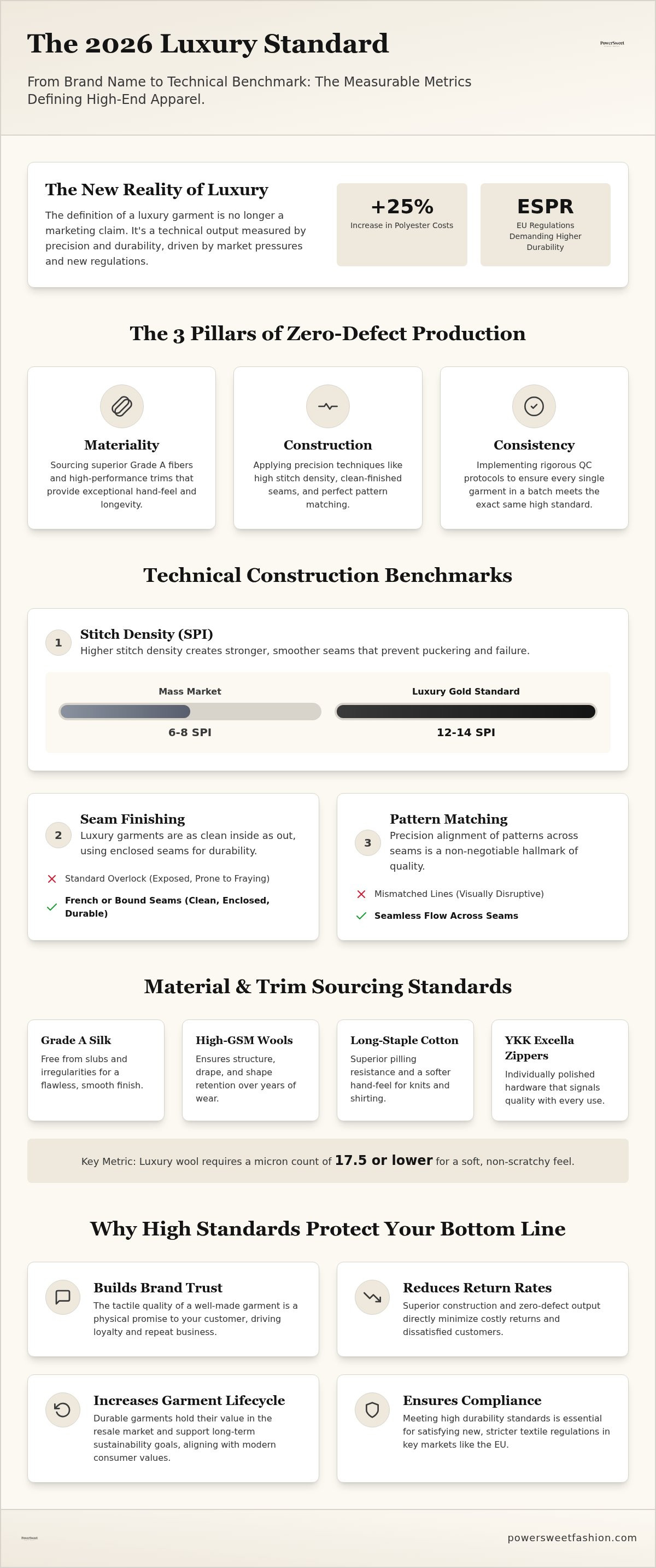
In 2026, a luxury label is no longer a marketing claim; it's a measurable technical output defined by zero-defect precision. With Brent crude prices pushing polyester costs up by 25% and new EU regulations like the ESPR demanding higher durability, the margin for manufacturing error has vanished. You likely know the frustration of receiving a production batch that fails the hand-feel test or results in high return rates due to poor construction. This article provides the clarity you need by detailing the specific luxury fashion quality standards required to separate high-end garments from mass-market apparel.
We'll show you exactly how to benchmark your production against the 2026 industry standards. You'll learn the technical specifications for stitch density, material purity, and structural reinforcement that ensure every piece is a physical representation of your creative vision. We're moving beyond abstract definitions to look at the logistical reality of luxury manufacturing. This guide previews the construction benchmarks that turn a simple garment into a durable investment piece, ensuring your brand maintains its prestige in a competitive market.
Table of Contents
Defining Luxury Fashion Quality Standards in 2026
The definition of luxury has moved away from heritage logos toward technical execution. In 2026, clients and consumers judge a brand by the physical integrity of the garment rather than just the label on the neck. True luxury fashion quality standards are built on three essential pillars: Materiality, Construction, and Consistency. Without these, a high price tag is just a marketing facade that won't survive the scrutiny of a discerning market.
Establishing these standards starts with a comprehensive Tech Pack. This document serves as the technical blueprint for your production journey. It ensures every measurement, seam type, and material specification is locked in before the first sample is cut. Unlike fast fashion, where benchmarks prioritize speed and cost-cutting, luxury manufacturing prioritizes zero-defect precision. Premium brands might offer better fabrics than fast fashion, but luxury garments require a level of technical mastery that ensures the piece looks as good inside as it does on the outside.
The Tangible Metrics of Luxury
Precision is measured in numbers. The industry gold standard for luxury stitching is 12 to 14 Stitches Per Inch (SPI). This high density creates a stronger, smoother seam that won't pucker or fail over time. We also look at fabric purity; 2026 standards favor natural fibers like Grade A silk or high-GSM wools over synthetic blends. These requirements align with Haute couture standards, where meticulous, hand-executed techniques define the product's value. Even the hardware matters. Zippers, buttons, and clasps must have a specific weight and durable finish to signal quality to the wearer's touch.
Why Standards Matter for Brand Longevity
High standards protect your bottom line. Superior construction directly reduces return rates, saving you the logistical headache of handling defective stock. When a customer feels the weight and finish of a well-made garment, it builds immediate trust. This tactile quality cue is what drives repeat business and brand loyalty. Additionally, garments built to these benchmarks hold their value in the growing resale market. This durability supports long-term sustainability by extending the garment's lifecycle, which is a critical factor for modern consumers and a core requirement of new EU textile regulations.
Material Excellence: Fabric and Trim Sourcing Standards
Materials are the physical foundation of any high-end collection. While branding creates the initial desire, the tactile reality of the fabric determines whether a customer keeps the piece or initiates a return. High-tier luxury fashion quality standards demand the use of Grade A silk, which is free from the slubs and irregularities found in lower-tier textiles. Similarly, long-staple cotton is non-negotiable for luxury knits and shirting because the longer fibers provide superior pilling resistance and a smoother finish. For tailored pieces, high-GSM wools ensure the garment maintains its shape and drape over years of wear.
Hidden details often separate a luxury garment from a premium one. We prioritize high-quality interlinings and linings that provide structural integrity without adding unnecessary bulk. A cheap interlining can bubble or peel after dry cleaning, ruining the garment's silhouette. Sustainable luxury has also become a benchmark in 2026. Eco-certified fabrics like GOTS-certified organic cotton or recycled cashmere must meet the same rigorous durability tests as conventional materials to qualify for luxury production. If you need assistance identifying the right textiles for your next collection, our team can help you with professional fabric sourcing tailored to your specific design needs.
Sourcing for Durability and Hand-Feel
Effective fabric sourcing is a critical stage in end to end clothing production. We identify quality through micron count and thread density. For instance, luxury wool typically requires a micron count of 17.5 or lower to ensure a soft, non-scratchy hand-feel. Trims follow the same logic. We recommend YKK Excella zippers over standard alternatives. These zippers are individually polished and move with a characteristic smoothness that signals quality to the user every time they dress.
Material Verification and Testing
Reliable manufacturing requires independent laboratory testing. We don't rely on a supplier's verbal claims; we verify fiber composition and chemical safety through certified labs. Luxury-grade requirements include colorfastness testing to ensure dyes don't bleed or fade. We also mandate shrinkage testing, where a tolerance of less than 2% is the standard for luxury garments. This rigor ensures batch consistency in large-scale runs, maintaining your brand's reputation for excellence from the first piece to the last. Ethical sourcing standards must also be verified to ensure the physical quality of the material matches the ethical promise of your brand, a principle also championed by Slim Saffron in the luxury spice market.
Technical Construction: Precision Benchmarks for Luxury Garments
Technical construction is the stage where a creative concept becomes a durable, high-value asset. While materials provide the foundation, the assembly process determines whether a piece meets luxury fashion quality standards. High-end manufacturing rejects the 'good enough' approach of mass production. Instead, it focuses on internal finishes that ensure the garment looks as refined on the inside as it does on the outside.
Luxury garments utilize sophisticated seam construction. French seams are essential for lightweight or sheer fabrics because they completely enclose raw edges within a second row of stitching. For unlined or structured pieces, bound seams provide a clean finish using silk or bias tape. Pattern matching is another non-negotiable benchmark. Whether it's a complex print or a simple stripe, the design must align perfectly across side seams and center-back closures. This requires a higher fabric yield and surgical precision during the cutting phase.
Internal architecture provides the skeleton for complex women's apparel. We use boning and stays to support structured bodices, while horsehair braid is applied to hems to create volume and movement in skirts—techniques that define the high-end aesthetic of brands like Guillermo Pharis Bridal. While machines handle the heavy lifting, hand-finishing adds the final layer of value. Hand-sewn buttonholes and pick-stitched lapels provide a level of nuance that automated systems cannot replicate.
The Importance of Pattern Making
Accurate pattern making for garment manufacturers is the blueprint for a superior fit. We balance the precision of flat patterning with the artistic nuance of 3D draping to achieve silhouettes that move naturally with the body. Consistency is the hallmark of a high-end fashion house; a size 4 must fit the same way every season. This level of reliability builds the consumer confidence necessary for a brand to thrive at a luxury price point.
Stitching and Seam Integrity
We verify seam integrity through the 'Pull Test.' A luxury seam must withstand tension without 'grinning' or distorting the fabric grain. Hemming techniques also signal quality. Blind hems are used for a seamless, invisible finish on trousers and skirts, while delicate rolled hems are reserved for lightweight silks. We also implement bar tacking at stress points like pocket openings and zipper bases. This reinforcement ensures longevity without compromising the garment's aesthetic flow.
Quality Control Protocols: Ensuring Consistency at Scale
Scale introduces risk. Maintaining luxury fashion quality standards requires more than a final glance; it demands a systematic approach that starts before a single cut is made. We implement the Four-Point System for all incoming fabric. This industry standard assigns penalty points based on defect size and frequency. If a roll exceeds the point threshold, it's rejected. This rigorous oversight ensures flawed material never enters the sewing line, protecting your production from costly downstream errors.
In-line inspections are equally critical. We catch errors at the sewing station, not the warehouse. Identifying a misaligned seam or a tension issue early allows for immediate correction, which reduces waste and maintains production speed. For luxury-grade shipments, we follow a 100% inspection rule. While mass-market brands rely on statistical sampling, high-end retail demands that every individual garment is verified. Our tolerance levels allow for zero deviation from the approved technical specifications.
Implementing a Zero-Defect Policy
We distinguish between major and minor defects to maintain a clear quality hierarchy. Major defects, such as fabric holes or structural seam failures, result in immediate rejection. Minor issues, like a stray thread or a slightly loose button, are corrected by hand before the piece moves forward. The factory floor manager acts as the primary facilitator, ensuring daily standards never slip. They use the "Golden Sample" finalized during sample development as the absolute benchmark for every production run. This physical reference point ensures that the final product matches your creative vision exactly.
Packaging and Final Presentation
The luxury experience concludes with the physical presentation. We ensure every piece arrives in floor-ready condition through professional steam-pressing and precise folding. Garments are protected by acid-free tissue paper and placed in branded boxes or dust bags according to your specifications. Final labeling and hang-tag placement are executed with surgical precision, measured to the millimeter to ensure brand consistency across the entire batch. If you need a manufacturing partner that treats your quality as their own, consider our Quality Control Services to safeguard your next collection.
Achieving Luxury Standards with Your Manufacturing Partner
Finding a factory that understands luxury fashion quality standards is the most significant hurdle for growing brands. Many facilities claim luxury capabilities but operate on a mass-market mindset. You need a partner that views quality as a technical requirement rather than an optional upgrade. Vetting a custom women's clothing manufacturer involves looking beyond their portfolio. You must audit their equipment, check their internal QC logs, and ensure their staff is trained in high-SPI stitching and complex seam finishes.
Face-to-face alignment is essential for high-end production. A factory visit allows you to see the working conditions and the human oversight involved in the process. It's the only way to ensure the facility can maintain the precision required for complex women's apparel. Clear communication through detailed Tech Packs is your best defense against quality drift. When every measurement and material is documented, the factory has a clear roadmap for bulk production. This prevents the gradual erosion of standards that often occurs when technical details are left to interpretation.
Strategic Partnership over Transactional Sourcing
Luxury isn't built in a single transaction; it's refined over multiple seasons. For emerging brands, low MOQ women's clothing manufacturers provide the flexibility to test complex designs without the risk of massive inventory. This smaller scale allows for closer collaboration. You can solve construction problems during the sample phase rather than discovering them in a warehouse full of finished goods. A long-term partnership ensures the factory understands your specific aesthetic and technical preferences. This results in tighter consistency and a more efficient production journey as the team becomes familiar with your brand's unique benchmarks.
The PowerSweet Fashion Advantage in Luxury Production
We provide the end-to-end transparency needed to meet global luxury fashion quality standards. Our facility in Guangzhou offers a unique strategic advantage, giving our clients direct access to the world's most sophisticated fabric and trim markets. We don't just execute your designs; we provide the industrial oversight necessary to protect your brand's prestige. From our 10-day sample development to our direct factory oversight, we act as the engine for your creative vision. We specialize in the complex construction that separates true luxury from mass-market apparel. If you're ready to elevate your brand's construction, consult with our production team today to start your next collection.
Securing Your Brand's Technical Future
The shift toward technical execution means your brand's reputation now lives in the details of every seam and fiber. We've explored how luxury fashion quality standards depend on material excellence, precise construction, and zero-defect quality control. Success in 2026 requires moving beyond aesthetic appeal to embrace industrial rigor. By prioritizing expert pattern making for a perfect fit and implementing rigorous in-house quality control, you ensure your collections withstand the scrutiny of a discerning market.
Speed doesn't have to compromise stability. Our 10-day sample turnaround allows for fast iteration while maintaining the technical integrity your designs deserve. We operate as your pragmatic industrial partner, bridging the gap between your creative vision and the physical reality of the manufacturing floor. This collaborative approach turns the complexities of production into a streamlined, manageable journey.
Start your luxury production journey with PowerSweet Fashion today and secure the technical foundation your brand needs to thrive. Your vision is ready for the world; we're here to make sure it's built to last.
Frequently Asked Questions
What are the standard quality requirements for luxury fashion?
Luxury fashion quality standards require zero-defect construction and material purity. These requirements include specific seam finishes like French or bound seams and perfect pattern alignment across all closures. Consistency is the primary metric; every garment in a production run must match the approved technical specifications exactly. High-end manufacturing prioritizes internal architecture, ensuring the piece looks refined on the inside, which distinguishes it from mass-produced apparel.
How many stitches per inch are in a luxury garment?
A luxury garment typically features 12 to 14 stitches per inch (SPI). In contrast, mass-market apparel often uses 8 to 10 SPI to speed up production and reduce costs. The higher stitch density in luxury construction creates a much stronger seam that won't pucker or fail under tension. This technical detail results in a smoother, more refined finish that significantly extends the garment's lifecycle and overall durability.
What is the difference between premium quality and luxury quality?
Premium quality focuses on using better materials than fast fashion, but luxury quality is defined by technical mastery. While premium brands might use nice fabrics, luxury garments include sophisticated internal finishes like horsehair braid hems and silk-bound seams. Luxury production also demands a higher level of consistency and lower tolerance for deviation. It's the difference between a high-quality material and a physically superior construction that maintains its shape for years.
How do I ensure my manufacturer meets luxury standards?
You ensure compliance by conducting factory audits and reviewing internal quality control logs. Vetting a manufacturer involves checking their equipment for high-precision stitching and ensuring their staff is trained in luxury fashion quality standards. Providing a comprehensive Tech Pack is your best defense against quality drift. It's also vital to conduct face-to-face quality alignment meetings to ensure the facility manager understands your brand's specific technical benchmarks before bulk production begins.
Are luxury garments always made from natural fibers?
Luxury garments primarily utilize natural fibers like Grade A silk and long-staple cotton, but they aren't exclusively natural. Modern luxury standards allow for high-performance synthetics when they provide specific technical benefits, such as stretch or water resistance. However, these materials must still pass rigorous laboratory tests for colorfastness, shrinkage, and hand-feel. The priority is always the physical integrity and tactile experience of the fabric, regardless of its fiber origin.
What is a 'Golden Sample' in luxury manufacturing?
The Golden Sample is the final, pre-production garment that has received total approval for fit and construction. It acts as the absolute physical benchmark for all quality control inspections during the bulk manufacturing run. Every piece that leaves the factory floor is compared against this sample to ensure zero deviation. It provides a clear reference point for the floor manager to maintain consistency and catch errors before they reach the warehouse.
Why is pattern making so important for luxury quality?
Pattern making is the essential blueprint for a garment's fit and silhouette. It's the foundation of luxury quality because it ensures sizing consistency across seasons and collections. Accurate patterns allow for complex draping and structural elements like boning or stays to function correctly. Without precise pattern making, even the best fabrics will fail to hang properly on the body, undermining the brand's prestige and increasing return rates.


Comments