%20(1).png)
How to Prevent Inconsistent Fit During Clothing Manufacturing
- Powersweet Team

- Jul 28
- 12 min read
Updated: Aug 7
What if the greatest drain on your fashion brand's profit margins isn't your marketing budget, but a simple tape measure? For many labels, the most damaging feedback isn't a critique of the style, but a customer complaint that their "Medium" fits more like a "Small."
We understand the frustration of seeing return rates climb because a factory failed to follow your tech pack with the precision your brand deserves.
Dealing with inconsistent clothing fit eats away at your bottom line and erodes the trust you have worked hard to build with your audience.
The good news is that sizing variance is not an inevitable part of the production process.
It is a technical challenge that can be engineered out of your supply chain with the right protocols.
This article will show you exactly how to achieve 100% fit consistency by leveraging professional pattern making and rigorous quality control.
We will walk you through the essential manufacturing strategies needed to eliminate variance, including how a 10-day sample cycle serves as your window for fit perfection.
By the end of this guide, you will have a roadmap to reduce returns to industry lows and protect your margins through reliable, repeatable sizing.
Table of Contents
The Hidden Impact of Inconsistent Clothing Fit on Your Brand
Precision is the silent engine of a successful fashion label. When we talk about inconsistent clothing fit, we aren't referring to a design choice or a specific style preference.
Instead, this term describes a technical failure where garments of the same size vary in physical dimensions across different production batches or styles.
It's the gap between what your tech pack promises and what the factory actually delivers. For a brand owner, this variance is more than a quality control headache; it's a direct threat to your scalability.
The consequences of these discrepancies often manifest as the "Return Trap."
Industry data suggests that sizing issues account for up to 70% of fashion e-commerce returns.
This creates a cycle of logistical friction that most emerging brands cannot afford to sustain.
When a customer receives a garment that doesn't match their expectations, the relationship is immediately strained.
Research indicates that a customer who returns a poorly fitting item is 50% less likely to buy from that brand again.
You aren't just losing a single sale; you're losing the lifetime value of that client.
The link to your profit margin is undeniable. Every return triggers a cascade of hidden costs:
Reverse Logistics: You pay for the return shipping and the labor required to inspect the item.
Restocking Fees: Repackaging and reintegrating items into inventory takes time and resources.
Inventory Deadweight: Items tied up in the return mail system cannot be sold to other customers, leading to missed opportunities.
Customer Support: Your team spends hours managing complaints rather than driving new growth.
Vanity Sizing vs. Technical Inconsistency
It's vital to distinguish between intentional "vanity sizing" and genuine manufacturing errors.
Vanity sizing is a marketing strategy where brands adjust labels to make customers feel more confident.
Technical inconsistency, however, is an unintentional drift caused by poor pattern grading or lack of oversight.
This drift has a profound psychological impact.
When a customer's self-image is challenged by a garment that is unexpectedly tight, they don't blame the factory; they blame your brand.
Modern "size inflation" across the industry makes it even more critical for you to establish a reliable, internal standard that your customers can trust every time they order.
The Financial Toll on Emerging Fashion Labels
For smaller labels, fit issues can quickly destroy your profit margins. If you use a fashion brand profit margin calculator, you'll see that even a 5% increase in returns can turn a profitable collection into a net loss.
Beyond the immediate numbers, there's the damage of negative social proof. One viral post about "weird sizing" can negate months of expensive influencer marketing.
Investing in fit consistency through professional pattern making and rigorous sampling isn't just a quality choice.
It's the highest ROI investment you can make to ensure your brand remains viable in a competitive market.
The Technical Foundation: Standardized Blocks and Tech Packs
Consistency begins before the first piece of fabric is cut. It starts with a Master Block, which serves as the technical DNA of your brand.
Without this foundation, you are essentially letting the factory guess your brand's silhouette.
Relying on factory-default patterns is a primary cause of inconsistent clothing fit across different production runs.
Every factory maintains its own internal standard for a size Medium. Your brand's sizing will inevitably drift if you don't provide your own technical blueprint.
A Master Block is a basic pattern without seam allowances or design details.
It represents your brand's ideal fit for a specific body type. Using this block across all your designs ensures that a customer who buys a dress in the spring will find the same fit in a jacket released in the fall.
This level of standardization is a critical step in mastering sample development. It reduces the number of revisions needed and speeds up the transition from concept to bulk production.
Developing Your Brand's Fit Identity
Successful labels define their fit through data. You must identify whether your target demographic leans toward straight or curvy body shapes, as these require entirely different grading rules.
Grading is the process of scaling your base size up or down to create a full size range.
If your grading rules are flawed, your Large won't feel like a scaled-up version of your Small.
Partnering with an experienced pattern making garment manufacturer ensures these technical nuances are baked into your patterns from day one.
Tech Pack Precision For Mass Production
The Tech Pack is your contract with the factory. It must include detailed Points of Measure (POM), grading sheets, and construction notes.
Precision here is non-negotiable. Establish strict tolerance levels, such as +/- 1cm, to define the acceptable range of variance.
If a garment falls outside this range, it's a defect. Your tech pack must also account for fabric stretch and recovery properties.
A pattern designed for rigid woven fabric will fail if executed in a high-stretch knit. Our in-house pattern making experts can help you refine these technical details to ensure your production remains flawless.
Manufacturing Variables: Why Fit Fails During Bulk Production
Precision on paper doesn't always translate to precision on the factory floor. Physical variables during the manufacturing process are the most common culprits for inconsistent clothing fit.
Even when your tech packs are flawless, the behavior of raw materials and the mechanics of mass production can introduce unwanted variance.
Managing these variables requires a deep understanding of textile science and industrial engineering rather than just design intuition.
Fabric shrinkage is the first major hurdle.
If you fail to pre-wash or test your bulk fabric rolls, you risk a post-production disaster where entire batches shrink or twist after the first wash.
Cutting variance presents a similar danger.
In high-volume environments, manual cutting through high-ply stacks often leads to pattern creep.
This occurs when the bottom layers of fabric are slightly larger or smaller than the top layers.
Automated cutting systems eliminate this risk by ensuring every piece is identical. Maintaining this level of oversight is why we advocate for end to end clothing production.
Tension control during the sewing process is equally critical.
If a machine isn't calibrated correctly or a seamstress applies too much pull, the fabric can stretch as it passes through the feed dogs.
Once the tension is released, the garment snaps back to a smaller dimension than intended.
This creates a garment that meets the measurements on a flat table but feels restrictive on a human body.
The Role of Material Sourcing in Fit
Material sourcing is about stability as much as it is about style. A Lyocell blend behaves differently than a heavy Crepe under the needle.
You must verify GSM (Grams per Square Meter) consistency for every bulk roll to ensure the weight matches your approved sample.
If the bulk fabric is lighter than the sample, the drape and fit will inevitably change.
Our process for fabric and trim sourcing includes rigorous 4-point inspection and shrinkage testing to prevent sizing surprises.
Machine Calibration and Human Error
Human error often creeps in through seam allowance variance. A deviation of just 2mm on four vertical seams can alter the total circumference of a garment by nearly a full centimeter.
This is enough to cause inconsistent clothing fit that leads to customer returns.
We recommend using fit models during the bulk production run, not just the sampling phase.
Implementing a mid-production check allows you to measure the first 10% of a finished run against your tech pack.
It's the most effective way to catch sizing drift before the entire batch is completed.
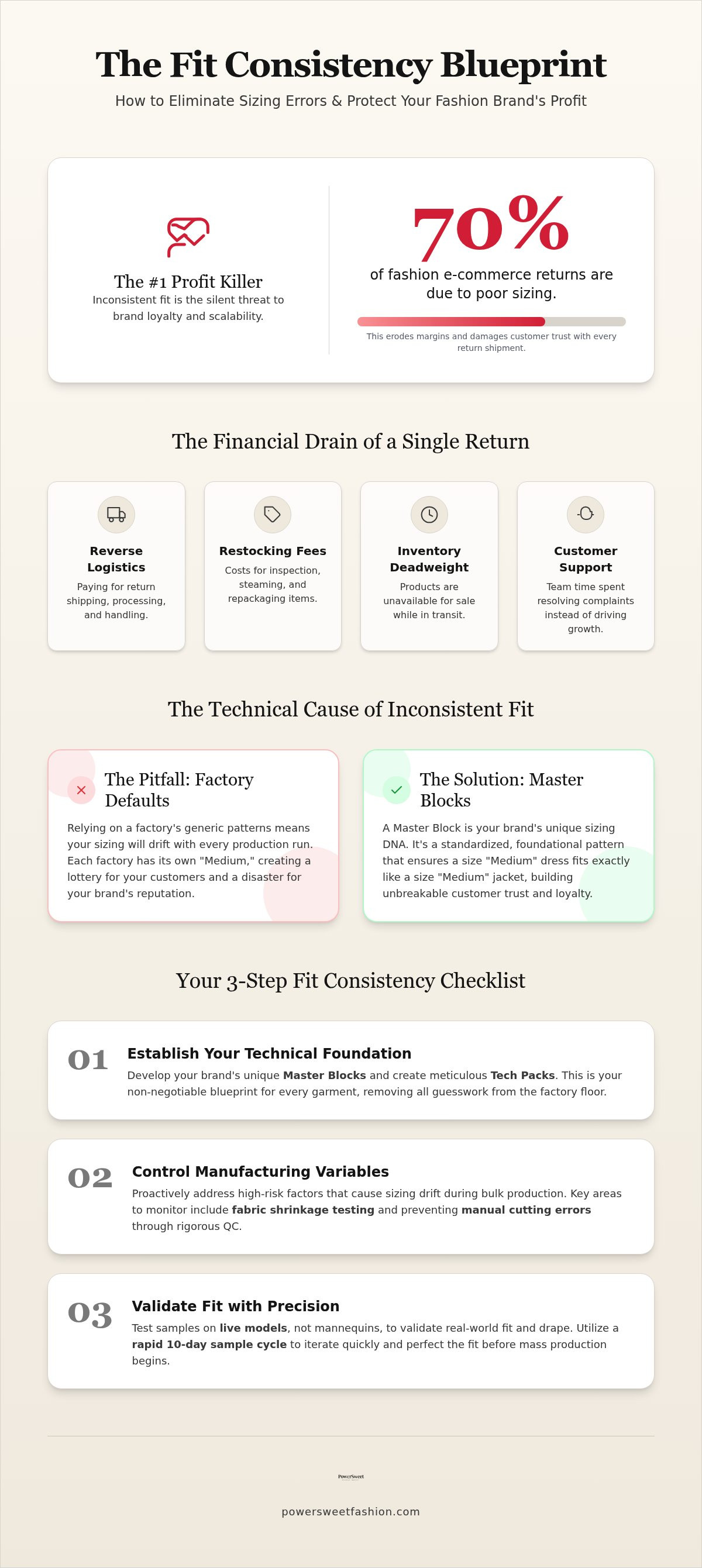
The Fashion Brand Fit Consistency Checklist (Template)
To eliminate inconsistent clothing fit, you need a standardized verification process at every stage of the production cycle. It isn't enough to hope the factory gets it right.
You must act as the technical gatekeeper for your brand.
This begins in pre-production by validating every Point of Measure (POM) in your tech pack against your established Master Block.
If the technical numbers don't align at this stage, bulk production will only amplify the error.
During the sampling phase, always review your fit sample on a live model.
Mannequins are useful for observing drape, but they lack the dynamic movement of a human body.
A live model can tell you if a waistband digs in or if an armhole feels restrictive during movement.
Finally, conduct a grading audit. Check the measurements for your smallest and largest sizes specifically.
Factories often apply linear grading rules that fail to account for how human body proportions change at the ends of the size spectrum.
Before any bulk order leaves the facility, require a Top of Production (TOP) sample.
This garment is pulled directly from the first run of the actual production line.
Comparing this against your approved fit sample ensures that no "sizing drift" occurred during the transition to mass manufacturing.
If the TOP sample doesn't match the approved prototype, the production run should be paused until the variance is resolved.
The 5-Point Measurement Audit
Focus your quality control on five critical benchmarks: Chest/Bust, Waist, Hip, Inseam, and Sleeve Length. These are the primary points where inconsistent clothing fit occurs.
If any of these measurements exceed your established tolerance levels, you must document the variance and request a re-cut.
Utilizing a low MOQ women's clothing manufacturer is a strategic way to test these fit cycles in small batches before committing to large scale production.
This allows you to iron out technical flaws without risking your entire inventory budget.
Size Chart Transparency for Consumers
Your technical precision should be visible to your customers.
Translate your tech pack data into a user-friendly size guide that distinguishes between "Body Measurements" and "Garment Measurements."
If a style is designed for an oversized fit, providing the actual garment dimensions helps customers make informed choices.
Use your customer reviews as a feedback loop to calibrate future fit standards.
If multiple buyers report that a style "runs small," it's a signal to adjust your Master Block for the next season.
Partner with PowerSweet Fashion to ensure your brand's sizing remains reliable and repeatable across every collection.
How PowerSweet Fashion Eliminates Fit Variance
Eliminating inconsistent clothing fit requires more than just a standard manufacturing agreement.
It demands a technical partnership where the factory acts as an extension of your design team.
At PowerSweet Fashion, we've built our entire production model around the goal of fit precision.
We understand that for a growing label, a single batch of poorly sized garments can stall your momentum.
That's why we don't just follow tech packs; we audit them to ensure every measurement is viable for mass production.
Our 5-7 day sample cycle serves as the critical window for fit-perfection.
This rapid prototyping phase allows you to test your designs on live models and make technical adjustments before any bulk fabric is cut.
Because we specialize in complex women's apparel construction, our in-house pattern making and grading experts know exactly how to scale your designs without losing the intended silhouette.
We translate your creative vision into a technical reality that works across your entire size range.
Control is the foundation of our process. We implement rigid quality control protocols, including 100% inspection of finished garments.
By maintaining a strict tolerance level of +/- 1cm for bulk production, we ensure that the final product your customer receives matches the approved sample exactly.
This collaborative partnership turns the manufacturing stage from a point of anxiety into a reliable engine for your brand's growth.
A Numbers-First Approach to Quality
We rely on empirical data to maintain sizing integrity.
Our location in the heart of Guangzhou provides us with direct access to a premium supply chain, ensuring that bulk fabric rolls match the GSM and shrinkage profiles of your initial samples.
We verify material stability at the source to prevent post-production disasters.
Scaling your brand requires a partner that prioritizes this level of logistical precision.
When your sizing is predictable, your return rates drop and your customer loyalty climbs.
Start Your Production Journey
Perfecting your fit shouldn't be a mystery. You can start by submitting your first tech pack to our team for a professional technical review.
Our low MOQ approach is specifically designed to help emerging labels perfect their fit in new collections without the risk of overproduction.
This allows you to gather real-world customer feedback and calibrate your sizing before scaling up.
We're ready to help you build a brand defined by quality and reliability.
Partner with PowerSweet Fashion for consistent, high-quality production and secure the future of your fashion brand today.
Secure Your Brand’s Reputation Through Technical Precision
Mastering the mechanics of garment production is the only way to move beyond the frustration of inconsistent clothing fit.
By establishing a rigid technical foundation through master blocks and detailed tech packs, you transform your manufacturing process from a series of guesses into a repeatable system.
We've seen how small oversights in cutting or fabric testing can spiral into costly return rates; however, these risks are entirely manageable with the right oversight and rigorous quality control protocols.
At PowerSweet Fashion, we provide the industrial expertise you need to scale with confidence.
Our 5-7 day sample turnaround gives you the speed to perfect every silhouette, while our low MOQ approach allows you to validate new styles without overextending your budget.
With our end-to-end quality control, you can trust that every piece matches your approved prototype exactly.
It’s time to stop managing complaints and start building a brand defined by reliability.
Your vision deserves a production partner that values accuracy as much as you do.
Frequently Asked Questions
What is the primary cause of inconsistent clothing fit?
The primary cause of inconsistent clothing fit is a lack of technical standardization between the design phase and the factory floor. When brands rely on factory-default patterns instead of providing their own technical specifications, sizing drift is inevitable. This drift occurs because every manufacturer interprets "standard sizing" differently based on their internal equipment and regional market data.
How much variance is acceptable in mass-produced clothing?
Most professional manufacturers operate within a tolerance range of +/- 1cm for bulk production. This means a garment is considered acceptable if its measurements fall within this narrow window of the tech pack specifications. If your brand requires higher precision, you must define these rigid tolerance levels in your contract before bulk cutting begins to ensure every item remains consistent.
What is a master pattern block and why does my brand need one?
A master pattern block is a basic, tested blueprint that represents your brand’s ideal fit without any design details or seam allowances. It acts as the "DNA" for your entire collection, ensuring that a size Large fits the same way across different styles. You need one to maintain sizing integrity as you scale and work with different production teams over multiple seasons.
How can I reduce return rates due to sizing issues?
You can reduce return rates by validating your fit on live models during the sampling phase and requiring a Top of Production (TOP) sample. Mannequins don't account for human movement, which often hides restrictive areas in the bust or hips. Implementing a strict 5-point measurement audit on finished goods also prevents defective sizing from reaching your customers and eroding their trust.
Why does my clothing fit differently after the first wash?
Garments fit differently after the first wash because of fabric shrinkage that wasn't accounted for during the cutting stage. Different materials have unique shrinkage profiles that require pre-production testing. We recommend washing fabric swatches at the source to ensure your patterns are adjusted for any expected dimensional changes before the bulk run is finalized.
How do I communicate fit requirements to a manufacturer in China?
The most effective way to communicate fit requirements to a manufacturer in China is through a comprehensive tech pack featuring clear Points of Measure (POM). Use visual diagrams and technical terms to eliminate the risk of translation errors. A detailed tech pack serves as a universal language that ensures your quality control team can hold the factory accountable for every millimeter.
What is the difference between pattern making and grading?
Pattern making is the process of creating the initial design template for your base size, while grading is the mathematical scaling of that pattern into larger and smaller sizes. Grading requires specific rules to ensure body proportions remain accurate as the garment grows. Poor grading is a frequent source of inconsistent clothing fit in plus-size or petite ranges where body shapes change non-linearly.
Does a low MOQ manufacturer provide better fit consistency?
A low MOQ manufacturer often provides better fit consistency because they allow for faster prototyping and tighter quality control oversight. With smaller batches, production teams can catch sizing drift early in the run without the pressure of massive volume. This approach gives you the flexibility to perfect your fit through multiple sample rounds before committing to thousands of units.


Comments