%20(1).png)
How to Choose a Custom Dress Manufacturer That Delivers Luxury Quality

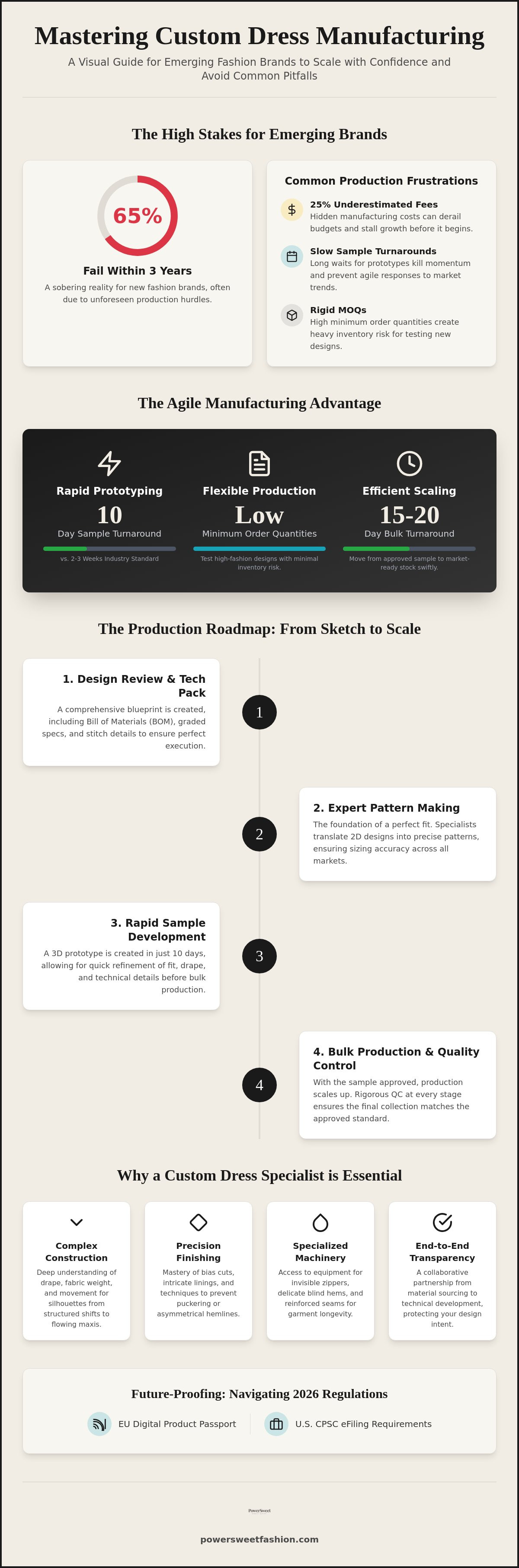
65% of emerging fashion brands fail within their first three years, often because they underestimate hidden manufacturing fees by as much as 25%. It's a sobering reality for designers who find their collections stalled by slow sample turnarounds or rigid MOQs that don't allow for agile growth. You've likely felt the frustration of poor communication regarding fabric sourcing or technical specs when trying to find a reliable custom dress manufacturer. Transitioning from a design prototype to high-quality bulk production shouldn't feel like a gamble with your brand's future.
This guide will help you master the complexities of dress manufacturing so you can scale with confidence. We'll show you how to identify a production partner that offers 10 to 15 day bulk turnarounds and expert pattern making for complex fits. You'll also learn how to navigate the 2026 regulatory landscape, including the EU Digital Product Passport and U.S. CPSC eFiling requirements. We're moving from high-level concepts into the physical reality of the factory floor, ensuring you have the transparent, end-to-end sourcing needed to thrive in a competitive market.
Table of Contents
Why Choosing a Specialist Custom Dress Manufacturer Matters
Choosing a production partner is the most critical decision for any apparel brand. In the global garment industry, the role of a custom dress manufacturer has evolved beyond simple assembly. They act as the technical engine that transforms a creative vision into a scalable product. Unlike basic streetwear or athleisure, dresses require a level of precision that standard "blank" manufacturers can't provide. Custom construction is the foundation of your brand identity. It allows for unique silhouettes and proprietary fits that set your collection apart from competitors who rely on pre-made templates. Specialized machinery plays a vital role here. High-end dress finishing requires specific equipment for invisible zippers, delicate blind hems, and reinforced seams that extend garment longevity.
Moving beyond generic blanks is essential for brands targeting the premium or contemporary market. While t-shirts and hoodies can often be sourced from stock inventories, a dress is a statement piece. It represents your brand's unique design language. If you rely on generic patterns, you lose the ability to innovate with asymmetrical cuts or mixed-media fabrics. A specialist manufacturer provides the infrastructure needed to execute these complex details at scale without compromising on quality.
The Complexity of Dress Construction
Dresses are inherently complex. They demand a deep understanding of drape, movement, and fabric weight. A structured shift dress requires different internal support than a flowing maxi. Specialized women's wear factories produce better fit consistency because they specialize in these nuances. They understand how different textiles react to tension and heat. This technical expertise prevents common issues like fabric puckering or asymmetrical hemlines. When a factory masters the mechanics of bias cuts and intricate linings, the resulting quality builds customer trust.
Bridging the Gap Between Design and Production
A professional custom dress manufacturer acts as a bridge between your sketches and the retail rack. They employ technical designers who evaluate design feasibility at scale. These experts create production-ready blueprints that account for every seam and stitch. A custom dress manufacturer is a partner that manages technical development and bulk execution. This collaborative approach ensures that your original aesthetic remains intact throughout the manufacturing process. By focusing on end-to-end material management and precision pattern making, we help you avoid the costly mistakes that often plague fashion startups. This transparency ensures that your production journey is efficient and reliable.
The Technical Process: From Pattern Making to Sample Development
The sample phase is the heartbeat of successful garment production. It's the most critical step for a custom dress manufacturer because it identifies technical flaws before they become expensive bulk errors. During this stage, we translate your 2D sketches into a 3D prototype. This allows us to refine the fit and ensure the drape matches your creative intent. While many manufacturers require two to three weeks for a single prototype, the PowerSweet Fashion standard is different. We achieve 10-day sample turnarounds for rapid prototyping. This speed allows your brand to stay agile and respond to market trends without the typical months of waiting. It's about moving fast without sacrificing the meticulous care your designs deserve.
Professional pattern making is the foundation of this process. It affects sizing accuracy across international markets, ensuring your "Medium" fits consistently whether your customer is in New York or Paris. We use an iterative process to refine the fit. We don't just cut fabric; we analyze how it moves on a body. If you're looking to scale, you can partner with us for sample development to ensure your first run is perfect.
Mastering the Tech Pack
Clear documentation prevents costly production errors. A comprehensive tech pack for a dress must include a detailed Bill of Materials (BOM), graded specifications, and specific stitch details. These blueprints ensure every department in the factory is aligned on your vision. Without these details, bulk production becomes a guessing game. For more insights on selecting the right team for this stage, read The Definitive Guide to Choosing a Clothing Line Production Partner in 2026. High-quality documentation is the best insurance policy for your brand's reputation.
Fabric Sourcing and Trim Management
Material consistency is vital between the sample and the final bulk run. We leverage local supply chains to source high-quality crepe, silk, and sustainable textiles that meet modern environmental standards. Our team manages the logistics of sourcing custom buttons, zippers, and brand labels so you don't have to. This end-to-end management ensures that the fabric you approved in the sample phase is the exact same material that arrives in your bulk shipment. We prioritize transparency in our sourcing, inviting you to understand exactly where your materials come from. This grounded approach provides the empirical reliability needed for long-term brand growth.
Agile Manufacturing: Evaluating Lead Times and MOQs
The apparel industry is undergoing a fundamental shift toward responsiveness. Traditional manufacturing models often require 60 to 90 days for bulk delivery, a timeline that frequently results in missed market opportunities. In contrast, agile manufacturing has established 15 to 20 day bulk cycles as the new professional standard. This speed allows brands to capitalize on real-time trends rather than gambling on forecasts made six months in advance. A specialized custom dress manufacturer provides the infrastructure to support this pace without compromising technical integrity. Balancing this speed with meticulous quality control is essential. We maintain rigorous checkpoints at every stage of the cutting and sewing process to ensure that a fast-paced environment doesn't lead to garment defects.
The economics of scaling have also changed. Successful brands no longer start with massive inventory. They begin with small batches to test design viability and then move to high-volume runs once a style is proven. This "test and scale" approach minimizes the financial burden of unsold stock. By choosing a partner that understands this trajectory, you can transition from 50 units to 5,000 units seamlessly as your brand grows.
Strategic Benefits of Low MOQ Production
Low Minimum Order Quantities (MOQs) are a powerful tool for risk management. For startup fashion brands, high MOQs often tie up vital capital in unsold inventory, creating a cash flow bottleneck. By utilizing lower minimums, you can diversify your collection and offer more frequent "drops" throughout the year. This strategy keeps your product line fresh and encourages repeat customers. We support this growth by offering flexibility that scales with your business. Whether you're producing a boutique run of 50 pieces or a global launch of several thousand, the focus remains on precision and reliability.
Understanding Global Lead Times in 2026
Production speed is influenced by two primary factors: fabric availability and construction complexity. While a simple shift dress might move through the line quickly, an intricate evening gown with custom trims requires more time for quality assurance. Despite these variables, maintaining a competitive edge in 2026 requires a 15 to 20 day bulk production window. This is particularly vital for influencer-led brands that must sync product launches with viral marketing cycles. Agile lead times are achieved through optimized sourcing and in-house production management. By keeping the supply chain tight and the manufacturing process transparent, a custom dress manufacturer ensures your collection reaches the market while the demand is at its peak.
The Production Roadmap: Navigating the Roadmap to Bulk
Success in garment manufacturing depends on a structured, repeatable process. We've developed a five-step roadmap that moves your vision from a digital concept to a physical product ready for retail. As your custom dress manufacturer, we act as a facilitator throughout this journey. We prioritize transparency, ensuring you're informed at every critical juncture. This methodical approach eliminates the guesswork and allows you to focus on marketing and brand growth.
Step 1: Initial Consultation and Design Review. We begin by auditing your designs for production feasibility. This isn't just a cursory glance; it's a technical evaluation to ensure the dress can be manufactured at scale without losing its aesthetic appeal. We identify potential construction bottlenecks early to prevent delays later.
Step 2: Fabric Sourcing and Pattern Development. Once the design is validated, we secure the necessary textiles and trims. Our pattern makers simultaneously develop the master blueprints that will guide the entire run. This ensures that the technical specs are locked in before the first cut is made.
Step 3: Sample Creation and Fit Approval. We utilize our 10-day window to produce a high-fidelity prototype. This is your opportunity to review the drape and construction. You can request adjustments during this phase to perfect the fit before we commit to the bulk phase.
Step 4: Bulk Production and Multi-Point Inspections. Your order enters the main production line for a 15 to 20 day cycle. We implement rigorous inspections at every station to maintain consistency across every unit. This controlled urgency keeps your project on track.
Step 5: Final Packaging and Global Logistics. We handle the final finishing, including brand labeling and poly-bagging, before managing the distribution to your warehouse. Our team ensures that every garment is retail-ready upon arrival.
Quality Control Standards
Reliability is built on standardized testing. We implement AQL (Acceptance Quality Limit) standards to ensure every batch meets international quality benchmarks. Our team conducts common QC checkpoints focusing on seam strength, zipper functionality, and strict measurement tolerances. These steps prevent the margin errors often seen in unmanaged supply chains. For a deeper look at this process, see our End to End Clothing Production: The Complete Guide for Fashion Brands in 2026. If you're ready to start your next collection, you can contact our production team today.
Logistics and Delivery
Navigating international shipping requires a pragmatic partner. We help you understand the nuances between FOB (Free On Board) and DDP (Delivered Duty Paid) shipping terms so you can choose the most cost-effective route for your brand. Managing customs and duties for bulk apparel shipments is a complex task that we handle on your behalf. We provide transparent tracking during the final delivery phase, giving you the empirical data needed to manage your inventory and launch dates with confidence. This end-to-end support ensures your transition from factory to customer is as seamless as the production itself.
Partnering with PowerSweet Fashion for Your Dress Collections
PowerSweet Fashion acts as the industrial engine for fast-growing global brands. We don't just sew garments; we build the technical infrastructure that supports your creative vision. As a specialized custom dress manufacturer, we understand that women's apparel requires a higher level of precision than basic knitwear. This focus allows us to maintain a standard of excellence that generalist factories simply can't match. Our commitment to transparency goes beyond status updates. We invite you into our process, providing an open-door view that allows you to oversee production and verify the meticulous care we put into every seam. This collaborative approach lowers the barrier to entry for growing brands by making the manufacturing world accessible and predictable.
Starting your next collection is a streamlined process. We utilize a 10-day sampling service to turn your initial sketches into high-quality prototypes. This rapid prototyping ensures that you can refine your designs without losing market momentum. By focusing on the mechanics of production and quality assurance, we provide the stability you need to scale your brand with confidence. We prioritize reliability over abstract descriptions, ensuring that every garment that leaves our facility meets your exact technical specifications.
A Safe Pair of Hands for Your Designs
Reliability is our foundation. We've built a history of meticulous execution by acting as a pragmatic partner for visionaries who need results, not just promises. The human element is at the core of our work. When you work with us, you're partnering with a team of seasoned pattern makers and production managers who have handled every industrial challenge imaginable. We bridge the gap between digital communication and physical reality by keeping you connected to the people actually making your clothes. This "numbers-first" approach to credibility ensures that your designs are in a safe pair of hands from the first cut to the final stitch.
Your End-to-End Manufacturing Solution
Our system is designed to remove friction from your supply chain. We've integrated fabric sourcing and expert pattern making into a single, streamlined journey. This end-to-end approach ensures that your technical specs are preserved from the first prototype to the final shipment. If you're ready to scale, our 15-20 day bulk production lead times provide the agility needed to dominate your market. We act as the engine that powers your growth, offering the low MOQ flexibility required to test new styles without inventory risk. It's time to transition from design prototypes to high-quality bulk production with a partner that understands your goals.
Start your custom dress production with PowerSweet Fashion today and experience the difference of professional, transparent manufacturing.
Scale Your Brand with Precision and Speed
Transitioning from a creative concept to a retail-ready collection requires more than just a factory; it requires a strategic partner. You've seen how specialized pattern making and technical design serve as the foundation for high-quality women's fashion. Choosing a dedicated custom dress manufacturer ensures your silhouettes maintain their integrity from the first prototype to the final bulk shipment. By leveraging our 10-day sample turnaround and 15-20 day bulk production cycles, you can respond to market trends with controlled urgency. This agile approach minimizes inventory risk while maximizing your brand's growth potential.
We've built a system rooted in transparency and empirical reliability to support your vision at every stage. It's time to move past the delays and communication gaps that stall most fashion startups. Our team is ready to act as the engine for your next successful launch. We prioritize the human element and industrial precision to ensure your collection arrives retail-ready and on schedule. Your designs deserve a safe pair of hands that can execute at scale without compromising on quality.
Request a Quote for Your Custom Dress Collection and start building your brand's future today. We look forward to powering your creative journey.
Frequently Asked Questions
What is the typical MOQ for a custom dress manufacturer?
Typical low MOQs for custom cut and sew production in 2026 range from 50 to 100 pieces per style. This flexibility allows growing boutique brands to test new designs without the burden of heavy inventory risk. We provide the infrastructure to support these smaller batches while maintaining the same technical standards used for high volume runs. It's a strategic way to manage cash flow as you scale your collection.
How long does the sample development process take for a custom dress?
The sample development process at PowerSweet Fashion takes approximately 10 days from the initial design review. This rapid turnaround is significantly faster than the industry average of two to four weeks. Speed in this phase is vital because it allows you to refine the fit and drape without delaying your collection launch. It ensures your brand stays agile in a fast paced market.
Can a manufacturer help with fabric sourcing and pattern making?
Yes, we provide comprehensive end to end fabric sourcing and expert pattern making as part of our core services. We act as a custom dress manufacturer that manages the entire technical journey from textile selection to production ready blueprints. This integrated approach ensures your original aesthetic remains intact. It also prevents the communication gaps that often occur when using multiple third party vendors.
What is the difference between FOB and DDP in apparel manufacturing?
FOB (Free On Board) means the manufacturer is responsible for the goods only until they reach the shipping port; DDP (Delivered Duty Paid) means the manufacturer handles all shipping, customs, and duties until the order reaches your warehouse. We help you evaluate which term best fits your logistics model. DDP is often the preferred choice for brands seeking a transparent, hassle free delivery experience.
How do I ensure quality control when working with an overseas factory?
Quality control is ensured through rigorous multi point inspections and the implementation of AQL (Acceptance Quality Limit) standards. We conduct checks on seam strength, zipper functionality, and measurement tolerances at every stage of the production line. This methodical system ensures that every garment meets your technical specs. Our commitment to transparency means you're always informed about our internal QA results.
What information do I need to provide for a custom dress quote?
You should provide a complete tech pack that includes a Bill of Materials, graded size specifications, and detailed design sketches. If you're in the early stages, a physical reference sample or clear inspiration images can help us assess production feasibility. Providing specific details about your desired fabric weight and trim requirements allows us to deliver a more accurate and reliable quote.
Does a low MOQ manufacturer charge more per unit?
Unit costs are typically higher for smaller production runs because the industrial setup time and material sourcing costs are spread across fewer garments. However, low MOQs are a vital tool for risk management for emerging brands. They prevent your capital from being tied up in unsold stock. As your brand grows, you'll naturally transition to high volume runs that offer better economics of scale.
Can I visit the factory to oversee my bulk dress production?
Yes, we maintain an open door transparency policy that encourages clients to visit our facility and meet the team. Seeing the physical reality of the production process helps build a stronger partnership between the factory and the brand. It provides reassurance that your designs are being handled with meticulous care. This human element is a defining characteristic of how we manage our industrial operations.


Comments