
How to Calculate Clothing Manufacturing Costs: The Professional Founder’s Guide

Updated: Sep 22
Most fashion brands don't fail because of poor design; they fail because they didn't calculate the cost of a single button before hitting the production floor. It's a common trap for founders to focus on the aesthetic while leaving the math for later, only to realize their margins have vanished into hidden shipping surcharges and duty fees. You've likely felt that frustration when a "successful" sample run turns into a bulk production nightmare of unexpected expenses. Understanding how to calculate clothing manufacturing costs is the only way to move from a creative hobby to a scalable, profitable business.
We agree that the technical side of garment production can feel like a black box of confusing acronyms and opaque pricing models. This guide promises to demystify that process, giving you the tools to master your math and protect your bottom line. We will walk through the critical differences between CMT and FPP pricing, explain how new 2026 regulations like the EU Digital Product Passport impact your overhead, and provide a clear framework for lowering your per-unit costs. By the end of this article, you will have the confidence to negotiate with any factory as a seasoned industry professional.
Table of Contents
Understanding the Foundations: CMT vs. FPP Manufacturing Models
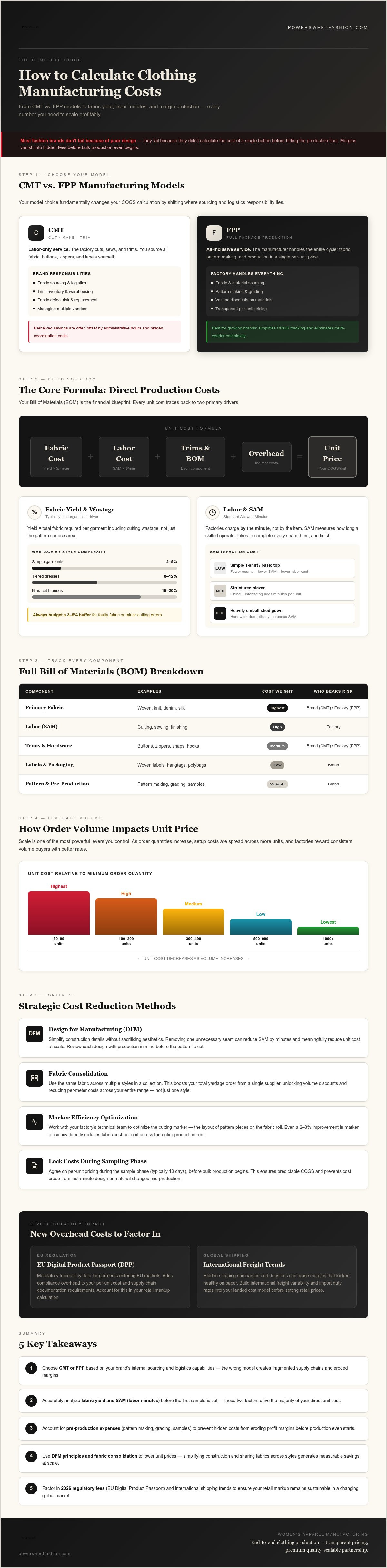
Before you can determine how to calculate clothing manufacturing costs, you must decide which operational model fits your brand's infrastructure. In the women's apparel industry, the two primary paths are Cut, Make, Trim (CMT) and Full Package Production (FPP). Each model fundamentally changes your Cost of Goods Sold (COGS) calculation by shifting where the responsibility for sourcing and logistics lies. Choosing the wrong model early on can lead to a fragmented supply chain and eroded margins.
When to Choose CMT for Your Brand
CMT is a labor-only service. The factory provides the skilled labor to cut the fabric, sew the garment, and add trims, but the brand is responsible for every other physical component. This includes sourcing the primary fabric, buttons, zippers, and even the woven labels. It's often chosen by brands with established local fabric suppliers or those who want absolute control over every component. However, the cost implications are complex. You must manage your own logistics, warehouse your own trim inventory, and absorb the financial risk of fabric defects or cutting wastage. If your fabric supplier sends a flawed roll, the manufacturing delay and replacement costs fall entirely on your shoulders. For many founders, the perceived savings of CMT are quickly offset by the administrative hours spent managing multiple vendors.
The Financial Benefits of Full Package Production (FPP)
FPP is a comprehensive solution where the manufacturer handles the entire production cycle. This model consolidates fabric sourcing, pattern making, and production into a single per-unit price. For growing women's fashion brands, this approach provides a "safe pair of hands" by leveraging the factory’s existing supply chain. Factories often secure better material rates due to their volume, which can reduce your total material markup compared to sourcing small quantities independently. We've found that this consolidation is the most efficient way to maintain quality across complex women's styles.
Choosing FPP simplifies the math behind how to calculate clothing manufacturing costs because it eliminates the need to track dozens of micro-expenses. It streamlines the accounting for end to end clothing production, allowing founders to focus on scaling rather than logistics. At PowerSweet Fashion, we use this model to provide transparent pricing early in the relationship. By locking in costs during our 10-day sample phase, we ensure that your bulk production remains predictable and profitable. This partnership approach removes the mystery from manufacturing, turning your creative vision into a stable, industrial reality.
The Core Formula: Breaking Down Direct Production Costs
Mastering the math of garment production starts with the Bill of Materials (BOM). This document is your financial blueprint; it tracks every physical component of your garment, from the primary fabric to the thread and brand labels. Many founders organize these expenses using professional spreadsheet dashboards, such as those available from Biz Infographs, to keep unit costs and margins clearly structured. To understand how to calculate clothing manufacturing costs with precision, you must look beyond the surface of a quote and analyze the two primary drivers: material yield and labor minutes. These direct costs form the foundation of your unit price before any logistical fees or markups are applied.
Calculating Fabric Yield and Wastage
Fabric is typically the largest expense in women’s apparel. To calculate your cost, you need the "yield," which is the total amount of fabric required to produce one garment. This isn't just the surface area of the pattern pieces. It includes the wastage created during the cutting process. In the U.S. textile and apparel industry, manufacturers use a "marker"-a technical layout of pattern pieces-to optimize fabric usage. Intricate women’s designs, such as tiered dresses or bias-cut blouses, often have higher wastage rates because the pieces don't fit together as tightly on the fabric roll. When budgeting, always include a 3% to 5% buffer for "faulty fabric" or minor cutting errors. This prevents a small production hiccup from turning into a total loss of margin.
Labor and Construction Complexity
Factories don't charge by the "item"; they charge by the minute. This is measured through Standard Allowed Minutes (SAM), a technical calculation of how long it takes a skilled operator to complete every seam, hem, and finish. Construction complexity dictates this time. A simple knit t-shirt might have a low SAM, but a structured blazer with internal linings and welt pockets requires significantly more labor hours. Specialized finishes like pleating, embroidery, or custom dyeing add labor premiums that must be captured in your initial BOM. Choosing a custom women’s clothing manufacturer that understands these nuances is critical for maintaining consistent quality. At PowerSweet, we analyze these complexities during our 10-day sample phase to ensure your final unit cost is grounded in reality. If you are struggling to balance design and budget, our fabric sourcing and sampling services can help identify more efficient construction methods without sacrificing your brand's aesthetic.
Once you have accounted for fabric and labor, don't forget the hardware. Buttons, zippers, interlinings, and even polybags are micro-expenses that add up. A high-quality YKK zipper or custom-engraved buttons can add several dollars to your unit price. By documenting every single item in your BOM, you eliminate the "hidden" costs that often surprise founders during their first bulk production run. This level of detail is what separates a professional brand from a struggling startup.
Accounting for Indirect and Hidden Manufacturing Expenses
While fabric and labor are the most visible line items, several indirect expenses can quietly erode your profitability if they aren't tracked with precision. Many founders overlook the pre-production phase; however, this is where the most significant "hidden" financial risks reside. An accurate understanding of how to calculate clothing manufacturing costs requires you to budget for the technical groundwork that ensures your bulk run is successful. This includes the creation of a professional Tech Pack, pattern making, and size grading. These one-time setup fees are essential investments that prevent costly production errors down the line. For a deeper look at these variables, you can consult a comprehensive guide to garment costing.
Quality control (QC) is another critical indirect cost that belongs in your budget. Relying solely on factory-level checks is a risk that seasoned founders don't take. Professional brands often budget for independent third-party audits to verify stitch quality and measurement tolerances before the goods leave the facility. While this adds a line item to your budget, it's far cheaper than dealing with customer returns or unsellable inventory once the shipment arrives. We view QC not as an extra expense, but as insurance for your brand's reputation.
The Cost of Sample Development
The first garment you produce will always be the most expensive item in your collection. Sample development involves translating a 2D sketch into a physical product, often requiring multiple iterations to perfect the fit. Most factories charge a fixed fee for sampling, which is naturally higher than the bulk unit price. Choosing the right sample development clothing manufacturer is about more than just the initial fee; it's about speed and accuracy. A slow sampling process delays your time-to-market, which carries its own significant financial cost in lost sales opportunities. We recommend planning for a "Revision Buffer" of at least two iterations. At PowerSweet, our 10-day sample phase helps lock in these costs early, ensuring your production timeline remains stable and predictable.
Shipping, Duties, and Logistics
Logistics often present the most significant surprises in 2026. You must understand Incoterms like FOB (Free on Board) or EXW (Ex Works) to know exactly when your financial responsibility for the goods begins. If you're importing, duties and tariffs can add a substantial percentage to your landed cost depending on the material composition. Additionally, air freight is calculated based on volumetric weight. Bulky items like structured blazers or heavy knitwear may cost more to ship than their physical weight suggests. Factoring in these 2026 shipping surcharges is non-negotiable when you are determining how to calculate clothing manufacturing costs for a sustainable business model.
The Math of Scale: How Order Volume Impacts Unit Price
Scale is the most powerful lever you have when learning how to calculate clothing manufacturing costs. Factories have a "floor" for production, known as the Minimum Order Quantity (MOQ), because every new style requires a significant disruption to their workflow. It's not just about the cost of the fabric; it's about the cost of stopping a production line to reconfigure machines. When you understand the math of scale, you can find the "sweet spot" where you balance the risk of holding too much inventory against the benefit of a lower unit price.
A primary driver of this price shift is the amortization of fixed costs. Expenses like pattern making, size grading, and technical setup are static. If you spend a fixed amount on a pattern for a structured dress and produce only 50 units, that cost is spread thinly across those items. If you produce 500 units, the "per-unit" burden of that pattern becomes negligible. This same logic applies to fabric MOQs. Textile mills often require a minimum yardage for custom dyes; if your order is too small, you may be forced to pay a "small-batch premium" or use stock colors that don't perfectly match your vision.
Why Per-Unit Costs Drop as Volume Increases
The reduction in price isn't just about bulk buying; it's about industrial efficiency. Machine setup time, or the cost of "changing the thread," is a major factor. Every time a factory switches from a black silk blouse to a white linen skirt, they must clean the machines and swap out every spool of thread. This downtime is factored into your quote. Additionally, sewers follow an efficiency curve. During the first 50 units, the team is learning the specific nuances of your garment's construction. By the time they reach unit 200, their speed increases, lowering the effective labor cost per piece. Higher volume allows the factory to pass these operational savings back to the brand.
Managing the Economics of Low MOQs
For many founders, starting with a low MOQ women’s clothing manufacturer is a vital strategic move to test new markets without overextending capital. While your unit price will be higher, you reduce the risk of unsold "dead stock." You can mitigate these small-batch costs by using stock fabrics or consolidating materials across multiple styles. We recommend calculating a "premium for flexibility" in your retail markup; essentially, you accept a lower initial margin in exchange for the agility to pivot based on real customer data. At PowerSweet, we provide the flexibility to scale from small samples to bulk production seamlessly. If you are ready to move from concept to a profitable production run, contact us to discuss your custom women's clothing project.
Strategic Optimization: How to Lower Your Manufacturing Costs
Calculating your production expenses is the first step; however, the most successful founders use that data to engineer better margins through Design for Manufacturing (DFM). DFM is the process of simplifying a garment's construction to reduce labor minutes and material waste without compromising the brand's aesthetic. When you understand how to calculate clothing manufacturing costs at a granular level, you can identify which "luxury" details are driving up prices and which functional alternatives provide the same value at a lower cost. This strategic mindset transforms your manufacturing from a passive expense into a competitive advantage.
Fabric consolidation is another high-impact optimization strategy. By using the same primary material across multiple styles in a collection, you increase your total yardage order for that specific fabric. This often helps you clear the textile mill’s MOQ or move into a more favorable price bracket. Additionally, standardizing your hardware, such as using the same zipper gauge or button size across your entire line, reduces the complexity of your Bill of Materials and minimizes the risk of production delays due to trim shortages. Partnering with an end-to-end manufacturer allows you to execute these strategies under one roof, eliminating the markups typically added by third-party sourcing agents.
Optimizing Design for Better Margins
Small design choices have significant financial consequences. For instance, evaluating the cost impact of a French seam versus a high-quality overlock stitch can reveal hidden savings in labor time. If you are developing a summer collection, looking at Resort wear manufacturer techniques can provide insights into simplifying garment construction. Lightweight, unlined pieces often require fewer Standard Allowed Minutes (SAM), which directly lowers your unit price. Standardizing your internal trims and interlinings across different styles further streamlines the cutting and sewing process, allowing the factory to maintain a faster, more efficient rhythm.
The Value of Factory Transparency
Clear communication is the most effective way to prevent costly production errors. Building a long-term partnership based on transparency allows you to unlock "preferred client" pricing and better production slots. When a factory understands your long-term vision, they can suggest more efficient construction methods that you might have overlooked. Speed is also a critical component of your financial health. PowerSweet Fashion’s 15-20 day bulk production turnaround significantly reduces your inventory carrying costs. Faster production means you don't have to tie up capital in storage fees or commit to massive stock levels months in advance. This agility is essential for maintaining a healthy cash flow while you learn how to calculate clothing manufacturing costs for a growing brand. By reducing the time between the initial sample and final delivery, you minimize market risk and maximize your ability to respond to real-time sales data.
Turning Production Math into Brand Profitability
Mastering how to calculate clothing manufacturing costs is the bridge between a creative concept and a sustainable fashion business. By accurately accounting for fabric yield, labor minutes, and hidden logistical fees, you protect your margins from the unexpected surcharges that often derail new founders. Successful scaling requires a shift from reactive spending to strategic optimization, where every design choice is made with the final unit price in mind. You've now seen that profitability is built on data, not just aesthetics.
You don't have to navigate these technical complexities alone. As a partner with deep end-to-end women’s wear expertise, we simplify the production journey through transparent pricing and meticulous quality control. We specialize in helping brands grow through our 10-day sample turnaround and low MOQ flexibility; this ensures you can test the market without excessive inventory risk. When you are ready to move from the drawing board to the production floor, get a custom production quote from PowerSweet Fashion. We are ready to provide the stable, professional engine your creative vision deserves. Let's build a profitable future for your brand together.
Frequently Asked Questions
What is the most expensive part of clothing manufacturing?
Fabric consumption is typically the most expensive component, often accounting for 50% to 70% of a garment's total production cost. This includes the primary textile, linings, and interlinings. Labor is the second largest driver, especially for complex women's apparel with intricate seams or finishes. Understanding these ratios helps you focus your cost-reduction efforts where they'll have the most significant impact on your bottom line.
How much should I budget for garment sampling?
Budgeting for sampling requires accounting for fixed development fees rather than per-unit production rates. This phase covers pattern making, sourcing specific materials, and creating initial prototypes. While sampling is more expensive than bulk production, it's a vital investment to lock in your final costs early. We provide a 10-day sample turnaround to help brands move quickly from concept to a finalized, professional production budget.
Does a higher MOQ always mean a lower price?
Higher Minimum Order Quantities (MOQs) generally lead to lower unit prices because they allow for the amortization of fixed setup costs. When you spread pattern making and machine configuration fees across more units, the burden on each item decreases. Additionally, factories gain better leverage with textile mills when purchasing bulk yardage. This volume-based efficiency is a core part of how to calculate clothing manufacturing costs for any growing brand.
How do I calculate the "landed cost" of my clothing?
Landed cost is the total price of a product once it arrives at your warehouse door. To calculate this, you must add the per-unit production cost to shipping fees, import duties, customs brokerage, and insurance. It's a comprehensive figure that represents your true investment. Mastering this calculation is a critical step in understanding how to calculate clothing manufacturing costs for a sustainable, long-term business model.
What is a wastage factor in garment production?
The wastage factor represents the percentage of fabric lost during the cutting and production process. No marker layout is 100% efficient; some material is always lost to scraps or minor defects. In professional garment production, we typically factor in a 3% to 5% buffer to ensure there is enough material to complete the full order. This prevents unexpected material shortages that could stall your production timeline and increase costs.
Can I reduce costs by providing my own fabric?
Providing your own fabric shifts you to a Cut, Make, Trim (CMT) model, which can reduce material markups but significantly increases your logistical burden. You become responsible for fabric quality, delivery timelines, and inventory management. While this offers more control, many brands prefer our end-to-end sourcing to consolidate these risks. We handle the entire supply chain to ensure material consistency and reduce the administrative overhead for your brand.
Why do different sizes cost the same to manufacture?
Most manufacturers charge a flat rate across a size run because the labor time remains identical for a size Small or a size Large. While a larger garment uses slightly more fabric, the difference is usually negligible when averaged across the entire production volume. Standardizing the price simplifies your retail accounting and ensures a consistent customer experience. This allows you to maintain stable margins across your entire women's apparel inventory.
How do I factor in the cost of quality control?
Quality control should be treated as a non-negotiable insurance policy within your production budget. You should factor in the cost of both factory-level inspections and independent third-party audits before goods are shipped. Budgeting for these checks prevents the significant financial loss associated with customer returns or unsellable defective stock. At PowerSweet, we integrate rigorous quality control services into our end-to-end production process to protect your brand's reputation and profitability.
Comments