%20(1).png)
How Better Fit Can Reduce Fashion Returns
- Powersweet Team

- Aug 8
- 12 min read
Updated: Aug 9
What if the biggest drain on your bottom line isn't your marketing spend, but the items coming back to your warehouse? High return rates are often treated as an unavoidable cost of doing business in the fashion industry, yet many of these losses are preventable at the manufacturing stage. You've likely felt the frustration of losing profits to reverse logistics while reading customer reviews about inconsistent sizing. To truly reduce clothing returns, you must look beyond the digital storefront and focus on the technical mechanics of how your garments are actually built.
We understand that maintaining quality across production batches is a constant struggle for brands aiming for scale. This article outlines how you can slash return rates by optimizing your production process, starting with technical pattern making and ending with strategic material sourcing. You'll learn how to leverage precision sampling and end-to-end quality control to ensure your bulk orders match your tech packs perfectly. We will break down the specific steps to transition from high-volume returns to a streamlined system that prioritizes fit accuracy and customer loyalty.
Table of Contents
The 8 Billion Returns Crisis: Why Fashion Brands Must Pivot in 2026
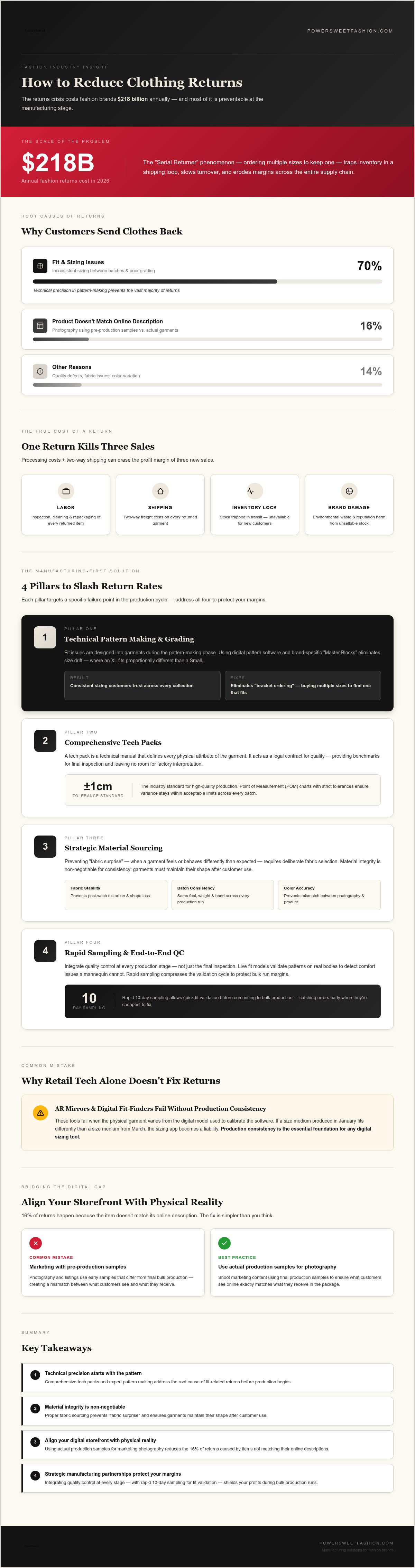
Engineering Perfect Fit: How Technical Precision Prevents 70% of Returns
Material Integrity: Choosing Fabrics That Match Customer Expectations
Bridging the Digital Gap: Optimizing Production for Online Accuracy
Scaling Success: Partnering with Manufacturers Focused on Quality Control
The $218 Billion Returns Crisis: Why Fashion Brands Must Pivot in 2026
The returns crisis is no longer a peripheral concern; it's a primary threat to fashion e-commerce margins. In 2026, industry data indicates that returns represent a $218 billion problem for retailers. This financial drain is fueled by the "Serial Returner" phenomenon, where customers order multiple sizes of the same garment with the intent of keeping only one. This behavior traps inventory in a shipping loop, preventing other customers from purchasing those items and significantly slowing inventory turnover. While brands try to optimize their storefronts, fit and sizing remain the top reasons for these returns. To effectively reduce clothing returns, you must address the physical product before it ever leaves the factory floor.
The Hidden Costs of Reverse Logistics
The true cost of a return extends far beyond the initial shipping label. Reverse logistics involves a labor-intensive chain of inspection, cleaning, and repackaging. Every returned garment must be checked for damage or signs of wear before it can be restocked. In many cases, the high cost of this processing combined with two-way shipping can erase the profit margin of three new sales. Beyond the financial impact, brands are facing increased pressure from consumers regarding the environmental waste of return shipping. Unsellable stock or items damaged during transit often end up as waste, creating a sustainability crisis that damages brand reputation as much as the bottom line.
Why Retail Tech Alone Isn’t Solving the Problem
Many brands invest heavily in AR mirrors and digital fit-finders, yet return rates often remain stagnant. These tools fail when the physical garment varies from the digital model used to calibrate the software. If a size medium produced in January fits differently than a size medium from March, the sizing app becomes a liability rather than an asset. Production consistency is the essential foundation for any digital sizing tool. Manufacturing variance renders sizing apps ineffective because the software cannot predict human error or material instability during the production cycle. Without a stable manufacturing process, even the most advanced retail technology will fail to reduce clothing returns accurately.
Engineering Perfect Fit: How Technical Precision Prevents 70% of Returns
Fit issues aren't random accidents; they're usually designed into the garment during the initial pattern-making phase. If the foundation is flawed, no amount of marketing or software can fix the customer experience. To reduce clothing returns, brands must prioritize technical precision at the start of the production cycle. This is where the physical reality of the garment is established. When a pattern is built with high-level technical expertise, the likelihood of a customer being surprised by the fit drops significantly.
The Role of Professional Pattern Grading
Grading is the process of scaling a sample size into a full range of sizes. Poor grading often leads to "size drift," where an XL fits proportionally different than a Small. We utilize digital pattern software to maintain mathematical precision across every grade. Establishing brand-specific "Master Blocks" ensures that your customers can trust that a size 8 fits the same way across every collection you launch. This consistency builds customer trust and reduces the need for "bracket ordering," where customers buy multiple sizes to find one that works.
Tech Packs: The Blueprint for Sizing Consistency
A tech pack is more than a drawing; it's a technical manual that defines every physical attribute of the garment. It must include detailed Point of Measurement (POM) charts and strict tolerances. A +/- 1cm tolerance is the industry standard for high-quality production, ensuring that variance remains within acceptable limits. A detailed tech pack acts as a legal contract for quality, providing a clear benchmark for final inspections and ensuring the factory has no room for interpretation during the cutting and sewing stages.
Mannequins are static, but clothing is meant for movement. Using live fit models allows designers to see how fabric reacts to joints, posture, and daily activity. This human validation is essential for complex designs that require specific drape or stretch. It identifies comfort issues that a plastic form simply cannot detect. By testing your patterns on real bodies during the sampling phase, you catch errors before they are magnified in bulk production.
Maintaining these rigorous standards is most effective when you utilize end to end clothing production. This holistic approach ensures the original pattern intent is preserved from the first sample to the final bulk shipment. By overseeing every step, from pattern creation to final finishing, we help brands build a reputation for reliability. If you are ready to stabilize your sizing, consider our pattern making services to build a stronger foundation for your next collection.
Material Integrity: Choosing Fabrics That Match Customer Expectations
Fabric choice is the silent driver of customer satisfaction. Even if the pattern is perfect, a material that feels different than expected will trigger an immediate return. To reduce clothing returns, you must eliminate "fabric surprise" by ensuring the weight, texture, and drape of the final product match the customer's perception from your digital storefront. This requires a rigorous approach to material integrity that begins long before the first roll of fabric is cut for bulk production. When the physical touch of the garment meets the visual promise made online, the likelihood of a successful sale increases.
Fabric Hand-Feel and Drape Consistency
The "Tactile Gap" occurs when a garment looks premium in high-resolution photos but feels thin or scratchy upon arrival. This disconnect is a major reason for dissatisfaction. Selecting textiles that hold their structure without sacrificing comfort is essential for maintaining your brand's reputation. Working with a sample development clothing manufacturer allows you to test how specific fibers behave during the construction process. Professional fabric sourcing ensures that the materials selected can support the intended silhouette, maintaining the drape that the customer saw on the model.
Ensuring your bulk run matches the approved sample requires a factory that oversees the entire supply chain. Inconsistent sourcing is a hidden risk that often leads to quality variance between batches. A factory might use a high-quality swatch for the initial sample but swap it for a cheaper alternative during bulk production to save costs. This practice is a primary cause of negative reviews regarding quality and fit. We mitigate this through end-to-end oversight, ensuring that every meter of fabric used in the final run matches the approved sample exactly.
Durability and Post-Wash Fit Stability
A garment that fits perfectly out of the box but shrinks two sizes after the first wash is a failure. High-shrinkage fabrics, such as low-grade rayons or untreated cottons, are common culprits in post-purchase returns. To reduce clothing returns caused by fit changes, we prioritize fabric stability through pre-shrinking and professional finishing techniques. Rigorous testing during the development phase identifies how a material will react to heat and moisture. This data allows you to provide accurate care labels, setting realistic expectations for the consumer and protecting the longevity of the garment's fit.
The customer's "keep" decision is often made within seconds of touching the fabric. If a dress is meant to be fluid but arrives in a stiff, low-cost synthetic, the silhouette is ruined. Our sourcing experts focus on the mechanical properties of the fiber to ensure the hand-feel aligns with your price point. By validating fabric performance early, you prevent the logistical nightmare of processing returns for items that simply didn't live up to the touch.
Bridging the Digital Gap: Optimizing Production for Online Accuracy
A significant 16% of e-commerce returns occur because the physical item delivered does not match the customer's visual expectation from the website. This disconnect is often a failure of communication between the production floor and the marketing department. To reduce clothing returns, brands must establish a "Production-to-Marketing" pipeline that ensures every digital asset is based on the final, approved version of the garment. When your online representation is technically accurate, you eliminate the guesswork that leads to dissatisfaction.
High-Fidelity Samples for Accurate Photography
Marketing teams often feel pressure to shoot collections early, but using "proto-samples" for e-commerce photography is a high-risk strategy. These early versions frequently lack the final color adjustments, hardware, or fabric finishes of the bulk run. To maintain integrity, only use sales man samples (SMS) or final production pieces for your studio shoots. This ensures that the color matching remains consistent, even under intense studio lighting that can sometimes distort specific fabric dye lots. Providing "Size of Model" data alongside these high-fidelity images gives customers a concrete scale reference, helping them visualize how the drape and length will translate to their own proportions.
Technical Descriptions Derived from Production Data
Vague product descriptions are a primary driver of buyer's remorse. Instead of using purely aesthetic language, translate your tech pack data into user-friendly specifications for the customer. Including specific measurements such as inseams, total lengths, and sleeve openings allows shoppers to compare the garment to pieces they already own. Your manufacturing partner is a valuable source for "Fit Notes" that should be featured prominently on product pages. If the factory feedback indicates a specific fabric has low recovery, a simple note like "Runs small, size up for a relaxed fit" can prevent hundreds of unnecessary returns. Transparency in fabric composition reduces buyer's remorse by ensuring the customer understands the weight and stretch profile before they hit the checkout button.
Static images often fail to communicate the mechanical properties of a garment. Incorporating short video clips that demonstrate "movement" and "stretch" is a highly effective way to manage expectations. Seeing how a skirt drapes while walking or how a bodice reacts to a model's movement provides a layer of detail that photos cannot capture. This visual evidence of fabric behavior helps the customer understand the physical reality of the product, leading to more confident purchasing decisions and fewer returns.
Precision in your digital storefront starts with precision in your sampling process. We provide high-fidelity samples that represent the exact quality of your bulk production, ensuring your marketing is always rooted in reality. If you want to improve your online accuracy and reduce clothing returns, explore our sample development services to get started on your next collection.
Scaling Success: Partnering with Manufacturers Focused on Quality Control
Scaling a fashion brand requires more than just increasing order volumes; it requires a stable production foundation that can handle growth without a spike in defect rates. A custom women’s clothing manufacturer should act as a strategic partner in your effort to reduce clothing returns. By moving quality control from a final "checkbox" to an integrated part of the assembly line, you catch errors before they become expensive logistical headaches. This proactive approach protects your margins and ensures that your brand’s reputation for quality remains intact as you reach new markets.
Rigorous QC Protocols at the Source
The most effective way to prevent faulty goods from reaching customers is through a Three-Point Inspection process. This starts with raw fabric inspection to catch snags or dye lot variances before cutting begins. In-line inspections occur during the sewing process to ensure seams are symmetrical and hardware is attached securely. Finally, a total garment review checks for loose threads and zipper functionality. Clear, direct communication with your factory lead is the best ROI for quality. Establishing a collaborative relationship ensures that the production team understands your specific tolerances and aesthetic requirements, leaving no room for guesswork.
Low MOQ Testing: Validating Fit Before Bulk Production
Committing to thousands of units based on a single sample is a high-risk strategy that often leads to warehouse shelves full of returned stock. Partnering with a low MOQ women’s clothing manufacturer allows you to validate fit in the real world through a "Soft Launch." By producing a smaller initial run, you can gather actual customer feedback on how the garment performs across different body types. If customers report that a specific waistline sits too high, you can iterate on the pattern before committing to a 1,000+ unit production run. This iterative process allows you to "perfect" the fit based on empirical data rather than assumptions.
We encourage brands to maintain open-door transparency with their manufacturing partners. Personally overseeing QC protocols or requesting detailed digital reports from the factory floor provides a level of reassurance that remote management cannot match. This hands-on oversight ensures that every batch meets the high standards established during your 10-day sampling phase. When you combine technical precision in pattern making with rigorous factory-level inspections, you create a supply chain designed to reduce clothing returns and maximize customer lifetime value. High-quality production is the engine that powers your creative vision; treat your manufacturer as the guardian of that quality.
Secure Your Brand’s Future with Production Excellence
Sustaining a profitable fashion brand requires a fundamental shift in how you view the production cycle. High return rates are often the result of technical oversights that occur long before a customer reaches the checkout button. By prioritizing precision in your tech packs and maintaining material integrity, you can systematically reduce clothing returns and build lasting customer loyalty. The path to lower logistics costs and higher lifetime value is built on the foundation of manufacturing consistency.
When you combine this consistency with a clear, positive brand mission—much like when you check out Happy Human Gear—you create a product that customers feel good about keeping, both for its fit and its message.
We're here to serve as your pragmatic industrial partner, providing the technical expertise needed to stabilize your sizing and quality. Our 10-day sample turnaround ensures you can validate every fit adjustment without delaying your launch schedule. We combine expert pattern making with end-to-end quality control at our specialized women’s apparel factory to eliminate variance across your production batches.
Your brand deserves a supply chain that is as reliable as your creative vision. Let's work together to create garments that fit perfectly the first time.
Frequently Asked Questions
What is the average return rate for online clothing stores?
Average online return rates typically range between 20% and 30%, though some apparel categories see spikes up to 40%. These numbers represent a significant loss in profit margins due to shipping and restocking costs. Monitoring these trends is the first step toward implementing strategies to reduce clothing returns across your entire collection.
How does poor pattern grading lead to more returns?
Poor pattern grading leads to returns by creating "size drift," where the fit of an XL is mathematically inconsistent with the original small sample. If the grading isn't handled with digital precision, the proportions of the garment become distorted in larger or smaller sizes. This results in customers receiving items that are technically the "right size" but have armholes or waistlines that sit incorrectly.
Can a tech pack really help reduce my return rate?
A comprehensive tech pack is essential because it serves as the definitive blueprint for every measurement and construction detail. By including specific Point of Measurement (POM) charts and strict +/- 1cm tolerances, you eliminate the factory's need to guess your requirements. This technical clarity ensures that the bulk production matches your approved sample, directly helping to reduce clothing returns caused by manufacturing variance.
What are the most common reasons for clothing returns?
Fit and sizing issues are the most frequent reasons for returns, accounting for approximately 70% of all e-commerce fashion returns. Other common drivers include "fabric surprise," where the texture or weight differs from the online image, and items arriving with functional defects like broken zippers. Identifying these root causes allows you to focus your quality control efforts where they have the most impact.
Is it better to use a low MOQ manufacturer for new designs?
Utilizing a low MOQ manufacturer is highly effective for new designs because it allows for fit validation through a "soft launch." Instead of committing to thousands of units, you can test a smaller run to gather real-world customer feedback. This strategy minimizes financial risk and provides the opportunity to refine patterns or material choices before proceeding with high-volume bulk production.
How can I ensure my fabric choices don’t lead to returns?
You can prevent fabric-related returns by prioritizing material stability through rigorous pre-production testing. Ensure your manufacturer performs shrinkage tests and provides samples that use the exact dye lot intended for bulk production. Consistent sourcing prevents the "tactile gap" where a garment looks premium in photos but feels low-quality or fits differently after the first wash.
Does high-quality photography actually reduce return rates?
High-quality photography reduces return rates by bridging the gap between digital perception and physical reality. When you use final production samples for shoots and include video of the fabric in motion, customers gain a realistic understanding of drape and stretch. This transparency manages expectations and reduces the 16% of returns triggered by items not matching their online descriptions.
How do I talk to my manufacturer about reducing sizing errors?
To minimize sizing errors, establish clear communication with your manufacturer regarding your Point of Measurement (POM) standards. Request detailed inspection reports for both in-line and final production stages to ensure tolerances are being met. Providing feedback on 10-day samples immediately allows the factory to adjust the patterns before bulk cutting begins, ensuring the final shipment matches your tech pack.


Comments